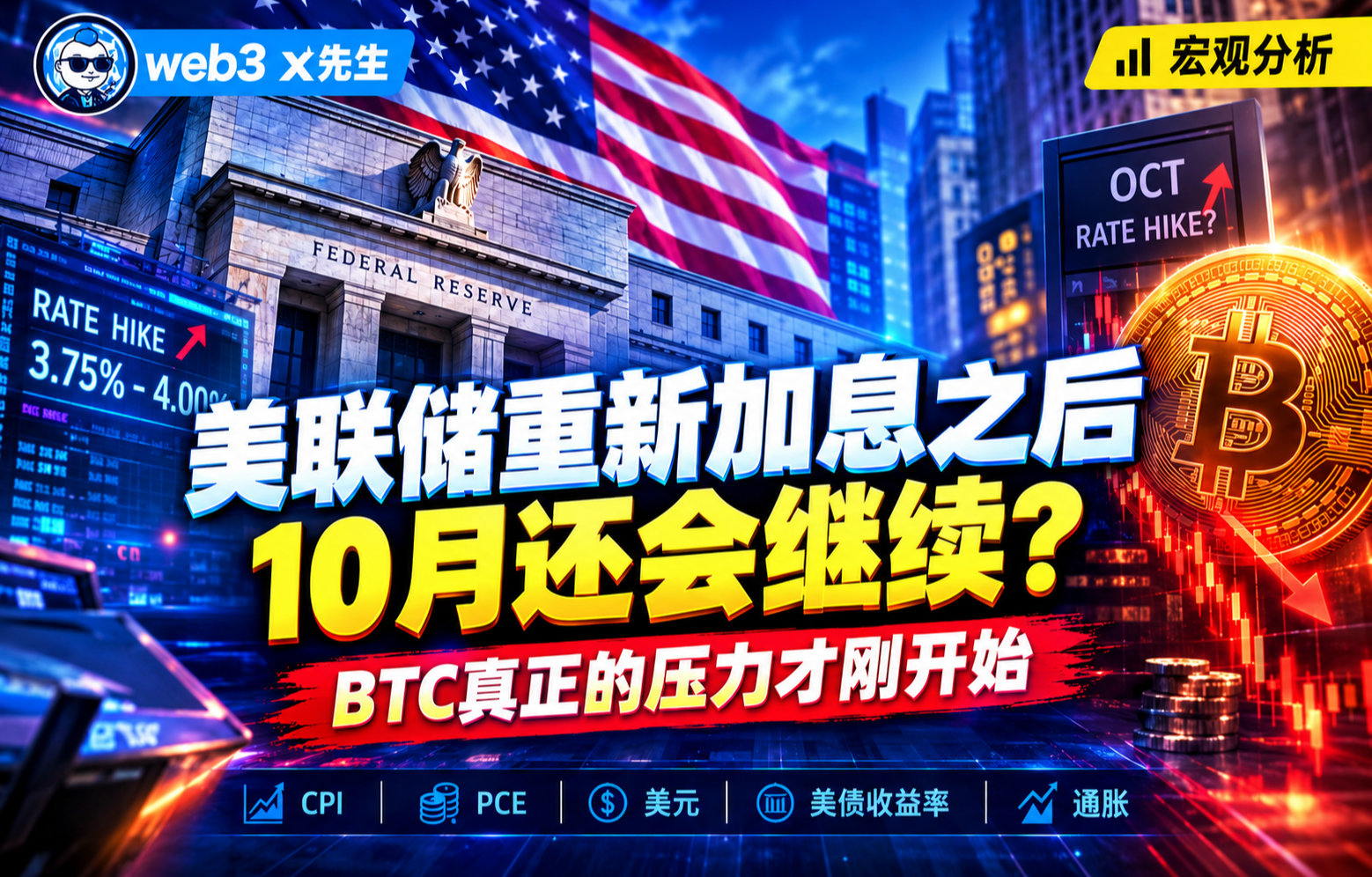
On September 17, 2026, U.S. media reported that Trump posted on social media, openly demanding that U.S. interest rates should be dropped directly to 1% or lower and used the narrative of the U.S. undertaking global trade costs and having a huge trade deficit to defend radical interest rate cuts; almost simultaneously, another group of decision-makers sent a completely opposite signal—the Federal Reserve's FOMC unanimously voted 12 to 0 to raise interest rates by 25 basis points, raising the federal funds target rate range to 3.75%–4.00%. This was the first break of about three years of "wait and see" since July 2023, and the overall tightening path presented in the dot plot made the market understand that this was not a symbolic action. On the same day, the Hong Kong Monetary Authority chose to follow suit, raising the Hong Kong dollar benchmark interest rate by 25 basis points to 4.25%. The collective increase in cross-market funding costs quickly reflected in prices: spot gold fell more than $130 from the day's high, the Dow Jones Industrial Average dropped about 1.2%, the S&P 500 fell about 0.44%, and the Nasdaq was nearly flat with a slight decline. Cryptocurrency-related listed companies became front-line samples of the stress test—Circle fell over 6%, Robinhood fell over 5%, Coinbase fell over 4%, Bitmine fell over 3%, and Strategy dropped over 2%. When politicians call for extremely low interest rates on social media, while decision-makers lock in longer periods of high rates with hawkish rate hikes, this disconnect directly exposes the cryptocurrency sector to the dual pressure of “expensive money” and asset pricing resets, prompting the industry to reassess the leverage intensity on every financing line and the compliance risk tolerance of platforms against a backdrop of high interest rates and tightening regulations.
White House Pressures Central Bank Independence: Trump's Regulatory Boundaries on Interest Rates
In almost the same news cycle, on one side, the Federal Reserve unanimously passed a 25 basis point rate hike by a vote of 12 to 0, raising the federal funds rate range to 3.75%–4.00%, while on the other side, Trump publicly asserted on social media that U.S. interest rates should drop to 1% or lower. His reasoning was not the traditional inflation and employment data, but rather emphasized that "the U.S. has the strongest credit in the world and the economy attracts a lot of new investment," even claiming that if the U.S. stopped trading with countries with trade deficits, it could gain at least $1.5 trillion annually, directly describing the trade deficit as a "loss." In this narrative, the trade account's "deficit" was shaped into evidence of the U.S. being taken advantage of, used to justify extremely low interest rates—as if the U.S. should reclaim in global trade what it is perceived to have "lost" at a super low cost of capital.
The problem is that such public calls are not a set of monetary policy rules but a political signal from the White House that directly impacts the perception of central bank independence. As the central bank of the United States, the Federal Reserve enjoys a certain level of independence by law, and its monetary policy decisions are not directly constrained by presidential executive orders; factual databases have not provided any evidence concerning the chronological order or causality between these statements and the rate hike decision, nor are there any records of responses from officials. However, when the president ties the level of interest rates to trade deficits and the sentiment of the country being "taken advantage of," demanding rates be lowered to 1% or lower with strong rhetoric, market participants see that monetary policy may be repackaged into political agendas, and the interest rate path is no longer told solely by the FOMC's dot plot and macro data.
For capital markets and the cryptocurrency industry, this disconnect will change two key expectations. First, it is the expectation of future interest rate policy itself—on one hand, the dot plot shows that a majority of officials expect at least one more rate hike before the end of 2026, and the bond market bets on three cumulative hikes before mid-next year, while on the other hand, top political figures publicly advocate for extremely low rates, prompting some funds to weigh their positions between “technical paths” and “political interventions.” Second, it is the expectation of the regulatory climate: if monetary policy can be mobilized repeatedly within the narrative of trade deficits, then the regulatory rules concerning financial institutions, cross-border capital, and cryptocurrency platforms may also be more frequently touched upon or even forced to adjust boundaries by political agendas in the future. For cryptocurrency platforms, what truly needs to be reassessed is how much uncertainty the entire capital structure can bear once both monetary and regulatory policies become politicized.
Federal Reserve's Hawkish Rate Increase Path: Dot Plot Locks in Long-term High Rates
This 25 basis point increase ended nearly three years of rate stagnation since July 2023, as the Federal Reserve passed the decision unanimously with a vote of 12 to 0, raising the federal funds target range from 3.50%–3.75% to 3.75%–4.00%, officially announcing a shift from "holding steady" to "tightening again." More critically, the path indicated by the dot plot shows that out of 18 officials, 16 expect at least one more rate hike before the end of 2026, and the overall interest rate curve is evidently hawkish. The bond market responded within its own coordinate system: generally betting that three more cumulative rate hikes will occur before mid-next year, CME data further quantifies this bet—there is a 50.2% probability of no change in October, and a 49.8% probability of an additional 25 basis point hike, nearly a "coin flip" rate hike gamble; by December, the probability of no change drops to 11.3%, while the scenario of a cumulative additional hike of 25 basis points holds 50.1% weight. The officials' dot plot and market probabilities collectively lock in a benchmark scenario of maintaining relatively high interest rates for the long term, rather than returning to the brief experiment of zero interest rates.
In this scenario, the long-term high rates first rewrite the capital structure of licensed institutions and the regulatory tolerance towards them. For banks and brokerages, an increase in financing costs means that leverage space is compressed, and the traditional asset-liability management models based on maturity mismatches and high leverage must be reassessed; regulatory authorities naturally tend to adopt a more conservative stance in stress testing and liquidity constraints. For trading platforms that have already obtained licenses or are applying for them, high rates will also transfer to compliance aspects such as margin ratios, off-exchange financing, and customer asset segregation: more expensive capital will force platforms to lower proprietary and customer leverage, and regulatory inquiries will more frequently focus on interest rate risk exposure and concentration management. The hawkish rate path outlined by the Federal Reserve in the dot plot sends a signal to all licensed institutions relying on leverage and cross-border funds: in the coming years, compliance and risk control must rewrite internal rules with "normalization of high interest rates" as a premise.
Tightening of the Hong Kong Dollar Peg and Rising Costs of Asian Licenses
On the same day that the Federal Reserve began its new round of rate hikes in the 3.75%–4.00% range, the Hong Kong Monetary Authority simultaneously raised the Hong Kong dollar benchmark interest rate by 25 basis points to 4.25%, clearly stating in its briefing to "maintain the stability of the Hong Kong dollar exchange rate and control inflation expectations." This is not a simple follow-up action but a passive tightening under the linked exchange rate system: when U.S. dollar rates rise, if Hong Kong dollar rates do not follow, funds will flow to dollar assets through arbitrage and cross-border borrowing, putting pressure on the Hong Kong dollar range, forcing the Monetary Authority to use more expensive HKD funding prices to tether funds within the linked exchange rate framework. Once the benchmark interest rate is raised, interbank lending rates will quickly rise, and the quotes for HKD funds over different terms such as overnight, 7 days, and 3 months will be re-priced accordingly; retail deposits and mortgage rates, as well as corporate loan rates, will be adjusted sequentially over the following weeks, raising the entire region's funding costs through this monetary policy transmission chain systematically.
For licensed brokers, banks in Hong Kong, and approved operating trading platforms, this 4.25% benchmark interest rate is not just a new coordinate in the yield curve but an invisible rise in the cost of licenses. Any margin business, customer financing, securities borrowing and lending, and on-exchange and off-exchange leverage structures will reflect in regulatory reports as higher interest expenses and more sensitive interest rate risk exposure. The risk management department must recalibrate stress testing scenarios and leverage limits within the licensing framework to ensure that interest rate fluctuations do not translate into capital adequacy deterioration or customer asset safety issues. Surrounding regions view Hong Kong as a hub for regional funding and compliance; the increase in Hong Kong dollar rates will layer upon cross-border funding pools, syndicated loans, and regional brokerage pricing, ultimately shifting the overall cost curve of "holding licenses and doing business in Asia" upwards, forcing platforms and licensed institutions to realign their expansion pace with the high interest rate environment and tighter regulatory tolerance.
Wall Street's Expectations Mishap and Macro Judgment Misalignment Risks
Following the latest interest rate meeting, Citigroup strategists chose to cut losses and exit their short USD/CAD trade recommendation, behind which lies a typical "expectation mishap." Previously, they judged that the Federal Reserve's hawkishness would not exceed the market's existing pricing, but the actual resolution and the tightening path displayed in the dot plot were more aggressive, overturning the logic that originally bet on a weaker dollar and stronger Canadian dollar, forcing them to close positions to cut losses. Almost simultaneously, Gundlach publicly stated that this rate hike of only 25 basis points was "too little," asserting that a direct increase of 50 basis points should have been made, while the bond market bet on three cumulative hikes before mid-next year—facing the same decision, the split expectations among mainstream institutions from “overly hawkish” to “not hawkish enough” were completely exposed.
When the interest rate path suddenly switches from "stagnation for three years" to "at least one more hike, even betting on three," any high-leverage trades built on a single assumption are passively exposing the risks of macro judgment misalignment. For banks and brokerages' proprietary positions, this means pressure from withdrawals in foreign exchange, interest rate swaps, and credit positions; meanwhile, on the level of cryptocurrency-related assets, structured products linked to interest rates and the dollar index, as well as cross-asset leveraged portfolios aimed at institutional clients, are designed based on models that assume long-term low interest rates or rapid cuts. Once real rates remain persistently high, it becomes easier to trigger concentrated margin calls, premature product terminations, and forced position liquidations in a short time. If platforms continue to use outdated volatility assumptions and stress testing parameters, they may not only misjudge their liquidity buffers but also face regulatory complaints and accountability when users' asset values diminish rapidly; in this round of rate and expectation dynamics, the ability to quickly identify and correct macro judgment deviations directly determines whether they will bear the costs associated with suddenly elevated risks and compliance.
Compliance Pressures on Cryptocurrency Platforms and Dollar Pegged Tokens
The Federal Reserve suddenly transitioned into a tightening cycle after approximately three years of inaction, and on the same day, the Hong Kong Monetary Authority raised the Hong Kong dollar benchmark interest rate to 4.25%. This synchronized interest rate hike in the U.S. dollar and Hong Kong dollar markets essentially declares that the era of "high leverage, light regulation" based on low interest rates is undergoing systemic liquidation. On that day, Circle fell over 6%, Robinhood fell over 5%, Coinbase fell over 4%, Bitmine fell over 3%, and Strategy dropped over 2%. The collective pullback of cryptocurrency stocks is not only a mechanical response to rising financing costs but is also seen as a signal of tightening regulatory scrutiny, continued elevation of license thresholds, and the need to rewrite historical business models that relied on transaction commissions and asset appreciation. In an environment where both interest rate and regulatory paths have significant uncertainties, U.S. and Hong Kong market brokers and platform operators must plan capital, liquidity buffers, and licensing frameworks as the same compliance mainline; otherwise, if there are further interest rate hikes or regulatory details intensify in the future, it will directly reflect in the dynamic tightening of margin requirements, product licensing, and cross-border operation qualifications. For issuers of dollar-pegged tokens, the duration and credit quality of reserve assets, the regulatory jurisdiction associated with custody arrangements, and the transparent information coordination with regulatory authorities in major markets such as the U.S. and Hong Kong are shifting from "compliance advantages" to survival bottom lines. In a period of high rates and unpredictable policy directions, whoever can first align license layouts, product structures, and risk management under the same prudent logic has the potential to retain cross-market operational qualifications and core pricing power within the dollar system in the next round of regulatory screening.
Join our community to discuss and become stronger together!
AiCoin exclusive Hyperliquid benefits: https://app.hyperliquid.xyz/join/AICOIN88
AiCoin exclusive Aster benefits: https://www.asterdex.com/zh-CN/referral/9C50e2
On-chain Telegram community: https://t.me/AiCoinWhaleData
On-chain community: https://www.aicoin.com/link/chat?cid=N6OVMor5g
AiCoin on-chain Twitter: https://x.com/aicoinwhaledata
免责声明:本文章仅代表作者个人观点,不代表本平台的立场和观点。本文章仅供信息分享,不构成对任何人的任何投资建议。用户与作者之间的任何争议,与本平台无关。如网页中刊载的文章或图片涉及侵权,请提供相关的权利证明和身份证明发送邮件到support@aicoin.com,本平台相关工作人员将会进行核查。