Today ByteDance has two important pieces of news.
First, according to the Bloomberg Billionaires Index, boss Zhang Yiming's net worth has surpassed 100 billion US dollars, which corresponds to ByteDance's valuation of about 550 billion US dollars (Tencent is 500 billion US dollars), making him the richest person in Asia. What does 100 billion US dollars mean? Currently, the total market capitalization of Midea Group and BYD is only over 90 billion US dollars.
Second, ByteDance's collaboration with ZTE on the Doubao phone has started sales today, priced around 6000 RMB. However, unlike when the prototype was just launched, there was minimal trading in this sector today, and ZTE's stock price only increased by 1 cm (thankfully it didn't spike; otherwise, the rebound would have been capped).
I am particularly interested in the second piece of information because in the process of AI development, it seems to be returning to the old way of internet strategy—whoever controls the traffic entry, controls everything.
The Doubao phone will definitely be a groundbreaking product, just like how the vehicle systems in new energy vehicles outperform traditional gasoline vehicles. In the future, other phone brands will surely begin to deeply integrate and embed AI large models, and if Apple still cannot get it right this time, continuing to lose some customers is foreseeable, as once the trend in user habits forms, there's no turning back—while the core of the Doubao phone is that Doubao controls all traffic entry, the command is given by the user, but how to decompose the command and allocate traffic is determined by the large model, which is a type of downward impact model.
Another AI case related to traffic entry is the recently popular workbuddy (note, the above and below are not advertisements).
The AI combination I am currently using is chatgpt+workbuddy, using the former for refined tasks and the latter for general needs, as it is cheap and can provide plenty.
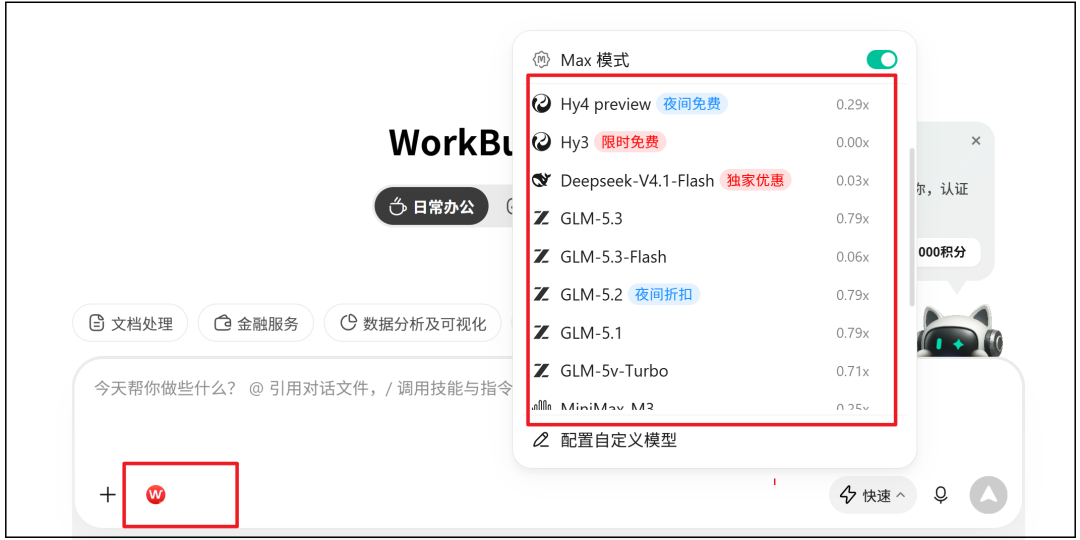
The core of Workbuddy is illustrated in the image below; it has connected to all major models, becoming a mainstream terminal, and through modes like "limited time free," it "entices" users to choose specific models, thereby completing traffic allocation—once it forms user stickiness, it effectively holds the "eggs" of other large models; if in the future you want to access more traffic, you can reduce costs on my platform, while workbuddy still collects a fixed subscription fee from customers, thus profiting from the difference.
Both my gpt and workbuddy have accessed the Wind database, and my feeling so far is:
The selling and buying research industries are heading towards an unavoidable phase of staff contraction.
The largest current paid scenario for AI large models is coding, which has replaced a significant number of programmers, and the next major scenario may include finance (claude and several top institutions are already doing this), as both are standardized and data-driven industries. Previously, we were worried about various data terminals withholding data, but now APIs from Wind and others selling point credits seem to earn more, so why not?
By the way, Tencent has workbuddy, ByteDance has Doubao phone, what does Alibaba have? Hmm?
......
Back to the market.
1. Today, the long-awaited surge in the entrepreneurial innovation sector, with the innovation and entrepreneurship 50 index rising over 3%. What is the reason?
I've summarized it into three main points.
First, from the fundamentals, yesterday morning, the Ministry of Industry and Information Technology and the National Development and Reform Commission issued the "14th Five-Year Plan for the Development of the Electronic Information Manufacturing Industry." This document was formed on September 10 but was issued yesterday, leading to a counter-market rise in the science and technology innovation board yesterday.
Second, the market is gradually digesting the negative impact of the Federal Reserve's interest rate hike tonight (or early tomorrow morning). Today, the Korean and Japanese markets also rebounded, with Samsung and SK Hynix rising over 2 cm and 4 cm respectively.
Third, the trading volume yesterday reached the second lowest of the year, and the sentiment is basically at the bottom; it's normal for it to bounce back a bit.
That's about it; I can't think of more.
2. Yesterday, when chatting with some industry peers, everyone described the current market as:
Having a hint of death.
For the vast majority of institutional investors, the current market makes them hesitant to add or reduce.
If you say to increase positions, waiting for the right side is fine too; the cost-benefit ratio is even higher. With uncertainty so high overseas, people are still hesitant.
If you say to decrease positions, after selling, what to buy?
Therefore, the best strategy right now is to take advantage of the market rebound while the leaders are in a good mood and quickly ask for a day off during the three days before National Day, so as to enjoy a 13-day super vacation.
So you watch; in the next two weeks, the number of people in financial institutions will decrease day by day, making it hard for market trading volume to pick up before the holiday.
In the short term, we still expect fluctuations before the holiday.
3. However.
Why do we still have a positive view on the market, at least for A-shares?
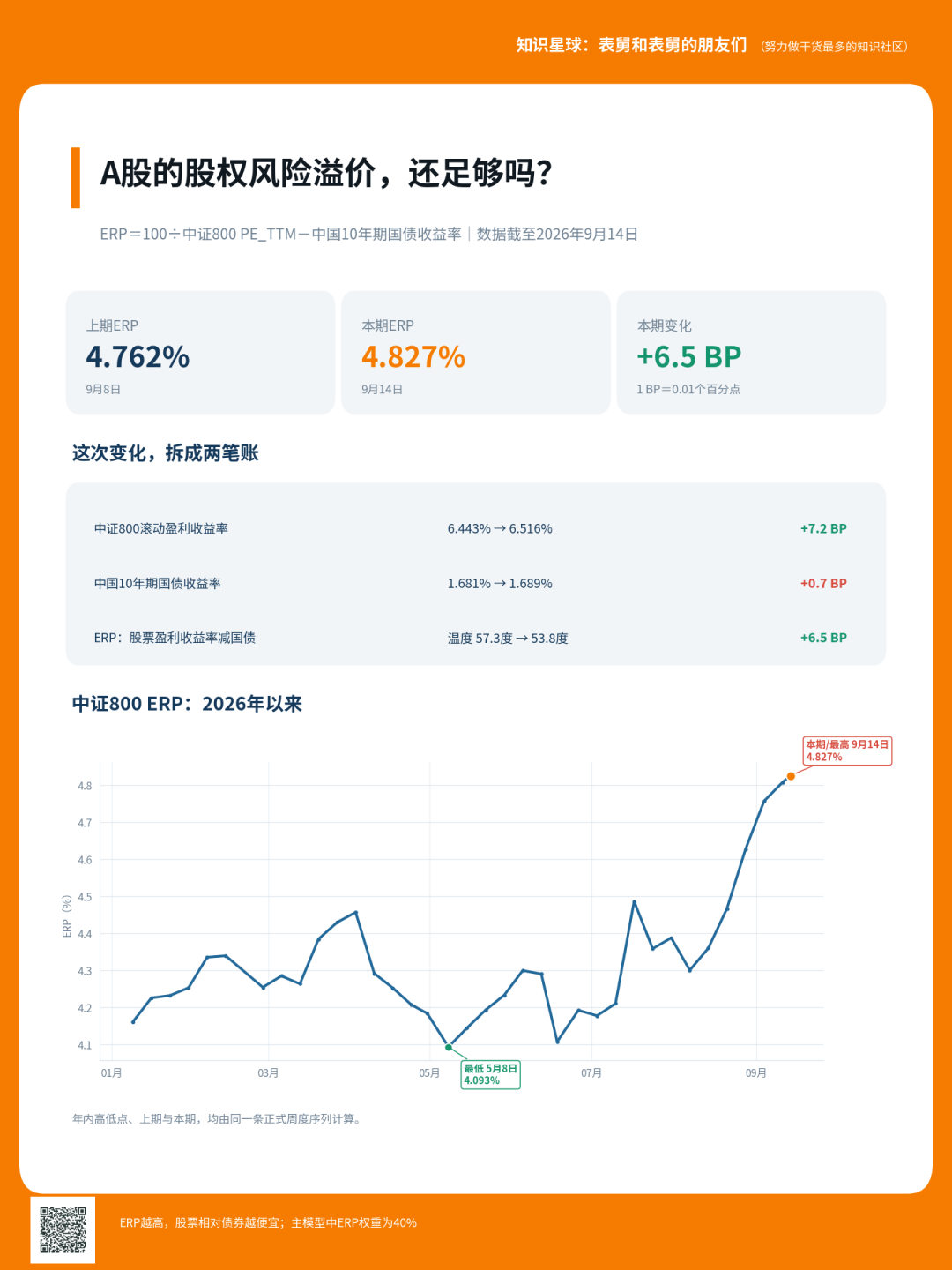
The answer is actually in the image below—this is one of the weekly tracking charts for core assets in A-shares published today in the community. Currently, the equity risk premium for A-shares is still higher than the historical median, and after recent declines, the equity risk premium has reached the highest point of the year.
In plain terms, the emotional low point is actually the relative high point of cost-effectiveness and will also be a good time for long-term layout (of course, this is all from a long-term perspective).
For the complete analysis, check out this afternoon's community post; the QR code below is the entry point.
4. Why have we repeatedly said that globally, A-share index has the best margin of safety (no need to put it first)?
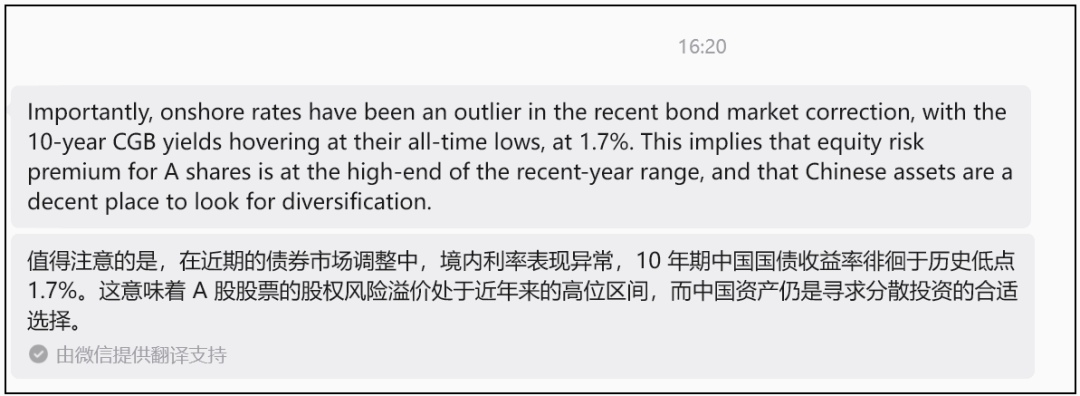
Today, Goldman Sachs also answered this question; let’s directly post an image.
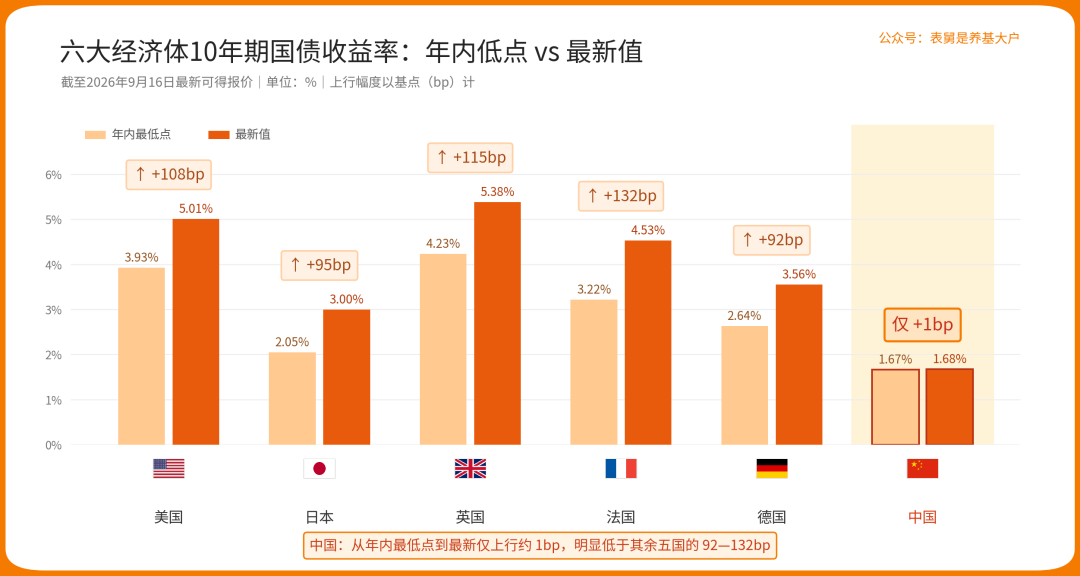
For comparison, the following image shows the lowest, latest values, and upward movement of 10-year government bonds for the six major economies: the United States, Japan, the United Kingdom, France, Germany, and China this year.
You can see that in this round of soaring overseas interest rates, China has remained unscathed:
Low interest rates, low volatility, 1 bp plays for a week.
5. Do high overseas interest rates have no impact on us?
Of course not.
It mainly affects several aspects:
First, it suppresses risk appetite and sentiment.
Second, the overseas computing power chain is interconnected, with the most direct impact.
Third, if the interest rates remain high, it will impact overseas demand, thereby suppressing domestic export momentum.
Fourth, Hong Kong stocks are being hit hard, and the A-H premium is lifted, which will also affect A-shares (if a stock is drastically cheaper in Hong Kong, funds will just go buy it there).
Thus, the impacts are mostly short-term and sector-specific.
However, for long-term investment, the key is still to look at the level of the risk-free interest rate behind the mainstream funds in A-shares.
6. There is another perspective to add.
In the current market where the bullish trend is at its midpoint, investors are also concerned about which directions incremental funds should be allocated to?
Over the weekend, a guest in the community, private equity veteran Wang, shared some of his thoughts in the image below, including structured雪球, 300 and A500 index growth, and all-weather strategies (essentially multi-asset). Those interested can refer to the post released over the weekend in the community.
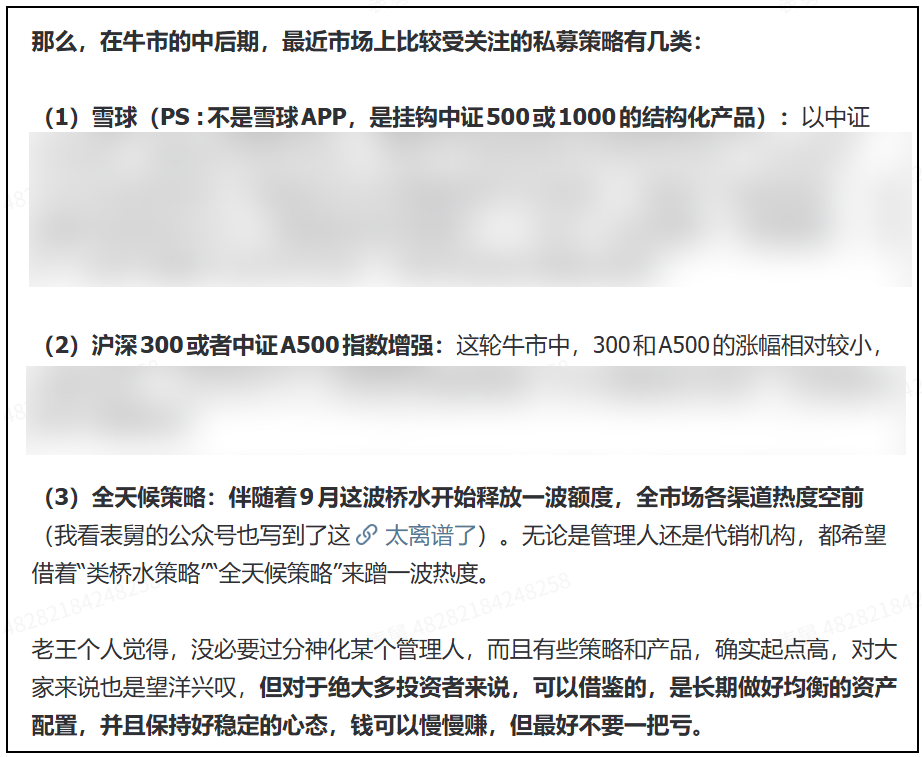
7. Last week we discussed that Bridgewater's all-weather strategy has reached a point where even if you have money, you can't grab it. Of course, I've also said earlier that there’s no need to idolize a single strategy, as there are no invincible generals in the market. However, as long as it's based on a systematic, team-based multi-asset allocation strategy, it could be viewed favorably in a low interest rate environment.
There are quite a few products in the market that resemble the “Bridgewater all-weather strategy,” including wealth management and public funds. Among public funds, only FOFs can truly deploy a multi-asset strategy, which is why we previously emphasized that in this wave of embracing high-quality equity during this big era, wealth management with multi-asset as the core concept and public fund FOFs, as well as fund advisory services, are one of the relatively friendly options for investors.
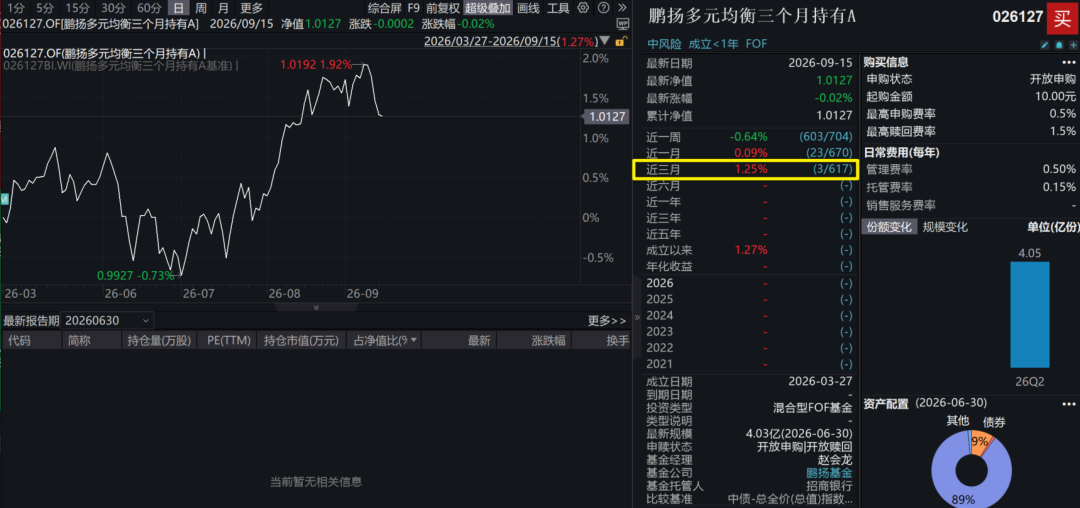
For example, the one below is a product previously launched by Miaoxing; looking at the holdings reveals it is a multi-asset allocation product that combines stocks, bonds, and business.
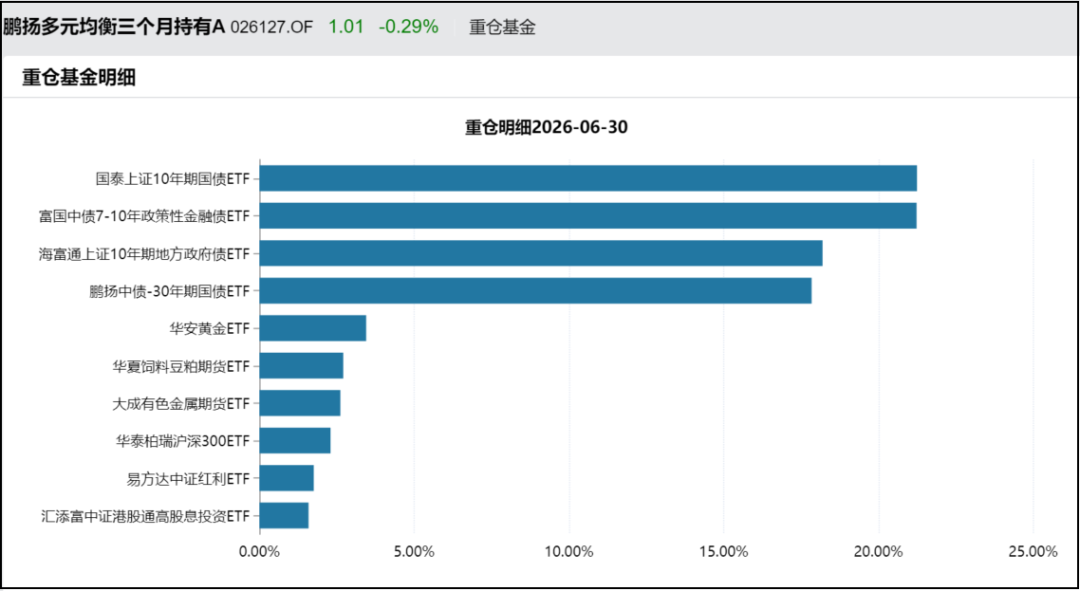
The advantage of multi-asset is that it can share a portion of the profits in a bull market; if entering a volatile market, the advantages of drawdown control and negative correlation of assets will become more prominent, making it a favorite among banking channels currently.
......
That's all for now; if you want to learn more about the deeper logic behind multi-asset, check out today's community Q&A, which is a lengthy article of several thousand words, so I won't paste it here.
免责声明:本文章仅代表作者个人观点,不代表本平台的立场和观点。本文章仅供信息分享,不构成对任何人的任何投资建议。用户与作者之间的任何争议,与本平台无关。如网页中刊载的文章或图片涉及侵权,请提供相关的权利证明和身份证明发送邮件到support@aicoin.com,本平台相关工作人员将会进行核查。


