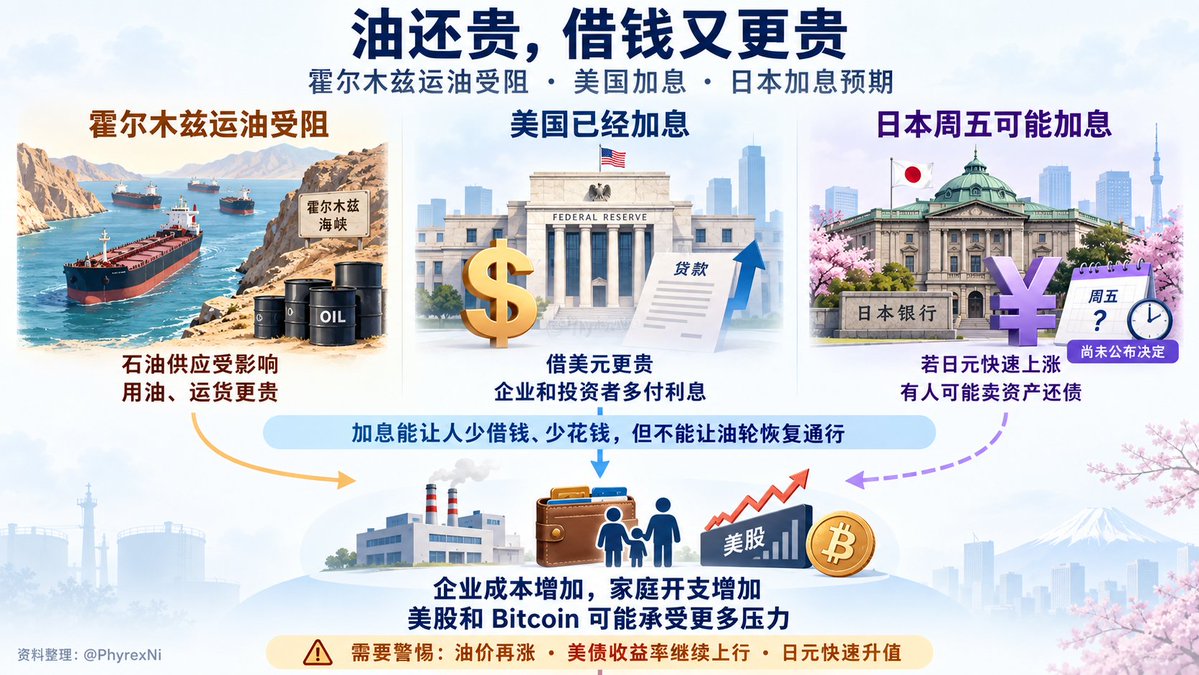
Oil prices remain high, the United States has raised interest rates, and Japan may follow suit on Friday.
Today the Federal Reserve raised interest rates by 25 basis points, bringing the rate to 4%. Before and after Waller's remarks, the U.S. dollar index reached above 100 during the day, 2-year Treasury yields exceeded 4.7%, 10-year yields rose again above 5%, and U.S. stocks fluctuated repeatedly.
Waller believes that the U.S. economy and employment still have support, while price increases show no significant improvement, which also means that there may still be possibilities for more rate hikes ahead. For businesses and investors, the cost of borrowing remains high, and companies might have to pay more interest when borrowing again after maturity, and investors will be more hesitant to borrow money to invest in risk assets.
Importantly, the situation in the Strait of Hormuz adds complexity. Waller himself admitted that interest rate hikes cannot open the Strait of Hormuz nor directly solve the issue of high oil prices, as the Federal Reserve hopes to prevent rising oil prices from further driving up the prices of other goods and services.
Raising interest rates can reduce borrowing and consumption, leading companies to cut back on investment, thereby easing inflationary pressures, but the decline in oil prices still requires resolving issues between the United States and Iran. With oil prices staying high and borrowing costs rising, production and transportation for businesses become more expensive, ordinary people spend more on fuel and purchasing goods, and the burden of loan repayment may also increase, ultimately leading to reduced other expenditures.
If Japan raises interest rates from 1% to 1.25% as the market expects on Friday, the cost of borrowing yen will also rise. If the yen rapidly appreciates afterward, some people who previously borrowed yen to purchase overseas assets will find that they need to spend more dollars to pay off the same debt, possibly prompting them to sell assets to repay.
Therefore, if oil prices continue to rise and the announced inflation data exceeds expectations, along with further increases in U.S. Treasury yields, caution is needed regarding the rebound in U.S. stocks and Bitcoin.
If there is also a rapid appreciation of the yen, along with a significant decline in U.S. stocks and Bitcoin, one must be wary of the pressure from selling assets to repay debts. After all, the supply issues caused by the Strait of Hormuz have not been resolved, and as long as oil prices keep rising, inflation is likely to increase, leading the United States, Europe, and Japan to continue raising interest rates.
@Gate Crypto, U.S. stocks, Hong Kong stocks, Korean stocks, gold, CFD, one-stop trading for prediction markets
免责声明:本文章仅代表作者个人观点,不代表本平台的立场和观点。本文章仅供信息分享,不构成对任何人的任何投资建议。用户与作者之间的任何争议,与本平台无关。如网页中刊载的文章或图片涉及侵权,请提供相关的权利证明和身份证明发送邮件到support@aicoin.com,本平台相关工作人员将会进行核查。


