Author: Andres Veurink
Translation: Deep Tide TechFlow
Deep Tide Summary: Andres Veurink believes Onto Innovation is an undervalued process control target in the AI boom: the installed base is expanding in line with backlog orders, the demand for Dragonfly G5 exceeds expectations, and is expected to support around 30% annual revenue growth and sustained gross margin increases. Under conservative to optimistic scenarios, the enterprise value upside over five years is about 62.9%–124%, giving a strong buy rating and preparing to open a small position in this document.

Investment Thesis
In my view, Onto Innovation (ONTO) is like a forgotten manufacturing target in the AI boom. The company's platform has a high adoption rate and is establishing a revenue base that is difficult to disrupt—because it has been deeply integrated into customers' production line operations.
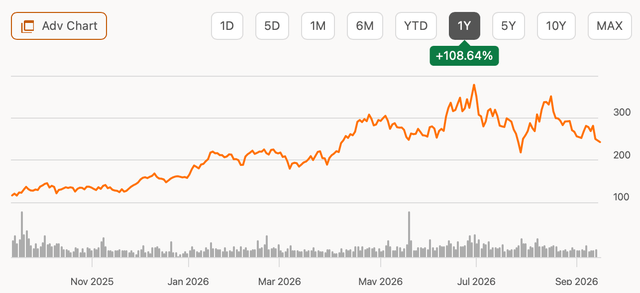
The stock price performance is actually quite good, having pulled back from a 52-week high of $386; in my view, this is a very attractive buying point. What truly matters is the recurring revenue driven by the installed base, and this foundation continues to grow. The demand for wafers has exceeded supply, making it more like a multi-decade play.
I have always been picky about companies like Micron (MU), even giving a sell rating, but that was mainly due to issues with end product pricing. ONTO is betting on overall capacity expansion: it deals with inspection and process control, helping factories stabilize yield rates. For me, ONTO is clearly a strong buy.
Business Model
ONTO's predecessor can be traced back to the 2019 merger of Nanometrics and Rudolph Technologies. Today's core business focuses on process control measurement, defect detection, and various data analysis systems, roughly falling into three categories:
Defect Detection
Measurement
Data Analysis Software
Looking at SEC filings, revenue is actually broken down by type: systems and software, components, services. Systems and software contribute over 85% of total revenue, and long-term typically stays above 80%. The growth is not thin: this segment has a year-over-year growth rate exceeding 37%, and components and services have also kept up with the same pace, indicating that momentum is spreading across the board, rather than relying on just one segment.

There is also a slight positive change in the customer structure: on a six-month basis, the concentration of the top three customers has decreased, which is a good thing in the current environment. On the product side, the Dragonfly platform is used for defect detection in wafers and advanced packaging—the customer profile is not hard to guess: microelectronic device manufacturers and pure wafer foundries. The essence of the company's work is to "find out where the problems are"; as wafer capacity expands, the application scope is growing each year.
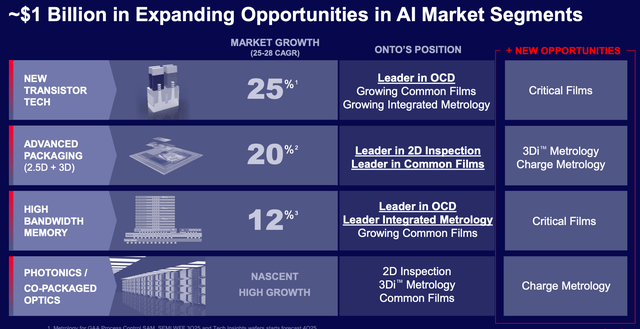
According to the materials disclosed by the company in January, all end markets are strengthening year-on-year and are sufficiently broad. Taking the wafer market as an example, by 2031, the pure capacity is expected to grow approximately 5%–7% annually. More wafers require more scanning and inspection, which means more work for ONTO, and it also builds a higher recurring revenue base through more tools in service.
Notably, U.S. revenue: on a six-month basis, it surged 216% year-on-year. The catalyst is the CHIPS and Science Act, encouraging clients like Intel (INTC), TSMC (TSM), and Samsung (SSNLF) to invest in increased production in the U.S. As long as these investments continue, I believe ONTO's growth in this geographical segment will amplify; in the next 12 months, the U.S. is expected to surpass Taiwan as the company's largest source of revenue.
A Business That Continues to Expand
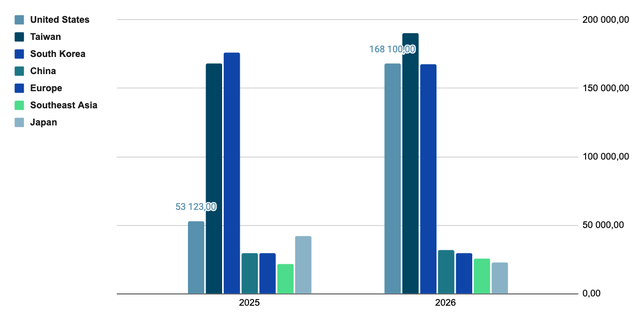
Currently, the largest customer base is still in the U.S., Taiwan, and South Korea. Intel, TSMC, and Samsung are major customers—although not officially confirmed, it is easy to infer. Growth is highly concentrated in the U.S.; other regions are stable or even declining.
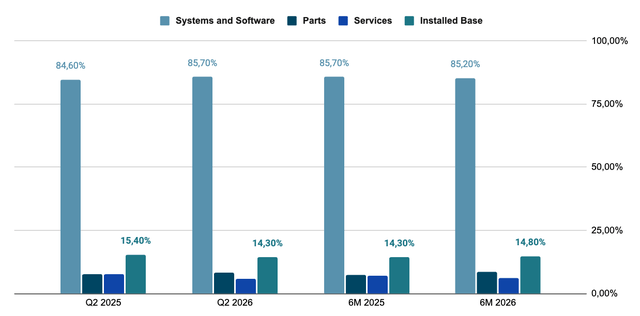
The installed base corresponds to "components" plus "services": this is what we need to focus on for the scaling curve. Their share of total revenue is declining, mainly because systems and software are rising too rapidly. Measured in dollars, installed-related revenue in the second quarter still increased by 25.5% year-on-year. I expect that as the industry continues to expand, these two segments will follow suit.

The second layer of evidence for recurring revenue is deferred revenue: it increased by 2.4% year-on-year, about 15% relative to the installed base. But the truly durable asset is its "tool-of-record" status.
The switching costs for customers represent another layer of logic that gives these revenues an indirect recurring color. ONTO disclosed that about 94% of revenue is recognized at the point of sale; the backlog orders and customer commitments are climbing so rapidly that it is difficult for this segment to drop easily.
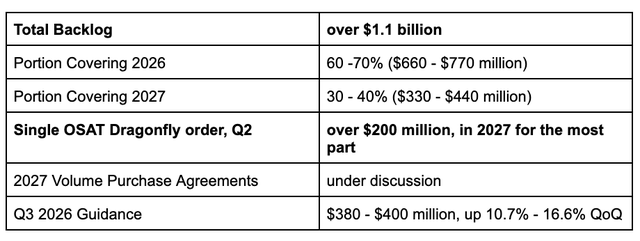
These figures largely come from ONTO's second-quarter earnings call. What I am most concerned about is the backlog orders and the company securing a large order of about $200 million for next year. This is directly connected to customer stickiness: if it's Intel, TSMC, or similar players making such a large commitment before delivery, it's hard not to question—what would be the cost of switching suppliers or waiting again?
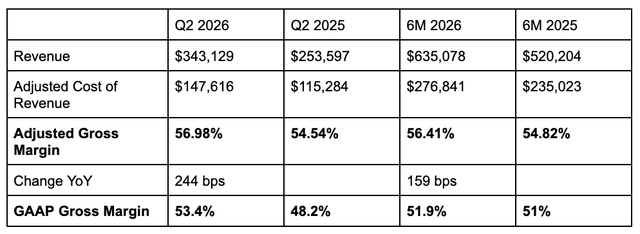
Perhaps the strongest argument is ONTO’s demonstrated pricing power. The gross margin continues to improve, and this is occurring alongside a rapidly expanding backlog.
Taking KLA (KLAC) as a reference: its TTM gross margin is about 61.3%. ONTO is still below this level, but I am not worried—what matters is that the company is still on an upward trend, which is the most important thing right now.
Management stated: after the successful launch of Dragonfly G5, the customer base has expanded, demand is unprecedented, and the company has raised its annual growth forecast for advanced packaging to about 80%, significantly higher than the 50% given last quarter.
The current figures do not yet account for the impact of Dragonfly G5. According to management, demand is very strong, and there is a very high probability of continued gross margin expansion; they even do not rule out the possibility of catching up to or even surpassing KLAC at some point.

Even if the gross margin never exceeds that of peers, market share is still rapidly expanding. By 2035, the relevant market is expected to reach $20.2 billion, with a compound annual growth rate of about 7.1% over ten years.
My Predictions and Conclusion
Before providing my predictions, let's align on the growth prospects. The company’s revenue on a six-month basis is approximately 22% year-on-year, compared to end markets, currently lagging only in one aspect:
Measurement and Detection Market: 7.1%–7.8%
Onto's HBM Addressable Market: Approximately 12% CAGR
Onto's Advanced Packaging Addressable Market: Approximately 20% CAGR
Onto's New Transistor Technology Addressable Market: Approximately 25%
The numbers come from the materials mentioned earlier in January. Currently, ONTO has not yet caught up in the last category, but I believe it does not significantly impact the overall situation. On the other hand, KLAC's revenue TTM growth rate is about 11.71%, with a forecast of about 20.78%.

ONTO may still be below KLAC in TTM terms (though not in the second quarter year-on-year), but it has already surpassed in forward-looking indicators. There is a consensus expectation for revenues of about $3.25 billion by 2030, which I think is conservative.
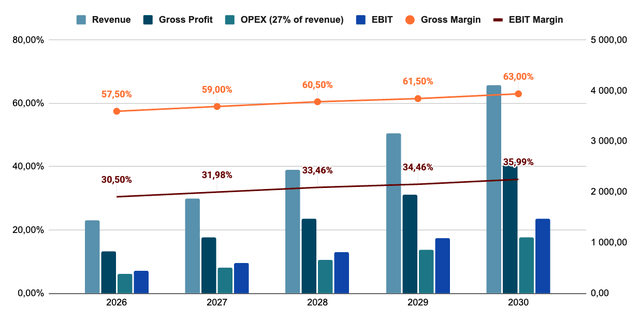
My outlook for ONTO is that, especially with the volume production of Dragonfly G5 expected next year and strong demand already present, the company is likely to continue expanding at about 30% pace, and gross margins will also continue to rise. The gross margin increase of over 200 basis points in the second quarter, I tend to see it as a slope towards 2030. Operating expenses relative to revenue, I used a normalized rate of 27%—this reflects the actual level of the second quarter and the first half of the year, which should be similar for 2025.
Accordingly, EBIT is expected to be approximately $1.479 billion by 2030. If using a more conservative 20% revenue CAGR, along with the same rates and margins, EBIT would be about $1.074 billion. Applying an industry valuation multiple of about 18 times, I believe applying the same multiple to ONTO is not excessive, translating to an enterprise value range of about $19.33 billion–$26.62 billion.
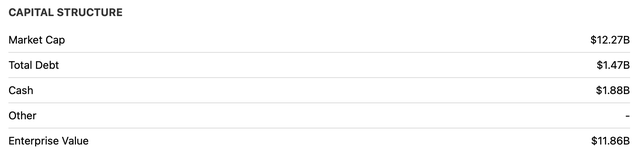
Compared to today's enterprise value, the upside potential is about 62.9%–124%. Looking at a five-year dimension, I can accept both outcomes, hence giving ONTO a strong buy rating.
There are about two months until the next earnings report, and during this time, there may not be many catalysts, unless announcements of expanded cooperation occur. I do not expect the stock price to break through the 52-week high before that. What really needs to be watched is the impact of Dragonfly G5 on the profit and loss statement: if revenue accelerates and margins follow, the market will likely re-support this stock. Right now, I am very comfortable with the holding and will also open a small position concurrently with the release of this document.
免责声明:本文章仅代表作者个人观点,不代表本平台的立场和观点。本文章仅供信息分享,不构成对任何人的任何投资建议。用户与作者之间的任何争议,与本平台无关。如网页中刊载的文章或图片涉及侵权,请提供相关的权利证明和身份证明发送邮件到support@aicoin.com,本平台相关工作人员将会进行核查。


