Author: Claude, Deep Tide TechFlow
For the first time in three years, the Federal Reserve has raised interest rates, Brent crude oil remains above $100, the yield on the 10-year U.S. Treasury bond has risen above 5%, and the crypto industry's bet on a market structure bill has also failed to pass the Senate. Based on past experiences, this news is sufficient to push Bitcoin down once more. On September 17, during the Asian early trading session, Bitcoin even briefly returned to $76,200. Did the bad news suddenly lose its effect?
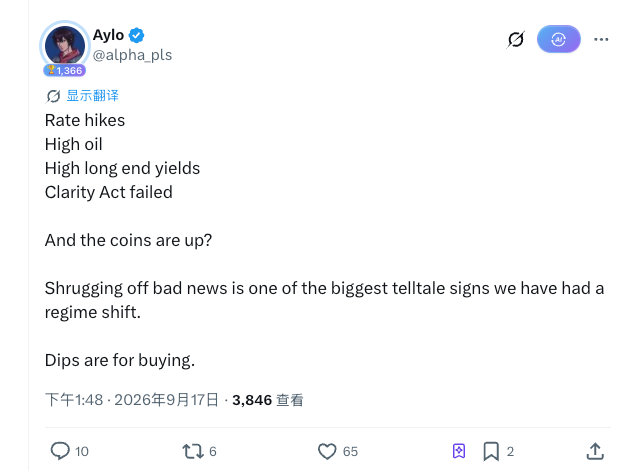
Image: Overseas KOL Aylo listed four pressures on X: interest rate hikes, high oil prices, rising long-term Treasury yields, and the bill failure, and viewed the resistance of coin prices as a sign of a market switch.
This screenshot captures one of the most abnormal scenes in the current market.
On September 15, the U.S. Senate's procedural vote to advance the Digital Asset Market Clarity Act ended with 49 votes for and 50 votes against, falling short of the required 60 votes by 11 votes. A day later, the Federal Reserve raised the target range for the federal funds rate by 25 basis points to 3.75% to 4.00%. After the interest rate decision, Bitcoin fell back to about $75,400, but during the Asian trading session, it touched $76,200 again; mainstream tokens like Solana, BNB, and Ethereum also rebounded.
The coin price hasn't continued to decline, and the one-day increase better reflects the market's state. However, spot funds have not yet provided evidence for a "market switch."
Negative news had been priced in before the vote
The failure of the bill easily created an emotional gap. Over the past year, the U.S. crypto industry has regarded it as one of the most important legislative tasks of this Congress. The bill attempted to delineate the regulatory boundaries between the U.S. Securities and Exchange Commission and the Commodity Futures Trading Commission, providing executable rules for token issuance, trading platforms, and custody services. The procedural vote did not pass, and the room for the bill to turn around in the remaining time of this Congress is very limited.
Prices did not wait for the vote to end to react. In the prediction market, the probability of the "bill being signed into law by 2026" had already dropped from about 34% to 17% before the vote. The Senate's final result of 49 to 50 seemed more like a confirmation that the market had already priced in the outcome over the past few days.
JPMorgan subsequently judged that the bill has not been completely killed, but the possibility of passing this year is very limited; regulatory work will continue to be pushed forward by the SEC and CFTC, but administrative rules are more easily rewritten by subsequent governments.
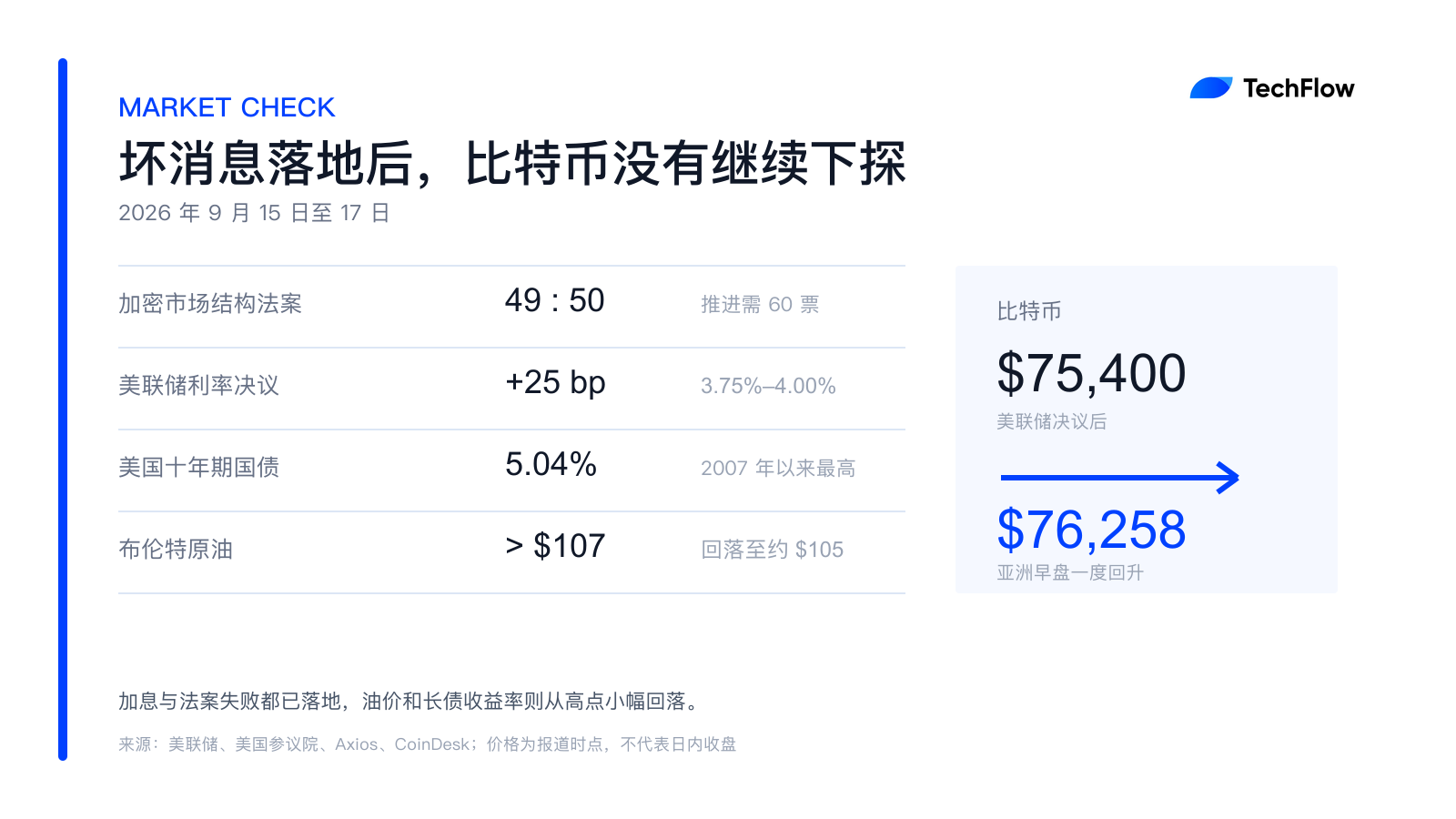
Image: Changes in policies, interest rates, and the market from September 15 to 17. Data sources:The Federal Reserve,The Washington Post,Axios,CoinDesk
Its impact on different assets is not the same.
Bitcoin has already been viewed as a commodity by U.S. regulators, and spot exchange-traded funds have been running for over two years. The market structure bill's most direct impact is on the legal attributes of numerous tokens, which assets trading platforms can list, and how stablecoin yields and decentralized finance terms are handled. The failure of the bill will raise the institutional costs for the entire industry but will not immediately change Bitcoin's trading identity in the U.S. market.
Interest rate hikes also did not exceed the market's previous main expectations. The Federal Reserve's dot plot gave a median policy rate of 4.1% by the end of 2026, corresponding to roughly one more 25 basis points increase within the year. The yield on the 10-year U.S. Treasury bond briefly touched 5.04%, reaching a new high since 2007, but then slightly retreated from that level; Brent crude oil had previously surged past $107, then retreated to around $105. The four pressures landed at the same time, the bill's outcome turned negative, the rate hike met expectations, and oil prices and long-term Treasury yields did not continue to accelerate toward worse directions.
Rebound? Still waiting for spot funds
If the market has already switched, funds usually leave traces earlier than opinions.
Currently, the most uncooperative numbers are from the U.S. spot Bitcoin exchange-traded funds. On the day of the bill vote, these funds experienced a total net outflow of $450.4 million, the largest single-day outflow since late June. Fidelity’s FBTC saw outflows of $214.8 million, and BlackRock’s IBIT saw outflows of $161.7 million, with these two products accounting for the vast majority of redemptions.
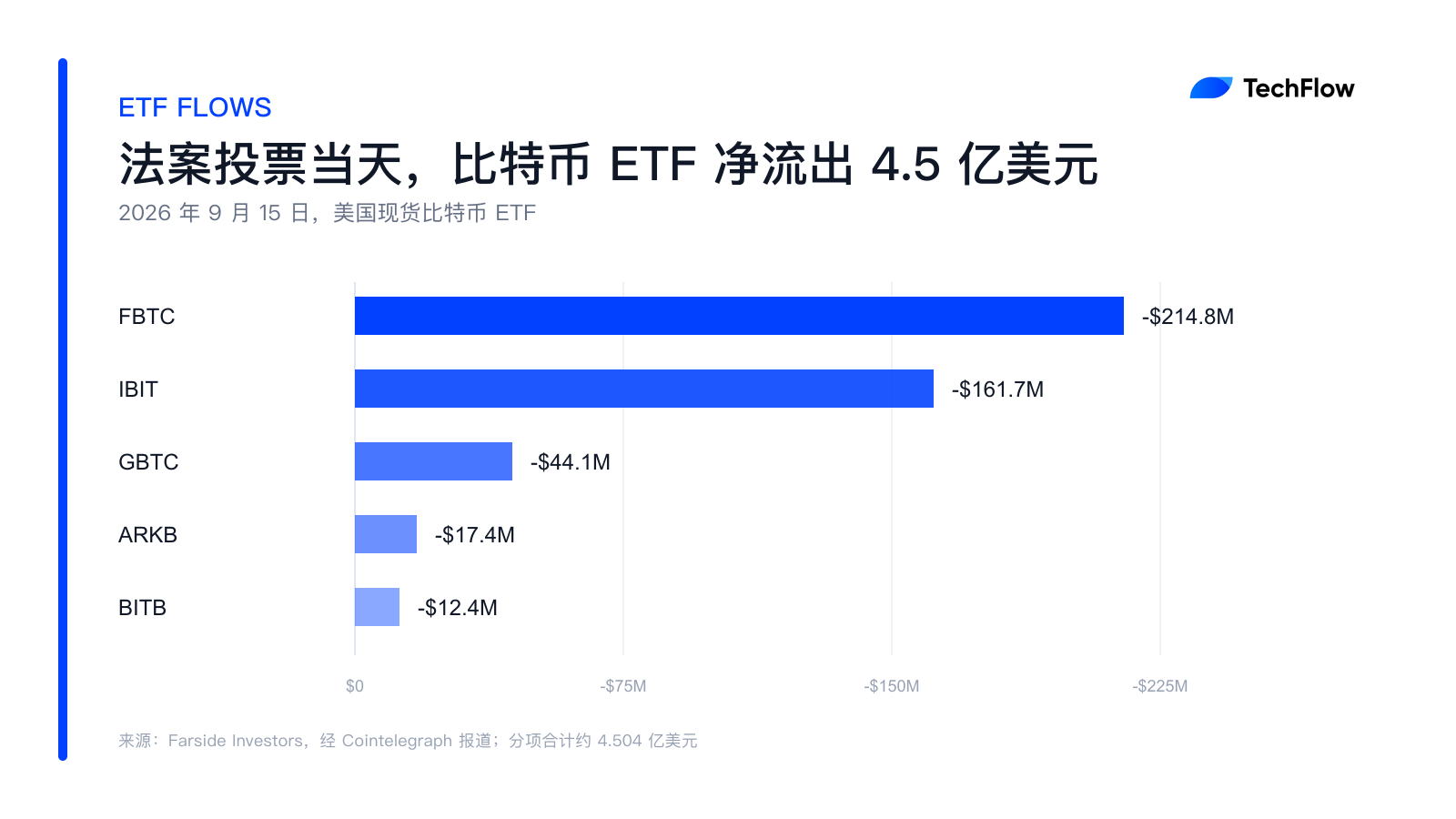
After the $450 million outflow, Bitcoin was still able to hold above $75,000, indicating that existing sell orders were not able to push the price down further.
However, this data cannot prove that institutions are replenishing; nor can it transform a single Asian trading session rebound directly into fund inflow. The most eye-catching performer that day, Zcash, rose about 23%, which was also driven by the independent catalyst of Paradigm co-founder Matt Huang publicly revealing his holdings, making it unsuitable to prove that the entire crypto market has already turned.
However, two prices can help judge how far this resistance will go. On the upside, Bitcoin needs to re-establish a firm stand around $79,000 before the vote on the bill and also needs to see spot exchange-traded funds stop the continuous outflow; on the downside, as long as $75,000 is not effectively broken, the sell pressure after the negative news remains within a controllable range.
If the price goes up, but funds continue to flow out, the rebound is likely to be driven more by short covering and price corrections during a thin liquidity phase.
High oil prices and the approximately 5% yield on the 10-year U.S. Treasury bond have not disappeared either. If oil surges again, the Federal Reserve's concerns about inflation will again compress the space for risky assets. What can be confirmed now is that the market has not continued to sell after multiple negative outcomes.
The next step is to see if Bitcoin can regain $79,000 and closely monitor changes in spot funds.
免责声明:本文章仅代表作者个人观点,不代表本平台的立场和观点。本文章仅供信息分享,不构成对任何人的任何投资建议。用户与作者之间的任何争议,与本平台无关。如网页中刊载的文章或图片涉及侵权,请提供相关的权利证明和身份证明发送邮件到support@aicoin.com,本平台相关工作人员将会进行核查。


