Written by: Rita
Microsoft raised its quarterly dividend by 8%, and Morgan Stanley maintained its overweight rating with a target price of $600 in a report released on September 16, 2026. The current price is $497.12, indicating an upside potential of approximately 20.7%. Morgan Stanley believes that Microsoft's total return structure remains attractive, with accelerated Azure growth and monetization of Copilot supporting high double-digit revenue growth.
Morgan Stanley analyst Adam Wood pointed out in the report that Microsoft's profit growth and AI leadership have not been fully priced in. The firm's baseline scenario assumes an FY28 earnings per share of $24.06, assigning a 25 times price-to-earnings ratio, corresponding to a target price of $600. In a bullish scenario, with stronger contributions from Azure and AI, FY28 earnings per share are expected to be $27.64, leading to a target price of $795.
Dividend increased by 8%, slightly below average
Microsoft has raised its quarterly dividend by 8%, slightly below the average increase of about 10% over the past five years. Morgan Stanley noted in the report that this increase reflects the company's confidence in its cash flow and profit outlook while retaining capital for AI infrastructure investments. The current dividend yield is about 1.1%, which is average among large tech stocks.
Morgan Stanley believes that the combination of the dividend increase and stock buybacks makes Microsoft's total return more attractive. The firm’s total return calculation assumes CY26 revenues of $337.3 billion, a year-on-year increase of 10.4%, gross profit growth of 18%, operating expenses growing by 10.6%, and earnings per share of $26.97, a year-on-year increase of 19%. This growth combination is leading among large software companies.
Azure growth accelerates to 44.9%
Morgan Stanley expects Azure and other cloud service growth to accelerate from 40.7% in FY26 to 44.9% in FY27, then slow to 43.2% in FY28 and drop to 41.2% in FY29. M365 commercial cloud growth is expected to rise from 16.4% to 16.6%, reaching 17.6% and 17.7% in FY28 and FY29, respectively. The gross margin is expected to decrease from 67.9% in FY26 to 63.4% in FY29, while the operating profit margin will remain between 46.5% and 47.2%.
Morgan Stanley noted that the decline in gross margin primarily arises from increased AI capital expenditure, but operational leverage and efficiency improvements offset some of the pressure. FY27 earnings per share are projected to grow by 9.6%, with FY28 growing by 22.4% and FY29 by 25.1%. The firm believes that Microsoft's profit growth continues to be driven by cloud and AI, with stable operating profit margins. Morgan Stanley's forecast for FY27 revenue is $393.6 billion, higher than the market consensus of $390.8 billion, and its forecast for earnings per share is $19.66, slightly below the market consensus of $19.72.
The combination of declining gross margin and stable operating profit margin indicates that Microsoft is using economies of scale to absorb the depreciation pressures of AI infrastructure. The acceleration of Azure growth to 44.9% in FY27 is a core validation of this logic. If the growth rate does not meet expectations, the offsetting effect of operational leverage may weaken, putting profit margins at risk.
Baseline scenario sees $600
Morgan Stanley's baseline scenario assumes FY28 earnings per share of $24.06, assigning a 25 times price-to-earnings ratio, corresponding to a target price of $600. This valuation carries a premium over large software peers, but at 1.2 times PEG, it is below Microsoft's historical PEG and that of its peers. Morgan Stanley believes this premium reflects Microsoft's strong positioning and execution in the cloud and AI space.
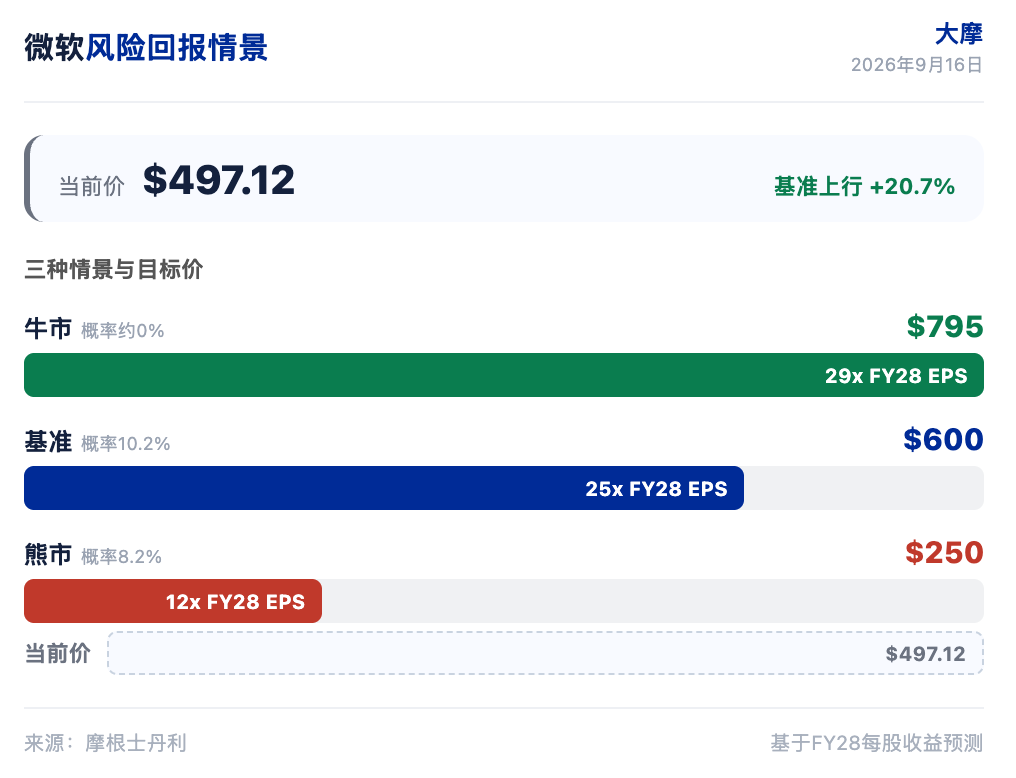
In a bullish scenario, accelerated Azure growth, high-priced SKU adoption in M365, and widespread deployment of Copilot drive low double-digit revenue growth, with operating profit margins expanding to 49.0%. FY28 earnings per share are projected to be $27.64, corresponding to a 29 times price-to-earnings ratio of $795. In a bearish scenario, Azure growth slows due to scale effects, M365 penetration peaks, AI adoption is limited, and the operating profit margin only expands to 45.0%, leading to FY28 earnings per share of $21.84, corresponding to a 12 times price-to-earnings ratio of $250.
Morgan Stanley estimates the probabilities of the three scenarios based on implied volatility from the options market. The probability of the bullish scenario is nearly 0%, the probability of the baseline scenario is 10.2%, and the probability of the bearish scenario is 8.2%. The firm believes that the market's pricing of Microsoft's AI leadership and cloud growth sustainability remains conservative. The valuation gap between the baseline and bullish scenarios primarily arises from differences in assumptions regarding Azure growth and Copilot penetration rates.
Upward and downward risks coexist
Morgan Stanley lists upward risks including accelerated cloud adoption with Azure emerging as a clear winner, significant revenue contributions from AI leadership, operational efficiencies leading to better-than-expected economies of scale and margin expansion. Downward risks include macroeconomic weakness impacting IT spending, on-premises deployments being replaced by the cloud, increased investments suppressing margin expansion, and limited AI adoption.
Morgan Stanley pointed out that the active shareholdings among institutional investors account for 52.4%, with a long-short ratio of 2.1 times among hedge funds and a net exposure of 33.6%. The firm believes that Microsoft's AI leadership and the sustainability of cloud growth have not been fully priced by the market, indicating that the current roughly 20 times FY28 GAAP price-to-earnings ratio is relatively inexpensive.
Morgan Stanley maintains its overweight rating with a target price of $600. Microsoft's dividend increase, accelerated Azure growth, and AI monetization form three supports for high double-digit total returns. The firm recommends focusing on Azure growth and Copilot monetization progress as key indicators to assess whether valuation re-evaluation can materialize.

Disclaimer
This article is a compilation and interpretation of third-party brokerage research reports (Morgan Stanley, September 16, 2026) by Chao Xiang Research, along with information from the public market. The ratings, target prices, earnings forecasts, and relevant judgments quoted in the text are solely the views of the analysts from that brokerage and reflect the position of their respective institutions, not those of Chao Xiang Research, and do not constitute any investment advice.
The market involves risks, and decisions should be made independently. This article should not be used as a basis for buying or selling any securities.
免责声明:本文章仅代表作者个人观点,不代表本平台的立场和观点。本文章仅供信息分享,不构成对任何人的任何投资建议。用户与作者之间的任何争议,与本平台无关。如网页中刊载的文章或图片涉及侵权,请提供相关的权利证明和身份证明发送邮件到support@aicoin.com,本平台相关工作人员将会进行核查。


