Whenever the Federal Reserve enters a rate hike cycle, gold and Bitcoin are always discussed together.
Both are scarce and are often given the narrative of being a “hedge against fiat currency risk.”
So, a very natural judgment arises:
Since gold can maintain resilience in a high interest rate environment, shouldn’t Bitcoin also have a similar performance?
But if one truly experiences a complete tightening cycle, one will find that this logic is not that simple.
Although gold and Bitcoin share some similar narratives, their buyer structures, liquidity environments, and market functions are not the same.
Therefore, when looking at Bitcoin, one cannot simply use gold’s performance as a reference point.
More importantly, it is essential to clarify: How does interest rate hikes actually impact BTC?

1. First clarify: What exactly does a rate hike affect?
Many people see “Federal Reserve rate hikes” and their first reaction is: interest rates rise → BTC falls.
But there are actually several links in between.
Rate hikes first raise the risk-free rate and financing costs.
When capital can achieve higher returns on lower-risk assets, the market’s valuation requirement for high-risk assets will also increase.
At the same time, rising financing costs may push down leverage, and the liquidity in financial markets may also gradually tighten.
For gold, one of the most important observational indicators is real interest rates.
Gold itself does not generate interest, so an increase in real interest rates raises the opportunity cost of holding gold.
However, gold also has a very mature reserve asset attribute.
Central bank reserves, investment demand, jewelry consumption, and multiple other demands together constitute the long-term buyer foundation for gold.
The situation for Bitcoin is different.
Although Bitcoin has a supply cap of 21 million coins, it still remains a high-volatility, high-elasticity asset.
Spot ETFs, institutional funds, trading funds, and internal funds within the crypto market all affect its marginal pricing.
Therefore, when rate hikes simultaneously lead to increased financing costs, liquidity contraction, and decreased risk appetite, Bitcoin often gets impacted more quickly.
So one can remember a simple distinction:
- When looking at gold, focus on observing real interest rates and safe-haven demand;
- When looking at BTC, one needs to observe liquidity, discount rates, and risk preference simultaneously.
These two observation frameworks are not completely the same.
2. The year 2022 was a very typical stress test
If one needs to find a most intuitive historical example, 2022 is very representative.
That year, the Federal Reserve raised interest rates by a total of 425 basis points, and financial conditions tightened rapidly.
Global risk assets were generally under pressure.
Bitcoin fell from nearly $69,000 at its historical high to a low of around $15,500, with the maximum decline being close to 80%.
Gold also experienced volatility, but its overall defensive characteristic was more apparent.
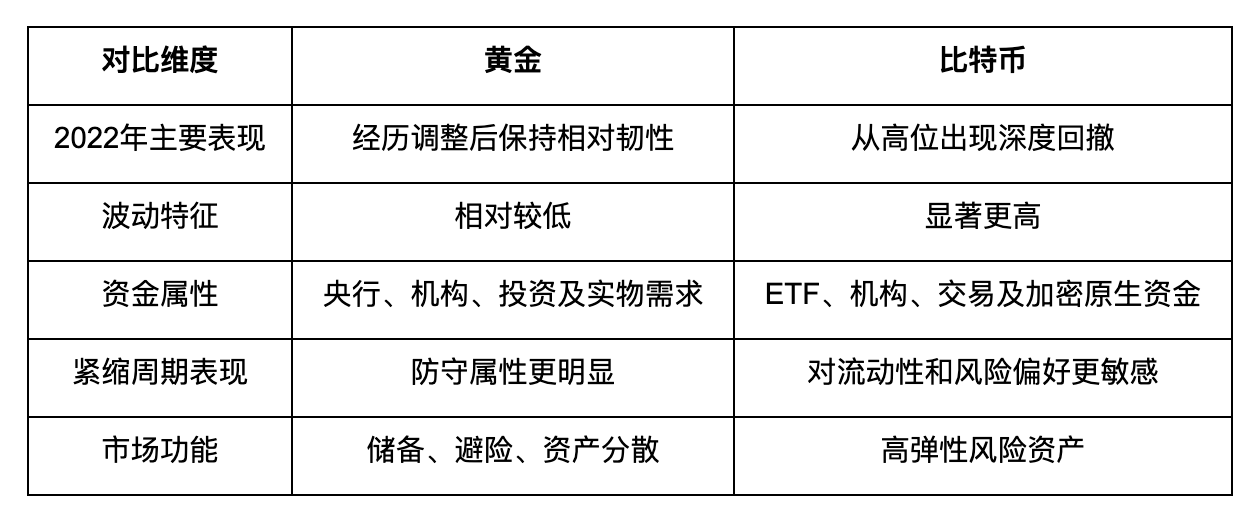
What is truly worth noting is not “gold won against BTC in 2022.”
Rather, it is: Faced with macro tightening, the price transmission mechanism of the two assets is completely different.
Gold has a large amount of long-term allocated capital.
Meanwhile, Bitcoin’s marginal capital is more reliant on market liquidity and risk appetite.
Therefore, when the market begins to rapidly deleverage, Bitcoin often bears more significant price pressure.
This also explains why the concept of “digital gold” cannot be simply understood as: whatever happens to gold, BTC should follow suit.
Bitcoin has some properties similar to gold, but its market performance still bears very evident characteristics of a risk asset.
3. Why is BTC so sensitive to rate hikes?
Understanding this is more important than remembering the ups and downs of any particular year.
1. Buyer structure determines price elasticity
The gold market has a very mature long-term allocation demand.
According to the World Gold Council, in recent years, global central banks have maintained a high level of net gold purchases.
For central banks, gold primarily serves the functions of reserve management, asset diversification, and long-term risk management.
This kind of funding does not easily change long-term allocations due to a single interest rate meeting.
The marginal buyers of Bitcoin are much more diverse.
Spot ETFs, institutional investors, macro trading funds, and internal funds within the crypto ecosystem all jointly influence market prices.
This means that when risk appetite declines, Bitcoin is more susceptible to capital withdrawals and valuation contractions.
2. The leverage structure of the crypto market amplifies volatility
The gold market has developed long-term, with very mature systems for spot, futures, ETFs, and over-the-counter trading.
The Bitcoin market, while continuously expanding, still exhibits pronounced leverage trading, borrowing, and staking structures.
When prices rapidly drop, forced liquidations and deleveraging may further exacerbate selling pressure.
A price drop may also trigger more risk controls.
Thus, the original macro shock might be further amplified through the market structure.
This also explains why: the supply cap of Bitcoin can explain its scarcity, but cannot explain why its short-term volatility is so large.
Short-term prices depend more on: who is buying, who is selling, how much liquidity the market has, and how much risk capital is willing to take.
3. Gold and BTC inherently serve different functions
One of the core functions of gold is defense.
It is used by central banks, institutions, and individual investors to diversify portfolio risk and is seen as a tool to cope with macro and geopolitical uncertainties.
Bitcoin, however, often plays the role of a high-elasticity asset.
Its long-term value narrative is closely related to the development of digital asset networks, global capital flows, and the infrastructure of the crypto market.
So, while both can carry the label of “scarce assets,” it does not mean they should have the same positions, nor does it mean they should be judged by the same set of indicators.
4. So, how should we view BTC during rate hikes?
If one only remembers “rate hikes are bad for BTC,” it is too simplistic.
In the future, when seeing the Federal Reserve raise rates, maintain high rates, or when the market discusses expectations for interest rate cuts, one can refer to the following sequence of views.
First, look at the direction of interest rates
Is the Federal Reserve continuing to tighten or is it nearing the later stage of the tightening cycle?
What the market really cares about is not just “how much was raised today,” but also whether there has been a change in the future interest rate path.
If the market has already priced in the rate hike expectations, then a hike that meets expectations and an unexpectedly tight situation may have completely different impacts on asset prices.
Second, look at liquidity
This is a crucial layer for observing BTC.
Is market funding becoming more abundant or tightening?
One should pay attention to the global liquidity environment, USD trends, financial conditions, and the overall performance of risk assets.
Because for BTC, macro liquidity is often more important than the words “rate hikes” themselves.
Third, look at risk appetite
If the NASDAQ, overvalued tech stocks, and other high-beta assets are all under pressure simultaneously, noticeable volatility in BTC is not surprising.
Conversely, if interest rates remain relatively high but market risk appetite has begun to recover, then BTC’s performance might not simply repeat prior tightening trends.
So don’t just focus on BTC’s own candlestick chart.
When looking at BTC, also consider the entire risk asset market.
Fourth, look at BTC's own funding
The macro environment is just the first layer.
Further observations are needed:
- Is funding for spot ETFs continuously flowing in?
- Is institutional funding increasing or decreasing?
- Is market leverage too high?
- Are there any significant changes in the flow of exchange funds?
- Are there real transaction volumes accompanying BTC’s rise?
These data can help assess whether the market's upward movement is driven by new capital or merely short-term leverage stacking.
Fifth, only then look at the price
This step is very important.
Don’t conclude “rate hikes render BTC worthless” just because BTC drops.
And don’t assume “liquidity is about to turn fully loose” simply because BTC rises.
Price is just the result.
What is truly worth tracking is: interest rate → liquidity → risk appetite → funding → price
By sorting out this chain, observing the market will be clearer than merely fixating on rise and fall.
5. Are gold and BTC truly a choice between one or the other?
Not necessarily.
From the perspective of asset allocation, they can completely serve different functions.
Gold leans more toward the defensive side of a portfolio.
Bitcoin, on the other hand, leans more toward the high-elasticity growth side.
There is also a very easily overlooked issue: the same proportion of funding does not mean the same risk contribution.
Allocating 10% to gold and 10% to BTC may have completely different impacts on portfolio volatility.
The reason is that their historical volatility, maximum drawdown, liquidity, and correlation with other assets are different.
So, rather than simply discussing: “Is gold better, or is BTC better?”
A more meaningful question is: Why do I need this asset?
If the need is for defense, diversification, and reducing dependency on a single economic environment, the functions performed by gold may be more straightforward.
If the need is for a portion of high-elasticity assets that can withstand greater volatility, then BTC may take on a different role.
The key has never been to find a “universal asset.”
Instead, it is knowing what each asset takes on in a portfolio after including it.
6. From asset logic to trading infrastructure
Understanding the asset itself is just the first step.
Once you start to engage with crypto assets, you also need to consider trading channels, liquidity, custody, and account security.
Gold can typically be allocated using traditional tools like gold ETFs and bank accumulated gold.
If you wish to further understand the global crypto asset market, you need to be familiar with another set of trading infrastructures.
If you are building your foundational understanding of crypto assets, you can explore basic functions like spot trading through mainstream global platforms like Binance.
Recently, Binance launched a Mid-Autumn new user benefit, including "Invite 1 person to receive a gift" + exclusive registration gift for new users, completing corresponding tasks can unlock up to approximately 28.8 U, and there are also opportunities to participate in activities like crab gift money and physical merchandise.
If you had plans to open an account and familiarize yourself with the trading platform recently, you might as well check it out.
Access link:
👉https://jump.do/zh-Hans/xlink-proxy?id=3
(Invitation code: aicoin668, enjoy a 10% rebate)

Note: Specific rewards, task thresholds, activity durations, and final collection conditions are subject to the actual announcements on Binance's official activity page.
In conclusion
What rate hikes truly change is not that a certain asset suddenly becomes a “good asset” or a “bad asset.”
What changes is: the price of capital, and how much the market is willing to pay for risk assets.
Although both gold and Bitcoin have scarcity and are often included in discussions of “hedging fiat currency risk,” they respond differently to changes in interest rates, liquidity, and risk preferences.
Therefore, when you see the words “Federal Reserve rate hikes” in the future, perhaps don’t rush to judge whether BTC will rise or fall.
First, look at three things:
- Are interest rates still tightening?
- Is liquidity increasing or decreasing?
- Is market risk appetite recovering or declining?
Then, look at funding and price.
This approach will bring you closer to Bitcoin's true market operating logic than simply using the movements of gold to predict BTC.
After rate hikes, don’t measure Bitcoin with gold's yardstick.
What you need is a ruler that truly fits Bitcoin.
Join our community to discuss and become stronger together!
Official Telegram community: https://t.me/aicoin_support
AiCoin Chinese Twitter: https://x.com/AiCoinzh
Binance benefit group:
https://www.aicoin.com/link/chat?cid=gmLgwvKD1
Risk warning: This article is solely for macro market judgment and asset characteristic analysis, and does not constitute any investment advice or income guarantees. The prices of crypto assets are highly volatile, and investors should fully assess their risk tolerance, participate prudently, and comply with local laws and regulations.
免责声明:本文章仅代表作者个人观点,不代表本平台的立场和观点。本文章仅供信息分享,不构成对任何人的任何投资建议。用户与作者之间的任何争议,与本平台无关。如网页中刊载的文章或图片涉及侵权,请提供相关的权利证明和身份证明发送邮件到support@aicoin.com,本平台相关工作人员将会进行核查。