
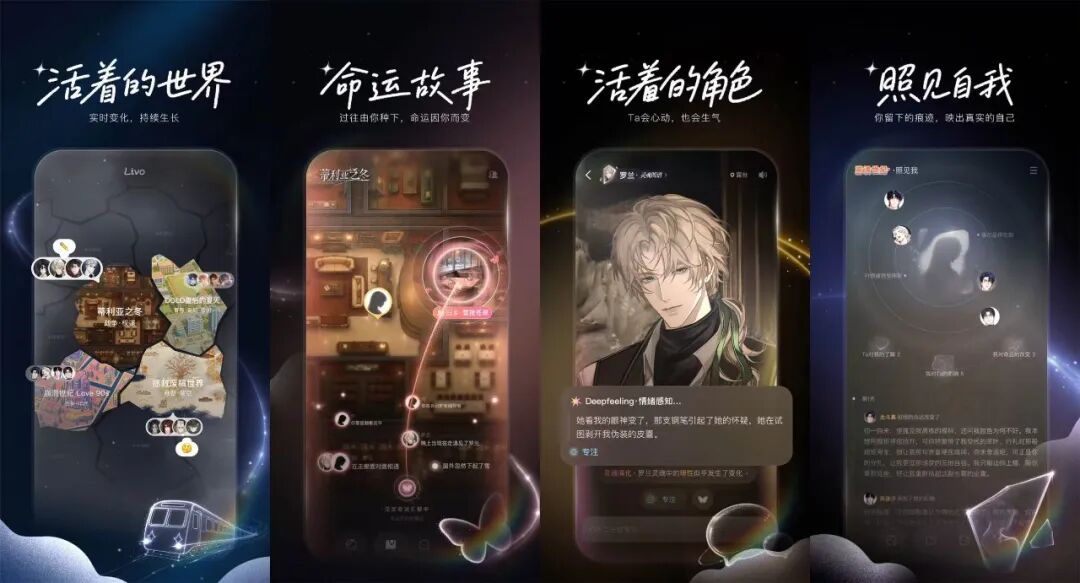
How significant can the impact of a single sentence be?
In most AI products, the answer depends on what you say and to whom you are speaking. However, in Livo, the impact of a sentence may not only affect a specific Agent but the entire world—relationships with oneself, relationships between people, and relationships with the world may all change because of this one sentence.
This is precisely the question Livo seeks to answer. Over the past three years, generative AI has brought the cost of content production close to zero. Text, images, videos—everything that once required humans to invest significant time can now be generated in seconds. With the development of the industry, relevant applications have proliferated, and “interacting with virtual personas” has become a daily habit for millions.
But a gap remains: AI generates content and characters, not a world that exists continuously and operates on its own. When you close the app, that character freezes; when you stop speaking, the story halts. The so-called “interaction” is essentially still you nudging it to move.
Livo aims to expand the “impact radius” of a sentence from a single conversation to an entire world. Kuai Kan Manhua will push it into internal testing in September 2026, with the name derived from Living, World, and Orbit—it aims to create a “bionic world” where a character possesses an independent personality, memory, and behavioral logic, capable of continuing to “live” even when the user is not present.
This world exists independently but still differs slightly due to the behavior choices of “me (the user).” In this created world, “I (the user)” am not an omniscient “God,” nor a “bystander” who can only progress along a predetermined plot line, but a genuine “participant” with subjective agency.
With this expectation, I entered Livo.

Initial Experience: “Time Travel” with Mind Reading
The first time I opened Livo, it reminded me of a famous film work—“Westworld.”
In “Westworld,” there are “West World,” “Roman World,” and “Medieval World” for visitors to choose from, and in Livo, there are “Winter of Tilia,” “The Last Summer of DOLO,” “The Crumbling Century Love 90s,” and “Saving the Wasteland World” for users to select. Each world corresponds to a storyline, with relationships among characters and their respective timelines. Whether users favor romantic experiences, fantastical adventures, or faction conflicts, they can find choices that suit their tastes here.
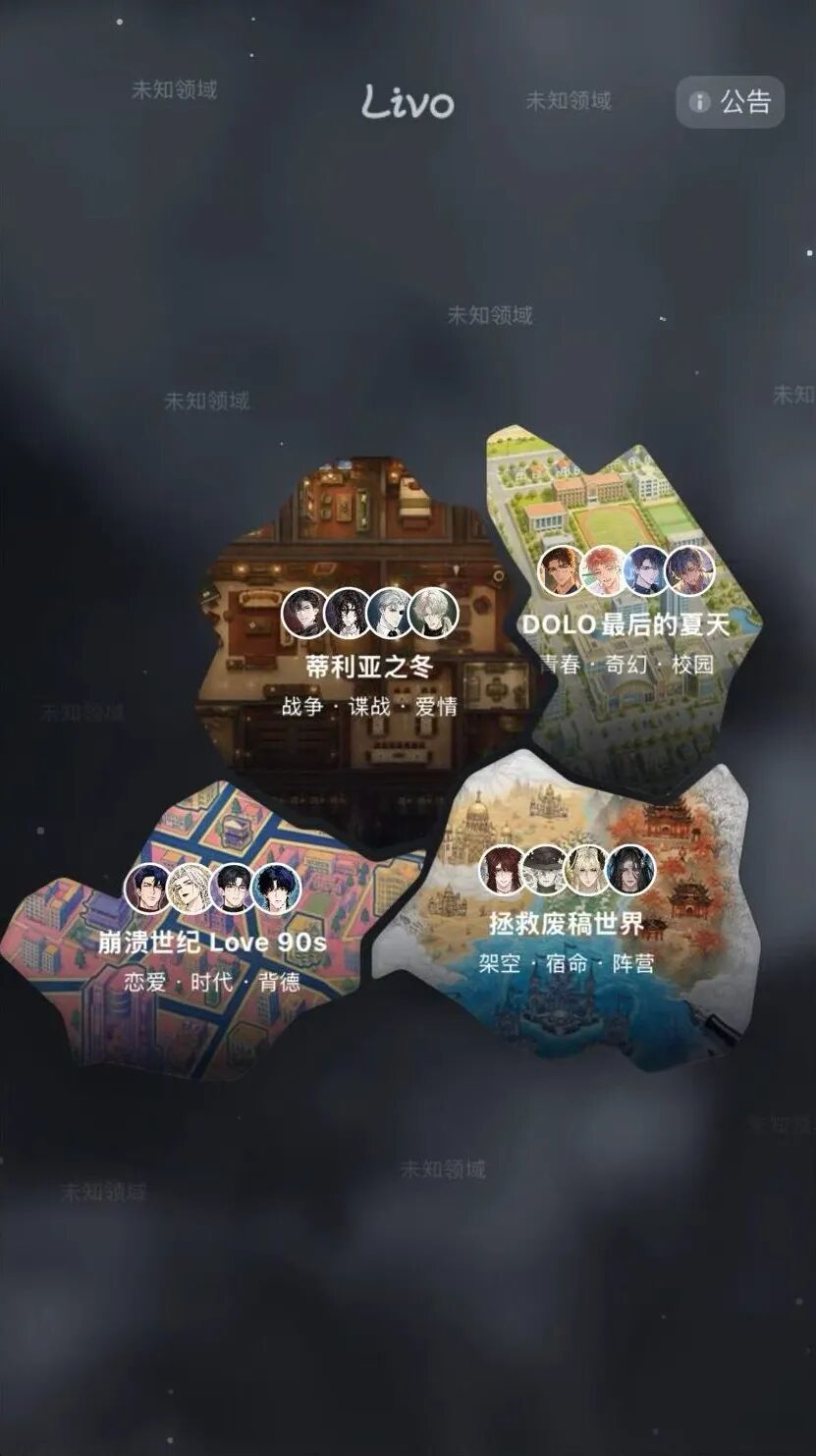
Unlike typical “AI character chat” or “AI emotional companionship” apps, Livo is not a dialogue window from the outset but a “world” that can be chosen to enter.
The initial experience in Livo feels much like “time travel”: a finely crafted opening video explains the worldview background, after which I am “placed” into a specific scene. I need to actively find topics to converse with the characters, even talking to passing NPCs. There is no task list, no “click to continue” button, and if I do not speak, time just slips away.
But soon the biggest difference revealed itself. In the conversation with an important character, “Roland,” I could choose from the content options provided by the system, or I could express myself. For every sentence he spoke, I could not only see the sentence itself but also understand why he said it—his status bar read “Current Emotion: Joyful.” The character is not making a “conditioned response” to my input; he uses his memory and current state to respond to me.
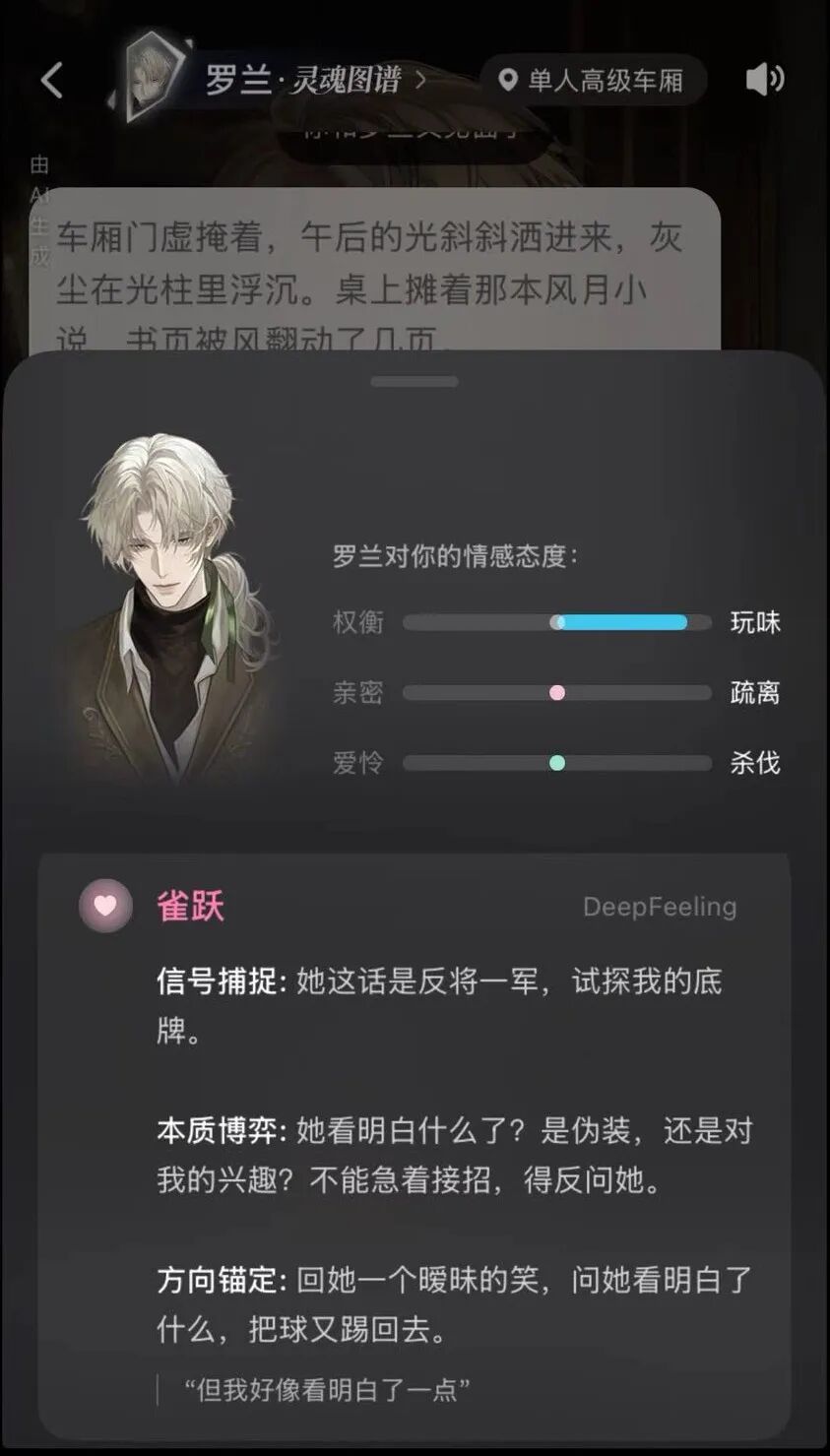
Another interesting point is that I could actively choose to advance the main storyline “fated destiny,” or I could “wander” in different scenes and “chat” with passing NPCs, triggering side plots of “potential destiny.”
For example, in an established conversation, Roland should slowly “extract” my identity information. However, instead of choosing the suggested reply from the system, I responded directly: “You’re very curious about me, even deliberately seeking opportunities to approach me; what for?”
Roland also gave a fascinating reply: “With one sentence, you drew back the curtain on my best trick. Used to controlling the rhythm, I never expected you would see through me…” This statement revealed a “secret” of his—thereby I learned that I was one of the core tasks of his current mission aboard the Peace Train, and that Roland had never encountered information like “Ten Thousand Yi Girl” before this.
This made me realize something: in Livo, the initiative in communication is not the user’s “natural right.” In most chat products, I can send a message at any time, and the character must respond. But in Livo, whether the character is willing to have a deeper conversation about a certain topic depends on the relationship we established before, his current state, and what is happening in the world. Dialogue is an “inevitable product of the relationship created by the world,” not a “right exercised by the user.”
The first experience of Livo does not resemble any existing category of AI products. It is not an upgraded version of a chat tool, nor an AI version of interactive fiction, nor an AI RPG. It is closer to a miniature world simulator with a map, timelines, and a network of character relationships.

Every Cause Has Its Effect; Your Feedback Is “Me”
As someone who has conversed with over a hundred Agents, my patience for AI characters is running thin.
From the initial enthusiastic engagement to later realizing that all characters were using the same template, to finally only caring about their character setup, illustrations, and voices—agents lacking “soul” are becoming increasingly harder to impress. Many “AI character chat applications” on the market share a common problem: characters win by “stacking quantity,” pushing new and intriguing personalities to entice you to click, but after a few exchanges, they behave out of character, and when the emotional threshold of the interactive experience rises, fatigue sets in quickly.
Livo gave me a completely different feeling. The core difference is: characters do not exist for me.
Under normal circumstances, if I close the app or even exit the chat window with them, that character freezes. But in Livo, while I communicate with others or explore new scenes, Roland has his own agenda. In the morning, he writes a new chapter of “Thorn Flower Letter” under the desk lamp, and in the afternoon, he reads in the reading room. I am not involved in these actions, yet I can see them happening. His life has a “main storyline,” and I merely entered his world; he does not revolve around me.
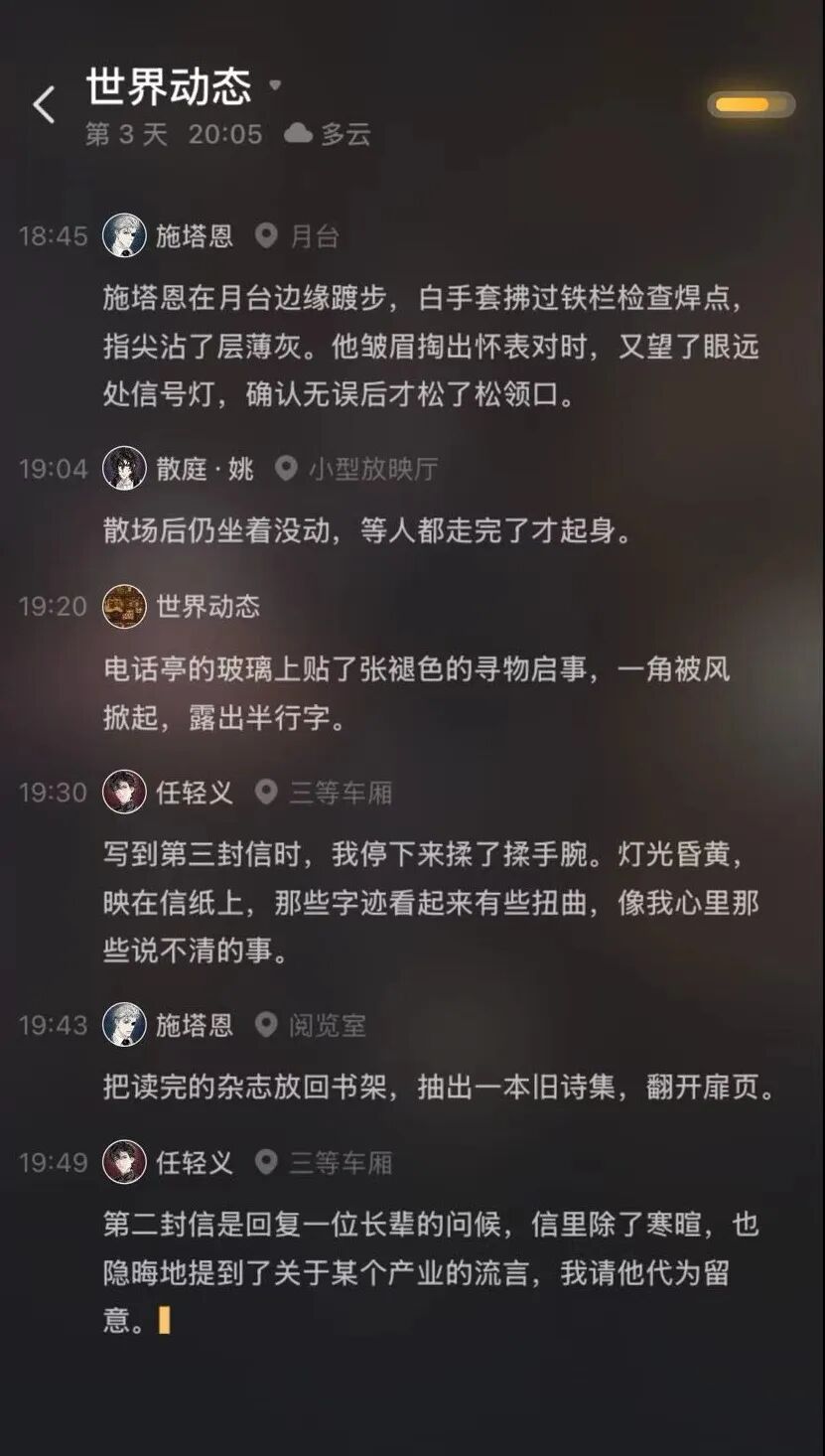
This ability is not a privilege of main characters; even the NPCs with minimal screen time have their own lives.
Livo’s underlying logic is “the world’s state continues to evolve”—when users are not present, the relationships between characters change, events happen, and causes accumulate. This may sound like product copy, but there was a moment in actual experience that made me truly understand its meaning.
During a task, I had an intersection with the NPC café owner and the bakery owner. Because of a minor incident where I gave a train attendant a hand warmer, the three of us created a fascinating chemical reaction. When I unintentionally reopened the dialogue box for this scene, I found the three of them discussing when I would come back, to keep the hand warmer warm in return for my kindness, and to invite me to drink a cup of newly created coffee and try some delicious pastries…
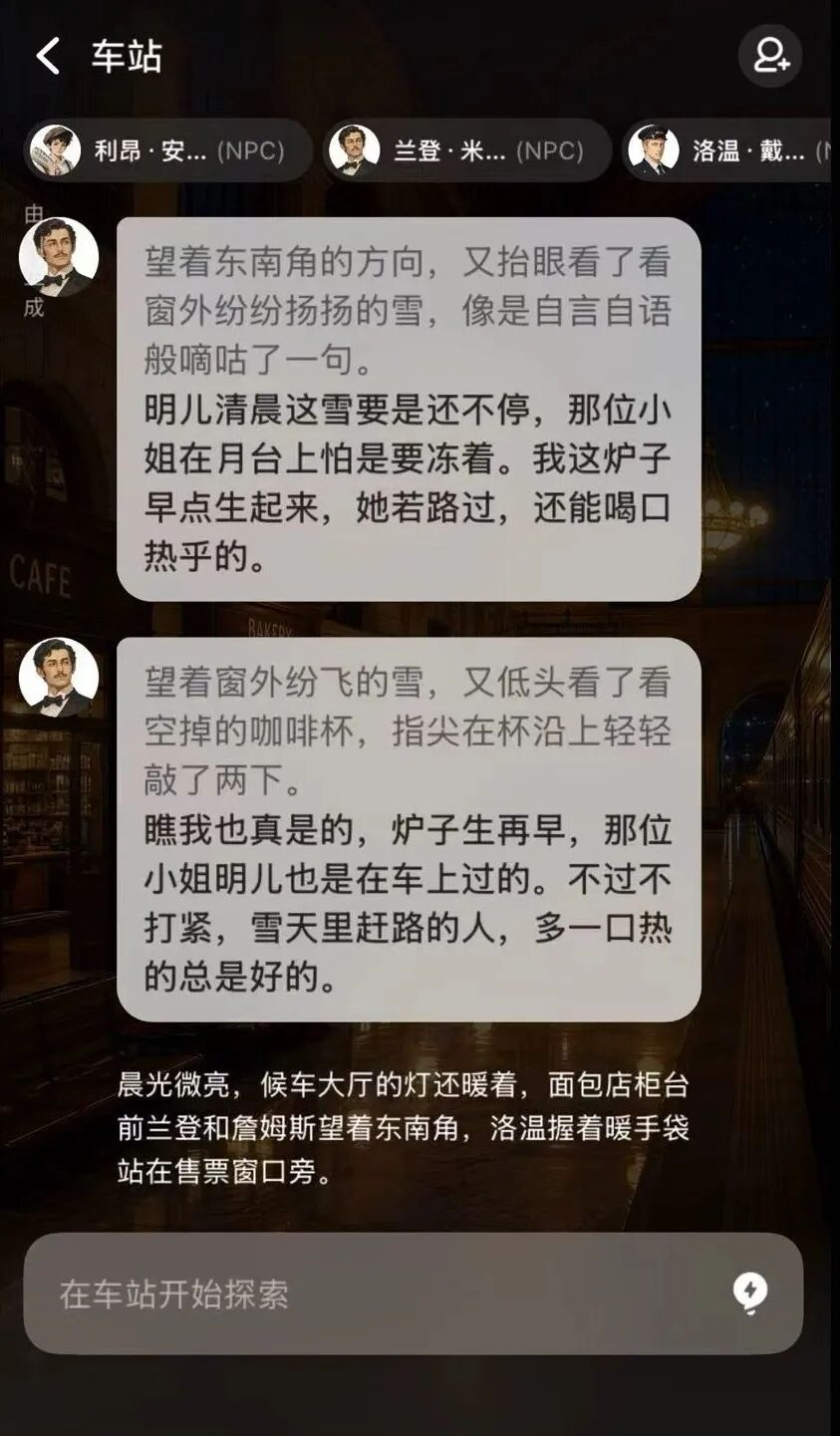
To be honest, seeing this content was shocking. They were merely marginal characters in my experience, not even the main characters, yet they were still doing their own things and would even argue because of me. It felt as if they were not NPCs but actual individuals living in that world.
This is what “causality” looks like in Livo. What I say and do to the train attendant affects his behavior patterns, which in turn influences the café owner's and bakery owner's attitudes toward me. This is not a pre-set plot branch but a chain reaction produced by the flow of information between several independent Agents. In turn-based dialogue products, such multi-character causality chains cannot emerge. You generate “responses”; Livo seeks to generate “trajectories.”
Even more surprising to me was a module in Livo called “Reflecting Me.” When interacting with Ren Qingyi, as the character gradually gets to know you, the system generates a “Reflecting Me” that belongs to me. It records the traces I left, how the character understands me, and how the world “sees me.”
In other words, the “me” in Livo is not a character set defined by the user but a feedback and sedimentation of the world based on my behavior. How I present myself to Ren Qingyi, to Roland, and to the café owner are recorded and understood separately, ultimately converging into a “me” that is “seen” by the world. This made me realize that Livo aims not only to make characters “alive” but also to allow users to rediscover themselves in the process of being seen by the world.
This may be the true meaning of “every cause has its effect”—every one of your actions will enter this world’s causal chain, and ultimately, this world will return those causes to you in the form of “what kind of person you are.”

What Does It Take for a “Living World” to Exist?
This time, I not only experienced the complete functionality of the app, but I also obtained testing permission for the new demo, through which I visually witnessed the underlying code of this world operating.
For example, because of the “snowstorm outside the window,” Shan Ting·Yao generates the “effect” of “when he pushes open the small screening room door, snow still rests on his shoulders; his action of shaking off the snow is lighter than the sound of film reels turning.” And in a place without me, Stein and Roland began to tentatively test each other regarding waiting…

From publicly available information, Livo's technical architecture is a two-layer structure, composed of the "Creator Soul Injection Input Layer" and "Three Major Engines," distinguishing Livo from typical AI character/chatbot products at an underlying level.
The input layer structurally transforms the materials written by creators in literary language into data usable by the engines. Specifically viewed, on the individual side, character profiles are extracted into a "Six Layers Personality" file, comprising self-awareness, basic needs, beliefs, thoughts, positions, and emotions; on the world side, the worldview framework is extracted into a "Six Layers World Structure," including origin, power, belief, order, law, and meteorological factors.
With this string of “basic code” from the input layer, the “three major engines” can begin to work collaboratively. The World Agent manages schedules, events, weather, fortunes, and other factors influencing the overall state. The Soul Agent is responsible for interactions between users and characters. The “Deeply Felt” engine ensures the authenticity of emotional responses through a five-step link. At this moment, each character is itself an independent Agent, possessing different personalities, worldviews, and states while invoking their respective Sub-agents and MCP services. At the core are Memory and the “Causal Writer”—the former is responsible for long-term information retention and recall, while the latter maintains story causality after prolonged operation.
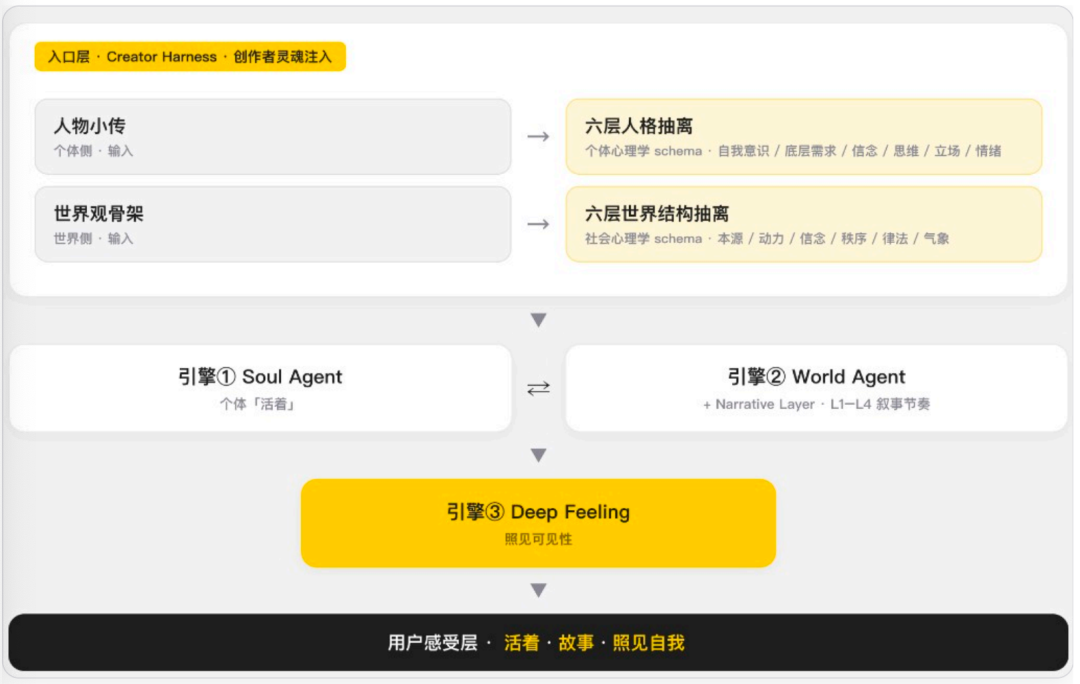
The key issue this architecture tries to resolve is not “technical breakthroughs,” but “consistency after prolonged operation.”
Those Agents that have been painstakingly “trained” with substantial economic and time costs suddenly going OOC, forgetting our past interactions, and generating behaviors inconsistent with their characters is a fatal blow for us old users.
But Livo has taken a completely different path—it does not pursue a physical engine-level sense of reality; it seeks credibility on the narrative causality level. A “living world” does not rely on more characters, longer plots, or prettier visuals but three things: the narrativity of long-term memory, autonomous interaction among multiple Agents, and the causal entry of user behavior.
In terms of memory, Livo's design logic is not to “remember what users have said,” but for characters to possess their own experiences. “What has been experienced” and “what is known” are two different things, and this distinction determines whether the character is “remembering” or “retrieving.”
In terms of multi-character autonomy, the tension in relationships between Ren Qingyi and Roland is not something I can directly control. Their interaction has its own logic, and what I sense is a relational network that is already in operation, not a stage constructed for me.
On the technical front, the Livo team draws inspiration from the idea of Stanford AI Town but clearly states it will not replicate any existing solutions. The infrastructure needed for this product does not yet exist on the market. Letting the bullets fly a bit longer is a reasonable attitude.

Conclusion
Objectively, Livo is not yet a perfect “living world.”
The depth of character “emergence” is limited, and after prolonged interaction, personalities may occasionally drift; sometimes, the plot has ended, and characters should leave, yet the dialogue box remains open, prompting me to continue the conversation; modules like “Reflecting” are still incomplete; and the story plot develops unidirectionally, unable to retract what was previously said, nor can it backtrack to a certain node like narrative games…
The essence of these issues is really the same: a continuously operating world means any interaction will permanently alter the world state. Between freedom and fault tolerance, Livo chooses the former. This choice has its cost, but the direction is correct.
So, compared to these minor experiential issues, I am more concerned about another question: after the tenth hour, the hundredth hour, will this world still be worth returning to?
This question is not just about Livo. Every era has its own entertainment methods. Electricity and light technology led to the emergence of cinema; electronic technology and the broadcasting television network made TV series popular; personal computers and the Internet brought interactive narrative games into popularity, and generative AI with multi-agent architecture led to the emergence of Livo.
They may seem like products from different eras, but behind them is the same thread: every leap in media technology redefines “how people enter a story.” Movies allow people to sit in darkness to watch, TV series provide companionship in the living room, interactive narrative games enable participation through choices, while Livo seeks to let people “live” in a world that operates on its own. From “watching” to “accompanying,” from “choosing” to “being”—each leap deepens the experience of “entering.”
Moreover, in this direction, Kuai Kan has an underestimated advantage. Twelve years of comic experience means it has muscle memory regarding “how characters make people care.” In a race competing for “a sense of world,” this capability is more crucial than one might imagine—because what makes a world worth returning to isn’t how advanced the technology is but because there are characters you care about inside.
From “generating content” to “generating ongoing existence,” this could be the next watershed moment in AI content products. Livo is not yet that watershed itself, but it currently comes closer to making people feel that “the world is alive.” It validates that “the world can move forward by itself” is not a daydream, but there are still numerous unresolved questions before reaching “a truly living world.”
It deserves to be seen, not because it has already achieved something, but because of the direction it points to—making stories not stop at “what happens next,” but giving it a real “what happens next.”
Image source|Provided by the company
免责声明:本文章仅代表作者个人观点,不代表本平台的立场和观点。本文章仅供信息分享,不构成对任何人的任何投资建议。用户与作者之间的任何争议,与本平台无关。如网页中刊载的文章或图片涉及侵权,请提供相关的权利证明和身份证明发送邮件到support@aicoin.com,本平台相关工作人员将会进行核查。


