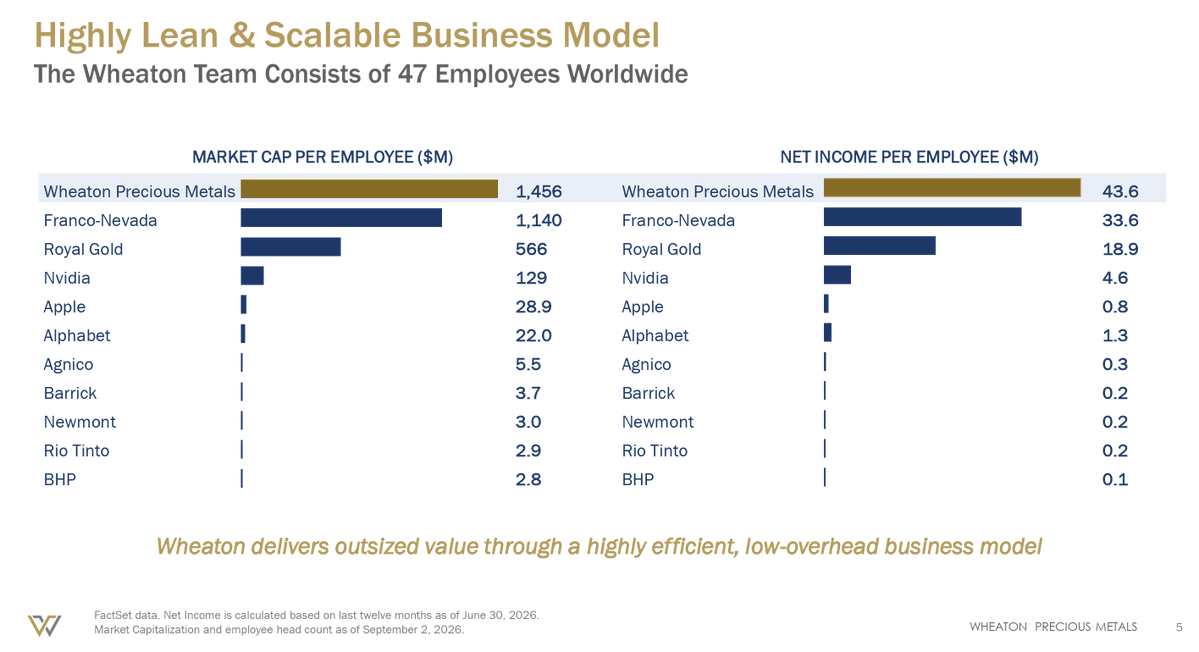
Let's talk about three top publicly listed companies in the anti-inflation field, one of which has only 47 employees globally, each contributing as much as 43.6 million dollars in net profit for the company, exceeding Nvidia's 4.6 million dollars, making it the number one in employee efficiency among global listed companies (as shown in 👇 Figure 1)! 🧐
When it comes to mining companies, everyone's first reaction is: buy equipment, hire workers, and face environmental pressures, working hard every day to mine ores. But there are three fantastic companies in the U.S. stock market that have completely changed my perception of mining. With a market value of several billion dollars, they only have 40 to 50 employees. Their revenue per employee and profit per employee directly outperform Nvidia and Apple.
They are Wheaton Precious Metals ($WPM), Franco-Nevada ($FNV), and Royal Gold ($RGLD). These companies essentially do not mine; they are top financial companies dressed in mining's clothing. Today, let's discuss just how impressive this business model is. 🧐
Let's start with the business model, which can be summed up in two words: buyout.
Taking $WPM as an example, the model it plays is called Streaming, or precious metals streaming. Many large copper and zinc mines, while mining main ores, will also accidentally dig out associated minerals like gold and silver. For copper mining companies, the capital expenditure for building and operating a mine is extremely high, and they urgently need liquidity. This is when $WPM steps in: they provide hundreds of millions of dollars in cash to the copper mine, which is equivalent to a one-time structured financing, in exchange for the right to purchase all the gold and silver produced by that mine at a very low fixed discount (such as 15-20% off market price or thousands of dollars per ounce) over the entire lifecycle of the mine.
Once the agreement is signed, the rest is simple: after the mining company extracts the gold and silver, WPM pays a few hundred dollars to pick them up and then immediately sells them in the secondary market for thousands of dollars at market price to profit. You see, isn't this just risk-free arbitrage? The cost is locked in when the contract is signed, and the higher the gold price rises, the more profit is made.
What do traditional mining companies have to endure? Rising oil prices, increased labor costs, equipment depreciation, safety compliance, and inflation pressure all have to be shouldered. In contrast, the procurement costs for companies like WPM are locked in when the contract is signed. What does this mean?
• Downside is capped: even if gold prices decline, the profit margin from purchasing at a discount remains locked in at a very low level, so losses are minimal.
• Upside is unlimited: when gold and silver prices rise sharply, the marginal cost is almost zero, and the price surge directly translates into 100% net profit.
The most remarkable aspect of this model is that it reduces heavy asset and marginal operating costs to zero. Once the contract takes effect, all subsequent expansions of the mine and the economic cycles of gold prices continuously deliver pure cash flow to the company at zero marginal labor cost. For the capital market, this is the real cash flow harvesting machine.
Now let's look at employee efficiency.
These companies do not operate a single tunneling machine, have no safety accidents, and do not manage a single steel pipe themselves. Their employees are all top legal, geological exploration experts, financial experts, and decision-makers. Everyone does only three things every day:
1️⃣ Due diligence: estimate future associated mineral production at potential mines around the world.
2️⃣ Risk control + contracting: use precise capital structures to lock in long-term equities.
3️⃣ Financial management: hedge and realize precious metals in the secondary market.
In simple terms, this is an ultra-geek arbitrage system. It doesn't need tens of thousands of workers, nor heavy asset investments; it only requires a few of the smartest people to go through global mining resources one by one, find the best targets, sign agreements, lock in profits, and harvest cash flow.
The three companies each have their focuses, so let's look at them one by one:
1️⃣ Wheaton Precious Metals ($WPM), the leading silver streaming company
Core model: Primarily Streaming, paying cash in advance to mining companies in exchange for the right to purchase future by-products at a fixed low price. For example, WPM might purchase silver at a fixed price of 20 dollars per ounce, regardless of whether the market price is 60 or 80, with the price difference being profit.
Asset portfolio: About 40+ streaming agreements, covering major global mining companies (such as Vale, Glencore, Newmont), with silver accounting for about 70%, and the rest being gold, palladium, cobalt, etc.
Extremely low cash costs: because it does not bear mining, maintenance, environmental protection, and other operational costs, WPM's operating profit margin is usually 60-70%.
Investment logic: Silver purity is the highest, with the largest silver exposure among the three, suitable for betting on both industrial and monetary attributes (demand for photovoltaics and new energy + inflation hedging). When gold and silver prices rise, because the purchase cost is fixed, the increase in profit is greater than the price increase, making leverage extremely flexible. Stable dividends (dividend yield of about 1-1.5%), but free cash flow is prioritized for new agreement expansions.
2️⃣ Franco-Nevada ($FNV), diversified royalty giant
Core model: Royalty model, where mining area royalties are the main focus, without pre-paying large amounts of cash, but continuously taking a percentage of revenue or profit (typically 1-3% NSR) after the mine has gone into production, similar to a landlord collecting rent.
Diversified assets:
• Precious metals: Gold and silver account for about 80% (400+ assets);
• Other sectors: Platinum group metals, oil and gas (accounting for about 10-15% of income, gradually divested in recent years), iron ore.
Zero operating costs: FNV does not engage in any mining activities, only collecting royalties, making cash flow extremely stable.
Investment logic: The optimal asset combination, holding top global mining interests (such as Cobre Panama, Antamina, Hemlo), and through continuous mergers and acquisitions, has cumulatively invested over 2 billion dollars during the 2023-2025 period. Clear cash cow characteristics, converting free cash flow at >90%, and increasing dividends consecutively for 16 years (dividend yield of about 0.8-1.2%). The Royalty model naturally hedges inflation costs, as mining companies shoulder cost increases, while FNV only takes a portion of revenue, and its income sources are diversified, with any single asset accounting for <15%.
3️⃣ Royal Gold ($RGLD), balanced combination of streaming + royalty
Core model: Driven by both Royalty and Streaming, with about 60% Royalty and 40% Streaming, placing it between FNV (pure Royalty) and WPM (pure Streaming).
High asset concentration: The top 5 assets (Mt Milligan, Peñasquito, Andacollo, Khoemacau, Cortez) contribute about 70% of revenue, more concentrated than FNV.
Gold-dominated: About 85% of revenue comes from gold, with silver accounting for <10%.
Investment logic: Gold beta is the purest, making it the most suitable among the three for betting on rising gold prices, with low dependency on by-products like silver and copper. Due to high asset concentration, individual risks are significant, historically valued 10-20% lower than FNV, making it suitable for value hunters. Dividends are steady, with a dividend yield of about 1.2-1.5%, and the dividend growth rate is slightly lower than that of FNV.
In summary, the strategies of these three companies fundamentally financialize the heavy asset industry of mining. They do not mine; they only sign agreements, collect royalties, and profit from price differences. Costs are locked in, upsides are unlimited, cash flow is stable, and employee efficiency is extremely high. This is true innovation in business models.
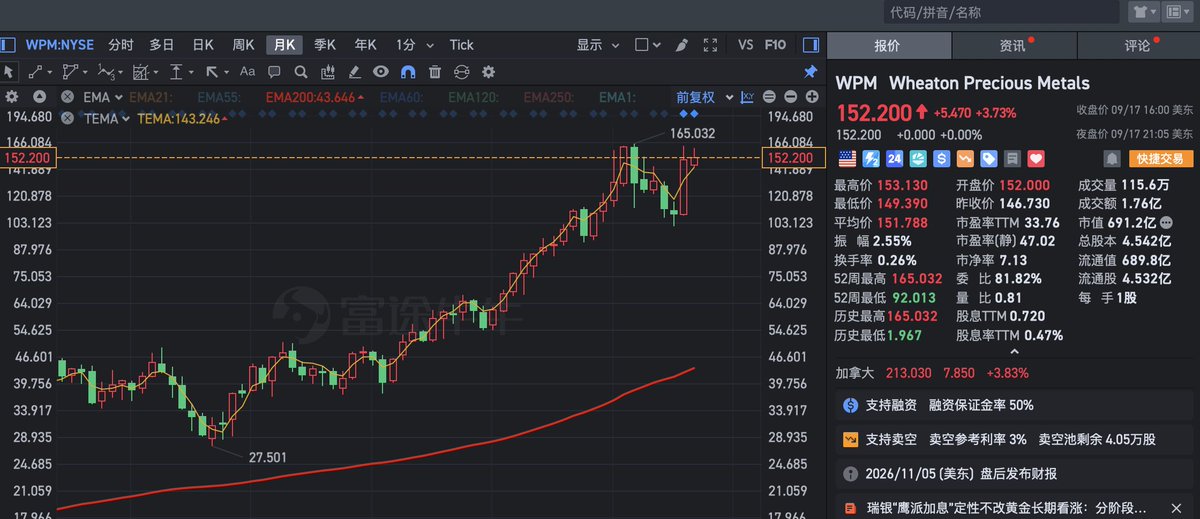
Currently, gold prices stand at 4,350 dollars per ounce, and silver prices are also high at 65 dollars per ounce. The big cycle for precious metals is not over yet, especially under the current high inflation backdrop, gold and silver still represent good investment options. If you are optimistic about gold prices continuing to rise in the coming years, these three companies are worth focusing on. $WPM is suitable for aggressive players betting on silver, $FNV is ideal for stable long-term investors, and $RGLD is suitable for value hunters betting purely on rising gold prices.
For trading U.S. stocks, I choose to use the #RWA U.S. stock tokenization platform #MSX; let's invest together in the U.S. stock market: http://msx.com/?code=Vu2v44
Early fans and partners of U.S. stock investments can message me privately; after filling out the form, you can enter the U.S. stock exchange and discussion community for free (currently limited to 10 people per week, assisted by review, which may take some time, thank you 🙏)!
免责声明:本文章仅代表作者个人观点,不代表本平台的立场和观点。本文章仅供信息分享,不构成对任何人的任何投资建议。用户与作者之间的任何争议,与本平台无关。如网页中刊载的文章或图片涉及侵权,请提供相关的权利证明和身份证明发送邮件到support@aicoin.com,本平台相关工作人员将会进行核查。


