Written by: Gandalf, Techub News
Introduction
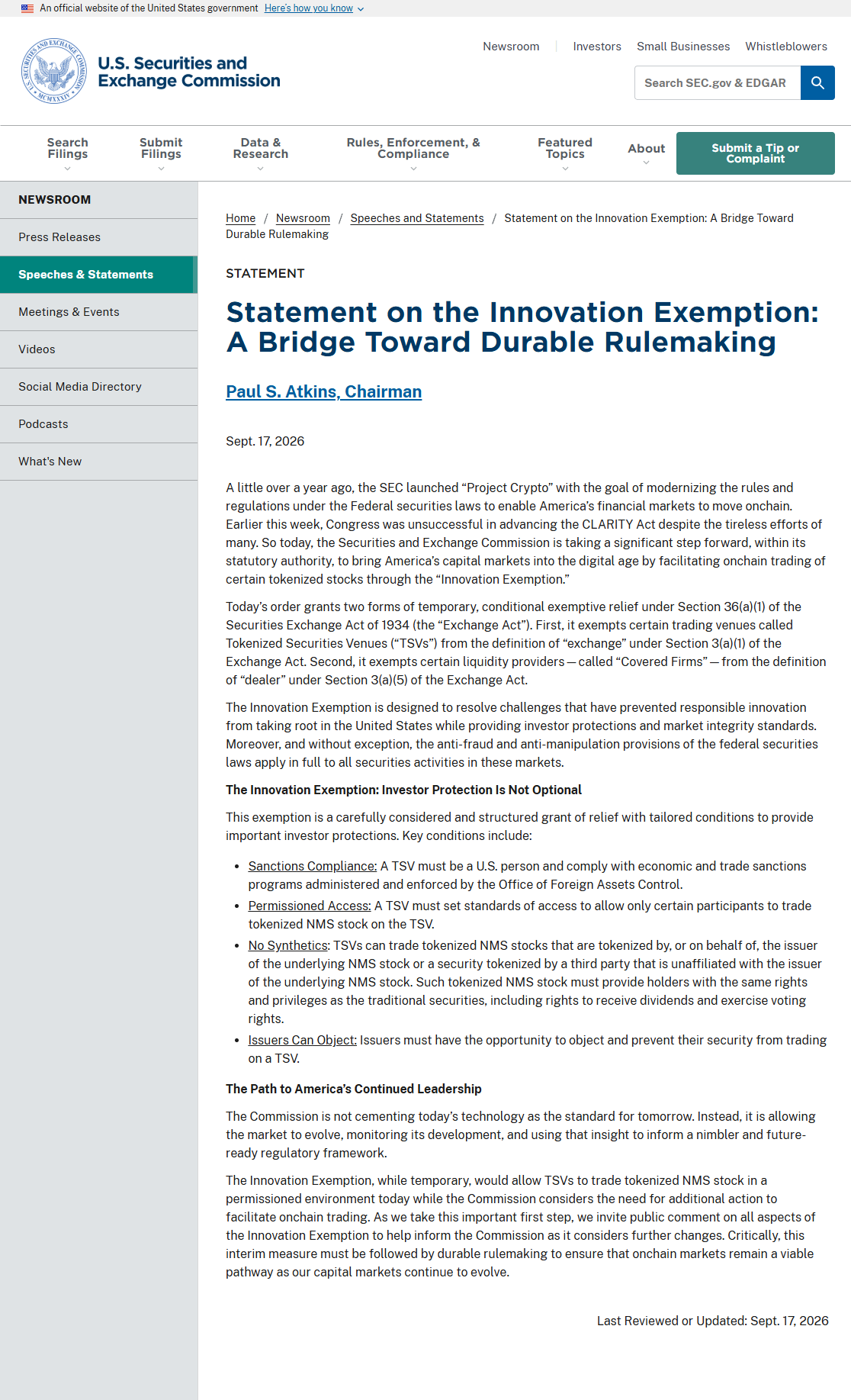
As the U.S. Congress failed to advance the CLARITY Act, the U.S. Securities and Exchange Commission (SEC) chose to take proactive steps within its existing statutory authority. On September 17, the SEC launched an "Innovation Exemption" for on-chain trading of tokenized stocks, providing conditional, temporary regulatory exemptions for certain trading venues and liquidity providers. SEC Chairman Paul Atkins stated that this is not a relaxation of traditional securities regulation, but rather a "bridge" to long-term, stable rule-making.
Key Summary
The SEC allows qualifying "Tokenized Securities Venues" (TSVs) to trade a portion of tokenized NMS stocks in a permitted environment.
Some TSVs will temporarily not be recognized as "exchanges" under the Securities Exchange Act of 1934; some liquidity providers will also temporarily not be recognized as "dealers."
The exemption does not weaken core prohibitions such as anti-fraud and anti-manipulation in securities law, which continue to apply comprehensively to related market activities.
Participating platforms must meet conditions such as sanctions compliance, access management, non-synthetic assets, equal shareholder rights, and issuer rights to refuse on-chain transactions.
The SEC will solicit public comments and emphasizes that further progress must be made toward more enduring formal rule-making after the temporary exemptions.
Policy Content: What is Allowed and What is Restricted
The legal basis for this measure is Section 36(a)(1) of the Securities Exchange Act of 1934. The SEC provides two types of exemptions on a temporary, conditional basis:
| Involved Entities | Exemption Content | Actual Significance |
|---|---|---|
| Tokenized Securities Venues (TSV) | Not regarded as a statutory "exchange" under specific conditions | Reduces institutional friction faced by on-chain trading platforms when directly applying traditional exchange regulatory frameworks |
| Specific Liquidity Providers (Covered Firms) | Not regarded as statutory "dealers" under specific conditions | Provides compliance testing space for automated market makers, on-chain liquidity pools, and other mechanisms |
| Tokenized NMS Stocks | Can be traded in a permitted environment | Incorporates the tokenization of securities into the U.S. regulatory framework, rather than just developing in offshore or gray markets |
However, this policy does not equate "tokenization with liberalization." The SEC emphasizes that anti-fraud and anti-manipulation provisions under federal securities law will unexceptionally apply to related securities activities. This means that trading occurring on the blockchain does not exempt issues like issuance, trading, information disclosure, market manipulation, and investor harm from existing securities regulatory systems.
In terms of specific constraints, TSV must be U.S. entities and comply with the economic and trade sanctions regime overseen by the U.S. Department of the Treasury's Office of Foreign Assets Control (OFAC); platforms must implement "licensed access" rather than opening to any on-chain address indiscriminately; tradable assets must not be purely "synthetic stocks" that only track stock prices; holders of tokenized stocks should receive the same rights as traditional securities holders, including dividends and voting rights; and issuers also retain the right to oppose the trading of their stocks on a specific TSV.
Background: Regulatory Initiative After Legislative Stalemate
This "Innovation Exemption" is a continuation of the SEC's "Project Crypto" initiative. Atkins stated that the SEC launched the project about a year ago, aiming to modernize federal securities law rules and progressively lead U.S. financial markets toward on-chain integration.
The immediate context for the policy's release is that the U.S. Congress failed to advance the CLARITY Act this week. This bill was originally viewed as an important attempt to build a more comprehensive regulatory framework for digital assets. After legislative progress stalled, the SEC did not wait for Congress to complete the overall institutional design but instead rolled out temporary arrangements within its statutory authority to respond to market demands for clarity on the legal status of tokenized securities trading.
This approach reflects a shift in U.S. regulatory thinking: not simply viewing blockchain finance as a replacement for traditional markets but attempting to incorporate it into the existing securities law framework to test new trading, settlement, and liquidity mechanisms within a limited scope. The SEC's focus has also shifted from "whether to allow technological innovation" to "how to permit innovation without undermining securities attributes, investor rights, and market integrity."
Impact: On-Chain Finance Gains Systematic Access
For the market, the most direct significance of this exemption is to delineate the regulatory boundary between "real stocks on-chain" and "synthetic products that merely track stock prices."
Traditionally defined tokenized stocks that correspond with actual securities rights allow investors to retain rights such as dividends and voting, and issuers can participate in deciding whether their securities are circulated on a platform, thus making it closer to a technological upgrade of traditional securities infrastructure. In contrast, synthetic stocks usually only replicate the price performance of a certain stock without representing ownership of actual stocks or shareholder rights. The SEC's explicit exclusion of the latter means that U.S. policy aims not to expand high-leverage or price speculation products but to explore the regulated issuance, registration, trading, and settlement of securities in digital form.
The impact on different entities can be summarized as:
- Trading Platforms and Fintech Companies: Can test on-chain trading, licensed automated market making, and liquidity pool models within compliance boundaries, but must bear strong identification, sanctions screening, access control, and investor protection responsibilities.
- Traditional Brokers, Exchanges, and Custodians: May face new competitive and cooperative opportunities. Blockchain can support longer trading hours, faster settlements, and programmable corporate action handling, but does not automatically eliminate core responsibilities such as securities custody, client asset isolation, and market surveillance.
- Listed Companies and Issuers: Have a clear "option." Issuers can block their securities from trading on a TSV, preventing their stocks from being tokenized in a manner that does not comply with corporate governance or brand management requirements.
- Investors: Theoretically may gain more ways to trade and hold assets, but should not misconstrue "tokenization" as a low-risk label. On-chain assets still face risks such as smart contract vulnerabilities, liquidity fragmentation, identification failures, unclear custody arrangements, and price discrepancies across platforms.
- U.S. Financial Markets: This measure may help keep innovative activities within the domestic regulatory framework, reducing the incentive for companies to turn to foreign markets due to ambiguous rules; however, it will also present regulators with more complex challenges in cross-market monitoring and enforcement.
Next Steps: From Temporary Exemptions to Formal Rules
The SEC has clearly positioned the "Innovation Exemption" as a transitional solution rather than a final answer. Atkins noted that the commission hopes to assess through practical market operations, industry feedback, and public opinion whether more measures are needed to support on-chain trading; ultimately, what will truly make on-chain markets a long-term viable path for capital markets will be "durable rule-making."
There are at least four areas to observe going forward:
- Can the Pilot Scope Be Expanded
The current focus is on tokenized NMS stocks and permitted trading environments. Future rules may involve more categories of securities, different types of clearing and settlement arrangements, as well as on-chain transfer agents, custody, and corporate action handling mechanisms. - Regulatory Standards for Automated Liquidity Mechanisms
The traditional securities market's market makers, exchanges, and clearing systems have clear capital, risk control, and regulatory obligations. If automated market makers and liquidity pools enter the securities market, the SEC needs to further clarify standards for smart contract audits, liquidity risk, market manipulation identification, failure handling, and liability attribution. - Can Shareholder Rights Truly Be "On-Chain Equivalent"
The ability for corporate actions such as dividends, voting, stock splits, rights offerings, and shareholder meeting notifications to be accurately, timely, and auditable communicated to token holders will determine whether tokenized stocks can evolve from trading tools to comprehensive forms of securities ownership. - How Will Congressional Legislation and SEC Rules Interconnect
If Congress pushes forward digital asset legislation in the future, the temporary exemptions and subsequent SEC rules will need to coordinate with higher-level legislative frameworks. At that time, the market will be most concerned not just with "whether to pilot," but whether the U.S. can form a long-term, consistent, predictable, and cross-agency executable digital securities regulatory system.
Conclusion
The signals released by the SEC's actions are quite clear: the U.S. has not chosen to allow the expansion of tokenized securities in a regulatory vacuum nor has it fully adopted traditional market's existing technical pathways, but rather attempts to establish a controlled channel between the two. For the industry, this is a limited yet crucial institutional breakthrough; for regulators, it represents a long-term experiment regarding securities rights, market fairness, technological risks, and the future forms of financial infrastructure.
The value of the "Innovation Exemption" ultimately lies not in the short-term increase of on-chain trading volume, but in whether it can provide a reliable sample for the U.S. to establish a formal system that permits upgrades of financial infrastructure without sacrificing investor protection and market integrity.
免责声明:本文章仅代表作者个人观点,不代表本平台的立场和观点。本文章仅供信息分享,不构成对任何人的任何投资建议。用户与作者之间的任何争议,与本平台无关。如网页中刊载的文章或图片涉及侵权,请提供相关的权利证明和身份证明发送邮件到support@aicoin.com,本平台相关工作人员将会进行核查。


