In the past two days, if we were to say what the hottest large model is, there might only be one name.
Jev.
This model comes from TypeSafe AI, and the founder is this Diogo Almeida.

This guy used to be at OpenAI, where he participated in creating RLHF and InstructGPT, which are the key methods that allowed GPT to truly learn to converse like a human and ultimately gave rise to ChatGPT and GPT-4.
Then, he chose to leave OpenAI in early 2024 to start a business, and after being in hiding for two years, he finally revealed his brand new model, Jev.
This thing might be the most different piece of technology I've seen in the past year.
Seriously, it has sparked a lot of imagination for me regarding AI. Trust me, this Jev is unlike any large model you've encountered before.
Because this model only does one thing: high-frequency decision-making.
That's right, a new model launched in September 2026 cannot chat with you, cannot write code, and cannot even generate text.
It only assists you in making decisions and judgments; it is a completely general classifier.
This might sound a bit bizarre, but there's a case on X these days that I think is particularly suitable for explaining what Jev is.
Developer Marcel Pociot integrated Jev into a browser plugin.

The function is very simple.
This browser is connected to Jev, which helps filter out those things on X that you definitely do not want to see.
For example, you can set it up and say that you do not want to see content that deliberately provokes replies, or do not want to see cryptocurrency and NFTs, or do not want to see political debates, and so on.
You can even say, “Fold away those things that are clearly just to make me angry, make me reply, or make me stop arguing.”
Then you just continue to browse X normally.
Every time a new post appears.
Jev quickly makes a judgment in the background:
Does this post hit that category of content we don't want to see?
If it does, it gets folded and not displayed; if it does not, it is shown normally.

And this judgment takes an average of only 380 milliseconds.
In other words, as soon as Jev sees a post, it inputs the post, then completes the judgment and decides whether to fold it, all within 380 milliseconds.
In the past, when we looked at large models, if we encountered this kind of problem, you could certainly have the large model make the judgment. Even with JSON Output enabled, it would be very slow; if you enabled the thinking mode, it would be even slower, potentially taking tens of seconds to complete a judgment.
But we actually do not need that much; we only need the model to give a yes or no as quickly as possible.
We don't need it to generate any content; it just needs to help us make decisions.
That's what Jev does.
This is the most peculiar and sexy aspect of Jev.
The large models we have seen in the past have all been trying to learn one thing: how to better respond to humans.
Jev has taken a different direction; what it seeks to solve is:
What if what we actually need in the end is just a piece of code?
Code doesn’t require eloquent writing. It doesn’t require you to explain for a long time.
It just wants to know: yes or no, A or B, continue or stop, and so on.
What it needs is a decision that can be executed directly.
And frankly, it’s not just about code; in this world, even for us humans, most things are essentially decisions and judgments.
Should you buy this piece of clothing? If you encounter a boss, do you block or dodge? When tokens run out, do you reset or give up? When it comes to marriage, should the bride price be given or not... too much to cover.
Many times, even in our lives, we don’t require lengthy texts or analyses; we simply need a decision, that’s all.
Therefore, Jev is charging toward this goal. To accomplish the best decision-making, they have outright eliminated text generation.
Thus, the speed has increased by 20 to 200 times, almost approaching real-time. When Jev plays games, it can make decisions 10 times in one second, and the cost has decreased by 40 to 400 times, at 0.042 dollars per million tokens, absurdly cheap (the output tokens are free because only a decision is output, and those tokens are so few that they’ve made it free).
The big shots online have gone crazy with it.
For example, some people use it to play Mario, as Mario essentially just involves button decisions...
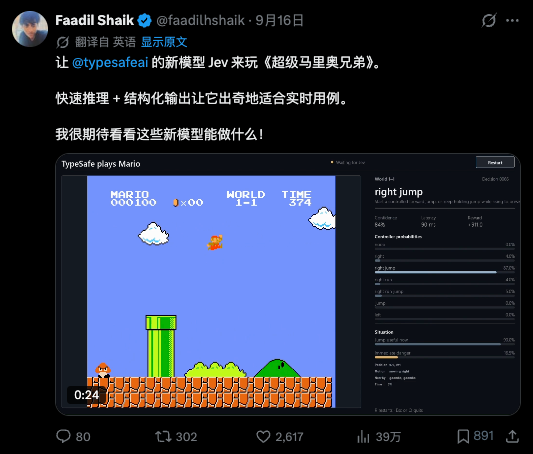
The results are surprisingly good.
Some use it to control browsers to check flights, taking only 7 seconds to click through everything, after all, controlling a browser is fundamentally about decision making.

There are also those who have built a trading robot with it, as trading is essentially decision making, it’s just about buying or selling.

There’s a lot more.
The millisecond-level response and bulk decision-making of Jev have both super practical scenarios and countless opportunities for imagination.
This is the model type they defined for themselves, called the System One Model.
The name System One comes from the famous book "Thinking, Fast and Slow" by Daniel Kahneman.
Kahneman crudely divides human thinking into two types.
System 1 refers to fast thinking, automatic, and intuitive.
For example, if I ask you: what is 1 + 2? You wouldn’t lower your head to ponder for three minutes and then report back a 3, right?
System 2 refers to slow thinking.
It requires step-by-step analysis, like doing mathematical proofs, writing complex code, and so on.
Current models like GPT, Claude, especially various Reasoning Models, are increasingly resembling a particularly strong System 2.
Jev, on the other hand, bets on the other side because they believe that there exist countless intelligent tasks in this world that do not require lengthy reasoning.
So they have redesigned a model architecture, a parallel sampler, and a training method they call RLCD.
The full name is Reinforcement Learning for Calibrated Decisions.
It can be roughly translated as:
Reinforcement Learning for Calibrated Decisions.
Just like we previously said, RLHF optimization is about which response humans prefer.
Then RLVR optimization is about whether the answer can be verified; hence we witnessed a major leap in mathematics, code, and similar fields in the past two years.
RLCD aims to optimize whether the decision is correct and whether the model's claim of "I have 90% confidence" is truly close to 90%.
Because if you really want to integrate AI into an automated system, those probabilities must be meaningful.
For example, if Jev gives a confidence level > 0.90, then it can be executed automatically.
0.7 confidence 0.90, then pass it to a stronger large model for verification.

Confidence 0.7, then pass it to a human for decision-making.
So I believe that in the path of Jev, the most important word is not just fast and cheap; this "calibration" is the real core.
When you connect with Jev and let it output, you can also see that its output looks like this.
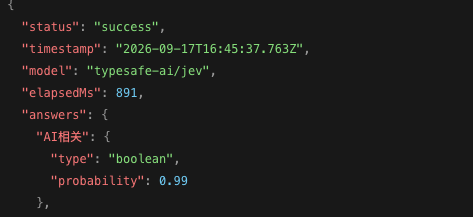
This is very satisfying.
Moreover, the most neat thing is that all those judgment questions can be asked simultaneously in parallel.
For example, I throw in an AI news article.
I can ask at the same time: Is it related to AI? Is it an advertisement? Is it fundraising? Which category should it belong to? Is it worth pushing to users, and so on.
Jev can complete all these judgments at once, at lightning speed, and take off directly.
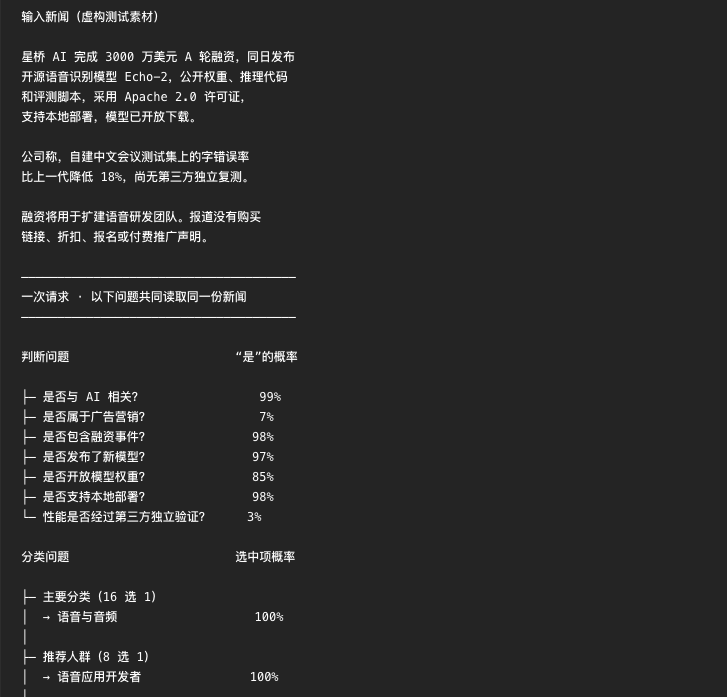
This is completely different from the traditional LLM generating one token at a time; it’s a different approach altogether.
Therefore, this thing fundamentally resembles:
A super if statement with world knowledge and semantic understanding abilities.
You can currently apply for qualifications on their official website, and you should be able to get approved fairly quickly.
Here is the URL: https://typesafe.ai/

But if you are eager to test it, you can also go to a platform called Vercel, where they have already integrated Jev as a first launch.
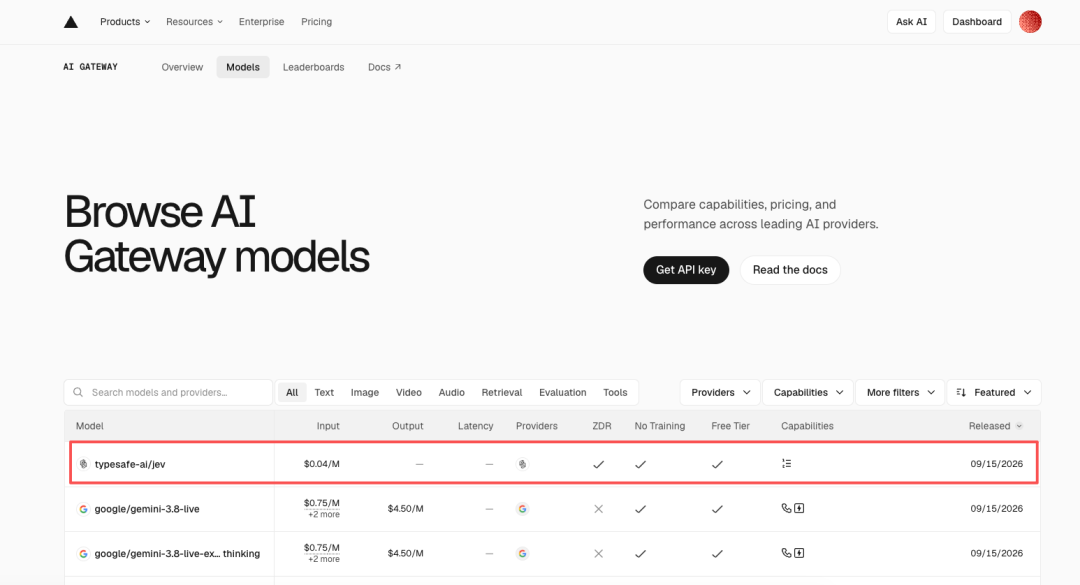
I also promptly tested some task judgments from AIHOT using Jev.
For instance, a very basic pre-screening task involves scoring thousands of content I monitor daily. The model responsible for selection is a slightly larger and costlier model to ensure ample world knowledge and sufficient taste.
However, if we throw all these thousands of pieces of information to that model, it would be very expensive. So instead, we use a cheaper model for preliminary screening, eliminating all content unrelated to AI, which saves a lot of money.
Thus, this pre-screening task is very simple; it only judges whether the current information is related to AI.
I tested 100 questions simultaneously with GLM-5.3 Flash, DeepSeek V4.1 Flash, Qwen 3.7 Flash, and Jev.
The results were quite surprising.

GLM 5.3 Flash was the only one to get them all right, but it was the slowest and the most expensive.
Jev currently appears to be the most comprehensive, second in accuracy and much cheaper; it is even cheaper than DeepSeek V4.1 Flash during idle periods. However, due to network latency issues in China, Jev's time cost and response speed were increased.
Qwen 3.7 Flash remains the cheapest and the one with the best cost-performance ratio but has a slightly lower accuracy rate than DeepSeek V4.1.
In another task related to clustering of same events, Jev also maintained second place in accuracy, but this time, due to the larger volume of content, it finally became the fastest.

If it were to do a more suitable parallel judgment task for Jev, such as answering ten questions behind a news piece simultaneously.
Then at this time, the advantages come out.
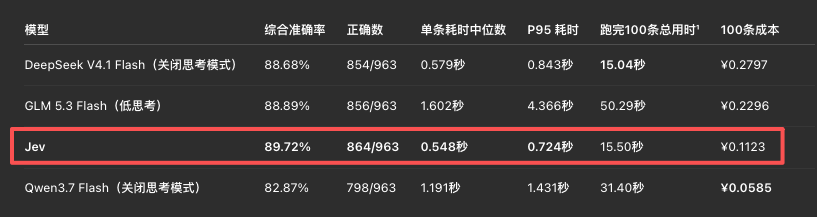
Highest accuracy, fastest speed, and second lowest cost.
In scenarios that pursue precision for classification and judgment, Jev is currently the highest cost-performance solution; Qwen 3.7 Flash is cheap, but once the task is a bit larger, that accuracy can drop by 7 percentage points, rendering it unusable.
And this is just the first generation model; if Jev releases version 2.0 in a few months, I can only imagine how accurate, speedy, and inexpensive this thing could become.
The name Jev is derived from a famous concept in economics.
The Jevons Paradox.
The proposer is named William Stanley Jevons.
In the 19th century, as steam engines became increasingly efficient, theoretically, burning the same amount of coal could accomplish more work, would humans reduce coal consumption as a result?
The result was the opposite; as steam engines became more efficient, using coal became more cost-effective, thus more industries began utilizing it.
In the end, coal consumption in society actually increased.
Increased efficiency, decreased per-use consumption, yet total consumption skyrocketed; this is the Jevons Paradox.
And TypeSafe named the model this way.
The meaning is already very clear; they are betting that intelligence will also experience the Jevons Paradox.
The models we are currently using are getting increasingly expensive, with prices rising. But do we really need such highly intelligent models in our everyday lives? Are there not numerous judgments and decisions that can just be handled by a model like Jev?
But if one day, judgments with reasonable semantic understanding abilities become cheap enough to be almost free, what will happen to this world?
AI, why must it always generate things?
Intelligence can certainly be used for creation.
But it can also merely be used for judgment.
Jev may indeed represent another particularly important piece of the puzzle in the Age of Agents.
A direction we have overlooked because of ChatGPT’s overwhelming success.
The contours of the future.
Seem to be gradually becoming clearer.
免责声明:本文章仅代表作者个人观点,不代表本平台的立场和观点。本文章仅供信息分享,不构成对任何人的任何投资建议。用户与作者之间的任何争议,与本平台无关。如网页中刊载的文章或图片涉及侵权,请提供相关的权利证明和身份证明发送邮件到support@aicoin.com,本平台相关工作人员将会进行核查。


