Written by: Rita
The SEC has opened the door to trading tokenized stocks in the United States for the first time. A report published by Goldman Sachs on September 18, 2026, points out that the SEC issued an order on September 17 granting a conditional registration exemption for a period of five years to specific exchanges and liquidity providers, allowing them to offer tokenized stock trading in the U.S. These entities are referred to as Tokenized Securities Trading Venues (TSV). Goldman Sachs believes that this order broadly permits U.S. tokenized stock trading for the first time and may drive gradual growth in the tokenized U.S. equity market.
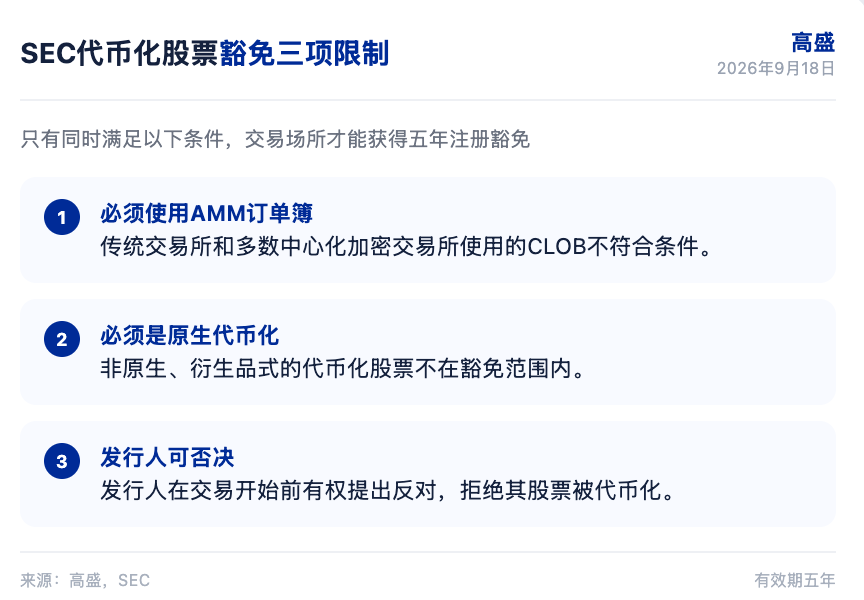
Goldman Sachs analyst James Yaro listed three conditions for the exemption in the report. Only venues using automated market maker (AMM) order books are eligible for the exemption; traditional exchanges and most centralized crypto exchanges use central limit order books (CLOB), which do not qualify. Only stocks with native tokenization characteristics are exempt, while non-native, derivative-style tokenized stocks are not included. Issuers have the right to oppose before trading begins, refusing their stocks to be tokenized. These three conditions determine the short-term limited impact of the exemption order.
AMM Requirement Limits Applicability
Goldman Sachs pointed out that AMMs are primarily used by decentralized exchanges, while CLOBs are used by traditional exchanges and most centralized crypto exchanges. AMMs provide liquidity for long-tail contracts through token inventories, which is suitable for new markets. As trading scales increase, the scarcity pricing of AMM smart contracts leads to higher price slippage risks, while CLOBs are more effective in deeper, more liquid markets. This technical difference means the exemption order has a limited impact on large markets.
The exemption order also requires that TSVs are limited in the number of trading symbols and trading volume, must provide rights and dividends equivalent to those of underlying stockholders for tokenized stockholders, AMM smart contracts must be auditable, public, and deployed on public blockchains, and TSVs must publicly disclose operational and trading information.
COIN Benefits the Most
Goldman Sachs believes that Coinbase (COIN) and Robinhood (HOOD), within its coverage, could establish a tokenized stock market in the U.S. COIN benefits the most, as its tokenized stock brokerage products already possess most of the characteristics required by the exemption order, including providing rights and dividends equivalent to those of the underlying stocks. COIN utilizes the exemption order to offer tokenized stocks in the U.S., with limited technical upgrades. COIN also offers tokenized platforms and custody services, and can benefit when other companies use the exemption order to develop tokenized stocks.
If COIN wishes to use the exemption order to establish a tokenized stock exchange, it needs to develop new exchange technology, as COIN's existing exchange uses CLOB. Goldman Sachs pointed out that COIN routes brokerage transactions to decentralized exchanges, many of which use AMM, and therefore can utilize the exemption order.
HOOD's current tokenized stock products are only available in Europe, and are non-native tokenizations, which do not meet the exemption order's requirements. HOOD needs to develop new tokenized stock products to satisfy the conditions. Goldman Sachs also noted that trading of tokenized stocks on-chain could promote the use of tokenized cash as a settlement currency, thereby enhancing the adoption of stablecoins, with Circle (CRCL) as the issuer of USDC potentially benefiting, and COIN also gaining considerable economic benefits from USDC.
Limited Impact on Traditional Exchanges
Goldman Sachs believes the exemption order poses limited direct competitive risk to traditional exchanges. Nasdaq (NDAQ) and the New York Stock Exchange (ICE) already operate registered national securities exchanges and can trade tokenized stocks without needing an exemption from the definition of “exchange.” Both exchanges are advancing tokenization within the existing market infrastructure framework, rather than through TSVs. They do not need to build AMM infrastructure to support current tokenization plans.
Nasdaq received SEC approval in March 2026 to allow tokenized versions of DTC-eligible securities to trade on the same order book, with DTC handling the tokenization and settlement. This pilot covers Russell 1000 constituent stocks and index ETFs for three years. The New York Stock Exchange is pursuing a similar path and developing a separate platform to support 24/7 trading, instant settlement, and stablecoin financing, but this platform still requires regulatory approval.
Goldman Sachs pointed out that traditional exchanges maintain a structural advantage over the most liquid stocks, as tokenized orders from Nasdaq and the New York Stock Exchange interact with traditional stocks on the same order book, while tokenized stocks on TSVs are limited by symbols and trading volume, and are only available to licensed participants. The eligible scope under the DTC pilot is Russell 1000 constituent stocks and major index ETFs, which are deep markets where CLOB is more effective than AMM.
Legislative Reform Remains Key
Goldman Sachs believes this exemption order is another step by the SEC and CFTC toward the elucidation of regulatory clarity for digital assets. Previously, the SEC proposed a regulatory framework for crypto assets in August 2026, providing token offering exemptions for smaller projects. The CFTC issued a non-action position on September 17, exempting self-custody wallet developers from registering as introducing brokers. Both agencies expressed an intention to develop comprehensive regulations for digital assets.
Goldman Sachs also noted that these regulatory efforts are insufficient to fully unlock widespread adoption of digital assets. Regulatory actions lack the permanence of legislation, and future regulators may reverse or modify rules. Goldman Sachs believes that full unlocking of digital assets requires comprehensive legislative reform, such as the CLARITY Act, which failed in a Senate procedural vote on September 15.
Goldman Sachs' assessment of traditional exchanges suggests that the outcome of the exemption order is more favorable than the passage of broader tokenization legislation. If the CLARITY Act were passed and led to broader adoption, the competitive pressure on traditional exchanges would be greater. The exemption order's AMM requirements and issuer veto rights limited the short-term diffusion of tokenized stocks, with limited impact on trading volume for traditional exchanges.
The exemption order has opened the door for tokenized stocks, but the AMM requirements and issuer veto rights keep the door only slightly ajar. If issuers widely choose to deny tokenization, or if the CLARITY Act is reintroduced, how will the long-term value of this exemption framework change?

Disclaimer
This article is a summary and interpretation of third-party brokerage research reports (Goldman Sachs, September 18, 2026) by Trend Research, combined with the organization of publicly available market information. The ratings, target prices, earnings forecasts, and related judgments cited in the text are the views of the brokerage analysts and represent their respective institutions' positions, not the views of Trend Research, and do not constitute any investment advice.
Investing in the market involves risks, and decisions should be made independently. This article should not be considered as the basis for buying or selling any securities.
免责声明:本文章仅代表作者个人观点,不代表本平台的立场和观点。本文章仅供信息分享,不构成对任何人的任何投资建议。用户与作者之间的任何争议,与本平台无关。如网页中刊载的文章或图片涉及侵权,请提供相关的权利证明和身份证明发送邮件到support@aicoin.com,本平台相关工作人员将会进行核查。


