The news in the circle has been quite lively recently, and everyone should have come across a lot of news.
On one hand, the Federal Reserve's interest rate direction influences the entire market; on the other hand, the SEC has made a significant move, opening a door for "stocks on the blockchain."
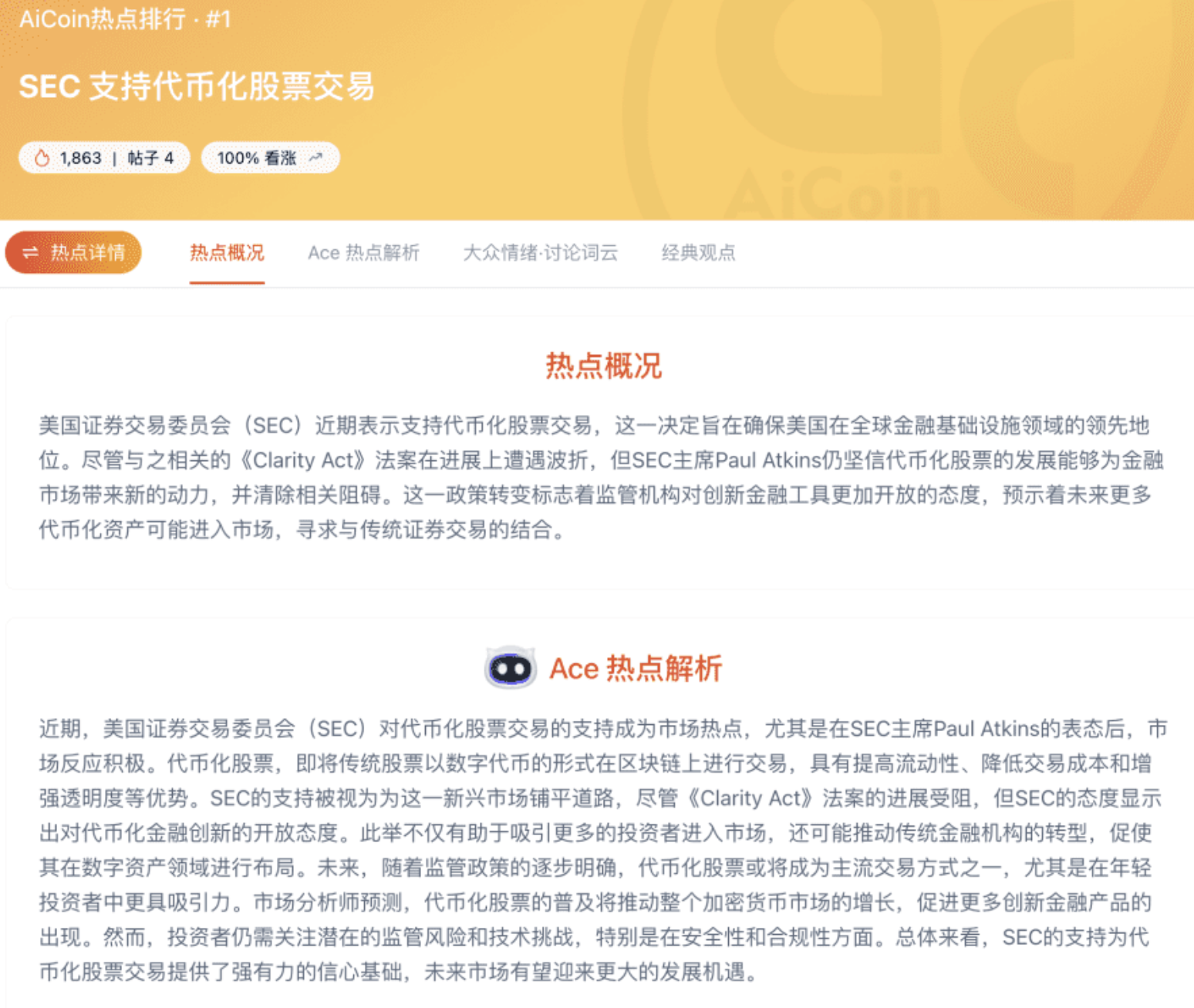
Yesterday, the SEC introduced a new regulation called Innovation Exemption. As soon as the news broke, eye-catching headlines flooded the internet.
There were claims that the U.S. has fully opened up stocks on the blockchain, that U.S. stocks are collectively embracing blockchain, and many even began to envision a future where all U.S. stocks could be traded freely on the chain.
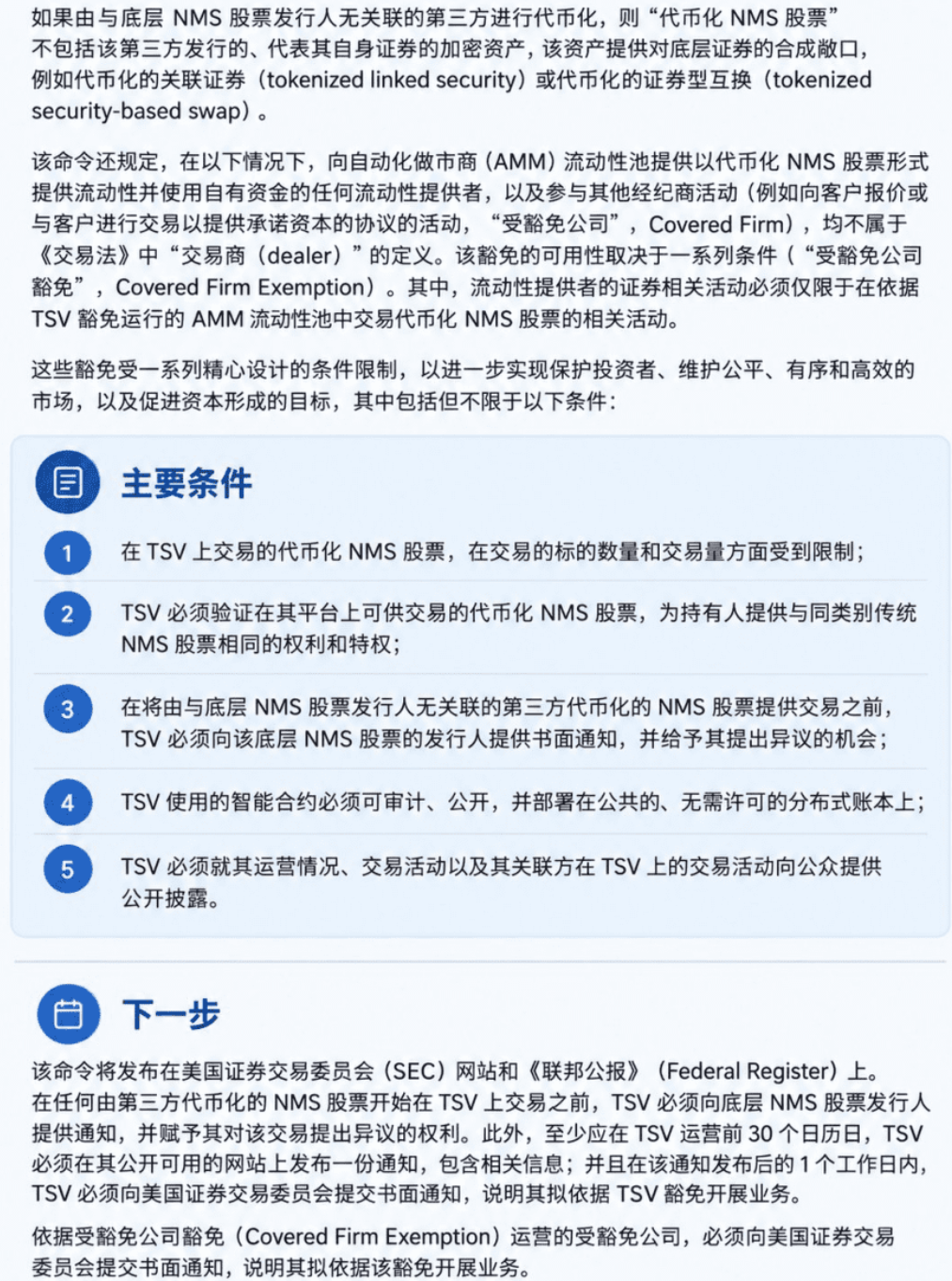
However, the truth is not as exaggerated as the headlines suggest. This time, the SEC is only providing a temporary, conditional experimental channel for qualified tokenized securities trading venues.
In simple terms, specific tokenized securities trading platforms can only trade tokenized NMS stocks on the blockchain after meeting certain standards. Three keywords must be remembered here: temporary, conditional, limited scope.
This is not a free pass; it does not mean that all U.S. stocks will be on-chain at once. This exemption is only valid for five years, and a more appropriate description is that the SEC has created an on-chain trading laboratory for traditional stocks.
Of course, there are many rules and regulations.
There are limits on the number of transactions and trading volume; third parties wanting to tokenize stocks must notify the underlying listed company in advance, and the company has the right to raise objections; if the underlying stock stops trading, the corresponding on-chain token must also be delisted.
One particularly crucial point: holders of tokenized stocks must enjoy the same shareholder rights as original NMS stocks.
It is evident that on-chain tokens remain dependent on traditional financial assets and have not escaped the jurisdiction of securities regulation.
Many newcomers easily confuse concepts: tokenized stocks do not simply mean wrapping a stock into a coin.
BTC is a native cryptocurrency asset; although tokenized stocks use blockchain as a carrier, they are still anchored in traditional securities.
Next time you see news like "some stock has gone on-chain," don’t rush to celebrate and focus on price. Think about a few more things: what rights correspond to it? Who is the issuer, and is the custodian reliable? Which regulatory jurisdiction does it fall under? How will the tokens be handled if the underlying stocks are suspended? When investing, details are the lifeblood.
So why is this worth our time to study?
In the past, there was a high wall between traditional finance and the crypto world. On one side were stocks, ETFs, and traditional exchanges; on the other side were blockchain, DeFi, and various crypto assets.
Now, this wall has finally been chiseled open a few small doors; although the scope of opening is not wide and there are many additional constraints. But at least it signifies that traditional financial assets have officially begun their on-chain testing phase.
Therefore, when assessing this situation, do not only focus on the hype of "stocks on the blockchain"; the key is to see if there are actual transactions, sufficient liquidity, and real users entering the market. At this stage, concepts alone are not enough; ultimately, everything must be backed by data.
Let’s look at a set of data from Binance Research’s report published on September 11 called "When Stocks Become On-chain Assets." Report link:
https://www.binance.com/en/research/analysis/when-stocks-become-on-chain-assets
There is a number that is quite impactful: 33 times. In January this year, the monthly trading volume for tokenized stocks was approximately 237 million dollars; by August, it had surged to nearly 7.9 billion dollars, with monthly trading volume increasing more than thirty-fold.
Looking at asset scale, the value of active tokenized stocks this year has increased by 314%, reaching about 4 billion dollars.
To be honest, 4 billion in the vast global stock market remains insignificant. Do not be misled by the 33-fold growth rate into thinking that stocks on the blockchain are about to overturn traditional finance; we are still far from that point.
However, it cannot be denied that tokenized stocks have moved beyond mere storytelling to real transaction implementation. This is also why, when looking at the RWA track now, data has reference value beyond just narrative.
To understand Binance's report, focus on three core indicators: market value, trading volume, on-chain activity.
The growth potential of an asset is not determined by how many tokens are issued. Even if thousands of tokens are issued all at once, if no one buys or sells, it remains stagnant.
Only when trading volume and on-chain liquidity truly take off does it represent real market participation.
In the future, when looking at RWA-related hotspots, be sure to dig into real data to see if there are actually users. Directions like tokenized stocks, RWA, and market structure can be distinguished by checking whether they are just weaving stories or creating real market demand with data.
Binance Research will continue to follow up on data related to crypto assets, RWA, and market structure. If you are already using Binance or just entering the crypto market, feel free to take a look; if you haven’t used it yet, it’s also worth exploring.
Recently, Binance launched a new batch of user activities, with low thresholds to conveniently grab some benefits. Benefit highlights: "Invite 1 person to receive a gift" + new user registration gift (up to approximately 28.8 U, plus other gifts like hairy crab vouchers and physical items, unlocked upon completing tasks, first come first served) Quick entry: click the exclusive link below to register for Binance and participate in the activity
https://jump.do/zh-Hans/xlink-proxy?id=3
(Invitation code: aicoin668, enjoy a 10% commission return)

Now turning back to macro news, yesterday the Federal Reserve raised the federal funds rate by 25 basis points, bringing the range to 3.75%-4%.
Many new friends hold the fixed mindset: interest rate hikes mean BTC will fall, and interest rate cuts mean BTC will rise. If market logic were really that simple and straightforward, then trading cryptocurrencies would have no secrets at all.
The essence of market trading is actually the expectation difference. This concept can be noted down.
For example, the market has generally anticipated a 25 basis point interest rate hike in advance. When the announcement is made that it is indeed a 25 basis point hike, the market may not necessarily crash just because of the word "hike." This is because this outcome has already been priced in beforehand.
What truly leads to significant market fluctuations is when the final announced result shows a clear deviation from the public's previous expectations.
In the future, when observing FOMC meetings, non-farm payrolls, CPI, and other critical data, do not solely focus on the price movement, but rather compare the actual results with prior market expectations.
By the way, gold has also shown strong recent performance. There are a multitude of variables affecting gold prices: interest rates, real interest rates, dollar strength, inflation expectations, risk sentiment, and continuous gold purchases by central banks. Therefore, an interest rate hike does not necessarily mean gold will fall.
People often like to compare gold with BTC, but the market characteristics of the two are vastly different. Gold has a long development cycle, and its overall volatility is relatively gentle; whereas BTC's price fluctuations are much more intense.
As for how BTC will move in the future, I will not give you a definitive short-term prediction.
Traditional finance is beginning to explore on-chain implementation, and the on-chain infrastructure is starting to accommodate more traditional assets; meanwhile, macro liquidity continues to influence the pricing of risk assets.
Let me reiterate: when encountering hot news, do not rush to make bullish or bearish judgments. First, clarify what exactly has happened in the event, whether there is real data support, which regulations delineate specific frameworks, and what signals need further verification.
Instead of trying to guess the next K-line direction every day, this method of analyzing the market is much more solid.
Here’s a simple news breakdown approach for newcomers. When you see hot news, first clarify what happened. Using the SEC incident as an example: it merely provided a temporary exemption for a specific on-chain securities model. Next, consider why the event is worth paying attention to: traditional securities are starting on-chain trading experiments. Then find corresponding supporting data: Binance Research indicates that the trading volume of tokenized stocks has significantly increased.
Finally, keep tracking these aspects: regulatory constraints, real trading volume, market liquidity, actual on-chain usage.
By analyzing a news item this way, you won't easily be led by eye-catching headlines.
Currently, there are live broadcasts every day; welcome to continue following AiCoin friends! Book in advance 👇
https://www.aicoin.com/zh-Hans/live/list?tab=upcoming
Join our community, discuss together, and become stronger together!
Official Telegram community:
AiCoin Chinese Twitter:
Aster Commission:
https://www.asterdex.com/zh-CN/referral/9C50e2
Hype Commission:
https://app.hyperliquid.xyz/join/AICOIN88
Binance Commission:
https://jump.do/zh-Hans/xlink-proxy?id=3
Invitation code: aicoin668
Coinbase Commission:
https://jump.do/xlink?checkProxy=true&proxyId=25
Invitation code: Y8L23JL
免责声明:本文章仅代表作者个人观点,不代表本平台的立场和观点。本文章仅供信息分享,不构成对任何人的任何投资建议。用户与作者之间的任何争议,与本平台无关。如网页中刊载的文章或图片涉及侵权,请提供相关的权利证明和身份证明发送邮件到support@aicoin.com,本平台相关工作人员将会进行核查。