Written by: Gemini, Deep Tide TechFlow
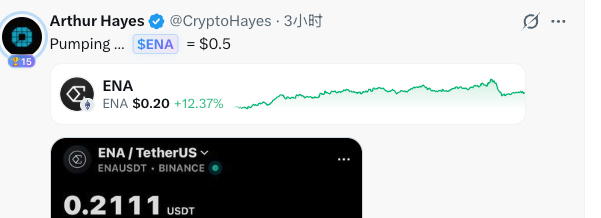
On September 20, BitMEX co-founder Arthur Hayes publicly called for a target price of $0.50 for the Ethena governance token $ENA.
After the statement was made, buying pressure in the secondary market quickly followed, and the spot price of ENA surged rapidly from around $0.17 to break through $0.21, with a daily increase exceeding 24% at one point.
However, before retail investors blindly chase the highs, they should first take a look at the bottom line and cost of the big funds.
According to on-chain analysis firm Arkham, Arthur Hayes had completed his position building a month ago. His associated wallet accumulated 25.33 million $ENA tokens at an average price of about $0.09, with a total expenditure of about $5.53 million. Based on the current market price, the unrealized profit of this position has reached as high as $3.28 million, with a paper return rate exceeding 146%.
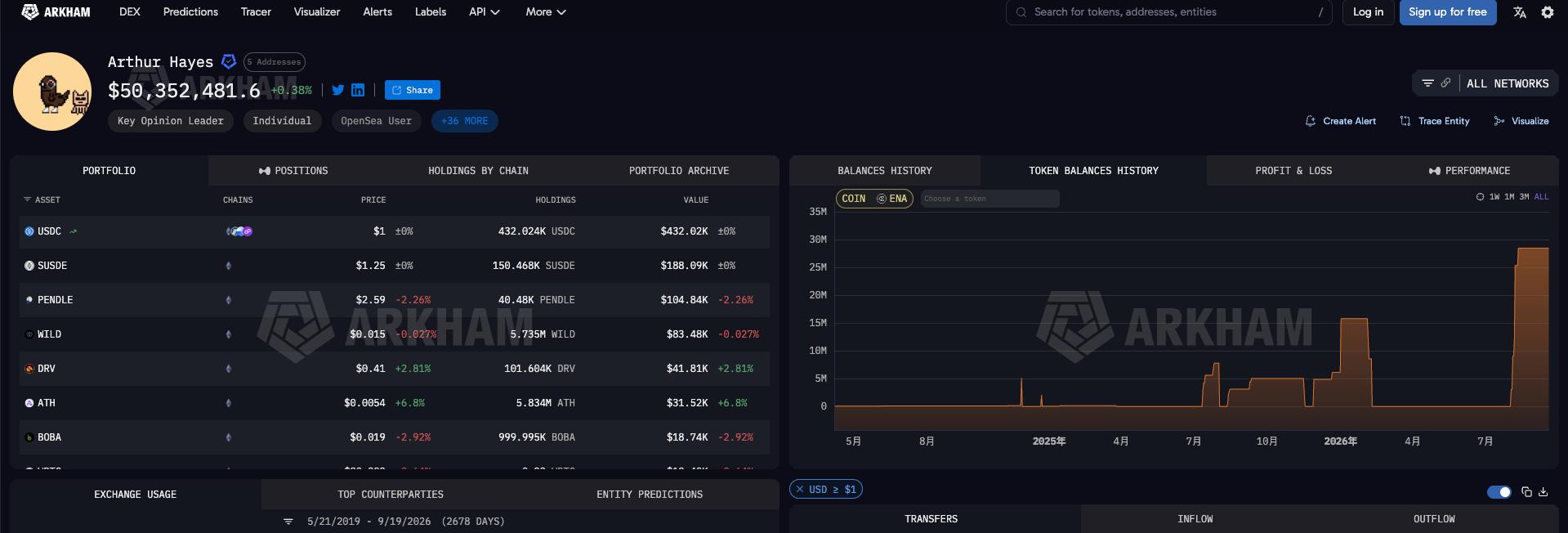
(Caption: Arkham's on-chain tracking shows Arthur Hayes' address holds 25.33 million $ENA, average price is about $0.09, unrealized profit exceeds $3.28 million)
When a big whale doubles their unrealized profit and makes a bullish call on social media, it is usually a highly dangerous signal in the cryptocurrency market. Many keen on-chain observers see this more as a form of selling. One community user pointed out that when a hedge fund trader holding tens of millions of low-priced tokens begins to sell high future profit expectations to retail investors, it often means they are looking for liquidity to exit their massive unrealized profits.
Not long after Arthur made the call, ENA faced a decline, further leading people to believe this was evidence of the whale selling.
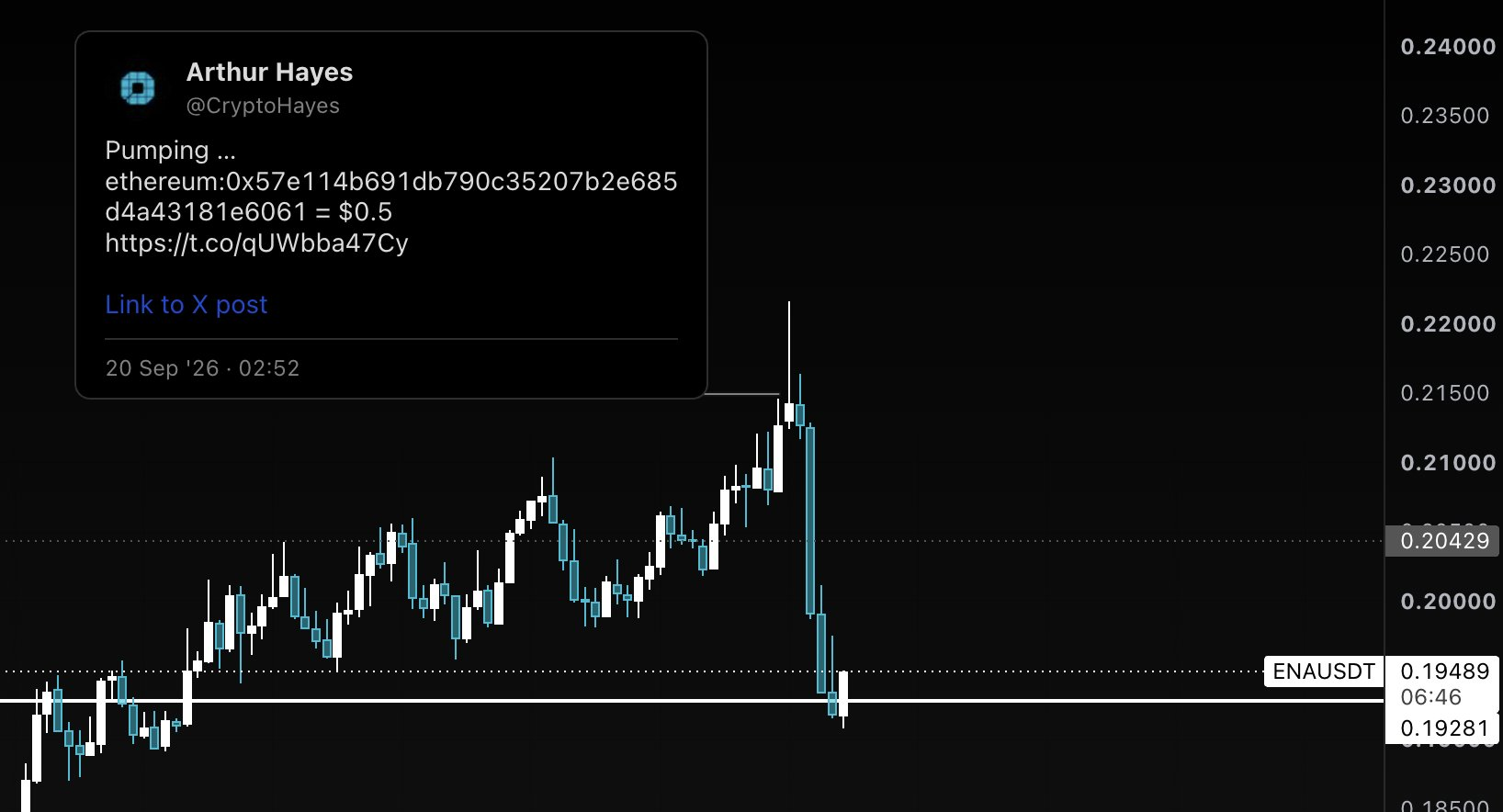
However, if we only understand this abnormal movement as a simple case of “high price calls looking for buyers,” we will also miss the narrative changes happening with Ethena or other similar structures of "old tokens."
This round of capital speculation on old tokens has favored those with actual revenue, positive changes in token structure, and certain fundamentals, with ENA being a typical representative.
Arthur Hayes' precise bottom fishing and high-profile statement coincided with the most aggressive change in token economics since Ethena's establishment. On one side is the hard-core reshaping of the fundamentals from a governance shell to a cash flow asset, while on the other side, there are structural hidden dangers as early tokens have not yet been fully cleared.
In this battle between bulls and bears, the logic of buying orders and the calculus of cashing out are fiercely clashing on the same asset, and this is what we should deeply investigate beyond the calls.
The foundation buys out early shares, but the selling pressure before October has not been eradicated
For a long time, the core pain point suppressing ENA token valuation does not lie in the scale of the protocol's business, but the substantial unlocks occurring monthly from the supply side have almost become a well-known challenge to the price.
For synthetic asset protocols managing billions of dollars, monthly unlocks are like a siphon hanging over the secondary market. Any valuation premium driven by business growth will be consumed in the continued expectation of inflation dilution.
This deadlock saw a change at the end of August.
An announcement previously released by the Ethena Foundation disclosed that the official used ecological reserves to buy out the locked shares of seed round early investors through over-the-counter transactions. For the early investors whose original allocation exceeded 0.25% of the total supply, the foundation implemented targeted identification and acquisition agreements; while the remaining locked shares that did not reach buyout agreements were required to be fully released before October 5, after which there would no longer be a long-term monthly unlocking schedule.
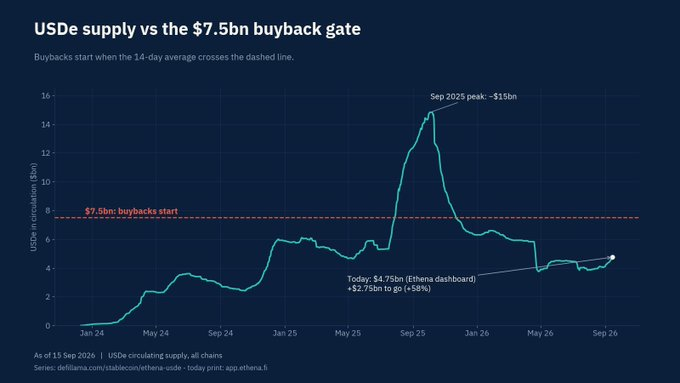
(Caption: Community researcher @0xsubwizard's on-chain analysis of Ethena Foundation's OTC buyout of early shares and adjustments in token economics)
This action, while theoretically severing a long cycle of bleeding, has the flip side of extremely frontloading the risk.
The early shares not bought out will be released before October 5, meaning that the secondary market must endure a sharp token liquidation pulse in the short term. In other words, the so-called vacuum period on the supply side is not expected until after mid-October. Before the large unlock takes place in early October, any violent rise devoid of actual buy-in power could easily become a golden window for early investors and large holders to escape at high prices.
95% net income buyback implemented, buyback narrative becomes a point of capital speculation
Aside from the changes in token structure, what truly gives bulls the illusion of valuation re-evaluation is the opening up of value capture channels.
In previous DeFi narratives, most protocols were trapped in the disconnection of "business booming, token price declining." Ethena's synthetic dollar USDe and investments in traditional U.S. treasury bonds USDtb have quickly expanded in scale owing to extremely competitive basis arbitrage and treasury yields, and successively secured a $1 billion financing support from FalconX and integration with BlackRock's Aladdin system.
However, regardless of how much the protocol earns upfront, ENA token holders have not economically gained any share, as the token's functionality has long been confined to "air governance" without substantial dividend rights.
The mechanism to change this situation has recently been the implementation of Ethena's governance proposal to use 95% of the protocol's net income for repurchasing ENA on the secondary market.
This plan constructs a closed-loop for on-chain value transmission: Users minting USDe and USDtb drive the protocol's asset management scale expansion; Ethena's short selling basis profit generated from hedging on derivative exchanges, combined with reserve asset interest margins, settles as net profit retained by the protocol; smart contracts will capture 95% of this net cash flow and directly execute timed buybacks on the secondary market, transferring the purchased tokens into the treasury or burning them.
After the entire mechanism runs smoothly, the pricing logic of ENA will no longer rely on pure emotions but shift towards the real cash flow discounting of the protocol. The governance proposal was ultimately passed with an overwhelming advantage of 14.1 million votes in favor and 0 votes against, far exceeding the 5 million vote legal threshold, indicating that large holders and market-making capital have reached a profit-sharing agreement on the fee switch.
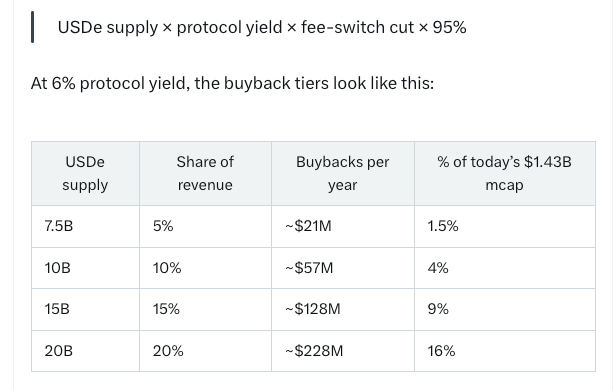
However, this seemingly perfect cash flow machine has an exceedingly fragile transmission shaft at its core: contract funding rates.
The core pillar of Ethena's underlying income is the bullish sentiment and positive basis in the derivatives market. Once the crypto market transitions into a deep bear phase and the perpetual contract funding rates turn negative, the protocol will not only be unable to obtain high basis profits, but may even need to use reserves to subsidize short hedged positions. Once the underlying income shrinks, the amount of buybacks at 95% net income will plummet, and the cash flow flywheel will stall.
Therefore, the survival of the protocol genuinely hinges on the overall market conditions in the crypto space. As long as the current market remains stable, there is still some narrative space regarding this real income story.
When the target is seen at 0.5, it cannot be fully believed
From an investment research perspective, Arthur Hayes' target price of $0.50 is essentially a sophisticated expectation management tactic.
My core judgment is that the massive chip barrier built by Arthur Hayes at $0.09 gives him almost absolute initiative. The space for a rise from $0.21 to $0.50 is a wealth creation blueprint painted for retail investors, but this does not prevent him from strategically placing liquidity into the buying pressure at any stage towards the target price.
For a whale that already has an unrealized profit of 146%, unloading at the peak of market sentiment is, after all, the most standard maneuver for hedge funds. We welcome his creation of buzz, but caution is needed to manage one's timing.
Thus, for keen players, the most critical action is to monitor his address (click here) to see if the actions match the rhetoric and provide reference for their own investment timing.
But aside from personal maneuvers and chip games, the asset attributes of ENA are indeed undergoing changes compared to other old tokens. The buyback of ENA tokens using 95% net income is beneficial for telling the story of real income. It is recommended to pay close attention to price changes leading up to the upcoming concentrated token unlock on October 5.
After all, the turnover and selling pressure of the large holders will provide the most objective answers.
免责声明:本文章仅代表作者个人观点,不代表本平台的立场和观点。本文章仅供信息分享,不构成对任何人的任何投资建议。用户与作者之间的任何争议,与本平台无关。如网页中刊载的文章或图片涉及侵权,请提供相关的权利证明和身份证明发送邮件到support@aicoin.com,本平台相关工作人员将会进行核查。


