Author: Jasper De Maere
Translation: Shenchao TechFlow
Shenchao Guide: Standing at the threshold of a possible new bull market, Wintermute believes that what is truly lacking is not money, but new channels that draw money into crypto assets. Stablecoins, ETFs, and DATs have all withstood cycles and have now become everyday conduits; on-chain tokenization (RWA) has attracted approximately $16 billion over the past 12 months, still a small scale, but if regulatory and collateral barriers are overcome, it may allow funds traditionally used for "buying apples/government bonds" to be placed in the same wallet and settled with stablecoins, making it easier to flow into BTC and altcoins.
As we face the potential upcoming new bull market, the question is: this time, which channel will bring in the pent-up liquidity? We believe RWA is the top candidate.
Bull markets are shaped by liquidity, and liquidity requires entry points. The crypto market has never automatically accessed the global liquidity cycle simply because "money exists"; it is only when an exciting new channel emerges that pulls money into this asset class that real participation occurs.
In the past, channels like stablecoins, ETFs, and DATs (digital asset treasury/corporate treasury coin-hoarding) have emerged successively, resulting in one-way capital inflows, pushing the market to reprice, and ultimately normalizing into everyday conduits—money flowing in and out as easily.
Now, the latest channels, ETFs and DATs, have completely normalized. The market is waiting for the next thing to drive the next bull market.
In each bull market, different channels grow, peak, and then normalize during the cycle reset:
- VC and ICO (2017/18): Fund capital and token sales carried the first wave of institutional inflow.
- Stablecoins (2020/21): A net issuance surpassing $120 billion in a single year built the on-chain dollar base to fund DeFi and altcoin cycles.
- ETFs and DATs (2024/25): Net inflows of $63 billion into ETFs and over $115 billion in treasury coin-hoarding primarily reprice mainstream coins, with limited spillover into other assets.
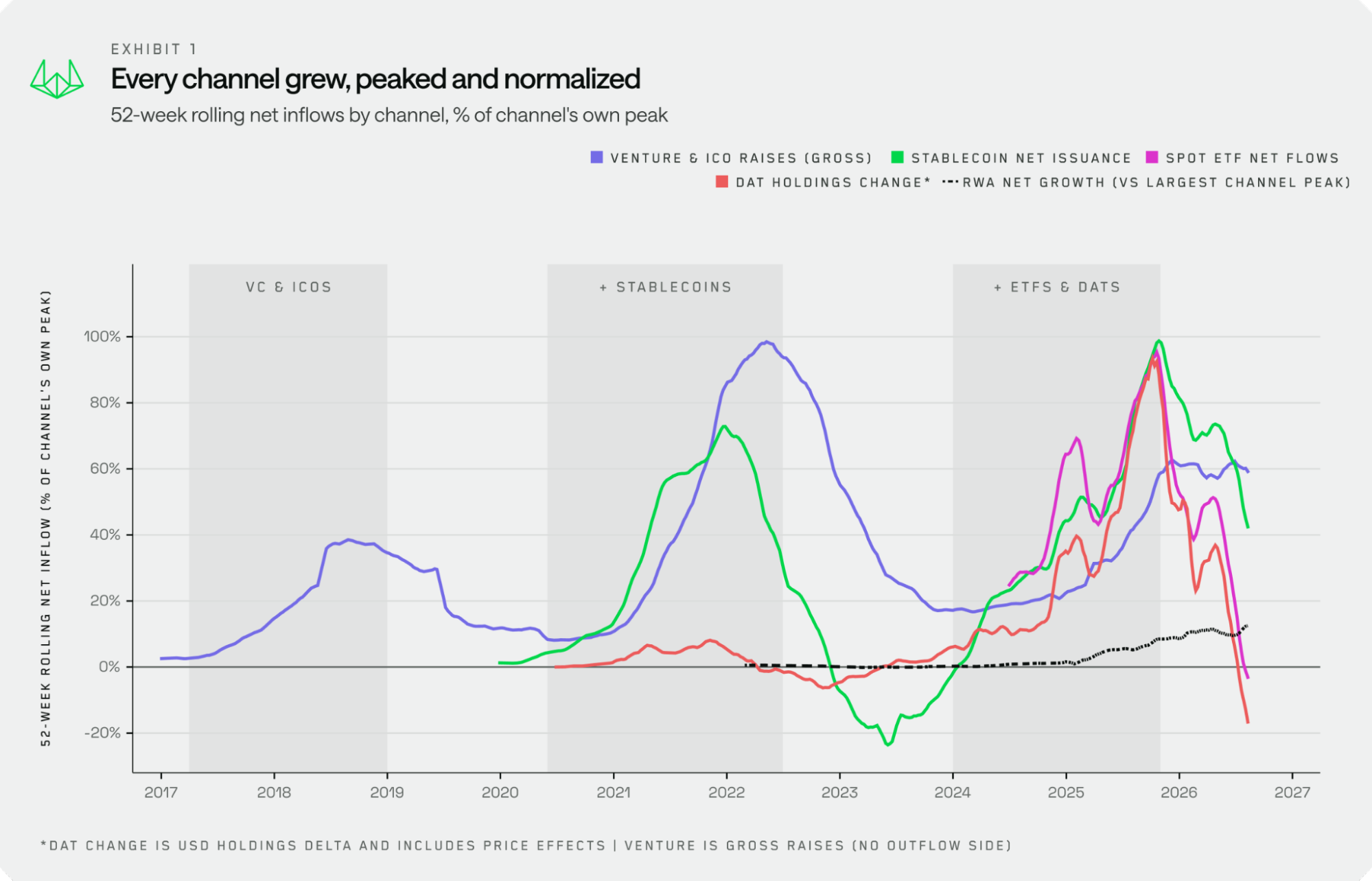
In Chart 1, the dashed line represents the fifth channel that is taking shape. The net growth of RWA is still small compared to the peaks of previous channels, but it is the only line still rising while other channels are retreating. Below, we explain why we believe it can become the next significant channel.
In every bear market, channels see a depletion of inflows. Chart 2 shows that each cycle is primarily supported by one channel, with total peak inflows reaching approximately 12% (2021) and 10% (2025) of market capitalization.
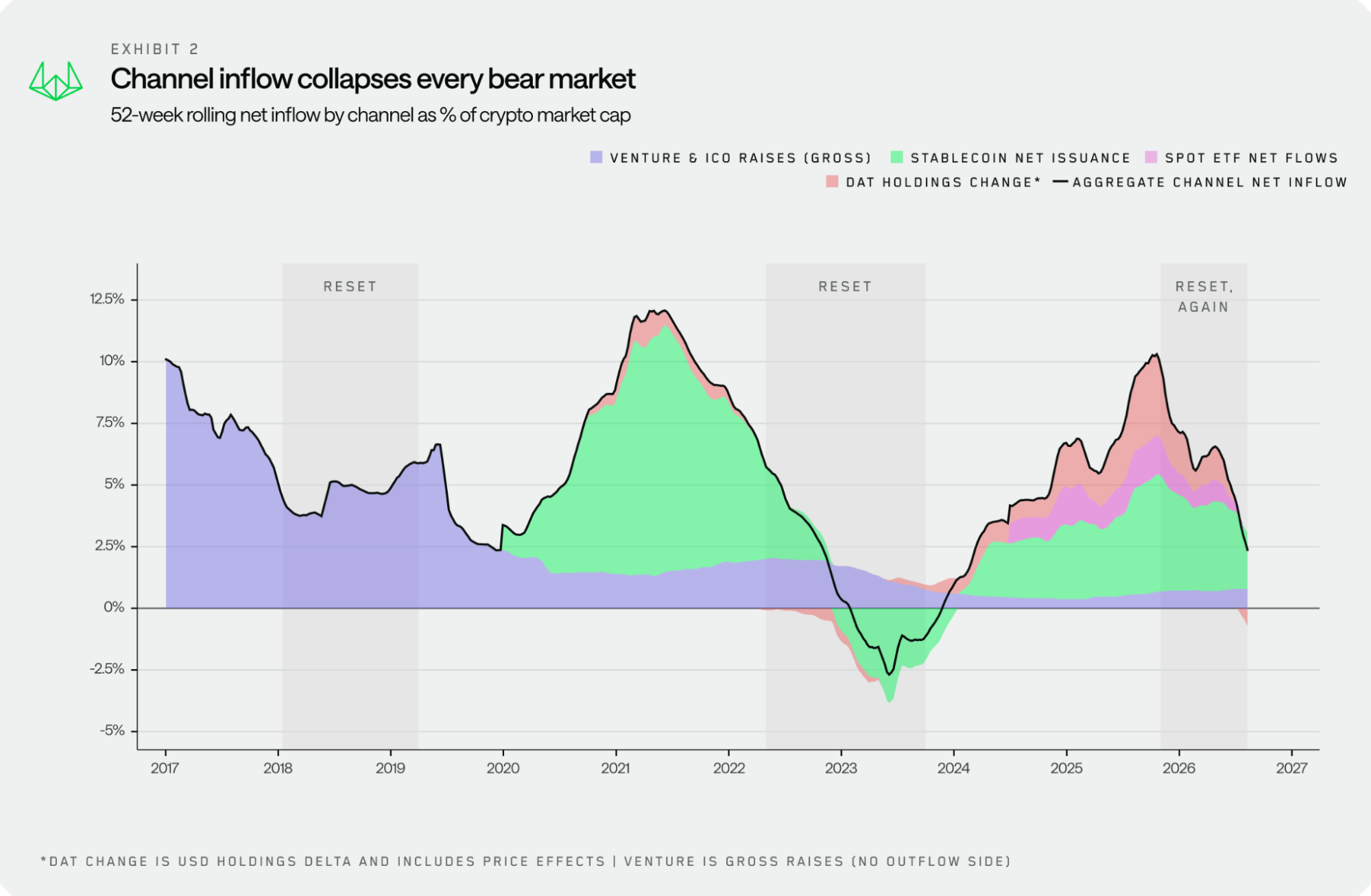
When that channel normalizes, inflows will collapse to zero. At recent lows, total inflows were only around 2.4% of market capitalization: ETFs turned into net outflows, a large number of DAT transactions were near or below net asset value, financial leverage attractiveness was stripped away, and stablecoin supply experienced the steepest contraction since the Terra collapse. In the past two weeks, these inflows have started to recover from the bottom but remain only a small fraction of previous cycle levels.
This collapse is the norm. In past resets, the next channel often began to ramp up when old channels were retreating. This time, the emerging channel is still an order of magnitude smaller and cannot bear the full load. Whether it can grow will determine the quality of this cycle.
RWA is often described as "bringing assets on-chain." We believe it is also about "bringing liquidity in." On-chain tokenization has increased in value threefold over the past year, reaching the $30 billion range, and has continued to grow during the same months when stablecoin bases were contracting. The barriers between tokenized assets and crypto-native assets are thinning as funds flow more freely between the two.
Today, tokenized stocks, tokenized funds, and crypto assets are increasingly residing in the same wallet and settling with the same stablecoin (stablecoins act as the exchange mechanism). This interchangeability transforms tokenization from "asset migration" into "liquidity channels," and we believe it may become the conduit for the next cycle.
The difference from previous cycles lies in how money comes in. Earlier channels directly sent buyers to specific assets: VC/ICO for new coins, stablecoins for DeFi and altcoin ecosystems, ETFs/DATs for mainstream and blue-chip altcoins.
Tokenization is different. The money buys apples or a government bond fund, not crypto assets. But since the money is already on-chain, moving capital into BTC or altcoins becomes much easier.
Previous channels pushed capital into specific assets; tokenization first places fresh capital into the internal system, which can then be allocated more freely. The short-term impact will be quieter than the inflow on ETF listing day. However, over time, these balance sheets will be deployed in the ecosystem, and as the underlying infrastructure matures, friction will continue to decrease.
Over the past 12 months, RWA has attracted about $16 billion, approximately one-tenth of the best 12-month inflows for ETFs and DATs in the last cycle. This channel is still in a climbing phase.
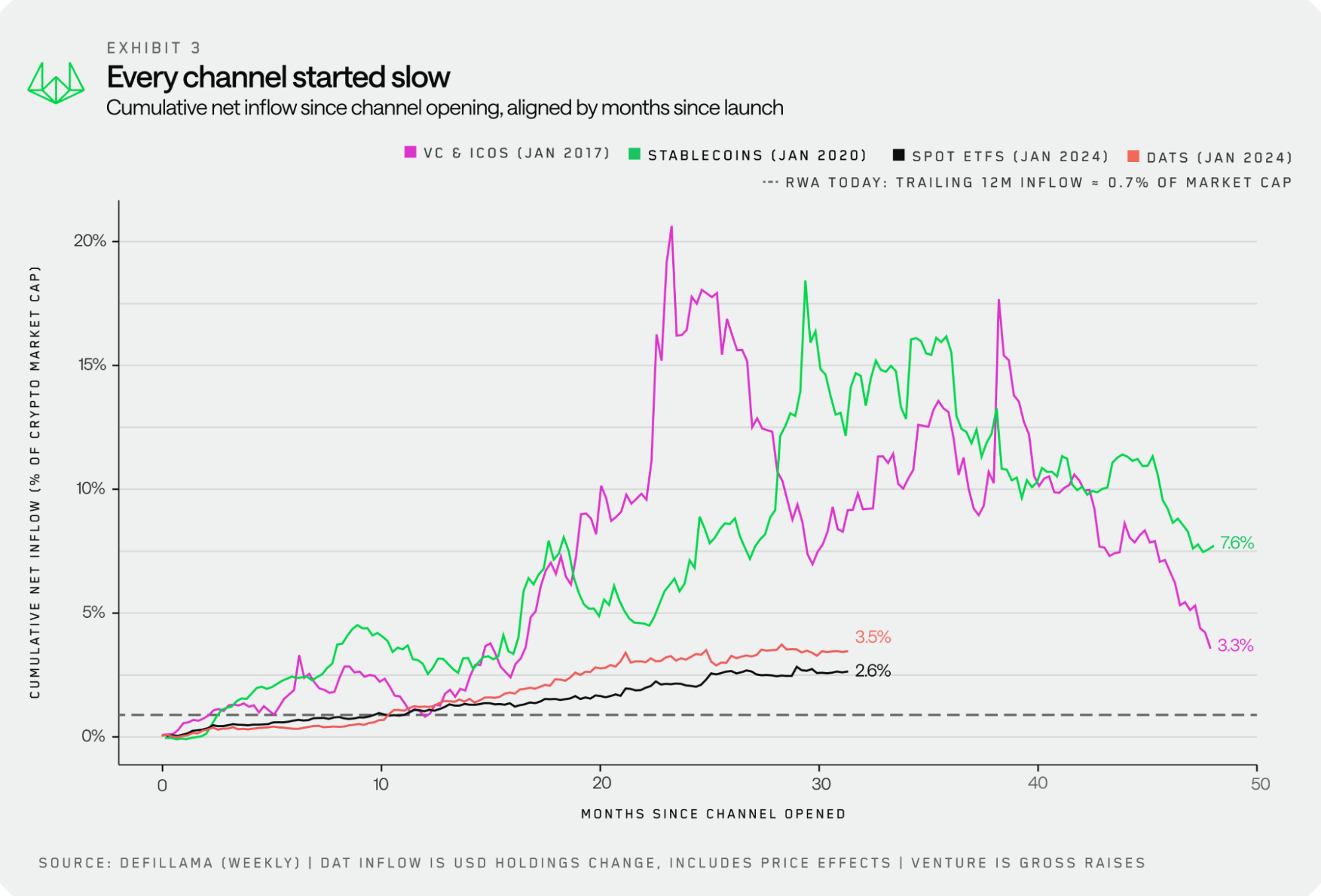
Chart 3 shows that for each channel, peak inflows usually occur 20 to 60 months after reaching measurable scale: ETFs peak around 20 months, stablecoins around 33 months, and VC and ICO around 54 months. By this metric, the RWA channel is approximately 18 months old, with trailing 12-month inflows about 0.9% of market capitalization, performing faster than DAT but slightly slower than ETFs during the same age. This is early, not a failure.
So far, most tokenized assets are still cash management products, government bonds, and money market funds, residing in permissioned packaging. The infrastructure connecting them to the rest of the system has only recently opened up.
Catalysts include both regulation and mechanisms:
- Regulation: Legislative structures for market structure and tokenization frameworks are broadening who can hold tokenized securities, and how they can be transferred, moving them out of closed permissioned pools.
- Mechanism: Tokenized government bonds and funds are being accepted as collateral by major venues and DeFi, transforming "idle cash" into usable working balances.
In 2024/25, liquidity will enter through packaging—holding ETFs and DATs for mainstream and blue-chip altcoins. BTC, ETH, and a few altcoins will be repriced. Aside from some narratives, the rest of the system has largely not received this money.
What tokenization changes is the entry point, not the destination. Funds first buy the packaging, then sit on-chain, and can be reallocated after friction decreases. The next two crucial questions are:
- Once RWA capital is on-chain, will it flow elsewhere besides packaging?
- If it moves, where does the value land? Which assets benefit, and which settlement tracks, collateral infrastructure, and DeFi primitives can capture the activity?
Understanding that tokenized assets are more held by balance sheets rather than traders is important. This makes liquidity and any cyclical effects more likely to accumulate slowly rather than through sudden shocks. The rhythm resembles a stablecoin channel rather than an ETF listing day.
In the past two weeks, inflows from existing channels, including ETFs and stablecoin minting, have recovered. This may support a rebound, but a complete cycle usually requires a new channel to bear the load. RWA is currently the only candidate still expanding.
We are closely observing whether tokenized balance sheets begin to move away from these packaged assets, emerge more in the form of collateral, and continue entering DeFi, thereby generating measurable flows in the secondary market and lending activities. That would signal the channel transitioning from "potential" to "operational."
免责声明:本文章仅代表作者个人观点,不代表本平台的立场和观点。本文章仅供信息分享,不构成对任何人的任何投资建议。用户与作者之间的任何争议,与本平台无关。如网页中刊载的文章或图片涉及侵权,请提供相关的权利证明和身份证明发送邮件到support@aicoin.com,本平台相关工作人员将会进行核查。


