

According to "Intelligent Emergence", touch intelligence company "Qianjue Robotics" (hereinafter referred to as "Qianjue") recently announced the successful completion of two rounds of strategic financing worth hundreds of millions. The latest round of investors includes BlueRun Ventures, funds under China International Capital Corporation, and Jingya Capital.
Previously, Qianjue had announced the completion of financing in the hundred million range, with investors including top companies in embodied intelligence, Tianji Capital, and Jide Electric. Currently, Qianjue's shareholder lineup has gathered well-known financial investment institutions such as Hillhouse Venture, Yuanhe Origin, and Futeng Capital, as well as leading industry players in the fields of embodied intelligence and industrial sectors such as Ideal Auto and ZhiYuan Robotics, with multiple institutions continuously increasing their investments.
This round of funding will focus on the iteration and large-scale delivery of visual-tactile sensors, enhancing real interaction data collection, tactile simulation and dataset construction, as well as continuing to promote the research and development of tactile embodiment models and tactile world models, and assisting related technologies in their implementation in robotics, industrial, and consumer scenarios.
Qianjue was established in May 2024. In the two years since its founding, the company’s self-developed visual-tactile sensors have achieved mass production in the tens of thousands and have served over 300 paid customers, covering robotics, industrial manufacturing, consumer brands, and research institutions.
Tactile perception is becoming an increasingly critical perception increment within the embodied intelligence industry chain.
Visual perception can assist robots in environmental perception and target identification. However, when tasks progress to physical contact elements such as grasping, assembly, and inspection, information such as slipping trends, contact force, and changes in contact surface morphology cannot be fully obtained through vision alone. Therefore, tactile perception has become a key sensing ability for robots to understand physical contact and perform fine operations.
On the policy front, there is also an increasing emphasis on the tactile sector. The embodied intelligence industry development plan released by Shanghai lists visual, auditory, and tactile modalities as important means for embodied intelligence to acquire environmental information; the revised embodied intelligent robot industry action plan in Shenzhen for 2026 includes multidimensional tactile perception, high-precision visual, tactile, and force multimodal sensors, as well as the visual-tactile-language-action (VTLA) model as key technological directions.
However, there is a significant engineering threshold that obstructs the realization of large-scale applications of tactile technology beyond the need for robots to "have tactile perception."
A high-precision sensor prototype is merely the starting point. Once in a real operational environment, customers’ assessments of the product will shift from single-point performance to more complex engineering issues such as long-term use, batch delivery, and system adaptation. The ability of tactile solutions to truly enter robotics and production systems also depends on whether these issues can be continuously resolved.
For Qianjue, which has treated visual-tactile sensors as its core hardware, the next key focus is transforming the technical capabilities developed in the lab into scalable and reproducible product capabilities.

Breaking Engineering Barriers, Uniting"Hardware - Data - Model"Flywheel
The basic principle of the visual-tactile sensor is to record the microscopic deformation of a flexible contact interface under load using a miniature camera, and then use algorithms to extract information such as force, motion, sliding, and surface morphology from image features.
Producing a high-precision sensor in the lab is entirely different from achieving large-scale delivery; it not only requires simultaneous handling of materials, optics, mechanics, and algorithms but also, during the delivery phase, various variables such as manufacturing processes, calibration efficiency, batch consistency, material lifespan, and supply chain stability become crucial determinants of whether the product can continue to be delivered. According to Qianjue, its products have already gained recognition in practical validations with multiple customers.
According to extreme condition test results disclosed by Qianjue, its visual-tactile sensors have achieved cross-individual consistency and repeat consistency rates of97%, with a contact lifespan of5 million; in terms of environmental adaptability, the product meets the IP68 waterproof rating and has completed a 240-hour continuous underwater working test.
In response to these engineering requirements, Qianjue tackles them from the bottom layer of hardware. The company adopts a three-color light visual-tactile solution, which can simultaneously output multidimensional tactile, motion, sliding, and three-dimensional morphological information, and is currently entering the stage of large-scale production.
For Qianjue, the sensor is the hardware entry point for acquiring physical contact information. With the large-scale application of hardware, the next core task is to efficiently collect and continuously generated interaction data, and convert it into the foundation for robot perception and decision-making.
To this end, Qianjue independently developed the XTac UMI G1 wearable data acquisition device to collect tactile data during real physical interaction processes and build the TacVerse realistic tactile interaction dataset. At the same time, the company generates interaction data through tactile physical simulation platforms, which not only reduces the cost of real data collection but also scales up the data needed for training.
At the model level, Qianjue attempts to allow robots to further understand and utilize this tactile information.
The company's self-developed X-TouchMind V1 visual-tactile-language-action (VTLA) multimodal model integrates tactile perception into the entire process of understanding contact states, reasoning decisions, and generating actions; at the same time, it promotes the research and development of a tactile world model, hoping to predict the physical interaction results that different actions may bring.
From sensors, data collection to model training, Qianjue has constructed a continuous technical link: the front-end hardware determines the quality of tactile information input, the data system is responsible for consolidating real interaction experiences, and the model further learns to understand and make decisions in application. Additionally, the new demands generated by the model in real tasks subsequently guide the engineering iteration of foundational sensor hardware and data acquisition systems.
This front-and-back-end synergy forms the "full-stack capability" emphasized by Qianjue.

From Humanoid Bodies to Industrial Applications, Tactile Implementation in Diverse Scenarios
Beyond the technical link, Qianjue is also exploring the practical application boundaries of tactile capabilities through various types of customers.
In the field of embodied intelligence, Qianjue has established deep cooperation with ZhiYuan Robotics and has entered a stage of mass application. The visual-tactile sensors are directly integrated into the robotic system, participating in fine touch perception during dexterous hand operations.
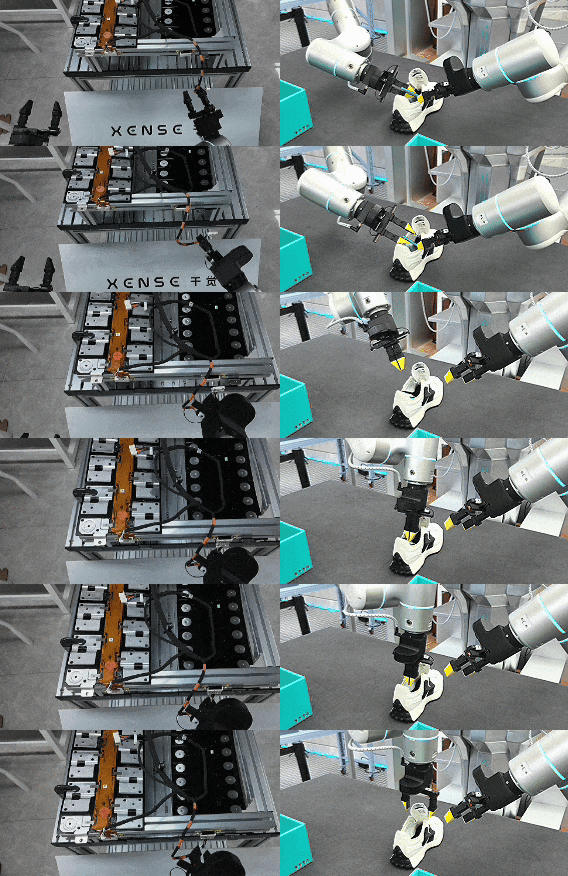
Meanwhile, Qianjue is also expanding tactile capabilities to industrial tasks beyond the robot body. The "Product Verification" of Dewu is a representative landing case in the consumer quality inspection field.
The authenticity of products is a crucial foundation for Dewu's quality assurance system, and the verification process plays an important role in its value chain. The AI identification robot jointly created by Qianjue and Dewu can complete insole positioning, non-destructive extraction, and replacement inside the visually restricted shoe body and uses tactile perception to acquire material and other physical information, then collaborates with Dewu's authenticity verification model to determine the authenticity of the shoe products.
In addition, Qianjue has also collaborated with a leading global medical group to verify the automation of dangerous drug preparationDemo. In response to the high risks of manual operations in the preparation of volatile toxic drugs, Qianjue utilizes tactile perception to grant robots more precise and flexible operational capabilities, enabling tasks such as smooth bottle grabbing, precise syringe filling, and gentle shaking, thereby verifying the feasibility of automated preparation of dangerous drugs.
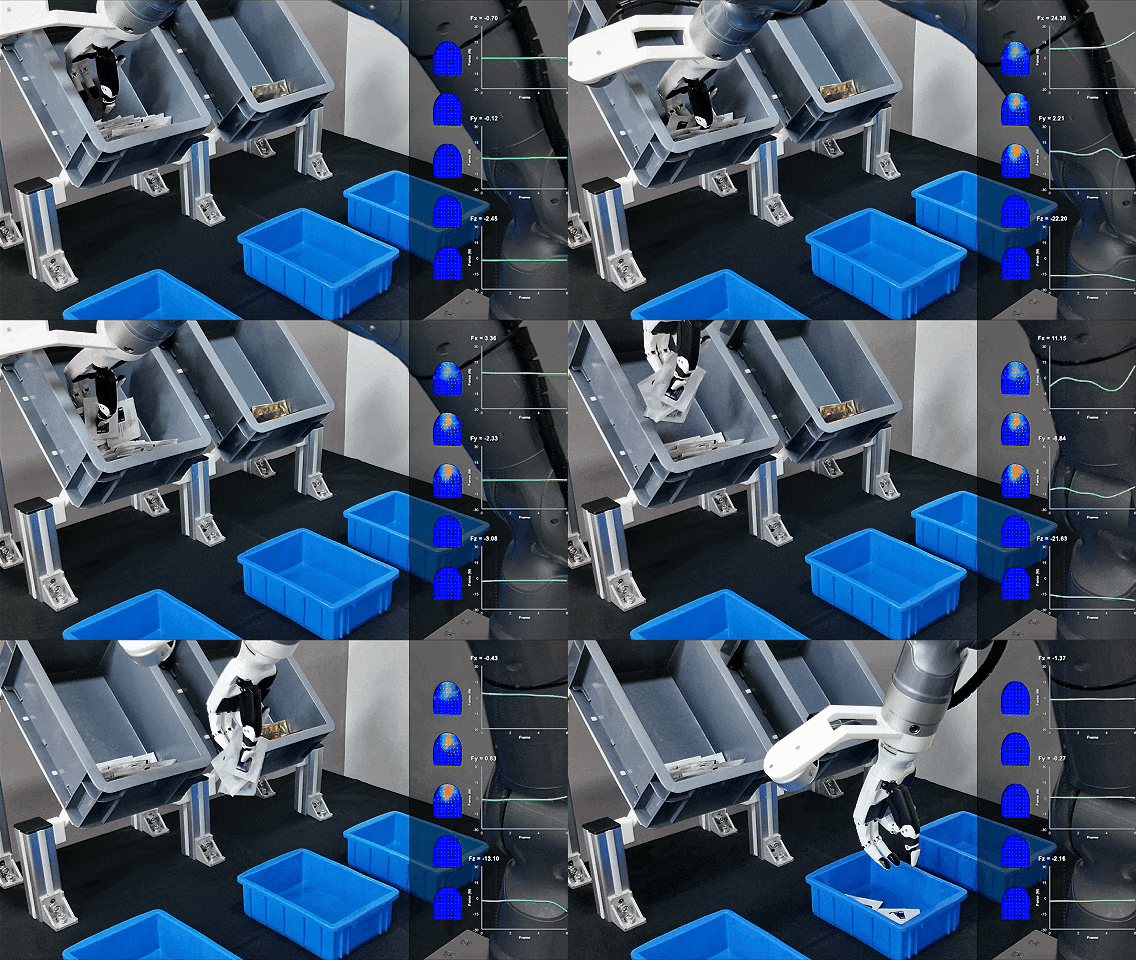
In addition to the above enterprises, Qianjue is also promoting the landing validation of embodied models in production line conditions in collaboration with CATL and is working with L’Oréal on specific logistics solutions. Covering entire machine bodies, new energy manufacturing, and consumer giants, these diverse scenarios not only expand Qianjue's commercialization boundaries but also provide continuous business needs and real data accumulation for its subsequent product and model iterations.

"Jiao Da + MIT"Background, Building a Full-Stack Team from Mechanics to Engineering
Qianjue's current technical route is closely related to the founding team's deep cultivation in the fields of physical mechanics and tactile perception over the past decade.
The company founder, Ma Daolin, is currently a professor at Shanghai Jiao Tong University, holding undergraduate and doctoral degrees from Peking University, and later conducted postdoctoral research at the Massachusetts Institute of Technology (MIT) under the guidance of scholar Alberto Rodriguez, who specializes in robotic manipulation and tactile perception (former MIT associate professor and currently head of Robot Behavior at Boston Dynamics).
In 2021, Ma Daolin won the unique best paper award at ICRA globally. Before founding Qianjue, his team had been conducting research in the field of tactile perception for over a decade, with related achievements once featured on the cover of the top international robotics journal IJRR.
Ma Daolin's long-term research on robotic dexterous manipulation and contact perception forms the physical basis of Qianjue's technological development. For visual-tactile technology, the interplay of material stress deformation, optical imaging, and algorithms for reversing mechanical geometric information is deep and interconnected; by the time it reaches the data and model stages, understanding physical laws further influences data acquisition architecture and model training paradigms.
Feedback from the investment institutions during this round reflects that investors' focus on Qianjue is not only on the tactile sector itself but also on whether the team can transform long-term research accumulation into industrial-grade products that can be delivered at scale.
BlueRun Ventures has been paying close attention to the process of robotics and artificial intelligence technologies moving from the lab to real applications. In their view, Qianjue's strengths lie in its long-term accumulation of tactile technology, as well as its capability to continuously solve complex engineering problems and advance large-scale product delivery.
As tactile technology begins to transition from the lab to industry, the evaluation standards also change accordingly. The investment team under China International Capital Corporation believes that the industrialization of tactile technology is moving from technological validation to large-scale delivery, with sensor mass production capability, supply chain collaboration, and an industrial client base becoming important supports for further enterprise development. Qianjue has already established a certain foundation in these areas and has gained recognition from several robotics and industrial partners.
Jingya Capital pays more attention to the synergy formed between Qianjue's sensors, data acquisition, and model research and development, along with the continuous validation brought by paying clients. In their view, as robotic applications extend to fine operations, companies that can continuously accumulate core technologies and respond to real customer needs will have greater opportunities to establish long-term advantages.
These judgments point to the same industry reality: when tactile technology moves out of the laboratory demo stage, the competitive barriers for enterprises increasingly manifest in engineering delivery, product consistency, and real customer ROI verification.
For Qianjue, after this round of financing worth hundreds of millions, the need is to continue proving the reusability of its full-stack tactile capabilities in more complex real tasks, further solidifying them into stable and reliable industrial-grade products and commercial monetization capabilities.
Image source |Company provided image
免责声明:本文章仅代表作者个人观点,不代表本平台的立场和观点。本文章仅供信息分享,不构成对任何人的任何投资建议。用户与作者之间的任何争议,与本平台无关。如网页中刊载的文章或图片涉及侵权,请提供相关的权利证明和身份证明发送邮件到support@aicoin.com,本平台相关工作人员将会进行核查。


