Author: 0xWizard
Translation: Deep Tide TechFlow
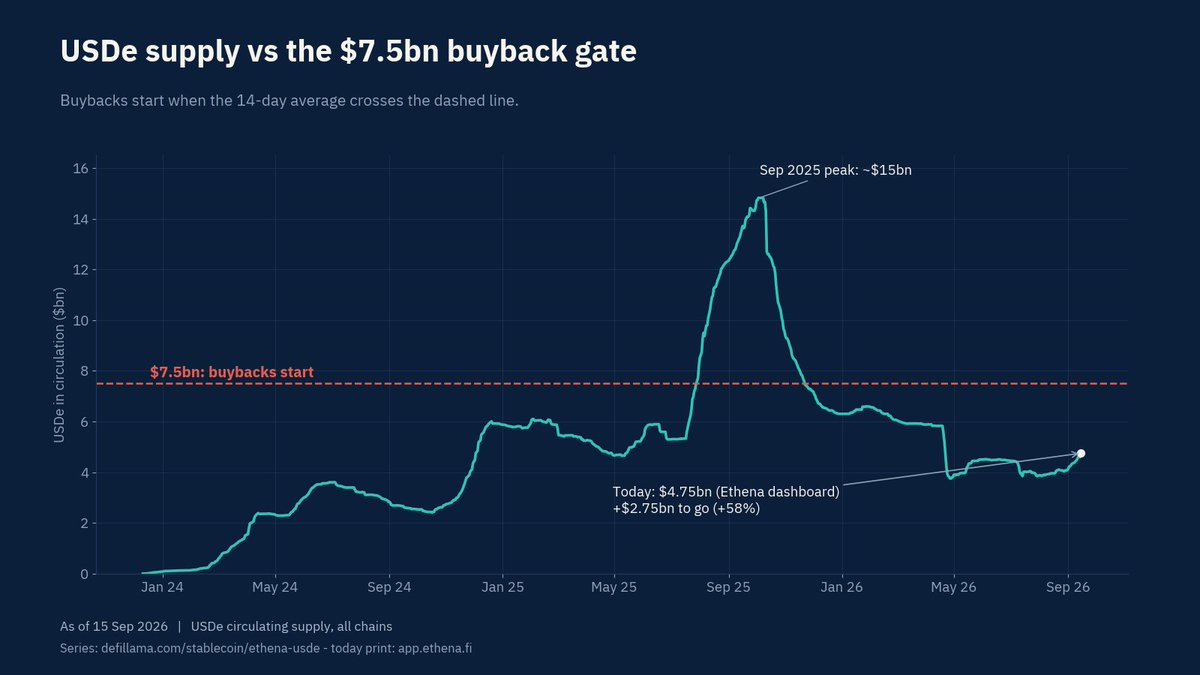
Deep Tide Introduction: Since its launch, Ethena has accumulated a total of 1.04 billion dollars in gains, of which 284 million dollars were contributed in the past 12 months (market conditions were not ideal). However, ENA holders have received nothing so far. On September 2, the governance vote approved the "fee switch": once the 14-day average supply of USDe exceeds 7.5 billion dollars, 95% of the gains routed through this switch will be used to buy ENA on the open market. The current scale of USDe is 4.75 billion dollars, still 58% lower than the threshold. The author believes that within the next 3 to 6 months, it will cross the threshold, driven by three major catalysts: stock perpetual contracts, positive funding rates for crypto, and the expansion of distribution channels.
Since its launch, Ethena has generated 1.04 billion dollars in gains, of which 284 million dollars were contributed in the past 12 months (market conditions were not ideal). However, so far, ENA holders have received zero gains from this.
But on September 2, the holders finally gained a path to this portion of the gains. The governance vote approved the fee switch: once the 14-day average supply of USDe exceeds 7.5 billion dollars, 95% of the gains routed through this switch will be used to buy ENA on the open market.
The current scale of USDe is 4.75 billion dollars, still 58% lower than the threshold. We believe it will surpass the threshold within the next 3 to 6 months, driven by three major catalysts:
- Stock perpetual contracts: A base book earning a funding rate of 15% to 20%, unrelated to crypto market conditions.
- Crypto perpetual contracts: Funding rates have recovered from negative territory, moving positively towards +8% levels.
- Distribution improvement: Ethena Pay, TRON deployment, and CEX collateral integration are all bringing USDe to potential new holders.
At the current valuation of 1.43 billion dollars, the pricing of ENA is about 5 times the fees charged in the worst year of the protocol. Once the fee switch is triggered, the situation changes: the "fee engine" that Ethena has built for two years will begin directly paying out gains to ENA holders.
Three Major Catalysts
1. Stock Perpetual Contracts
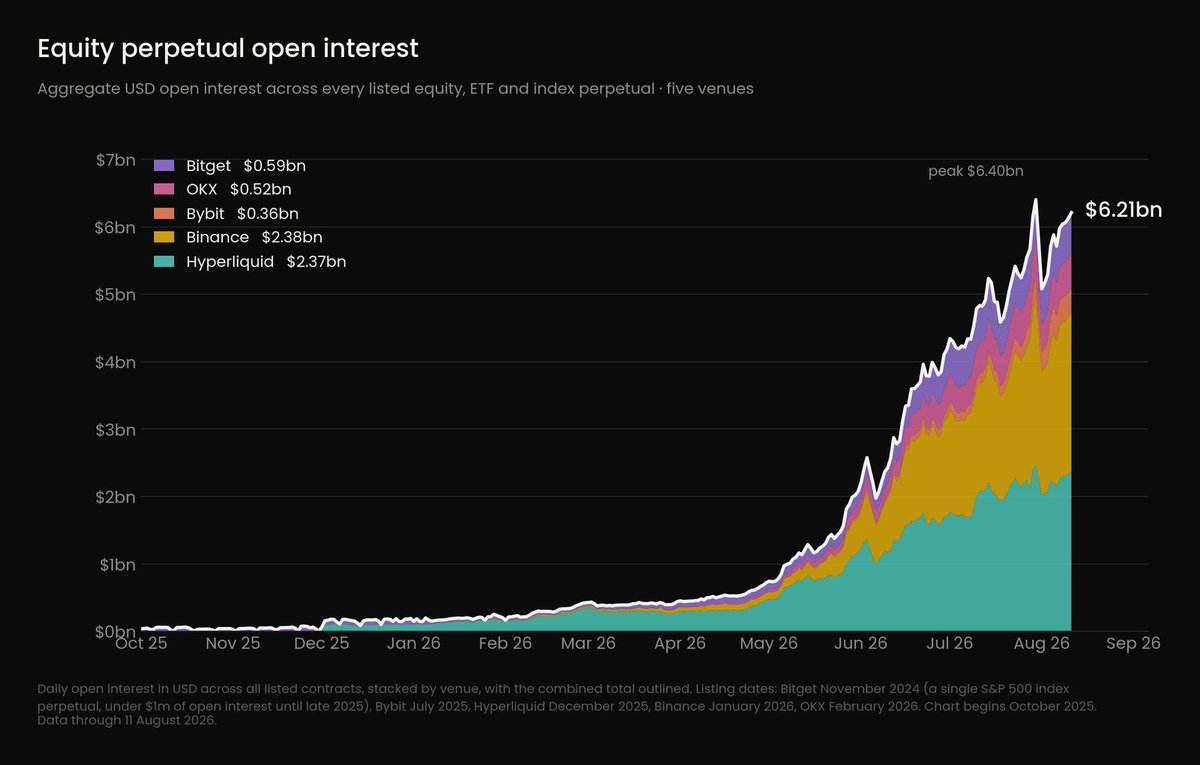
As of late August, the open contracts for stock perpetual contracts on major trading platforms reached about 6.2 billion dollars, roughly 10 times the level in March. In recent months, the funding rates for these positions have annualized at approximately 14% on Hyperliquid and about 17.5% on Binance, while ETH and BTC were only at 4% to 7%. The key point is that stock funding rates are unrelated to crypto funding rates: this is a source of gains that will be paid regardless of whether the crypto market is in a bull or bear phase.
On August 28, Ethena announced it would extend the endorsement of USDe to stock perpetual base trading, with the first batch of partnered exchanges expected to be deployed in the coming weeks. Ethena expects that RWA perpetual contracts will surpass crypto configurations within 12 to 24 months (currently accounting for 13% of endorsements).
If RWA perpetual contracts exceed crypto books with a funding rate of 15% to 20%, it could bring a combined gain boost of 2% to 3%. If this part eventually expands to half the size of endorsements, then just the stock leg could contribute 8% to 10% of sustainable gains.
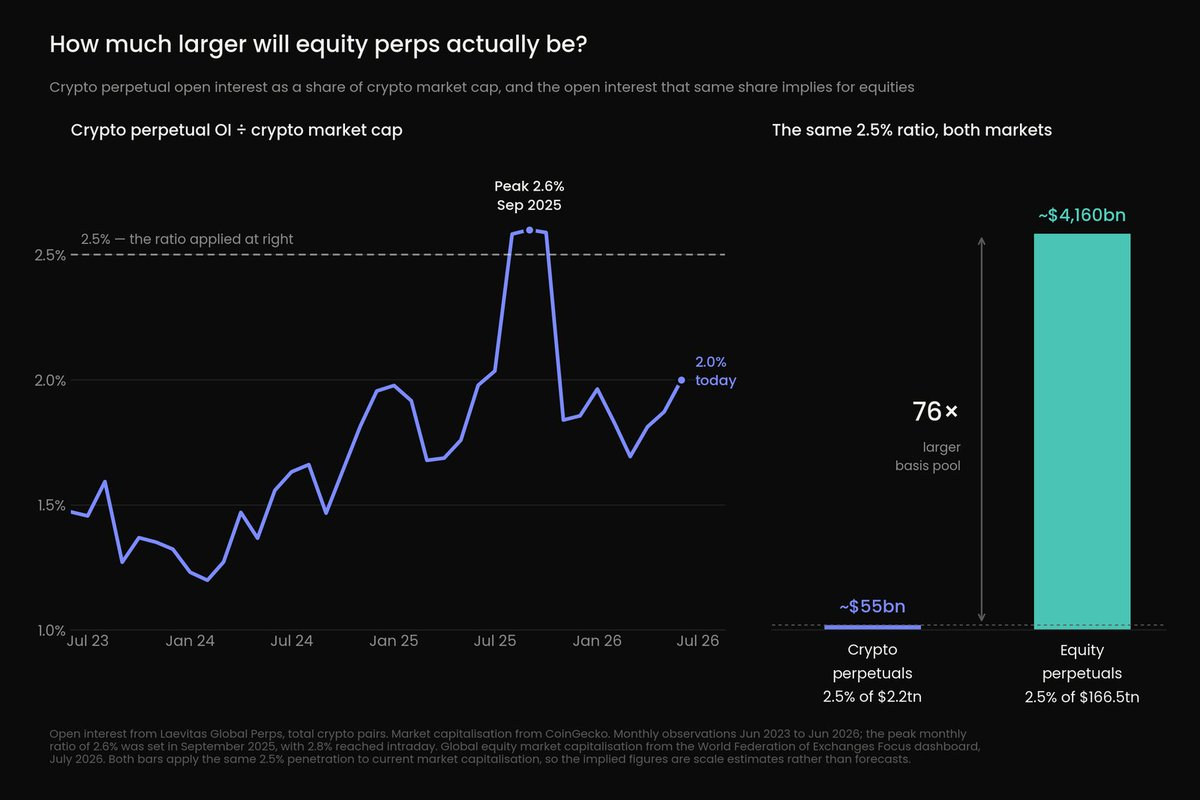
More importantly, the potential behind stock perpetual contracts is far greater than that of crypto perpetual contracts. By July 2026, the global stock market is expected to reach 166.5 trillion dollars, while crypto is about 2.2 trillion dollars. According to Ethena's own forecasts, the open contracts for stock perpetual contracts could grow to 40 trillion dollars, about 40 times the 110 billion dollar peak of crypto perpetual books. This is the same base trading, just scaled up by several orders of magnitude. Of course, a 40 trillion dollar market will not always pay 15% to 20% (as more capital enters, funding rates will be compressed), but depth is key. A larger, unrelated source of gains is what will pull the USDe supply towards the 7.5 billion dollar threshold, along with the power of the subsequent fee switch.
2. Crypto Funding Rates Have Recovered
From February to April 2026, crypto funding rates on Binance were in negative territory, with ETH averaging -4.0% in February, marking the weakest month since 2023. During this period, Ethena reallocated its endorsements from base trading to various DeFi lending, liquidity stablecoins, institutional lending, and RWA (until recently, only 1% of the USDe endorsement was base trading). Although the yields from these configurations were lower than 2024's crypto base trading, they provided stable returns of 4% to 5% for sUSDe holders when funding rates were not paying out.
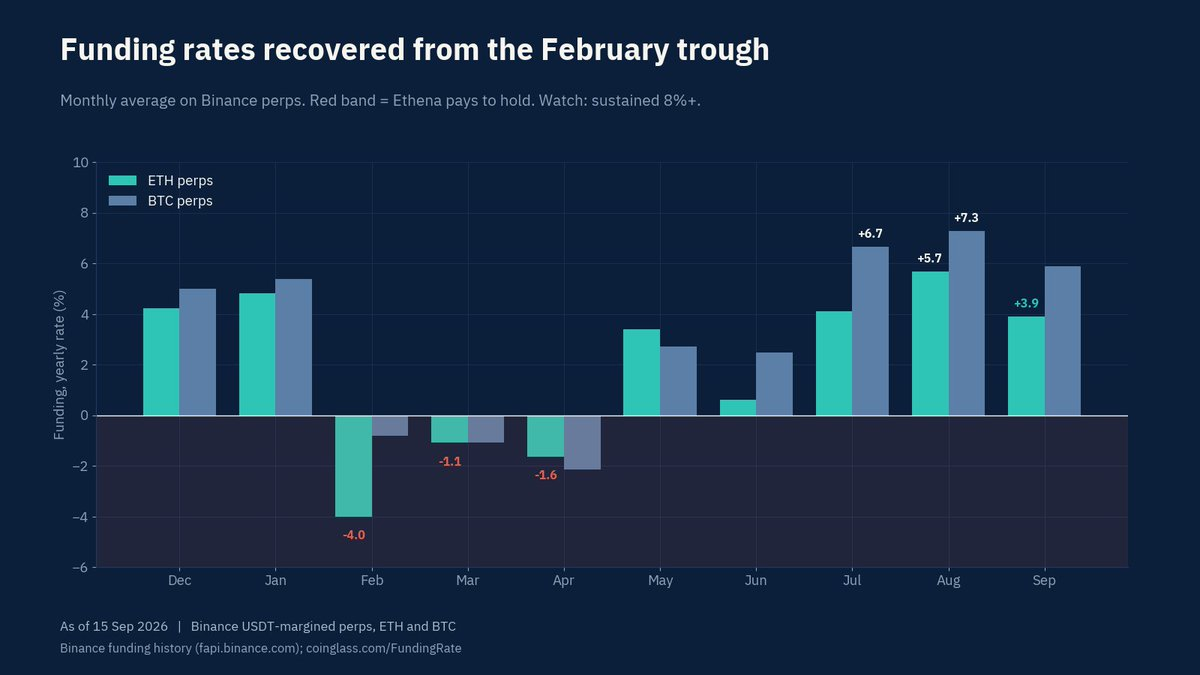
Fast forward to now, BTC is currently reported at 80,000 dollars, and funding rates have turned positive again, with August's ETH funding rate averaging +5.7% and BTC averaging +7.3%. As the market continues to warm up, Ethena is expected to redirect more book positions back to crypto base trading, replaying the script that enabled the USDe supply to reach 15 billion dollars from 2024 to 2025.
It is worth noting: Ethena's crypto base trading has now proven to possess the Lindy effect; it has survived historical liquidation events such as 10/10 and other generally poor market conditions, while smaller competitors have crumbled.
3. Distribution: TRON Launch, CEX Collateral
The gains themselves will not make USDe grow. People need a place to purchase and a reason to hold.
Traders can now use USDe as collateral on Bybit and Binance, and hold it on Bybit, OKX, Bitget, and Binance. Coinbase and Robinhood have already accepted it in their products (Coinbase Treasury, Robinhood Earn). USDe also launched on TRON on September 11, which is the chain with the largest stablecoin trading volume. Note that when a chain is truly important and growth strategies are executed properly, on-chain expansion is crucial (see how quickly USDe reached 300 million dollars after launching on Robinhood).
On September 1, Ethena launched Ethena Pay (@EthenaPay), led by @gdog97_ and @litocoen. Holding USDe can earn up to 6% on balances, and all spending can earn 5% cash back in AVAX, making Pay the perfect hook for attracting retail users to hold USDe. From September 1 to 9, on-chain card spending reached 632,000 dollars, with daily average spending rising from 16,000 dollars to 61,600 dollars. This is still a beta version (with only a few hundred non-US/EU users at launch), but it represents the first time ordinary users can hold USDe, earn returns from it, and spend with a card.
Given the success of EtherFi and Plasma's crypto card products, along with Ethena Pay's generous rewards (powered by @avax), this is expected to become one of the star products pushing USDe towards the 7.5 billion dollar mark.
Fee Switch
Once the above catalysts drive the USDe supply to exceed 7.5 billion dollars, the fee switch will be activated. A portion of Ethena's gains will begin to be used to buy ENA on the open market. The revenue share is as follows: at 7.5 billion dollars, 5% of the revenue will be taken, at 10 billion dollars, 10%, at 15 billion dollars, 15%, and at 20 billion dollars, 20%. Nearly all of this revenue share (95%) will be used for buybacks.
The buyback scale will expand with the profitability of the USDe reserve book. The protocol yield is the interest rate that Ethena earns on the assets backing USDe, so the formula is:
USDe supply × protocol yield × fee switch revenue share × 95%
At a 6% protocol yield, the buyback scales for each tier are as follows:
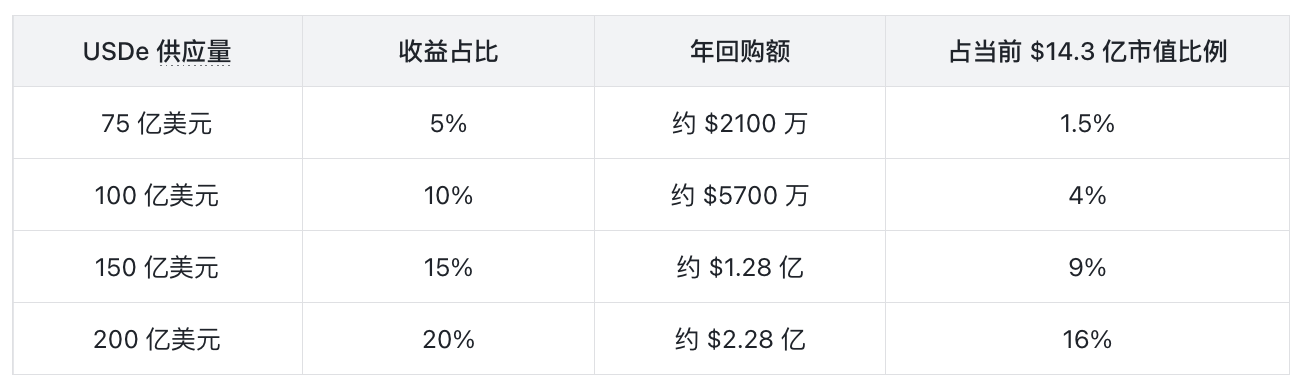
The first tier is small, but the 10 billion and 15 billion dollar tiers (USDe once reached 15 billion dollars in 2025) are key. 4% and 9% of the current market value will be used to buy the token.
Reference link: Ethena Foundation Announcement
Risks and Considerations
- Unlock on October 5: The token unlock for all VCs has been compressed to October 5. It is estimated to account for 14% of the circulating supply, approximately 200 million dollars at current prices, 17 months ahead of the original vesting schedule. The Ethena Foundation announced that they have bought out the locked tokens of those major seed round investors who sell ENA after October 10, 2025. This alleviates the supply pressure from large unlocks, but investors should remain vigilant.
- Negative Funding Rates: If the overall market stagnates and crypto perpetual funding rates turn negative again, the USDe reserves will again shift to low-yielding (4% to 5%) non-base trading pathways. This will suppress demand for holding USDe, especially for sUSDe and PT loopers.
- Small Scale of Stock Perpetual Contracts: If the deployment of stock perpetual contracts is delayed, the open contracts shrink, or stock perpetual funding rates fall to crypto levels, the effectiveness of this new non-crypto-related source of returns will be greatly discounted. The mixed sUSDe yield will remain in the single digits, which becomes a weaker argument for minting USDe to 7.5 billion dollars.
- Lending or Credit Crashes: A large portion of the reserves lies in DeFi lending (such as Aave, Morpho) and institutional credit (such as Maple, FalconX). A single exploit or borrower default could cut the endorsements and pause minting.
- Supply May Never Exceed 7.5 Billion Dollars: If the USDe supply remains below the threshold throughout 2027, then the fee switch will never activate, and ENA will just be a governance token.
Conclusion
Once the USDe supply stabilizes above 7.5 billion dollars, the fee switch will activate. Three new catalysts can push it there: stock perpetual contracts, positive reversals in crypto funding rates, and new distribution channels for purchasing and holding USDe (TRON, CEX collateral, Ethena Pay).
When @0xENAS published "Ethena: A Trillion-Dollar Crypto Opportunity" in October 2024 (which has unfortunately been deleted), that opportunity was the stablecoin market plus crypto base trading that pays USDe returns. Now this market is larger, and the distribution is better.
Everything in this article is a bet: betting that the catalysts mentioned can bring the USDe supply back to 7.5 billion dollars and continue to rise. If you don't believe this, then don't hold ENA. If you do, you know what to do.
免责声明:本文章仅代表作者个人观点,不代表本平台的立场和观点。本文章仅供信息分享,不构成对任何人的任何投资建议。用户与作者之间的任何争议,与本平台无关。如网页中刊载的文章或图片涉及侵权,请提供相关的权利证明和身份证明发送邮件到support@aicoin.com,本平台相关工作人员将会进行核查。


