Author: Josh Riezman, Slater Santer (GSR)
Translated by: Deep Tide TechFlow
Deep Tide Introduction: The model of low circulation and high valuation token issuance is being rejected by the market: the median price drop exceeds 80% within a year. This research by GSR dissects the root of the problem with data and provides several actionable alternative paths, which are valuable references for project teams and early investors.
Key Points
- The GSR research team collaborated with the consulting team to analyze every token listing on mainstream exchanges since 2013, covering over 2,300 issuances, including performance, circulation, FDV, and track information for each issuance.
- Since the ICO era, issuance circulation has halved. The median circulation at listing decreased from 38% in 2017 to 13% in 2020, and has only partially recovered since.
- As issuance valuations rise, median circulation steadily declines: 97% of tokens have an FDV of less than $10 million, while only 14% have an FDV exceeding $1 billion.
- Tokens issued at the billion-dollar level perform the worst. Tokens with an FDV exceeding $1 billion have a median return of -81% one year later. Issuances with circulation below 20% drop about 75% after one year, while those with circulation between 30% and 50% drop about 45%.
- This is no longer just a problem in the crypto space. The stock market has adopted the same pattern: companies remain private longer, insiders accumulate shares before public buying, and since 2019, IPOs have underperformed the market based on a three-year holding period.
- GSR is an active participant in token issuance and the secondary market. Our services include market-making and liquidity provision, issuance and listing consulting, as well as providing OTC execution and bulk trading for foundations, teams, and early investors, managing concentrated holdings.
The reality of low circulation and high FDV tokens has been validated hundreds of times. A token listed with a high fully diluted valuation and a very small circulation share may rise in the short term, but will inevitably continue to bleed overall. However, we wish to gain a deeper understanding of the dynamics of this process, both for our clients and for ourselves: does circulation determine the average return after listing, is there a correlation with FDV, and what might the solutions to this model look like?
The GSR research team collaborated with the consulting team to analyze every listing since 2013 on mainstream exchanges, creating the first dataset of its kind covering over 2,300 token issuances. The findings are not entirely optimistic. We tracked every token listing in history, meaning our dataset includes tokens that have died or been delisted, so these numbers are not beautified by survival bias. The median price of listings falls below the issuance price within 3 days, and drops by 50% within 90 days. Clearly, recent token issuances have disappointed buyers. Why does this structure inevitably lead to this result, and what might better issuances look like?
Circulation Halved, Valuation Not
The ICO era had many issues, but it put tokens in the hands of the public. The median circulation at first listing in 2017 and 2018 was 38% to 41%. As stricter regulations pushed fundraising towards private offerings, the model reversed: venture capital rounds determined valuations, loyalty and airdrop plans replaced public sales, and by 2020 the median circulation at listing had dropped to about 13%. Since then, it has only partially rebounded, staying mostly in the low teens to just above 20% range.
However, looking solely at circulation numbers underestimates the problem, because circulation must be assessed in conjunction with valuation. Releasing 5% of a token worth less than $50 million has far less impact than releasing 5% of a billion-dollar token.
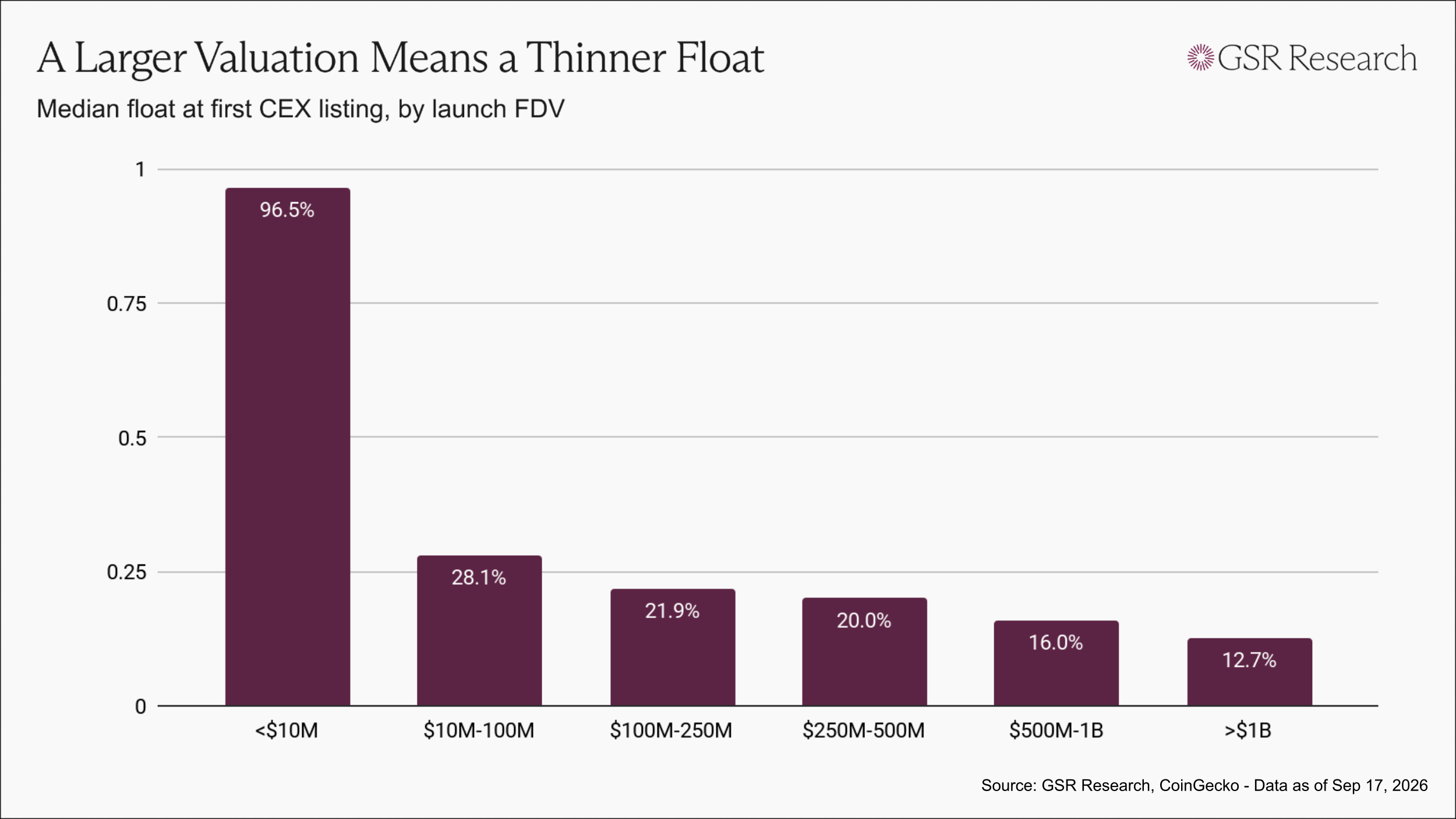
Median circulation at the time of listing steadily declines with rising issuance FDV: 97% for tokens below $10 million, 28% for those between $10 million and $100 million, 16% between $500 million and $1 billion, and 13% for those above $1 billion. The higher the valuation, the thinner the circulation. This is clearly not a coincidence, but rather a pattern solidified in our industry.
Why These Issuances Bleed
When only a small portion of the supply is in circulation, moderate demand can push up the entire token's value. All insiders in the issuance benefit on day one. Venture capitalists value based on the listing price, the team's holdings are valued at the listing price, and exchanges also list a star asset. The only participants benefiting more when the token price is low are the buyers.
Then the unlock timetable arrives, and the supply excluded from circulation starts entering the market according to a predetermined schedule, being sold at a price discovered by only a small portion of supply. None of this requires anyone to have malice. This structure itself guarantees that incentives will produce the same result.
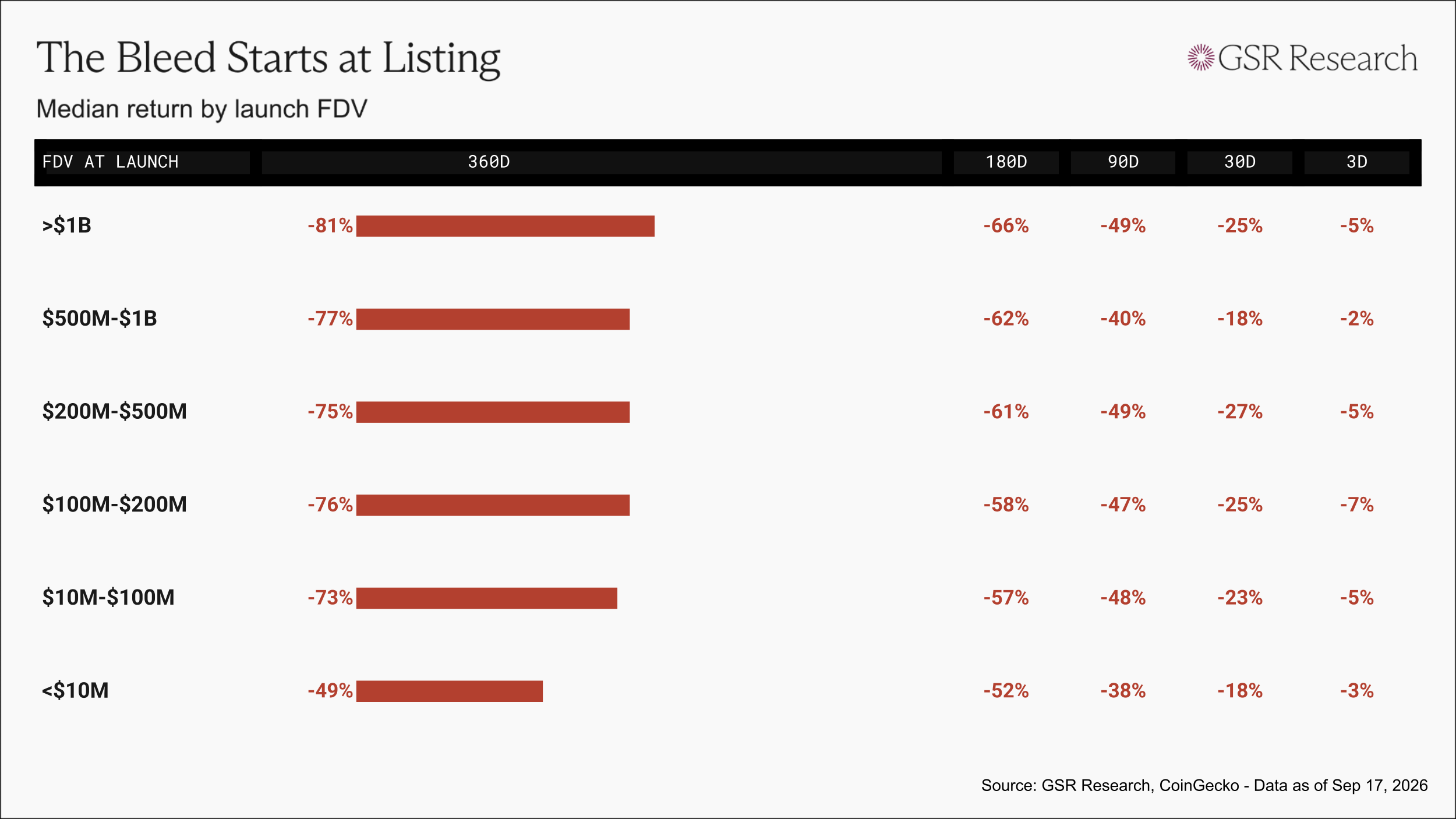
In our dataset, the median price drops below the issuance price within 3 days, declines by about one-fifth to one-fourth within a month, and nearly halves by day 90. Among project teams with an FDV exceeding $1 billion at listing, the median amount of dollars invested after 360 days post-issuance is just $0.19.
The Stock Market Has Also Caught Up
The low circulation high FDV model is often considered unique to the crypto space. However, in recent years, the public stock market has also drifted towards the same structure: companies like SpaceX have remained private for up to ten years, insiders and later funds accumulate shares in a rising valuation, ultimately releasing only a small portion of the company's shares to the public at the time of listing. Based on a three-year buy-and-hold strategy, every yearly IPO group since 2019 has also underperformed the market, with recent combinations being among the worst performers on record.
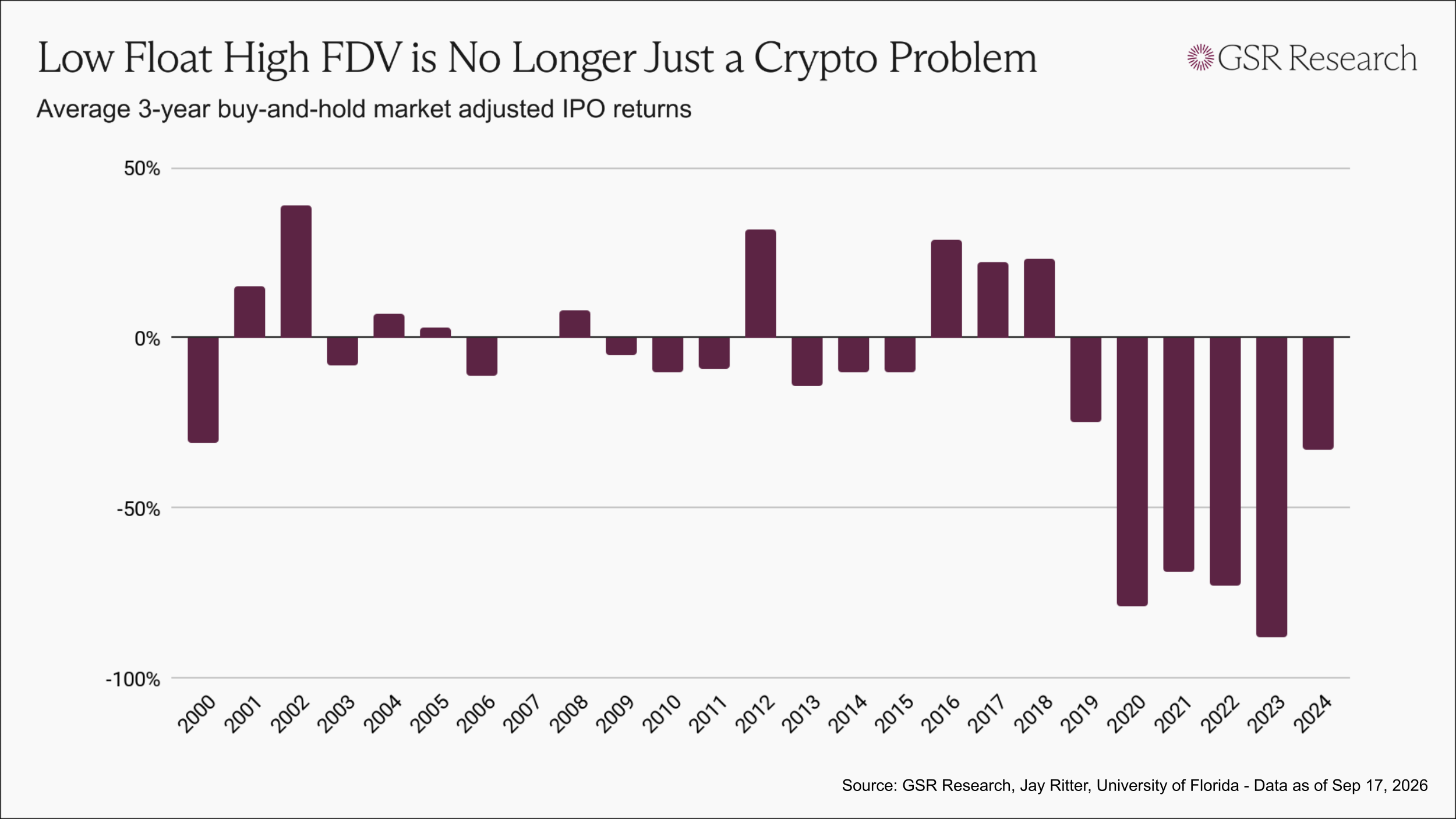
The issues with crypto issuance mirror modern IPO problems, just with faster unlocks and less disclosure.
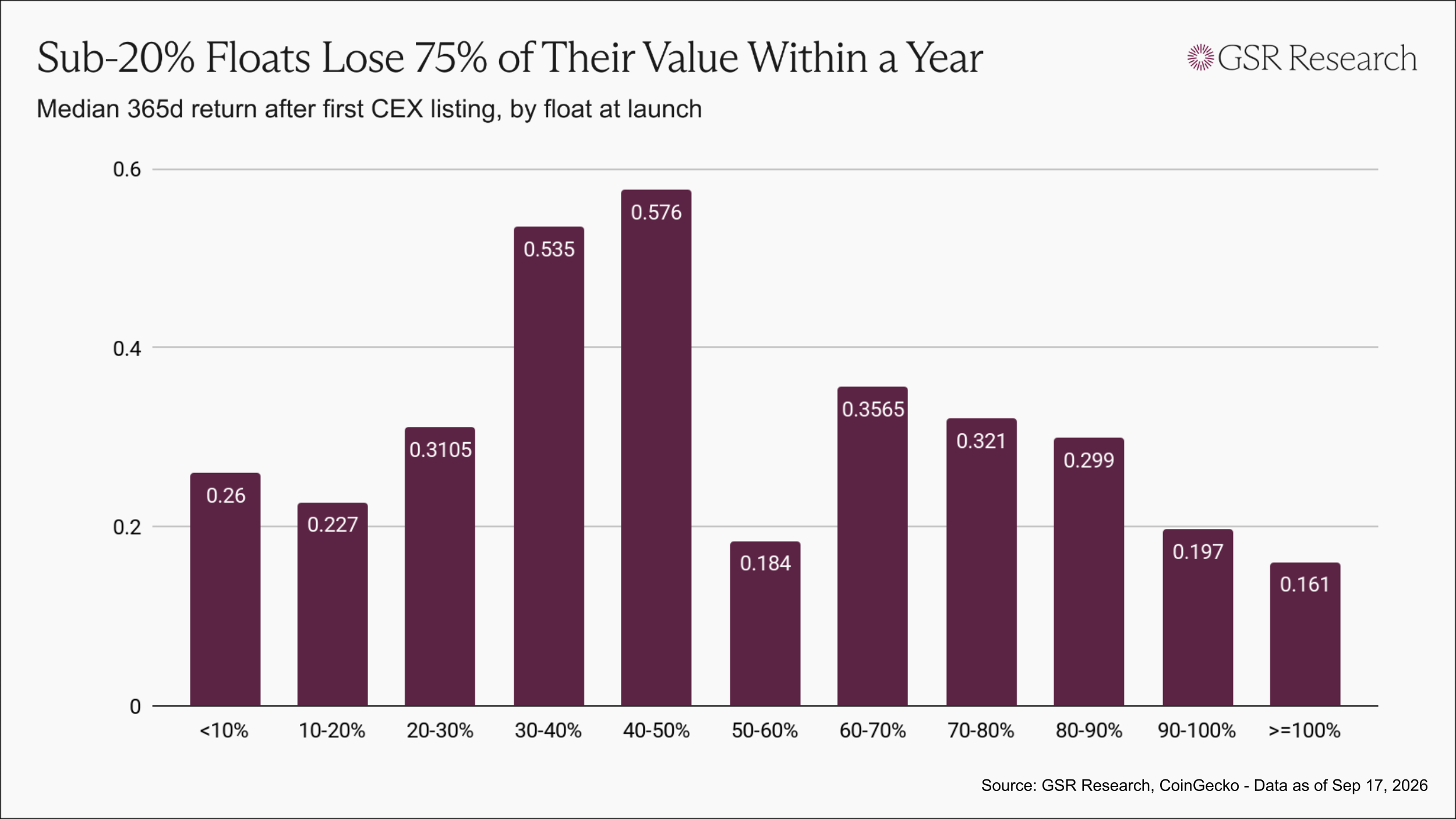
Within the crypto space, issuances with circulation below 20% retain about $0.23 to $0.26 per dollar after one year. Issuances with circulation between 30% and 50% retain about $0.55 per dollar, more than double that of the former. This relationship fails in the high-end range since nearly fully circulating issuances are mainly low market cap tokens and meme coins, but within the range of higher interest projects, circulation that allows broader distribution performs better than circulation designed to create scarcity.
What Might Solutions Look Like
There is no single solution, and we are skeptical of anyone peddling a one-size-fits-all approach. However, from our perspective of participating in hundreds of issuances, actionable levers are obvious.
First, issuance pricing should benefit both holders and traders. The lasting communities in this industry belong to a few assets that the public can buy early and at a low price. Simply put, if you can let your holders profit, you'll naturally build a community. Selling the first public allocation at the highest private valuation is exactly the opposite, as it recruits holders into positions that will only disappoint them. It also drives away traders. A token that continuously declines from day one provides traders with no actionable space: no two-way liquidity, no reason to build short-term positions, and no buyers when holders want to sell. These two groups are complementary. Traders provide the liquidity and price volatility that holders need, while holders provide the demand foundation that makes the market worth trading. An issuance priced only for insiders will simultaneously lose both. Projects should sell to the community earlier and at lower prices, rather than exposing the public to risk at the peak for the first time.
Second, supply enough circulation to allow for a more genuine price discovery. This ratio should be clearly higher than the low points of 13% to 20% from 2020 to 2022, and must be assessed in conjunction with valuation, not in isolation. For reference, a typical stock IPO usually circulates around 30%, and 50% is regarded as very high; in the crypto space, it's rare for major assets to have more than half of the circulation upon listing. The goal is to have enough circulation so that the opening price is meaningful.
Finally, expand the range and timing of participants. Both participation opportunities and circulation are equally important. We have seen recent development and popularity of co-investment platforms, allowing small funds to participate under venture capital terms, along with reputation threshold distributions for real users, public sale channels, on-chain auctions, and fully circulated fair issuance. Each method comes with trade-offs. But all of this is moving in the right direction towards broader participation.
Additionally, the legal and compliance environment has seen significant improvements. In Europe, MiCA has already allowed issuers to offer tokens directly to the public. In the United States, according to the draft of the CLARITY Act, it considers direct sales to retail investors with limits. If this bill passes, the narrative that securities law forces the adoption of private accumulation models will be greatly weakened, and the issuance structure will become a choice rather than a limitation.
How GSR Can Help
Every issuance is different. The stage, track, jurisdiction, venue strategy, community, and release design all affect what reasonable circulation and valuation should look like. The answer for a $50 million project is not the same as that for a $5 billion project.
GSR collaborates with token issuers, foundations, and investors to provide issuance and listing consulting, including circulation scale, valuation, allocation, and release design, while also offering listing market-making and liquidity services, as well as OTC execution and bulk trading services for participants managing concentrated holdings or releasing mid-sized positions.
Our industry has been learning the same lesson repeatedly. Projects that can establish a lasting base of holders will be those that set issuance prices such that the public can win, provide enough circulating supply for real pricing, and allow insiders to benefit in a slower manner: alongside the community, not ahead of the community.
免责声明:本文章仅代表作者个人观点,不代表本平台的立场和观点。本文章仅供信息分享,不构成对任何人的任何投资建议。用户与作者之间的任何争议,与本平台无关。如网页中刊载的文章或图片涉及侵权,请提供相关的权利证明和身份证明发送邮件到support@aicoin.com,本平台相关工作人员将会进行核查。


