Author: Claude, Deep Tide TechFlow
In the past few weeks, with long-established altcoins like ARB, NEAR, UNI, and ENA occasionally doubling in short-term rallies, the fervent sentiment of "altcoin season is back" has begun to spread across major communities. The flood of gainers on the screen can easily lead one to believe that the market is about to return to its peak.
However, when the timeline is extended, this enthusiasm immediately appears somewhat hollow. Those trapped at the highs last October may not feel the same way in terms of their accounts.
Jeff Dorman, Chief Investment Officer at digital asset management firm Arca, provided a very real statistical breakdown on Twitter today:
Using the last market peak on October 13, 2025, as a reference, out of the top 50 assets in the market, as many as 39 are still deeply entrenched in significant losses, with an average drop of 30%-50% from their previous highs.
A true bull market does not bring widespread blessings.
In this brutal game of existing assets, the very few that can cross cycles and break last year's old highs rely on emotions and promotion on one hand, and on the other, they depend on protocol income and token deflation mechanisms, carving out independent bullish trends.
This week's big rise doesn't fill last year's hole
Just looking at the rebound since July 1 of this year, the data is indeed enough to sustain a wave of FOMO on social media: ARB has risen from its low by 177%, ENA has increased by 132%, and even the PUMP from an established public chain ecosystem recorded a gain of 213%.
But this feeling of "making a lot" is merely because they previously fell far too harshly.
If we change the reference point to October 13, 2025, which is the absolute high of the last major market, then the picture changes:
ARB is still down 40.81% compared to then, ENA has dropped 64.61%, and although RAY has recently surged by 161%, it still shows a drop of 21.91% from last October.
Not only altcoins, but also the core assets of the market have failed to rewrite this brutal bill.
Looking back at the peak of the last cycle, Bitcoin touched an all-time high of about $126,000 in October 2025, but subsequently plummeted, dropping to around $90,000 by the end of Q4 2025, and at the start of 2026, even breaking below the $60,000 mark.
Against the backdrop of significant macro liquidity contraction, mainstream assets are experiencing blood loss across the board. Dorman's comparison chart shows that BTC is still down 30.69% compared to October 13 of last year, ETH is down 39.95%, and SOL is down 48.19%...
The last number means that even if SOL doubles from its current price, it would just barely break even.
The illusion many retail investors have of "feeling like there's been a rebound" starkly contrasts with the real balance shrinking in their accounts.
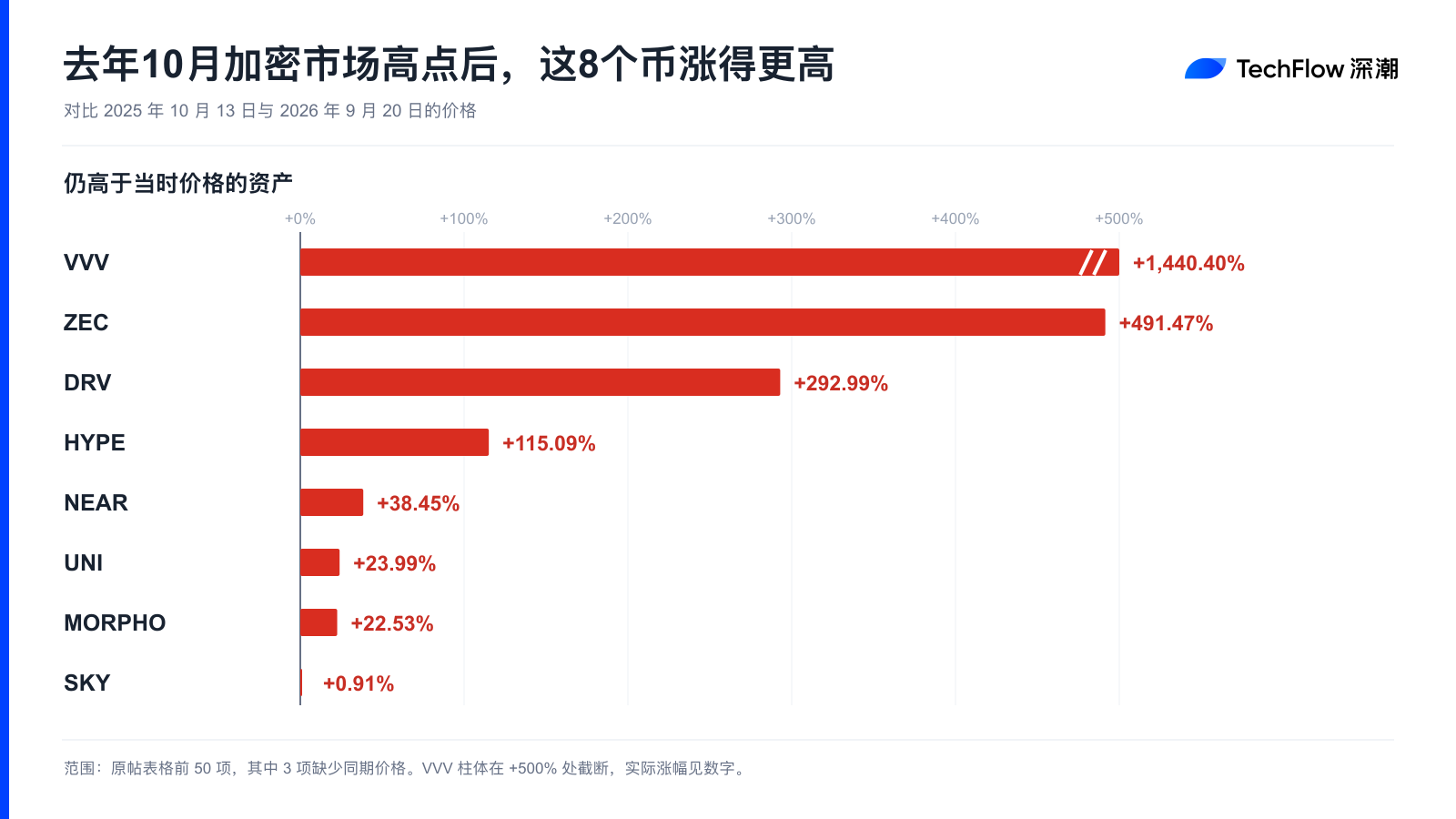
(Caption: Comparison of prices on October 13, 2025, and September 20, 2026. In the top 50 items of the table, only 8 are above the reference date price. The VVV bars are truncated at the 500% gain for proportional adjustment. Data redrawn based on Jeff Dorman's original table.)
8 tokens that have crossed the previous highs
In the aforementioned statistics, only 8 names have crossed the high point of last October: VVV, ZEC, DRV, HYPE, NEAR, UNI, MORPHO, and SKY.
Setting aside VVV (up 1440%) and DRV (up 292%), which are driven by extreme concentration or single events, the remaining hardcore breakout performers (like HYPE, UNI, NEAR) have all completed a fundamental reconstruction from "virtual governance authority" to "real value capture."
The fuel for their rise is real protocol income.
Taking decentralized derivatives leader Hyperliquid (HYPE) as an example, its price is up 115.09% compared to last October. Its surge does not rely on empty roadmaps but has directly penetrated the inflation subsidy model of traditional DEXs. According to Hyperliquid's latest execution document, the high-frequency trading fees and clearing gains generated by the protocol will be automatically converted into HYPE in the secondary market at a fixed ratio, and this portion of tokens will then flow into a support fund and be permanently burned. The larger the business volume, the more aggressive the deflationary buying pressure in the spot market.
The once "useless governance token" representative Uniswap (UNI) has also completed this leap (up 23.99% from last October). Investors used to repeatedly ask, "With so much business done by exchanges, what do token holders get?" Now Uniswap's developer documentation gives a hard answer: since the activation of the fee switch in December 2025, all protocol fees collected from the frontend have been forcibly used for secondary market buybacks and destruction of UNI. The larger the frontend traffic, the less circulating supply there is, and this buying pressure brought about by the real business generating capacity has allowed UNI to successfully cross the deep bear market, coupled with the recent coin issuance craze from Robinhood, fundamentally providing room for capital speculation.
Even PENDLE, which has not yet returned to last October's high (still down 31.01%) but has shown extremely strong recent performance, also derives its bottom support from this.
According to Pendle's official API data, the protocol strictly allocates 80% of the yield and exchange fees for the repurchase of $PENDLE. In the last 17 execution cycles, 16 of them have had positive buyback amounts, totaling about 2.832 million tokens bought in the open market. Although the price has not yet recovered lost ground, the underlying protocol is continuously "paying" for itself.
Transforming narratives, advocating income
In addition to being a "cash flow printing machine" with fee buybacks and destruction, several other old coins that broke their previous highs have reshaped investors' buying reasons through product iteration.
The old privacy coin Zcash ($ZEC), which has surged by 491.47%, has not taken the fee destruction route; its surge is due to a complete restructuring of community consensus.
This year, due to inflation and performance issues surrounding ZEC, its community launched the highly executable Nu7 network upgrade. The results of on-chain voting showed that about 2.4 million ZEC (nearly two-thirds of the voting coins available during the snapshot) participated in the vote. Token holders not only rigidly defended the deflationary tone of "retaining halving" but also voted to significantly reduce the block interval from 75 seconds to 25 seconds, directly optimizing the trading experience at the foundational level.
At the same time, KOLs on English social media unanimously view ZEC positively, giving it a lot of social media heat.
The established public chain NEAR (up 38.45% from last October) has also long since moved beyond the simple "Layer 1 scaling" narrative. Its newly launched "Confidential Intents" product addresses the current most scarce dark pool trading demand for institutional funds, allowing cross-chain transactions to conceal core order information. According to its official income dashboard, as of September 20, the single locked amount for the confidential pool has exceeded $90.52 million.
The investment logic in the crypto market has undergone irreversible capital migration in this version.
Finding investment opportunities in old coins can no longer merely revolve around asking "how far is it from the previous high" while staring at K-lines; it is essential to interrogate what new products this protocol has developed after the fervor faded last October. How much real income has it generated? How much of this net income has transformed into actual buying orders in the secondary market?
Old coins without real fee and buyback mechanisms can only continue to decline endlessly amid infinite unlocks; while those tokens that have closed the commercial loop are ruthlessly using the trading fees paid by retail and institutions to buy back their circulation on-chain.
The next wave of BTC may reach new highs, but it certainly cannot carry all old altcoins to new highs. Cherish the chips in hand and consider trading during cycles where narratives and fundamentals resonate, rather than holding onto a few altcoins based on sentiment.
免责声明:本文章仅代表作者个人观点,不代表本平台的立场和观点。本文章仅供信息分享,不构成对任何人的任何投资建议。用户与作者之间的任何争议,与本平台无关。如网页中刊载的文章或图片涉及侵权,请提供相关的权利证明和身份证明发送邮件到support@aicoin.com,本平台相关工作人员将会进行核查。


