After the interest rate hike to 1.25%, the yen did not rise, and BTC first climbed to 81,000; what really needs to be watched is whether the carry trade will start to close positions.
The Bank of Japan raised its policy interest rate from 1.00% to 1.25%, passing by a vote of 7 to 2, marking the highest level in about 31 years and the second rate hike in three months. The new rate will officially take effect around September 24. In the same week, the Federal Reserve just raised rates to 3.75%–4.00%.
The topic surged to hundreds of thousands of views on Binance Square, and the BTC sentiment vote (currently showing greed) essentially boiled down to one sentence: Japan is no longer a nearly zero-cost ATM. For the past decade or so, institutions have been accustomed to borrowing yen, converting it to dollars, to buy U.S. Treasuries, U.S. stocks, emerging market assets, and also including high-volatility varieties like Bitcoin. This is the yen carry trade. With financing becoming more expensive, theoretically, global risk assets would experience less "borrowed buying pressure."
But this time, the market did not crash according to the textbook.
After the interest rate announcement, the USD/JPY temporarily rose to about 157.8–158, indicating that the yen was weakening. Bitcoin did not crash along with it but rebounded from about 76,200 to 77,400, then surged to about 81,000. This suggests that the decision itself was priced in ahead of time, and the USD/JPY interest differential remains significant—1.25% in Japan versus nearly 4% in the U.S.—the interest differential for borrowing yen to buy dollar-denominated assets still exists, and the carry trade has not seen a "collective closure."
How Deep Was that Cut on August 5, 2024
The market often gets nervous at the mention of Japanese interest rate hikes, mostly because of the events of August 5, 2024, not because every time 25 basis points are added the same scenario is replayed.
The trigger was not "a lot of hikes," but "the sudden hike combined with U.S. data."
On July 31, the Bank of Japan raised its policy interest rate from about 0–0.1% to 0.25%, while also signaling a reduction in bond purchases. Although the magnitude seems small, the yen carry trade had built up for a long time: borrowing almost free yen, converting it to dollars, to buy U.S. stocks, emerging market currencies, and crypto. It is estimated that these positions were around 250 to 500 billion dollars.
Three days later, U.S. non-farm payrolls for July were only about 114,000, far below expectations, leading to recession trading. With two extremes: Tokyo was tightening money, while Washington was scaring growth. The premise of the carry trade—"the yen will always be cheap, and dollar assets will always rise"—was simultaneously broken.
The exchange rate moved first, assets moved later.
The USD/JPY fell from around 161, near its July peak, sliding to 142–146 within days. This means the yen appreciated by about 8%–12% in just a few days. Those borrowing yen suddenly realized: the yen they needed to repay had become more expensive, margin was insufficient, and they could only sell all liquid assets they had. What was sold wasn’t “Japanese assets,” but a basket of risk assets.
The impact of "Black Monday" on August 5 can be tracked by the market:
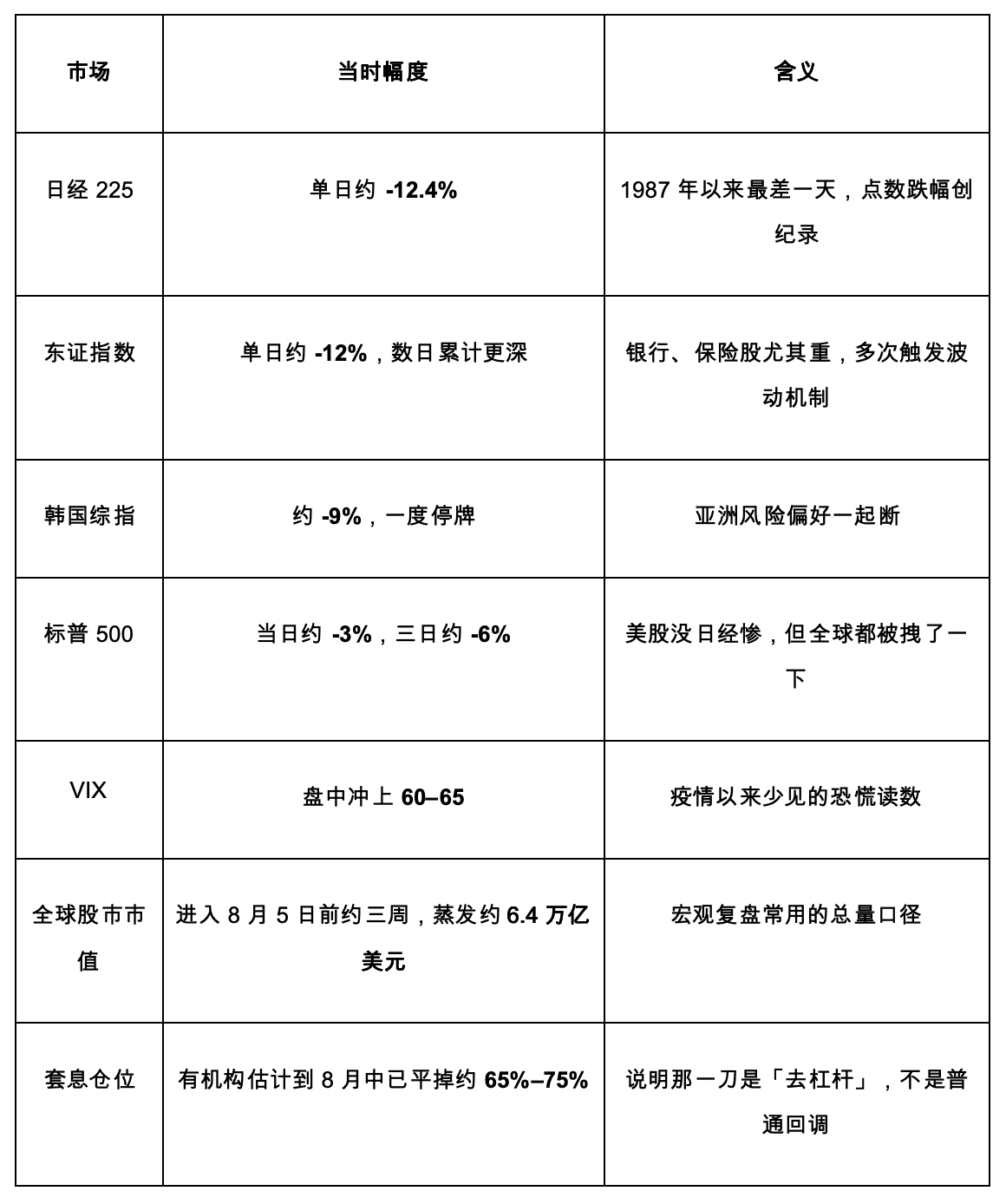
Crypto was hit harder because leverage was thinner.
Bitcoin fell from about 64,600 dollars near the close on July 31 to about 54,000 dollars at the close on August 5, a drop of about 16%. It saw intraday lows around 48,800–49,600, with the maximum drawdown being about 24% relative to the close on the day of the rate hike. Ethereum fared worse, commonly reported to have dropped about 20%–26%, hitting around 2100 dollars at one point.
From August 4 to 5, over 1 billion dollars in contracts were liquidated across the network, and the total crypto market cap briefly fell below 2 trillion dollars. Gold, dollars, and Bitcoin were all sold at once—this is rare in textbooks, and the reason is very specific: liquidations needed cash in dollars to meet margin requirements, so everything liquid was being sold.
Recovery also happened quickly, making it easy to forget the pain.
On August 6, the Nikkei rebounded about 10%. By August 8, Bitcoin had risen back to around 61,000 from 54,000. U.S. stocks essentially made up for the losses incurred on August 5 within a week. That is to say: the cut was extremely deep, but the duration was not long. What was left was not "Japanese rate hike = assets drop to zero," but rather a trading memory—
Once the yen appreciates quickly, global high-leverage positions will close together within 48 to 72 hours; crypto often falls by half more than the stock market because the liquidation chain is shorter.
How Tight is Global Liquidity Now
1. Financing costs are rising, but the water level hasn’t dried up
Japan's interest rate has risen from negative territory to 1.25%, and borrowing yen is no longer nearly free. However, compared to the United States, the interest differential still stands at about 2.5 to 2.75 percentage points. The "profit cushion" for the carry trades has become thinner, but it hasn’t disappeared. Therefore, it currently resembles a rise in costs, rather than a sudden withdrawal of liquidity.
2. The real signal of liquidity withdrawal is when the yen appreciates + risk assets fall together
In August 2024, the yen quickly appreciated, and those borrowing yen had to repay more expensive money, forcing them to sell stocks and Bitcoin to close positions. At that time, Bitcoin saw declines of over ten to twenty percent in just a few days. This time the direction is opposite: yen weak, risk assets strong, suggesting large-scale liquidations have not yet started.
Two criteria can be noted for judgment:
● If the USD/JPY quickly drops from around 157 to 152 or 150 (yen becomes expensive), then it is more like the beginning of liquidation.
● If we simultaneously see U.S. stocks, gold, and BTC being sold together, then global liquidity has been withdrawn, rather than crypto independently fluctuating.
3. A slower, but tougher trend: funds flowing back to Japan
Earlier this year, Japan's holdings of U.S. Treasury bonds decreased by about 122.6 billion dollars. Japan is one of the world's largest foreign debt holders, and reducing U.S. Treasury holdings will raise the cost of dollar financing, impacting U.S. Treasuries and dollar liquidity, which will then transmit to all risk assets priced in dollars. This process is slower than "raising rates by 25 basis points," but once it aligns with the appreciation of the yen, the impact will be bigger than on the day of the decision.
In summary:
The decision made "cheap money" a little more expensive, but did not withdraw global liquidity on the spot; the market is trading on "will there be further rate hikes, will the yen suddenly strengthen."
What This Means for BTC and ETH
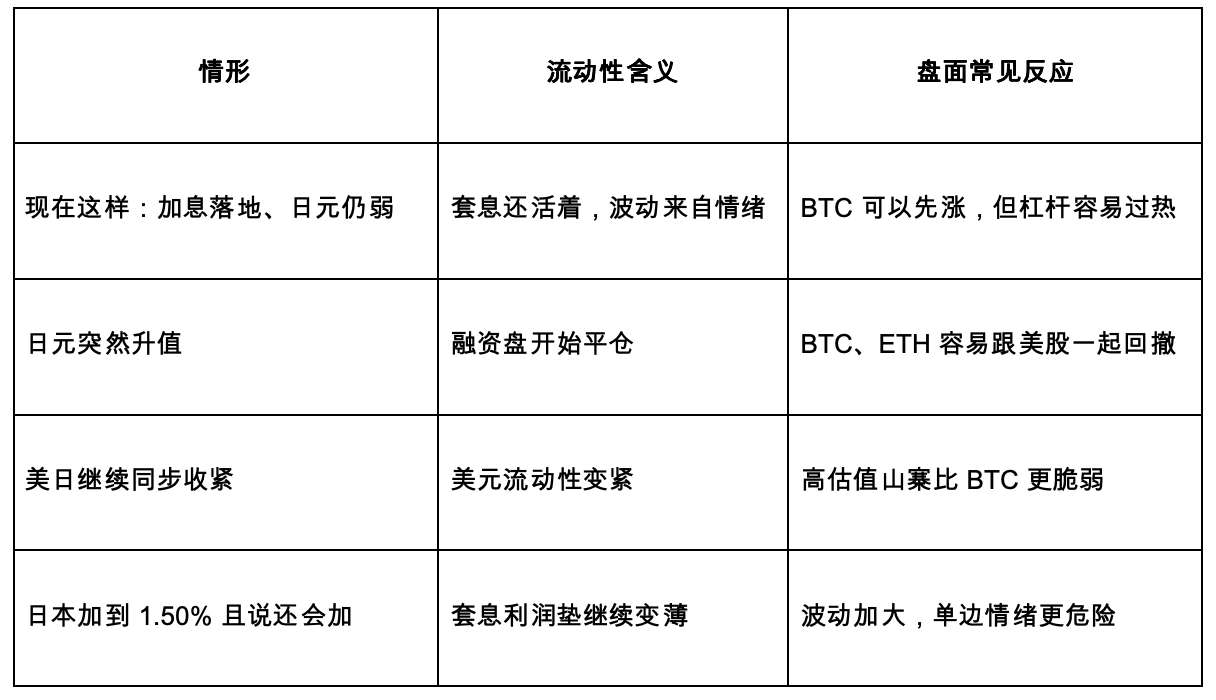
Cryptos are sensitive to Japanese rate hikes, not because people are trading in front of mining machines in Japan, but because the same batch of macro funds are short yen and long risk assets. When they close positions, they sell a basket, not just the Nikkei.
Therefore, what is more suitable now is to "watch the volatility," not to "bet that the Japanese rate hike will definitely lead to a crash" or "will definitely continue to soar." Both one-sided narratives have been hit this week.
What to Watch in the Next 7 Days
1.September 24: 1.25% officially goes into effect, observe whether there is a second wave reaction in short-term Japanese bonds and USD/JPY.
2.USD/JPY: If it stabilizes above 157, pressure on the carry trade may ease; if it swiftly drops below recent lows, watch out for liquidations.
3.BTC Key Levels: Near 81,000 is a sentiment level; levels above 82,000 and below 80,000 will determine whether this rebound is digesting negative news or just short covering.
4.ETH and Altcoins: When liquidity tightens, the first to fall is often not Bitcoin, but high-leverage altcoins.
Japanese interest rate hikes change the "borrowing cost" of global funds, not the intrinsic story of any specific coin. In the coming days, BTC, ETH, and yen-related volatility will be more intense than usual. To track the market, you need an account that can check prices 24/7, with both spot and futures options.
New users: Register and complete the verification → first make a small deposit → start with BTC/USDT and ETH/USDT spot, using limit orders.
Binance registration:
https://jump.do/zh-Hans/xlink-proxy?id=3
(Official cooperation link) Invitation code aicoin668
OKX registration:
https://jump.do/zh-Hans/xlink?checkProxy=true&proxyId=2
(Official cooperation link) Invitation code aicoin20
Existing accounts: First, check the leverage and funding costs. In macro events, liquidations often stem from positions, not from the news itself.
Digital assets are highly volatile and may incur losses to principal.
The above content is an event summary and does not constitute investment advice. Previous yen carry trade liquidations have led to significant market downturns; this time it could completely result in a different outcome.
免责声明:本文章仅代表作者个人观点,不代表本平台的立场和观点。本文章仅供信息分享,不构成对任何人的任何投资建议。用户与作者之间的任何争议,与本平台无关。如网页中刊载的文章或图片涉及侵权,请提供相关的权利证明和身份证明发送邮件到support@aicoin.com,本平台相关工作人员将会进行核查。