In November 2024, Hyperliquid allocated 31% of the total supply of HYPE to early participants, with all 310,000,000 tokens unlocked, without any VC rounds or reserved shares for centralized exchanges or market makers.
That Genesis distribution later became one of the most representative community distribution events in the cryptocurrency industry.
Today, the market has begun to revisit a question: Will Hyperliquid come again?
The reasoning provided by the market is straightforward: Of the total supply of HYPE, the largest portion—38.888%—was explicitly marked from the beginning as “Future Emissions and Community Rewards.” If this portion of the tokens is only intended for staking emissions, it seems unnecessary for the officials to add “community rewards” initially.
About 4% of the initial Genesis distribution was unclaimed, and Hyperliquid's real users today far exceed those during the first distribution period; based on an annualized staking rate of about 2.2%, it would roughly take around 44 years to digest the remaining supply solely through staking.
These clues certainly make a "second airdrop" sound reasonable.
However, it must be made clear:
Hyperliquid has not announced a second airdrop, nor have they published a snapshot, points, qualification criteria, or distribution date. The 38.888% means there is still significant space for community incentives, not that a second airdrop is a foregone conclusion.
What truly matters for traders is not guessing whether a token will suddenly be distributed one day, but that the community distribution story of HYPE clearly is not over yet.
38.888%, not market rumors, but the largest single item officially written into the Genesis distribution
The Hyper Foundation clearly provided a complete allocation of the maximum supply of 1 billion HYPE in the Genesis announcement:
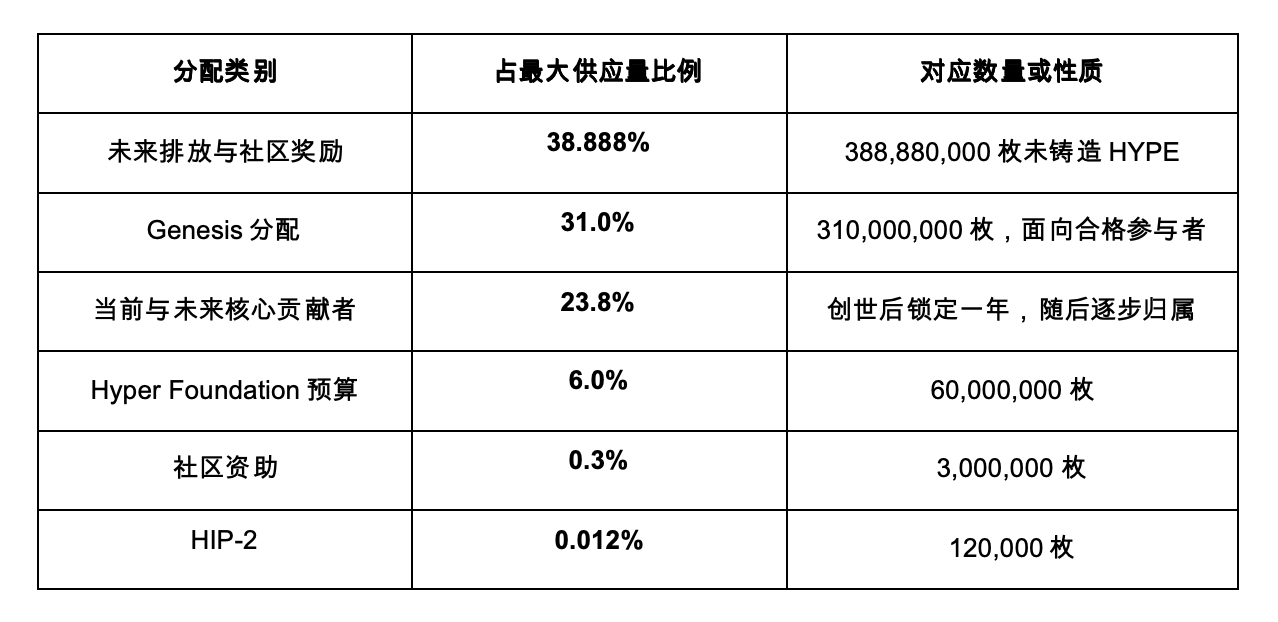
The officials also stated that HYPE will be gradually emitted over time, with 76.2% directed toward the community; the tokens not actually distributed in the Genesis allocation will also be transferred to “future emissions and community rewards.”
These two sentences are very important.
First, 38.888% is not a chip that has already entered the market circulation but is a reserved supply that has been set aside for future use. Second, the official name of this reserve includes both “emissions” and “community rewards,” indicating its use is not just a mechanical staking inflation curve from the beginning.
However, the officials did not further specify what forms “community rewards” must take. It could be a one-time distribution, or it could be a continuous ecological incentive; it could cover traders, Builders, liquidity providers, or other contributors.
Airdrop is just one possible form of community distribution, not the only answer for 38.888%.
What does Henrik’s “44 years” deduction really explain?
Based on an annualized staking rate of about 2.2%, if the remaining community reserve is only distributed through staking, it would take approximately 44 years to complete the distribution.
This calculation did not arise out of thin air.
The official staking documentation from Hyperliquid shows that when the total staked amount is 400 million HYPE, the theoretical reward rate is about 2.37% per year, and the staking rewards come from future emission reserves.
If we use Henrik's assumption of about 2.2%:
400 million staked × 2.2% ≈ 8.8 million HYPE emitted per year
388.888 million reserves ÷ 8.8 million ≈ 44.19 years
However, this is just a static scenario, not the official release schedule. The actual annualized staking rate will change with the total staked amount, and the community reserve may not be entirely allocated for staking rewards.
Therefore, “44 years” cannot prove that a second airdrop will necessarily occur. What it can explain is another matter: If such a large reserve only undertakes current staking rewards, the distribution speed will be very slow, leaving room to design other community incentive methods in the future.
Regarding the “4% unclaimed,” we need to be precise in our terminology
Approximately 4% of the first airdrop was unclaimed, and it was believed that these tokens originally belonged to the community, thus converting all into staking rewards does not align with the initial spirit.
We need to distinguish between two layers of facts.
The official announcement confirmed that the Genesis allocation distributed a maximum of 310 million HYPE to qualified participants, and the undistributed portion will return to the future emissions and community rewards pool.
“About 4%” is an estimate given by Henrik and is not the official proportion disclosed by the Hyper Foundation in the Genesis announcement. Therefore, it can serve as a clue for market analysis, but cannot be directly stated as a verified airdrop balance.
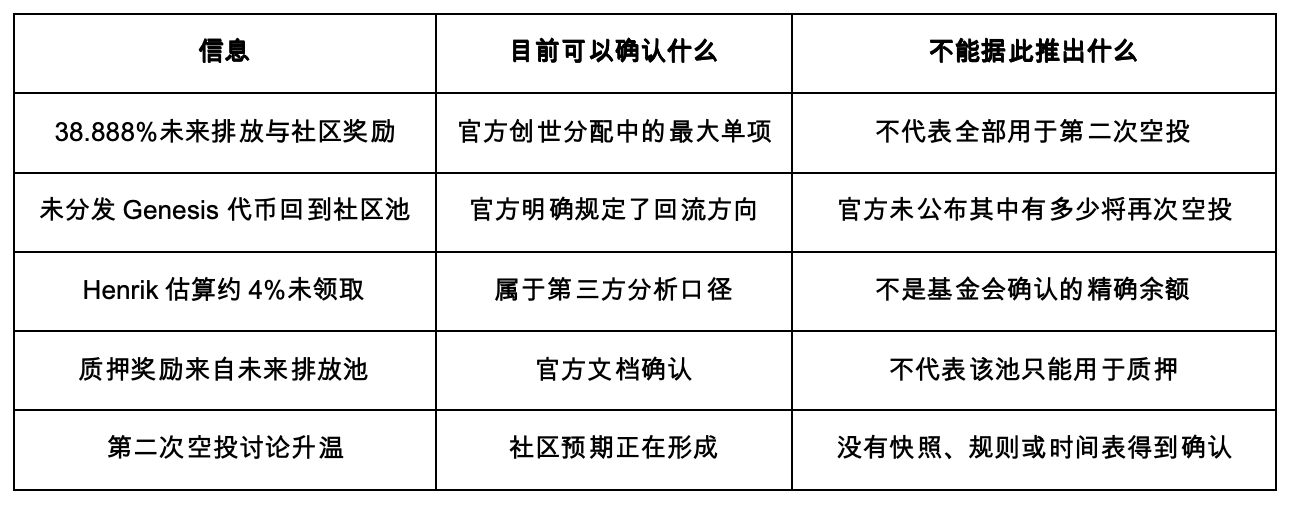
This table represents the most reasonable factual boundary: the reward pool exists, and the second airdrop remains speculative.
Why is there logical reasoning behind revisiting the airdrop discussion now?
The first Genesis rewarded early users of Hyperliquid. At that time, the product scope and user scale of the platform were not at the same level as today.
Now, Hyperliquid is no longer just a cryptocurrency perpetual trading platform. Users can participate in spot markets, the HIP-3 stock and commodities markets, staking, native lending, and HyperEVM applications. Community contributions are now measured by more than just “how much trading volume was generated.”
The market's judgment is: There are currently many real users using Hyperliquid who have never received HYPE allocations; meanwhile, institutions like digital asset treasury companies are continuously purchasing circulating chips. If Hyperliquid seeks to maintain broader community ownership, distributing tokens again to real users in the future is a logically sound choice.
But “logically sound” does not equal “already decided.”
New community rewards may also take on a more decentralized form, such as continuous incentives for staking, liquidity, Builders, or specific ecological activities, rather than replicating a Genesis airdrop of 31% scale.
More importantly, community rewards represent potential opportunities for users, but for token holders, they also represent potential supply.
CoinShares included future community distribution as a clear risk in their HYPE research: new airdrops or emissions could increase market selling pressure and alter assumptions about circulating supply.
Therefore, the 38.888% must be understood from two perspectives:
For users, it is still undestributed community equity; for token holders, it is potential supply that has not yet entered circulation.
Discussing only the value of the airdrop without mentioning dilution pressure is similarly incomplete.
What truly matters is not “chasing the airdrop,” but leaving behind a record of real usage
In the absence of official rules, the worst strategy is often to blindly generate trading volume for an unconfirmed reward.
High-frequency trading may incur fees, slippage, and capital cost rates; excessive leverage may also lead to actual losses that far exceed future potential rewards. The officials have neither confirmed Season 2 nor promised that the more trading volume there is, the more airdrop will be.
A more reasonable approach is to treat Hyperliquid as a genuine trading and capital management platform:
Trade normally when needed, manage positions when hedging, and interact only when using lending or the HIP-3 market. Even if there is no second airdrop in the future, these operations still serve real needs rather than paying costs for a non-existent coupon.
The experience from the first round of Genesis is not “the better you are at chasing, the more you can get,” but that Hyperliquid is willing to let genuine users share in the network's growth.
If a second round does occur, sustained, natural, and explainable on-chain behavior is at least more in line with this distribution philosophy than temporary volume spikes. Of course, this is merely a strategic judgment and does not imply any qualifications.
Participate through AiCoin, focusing not on betting on the snapshot but on reducing real trading costs
For regular users, the most practical action now is not to speculate about the snapshot time, but to first clarify the market and then decide whether to participate.
Through the AiCoin mobile app, you can monitor whether HYPE’s price, transaction volume, open interest, and funding rates are changing in sync, and combine it with smart money tracking to determine if the market is trading on “second airdrop expectations” or if large players are genuinely increasing their positions. For HIP-3, cryptocurrencies, and other markets, you can also confirm liquidity and funding behaviors first before deciding whether to execute.
After confirming trading logic, you can connect to Hyperliquid via AiCoin to complete the order, and manage different assets and positions uniformly on the mobile app. The value of doing so is not to guarantee future rewards but to reduce information switching and execution friction when there is an actual trading demand.
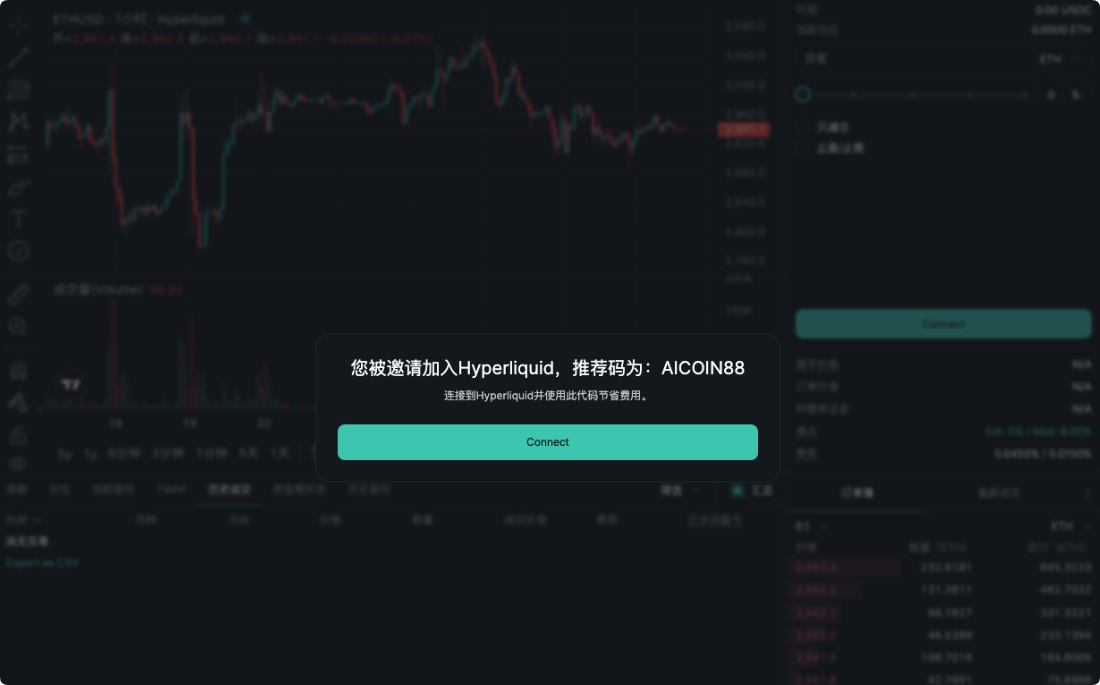
Entering Hyperliquid through the exclusive AiCoin portal and using invitation code AICOIN88 allows you to receive 4% fee rebates according to the activity rules:
Exclusive link: https://app.hyperliquid.xyz/join/AICOIN88
The 4% rebate is a real, verifiable trading cost optimization; while a second airdrop remains an unconfirmed possibility. Do not conflate the two.
Final judgment
There is no evidence that Hyperliquid will definitely conduct a second airdrop, but one fact that the market should not ignore is: The largest portion of HYPE distribution still reads “future emissions and community rewards.”
The 388.888 million unminted HYPE will not lose its significance simply because the market temporarily does not know its use. It may continue to bear the load of network security and staking rewards, or it may be used in the future for broader community distribution.
The officials confirmed the funding pool but did not verify the distribution answer.
Therefore, what is currently most worth betting on is not a specific airdrop date, but that Hyperliquid is still willing to leave a significant portion of the network's value for future real participants.
If the second airdrop ultimately appears, the real signal will not be a community speculation chart but the Hyper Foundation publishing clear rules, subjects, and timelines. Until then, treating normal usage as demand and potential rewards as an extra option is far more rational than generating meaningless trades just for an airdrop.
The first distribution of Hyperliquid rewarded those who used the platform from scratch; regardless of the format in the next phase, the core issue determining community token ownership remains unchanged: Who is genuinely using, building, and expanding this network.
Exclusive benefits for AiCoin users
👉 Enter invitation code AICOIN88 when linking your Hyperliquid account for a 4% fee rebate
🔗 Exclusive registration link:
https://app.hyperliquid.xyz/join/AICOIN88
📖 Beginner's guide:
- “AiCoin PC client Hyperliquid authorization trading tutorial”:
https://www.aicoin.com/zh-Hans/article/514197
- “AiCoin mobile client Hyperliquid authorization trading tutorial”:
https://www.aicoin.com/zh-Hans/article/541383
- “Getting Started Without Any Basics! Hyperliquid First Trading Super Detailed Illustrated Tutorial”:
https://www.aicoin.com/zh-Hans/article/510225
📖 Community Communication:
- Telegram:
https://t.me/AiCoinWhaleData
- Discord:
https://discord.gg/D7UjAcFrah
- AiCoin-Group chat:
https://www.aicoin.com/link/chat?cid=N6OVMor5g
The content of this article represents the author's personal views and does not represent the position of the platform. The opinions, conclusions, and suggestions in the text are for investors' reference only and do not constitute any investment advice related to this platform. Investing in US stocks still involves assuming market risks, regulatory risks, and compliance risks with local laws and regulations (especially foreign exchange controls, foreign investment filings, etc.).
免责声明:本文章仅代表作者个人观点,不代表本平台的立场和观点。本文章仅供信息分享,不构成对任何人的任何投资建议。用户与作者之间的任何争议,与本平台无关。如网页中刊载的文章或图片涉及侵权,请提供相关的权利证明和身份证明发送邮件到support@aicoin.com,本平台相关工作人员将会进行核查。