Author: ZetaChain Team
Translation: Deep Tide TechFlow
Deep Tide Overview: ZetaChain is no longer satisfied with being an independent Layer1 but wants to move the tokens and core products to Solana. Behind this decision lies a more crucial product: Anuma, a private AI application that has already served 300,000 users. If you are paying attention to the intersection of AI and cryptocurrency, this article is worth a closer look: it discusses not just migration but where private AI should be anchored on which chain.
TL;DR
We propose bringing ZETA to Solana, along with Anuma: a private multi-model AI application with 300,000 users, a unified memory across all models, and a brand new testing feature for real social discovery. ZETA will become a native SPL token on Solana, exchangeable at a 1:1 ratio, using the same code. The proposal has been released on ZetaHub. Voting started on September 17 and will last for 72 hours. No changes will occur before the ZETA holders vote. Anuma is now live. Go try it out.
AI is becoming increasingly personalized. It understands your health, relationships, and plans, but today this knowledge belongs to the model providers you use. We believe it should belong to you and reach a certain model only when you decide.
We founded ZetaChain in 2021 with the goal of connecting various chains. This year we found our product: a private memory layer—a segment of encrypted memory that follows you across every AI model, application, and agent, with your wallet holding the keys, allowing each model to see only what you permit.
Since February, we have been running the private memory layer in a production environment and building the application layer on top of it. Solana is precisely where the rest of the AI technology stack is being assembled, so we propose moving there to enable any AI application or agent to build on it.
Solana is assembling the tech stack necessary for private AI.
Computational power and models are being opened in a way Solana calls "open intelligence." Agents can prove their identity via the Agent Registry and use fees through x402 payments, while Solana has borne most of this traffic: over 20 million payments have been completed since July.
What Solana's AI tech stack currently lacks is an application layer: an application that people use daily, with memory that belongs to users, and that can circulate between models, applications, and agents.
This application layer should be built on Solana because this network is designed for scaling agents. Memory reading, agent calling, and pay-per-use reasoning require sub-second, sub-cent settlement, which Solana can provide today: with a confirmation time of about 400 milliseconds and a median fee of about 0.1 cents. In testing, it has handled over 100,000 transactions per second, allowing agents to transact at machine speed.
It also boasts one of the deepest consumer-grade crypto ecosystems, having led DEX trading volume for seven consecutive quarters, with stablecoin balances exceeding $15 billion, so agents can pay with currencies already in use.
Every Anuma account is a wallet, meaning migration will start with over 300,000 users entering Solana on day one.
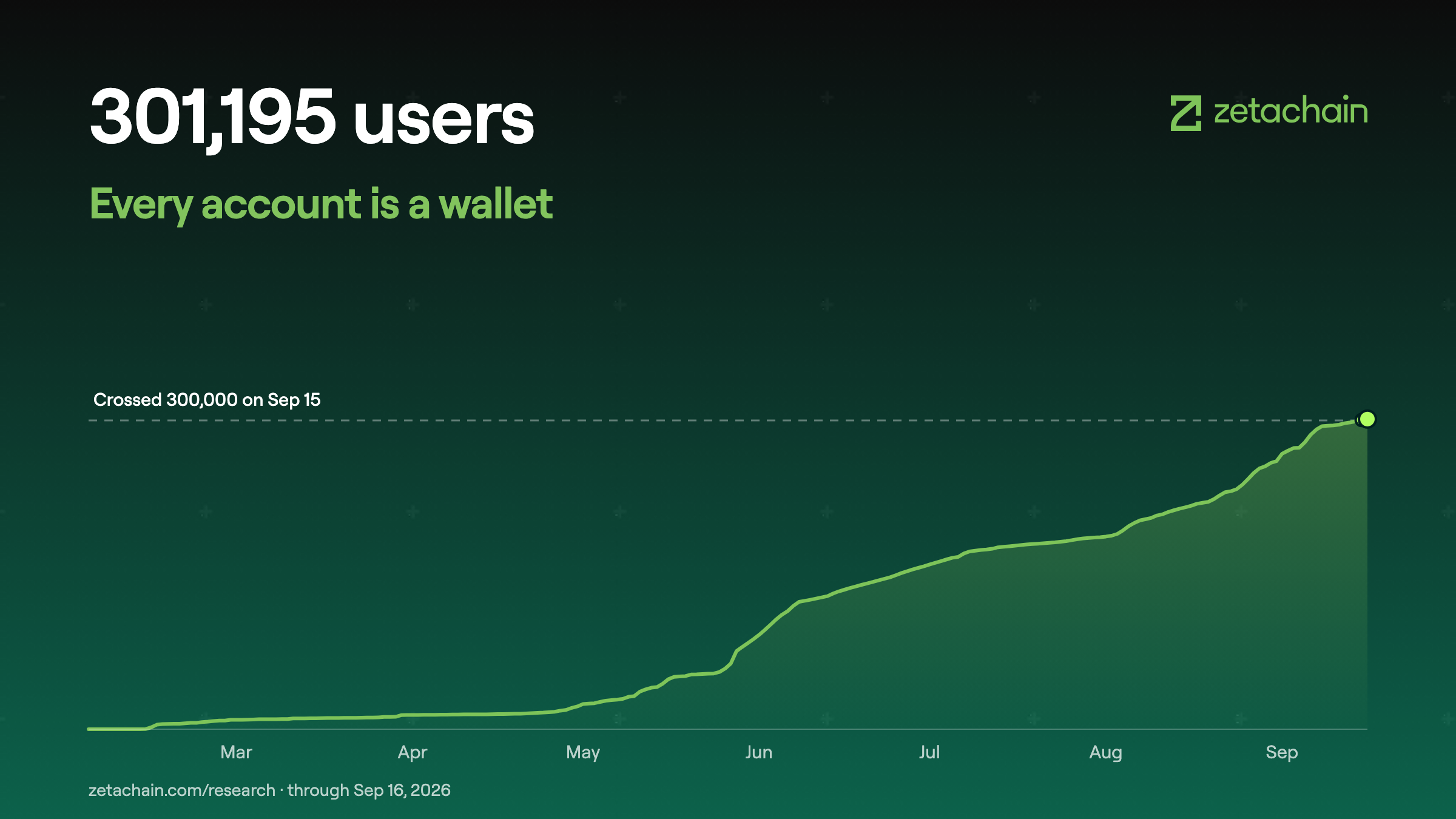
Image: Anuma user growth, source ZetaChain Research: as of September 16, 2026, there were 301,195 users, with the count surpassing 300,000 on September 15.
Default Privacy, Available Today
Private memory protects AI regarding your memories. Private mode restricts what models can see.
Anuma challenges the status quo: under current models, every prompt, complete chat records, and personal context are directly sent to the model providers. The application only sends the required context for requests. Closed-source model providers will never access your complete memory or history, identifiers can be anonymized before the prompts leave the application, and the private mode will route requests to zero-retention open model infrastructure. No content is recorded or used for training.
As agent capabilities strengthen, this becomes even more crucial. An agent acting on your behalf may need your preferences, relationships, financial information, or messages; it should use that information without permanently exposing everything about you to every model or service.
Anuma's latest feature (currently in testing) extends private AI into real-life social discovery: helping you find people worth getting to know nearby.
ZETA on Solana
Role of ZETA
ZETA is the token behind Anuma, and on Solana, it will become the token behind the entire application layer. In Anuma, this already operates through a points mechanism: lock ZETA to earn points, then use points to pay for AI usage. Locked ZETA leaves the circulating supply. As more AI applications and agents on Solana connect to the same layer, ZETA will become the universal access token among them. This migration also changes the world scale where ZETA sits, where the DEX clears about $70 billion monthly and has payment channels built for agents.
Economic Opportunities
This opportunity means ZETA will play a larger role: an ecosystem with more applications, more users, and more AI activity, where users engage by locking ZETA.
More applications bring more users. More users lead to more AI activity. More AI activity increases the utility of ZETA, leading to more applications.
We will focus on three things:
Grow Anuma. A consumer-grade AI product that people continually use, built around memory, multi-model AI, and social discovery.
Open the application layer. Allow other AI applications and agents on Solana to build on it, so ZETA serves more than a single product.
Build the Solana AI ecosystem. Collaborate with developers and partners building AI on Solana, allowing the application layer and ZETA to function in their products.
Real products used by people lead the way, and the demand for ZETA will grow with usage.
What It Means for ZETA Holders
Most holders do not need to do anything.
ZETA code remains unchanged, 1:1 exchange, total supply remains the same, and there will be no issuance of new tokens.
The unlocking schedule will proceed as originally scheduled.
Your balance (including locked and staked positions as well as Anuma points in the Token Dashboard) will remain unchanged.
ZETA on Ethereum and BSC is unaffected by this proposal.
Anuma, memory layer, and your privacy: memory remains encrypted by the keys you hold, and conversations are not recorded or used for training.
What will change
The chain where ZETA operates: from our own L1 to Solana.
Token standards: become native SPL tokens.
Validators: become Solana validators, rather than a group we run ourselves.
The ecosystem around ZETA: become Solana's DEX, wallets, and agent payment channels.
Our focus: invest every contributor's time into building ZETA, Anuma, and Solana.
Protections for holders have been written into the formal proposal. Exchange redemption depends on each exchange confirming the redemption process; the list of participating exchanges will be published before any changes occur. The form staking takes on Solana (including how staking rewards transition) is actively being explored, and the proposal will specify the mechanisms.
What Happens Next
The complete proposal has been published on ZetaHub. Voting begins on September 17 and lasts for 72 hours. Please read the proposal and vote. Any questions can be raised on X or Discord.
Anuma is already live. Try it now.
Will this change the assets I hold? No. You will receive the same amount of ZETA on Solana, 1:1 exchange. Total supply remains the same, there will be no issuance of new tokens, and the unlocking schedule stays as originally scheduled.
When will the migration happen? There is currently no date. Voting will be from September 17 to 20. The timeline afterward depends on exchanges confirming the redemption process; the formal proposal will specify the exact date. No changes will occur before the proposal passes.
What will happen to the ZetaChain network, and why not just do a bridge? If the vote passes, once holders complete the migration, ZetaChain's L1 will gradually shut down. Until then, validators will continue validating, and staking will continue to run. Bridging is unfeasible: wrapped tokens require the original tokens to be locked on a chain that will no longer exist. Instead, the native SPL token will become the only ZETA, and the proposal will define how balances are migrated.
What if the vote fails? ZetaChain continues to operate as an independent L1, and there will be no changes to the tokens themselves.
About ZetaChain
ZetaChain is building an application layer for private AI: user-controlled memory, identity, permissions, and payments, usable across AI models, applications, and agents. Its first consumer-grade product is Anuma, a private multi-model AI application, with all models sharing the same memory, and over 300,000 people have joined since February. The next phase is to bring this application layer to Solana and open it up to a broader AI applications and agents ecosystem.
免责声明:本文章仅代表作者个人观点,不代表本平台的立场和观点。本文章仅供信息分享,不构成对任何人的任何投资建议。用户与作者之间的任何争议,与本平台无关。如网页中刊载的文章或图片涉及侵权,请提供相关的权利证明和身份证明发送邮件到support@aicoin.com,本平台相关工作人员将会进行核查。


