Author: Nancy, PANews
With just a few hundred dollars or even lower settlement costs per day, Layer 2 can take advantage of Ethereum's secure "signboard" and leave most of the economic value to itself. L2 is gradually becoming a highly profitable passive income business, rekindling discussions in the market about Ethereum's value capture model.
L2 is making a fortune, while Ethereum only gets a "tip"
As Ethereum gradually becomes the secure foundation for more and more on-chain economic activities, L2 is taking on a large number of users, liquidity, and trading activities at very low costs. Even though the L2 space for Ethereum is highly competitive, and many projects ultimately do not escape elimination, for the top-performing L2s that have truly emerged, sustained on-chain activity is converting into substantial income, turning them into veritable "cash printing machines."
According to data from Growthepie, since the beginning of this month, the income from Ethereum's ecosystem chain has reached 52.19 million USD, with the top four being Robinhood Chain, Ethereum mainnet, Base, and Polygon, with incomes of approximately 39.06 million USD, 7.32 million USD, 3.62 million USD, and 1.44 million USD, respectively, accounting for a total of 98.5% of the ecosystem's total income. Among them, Robinhood Chain's income increased by 1266% month-on-month, ranking first among all chains, and single-handedly contributed the vast majority of revenue to the entire Ethereum ecosystem.
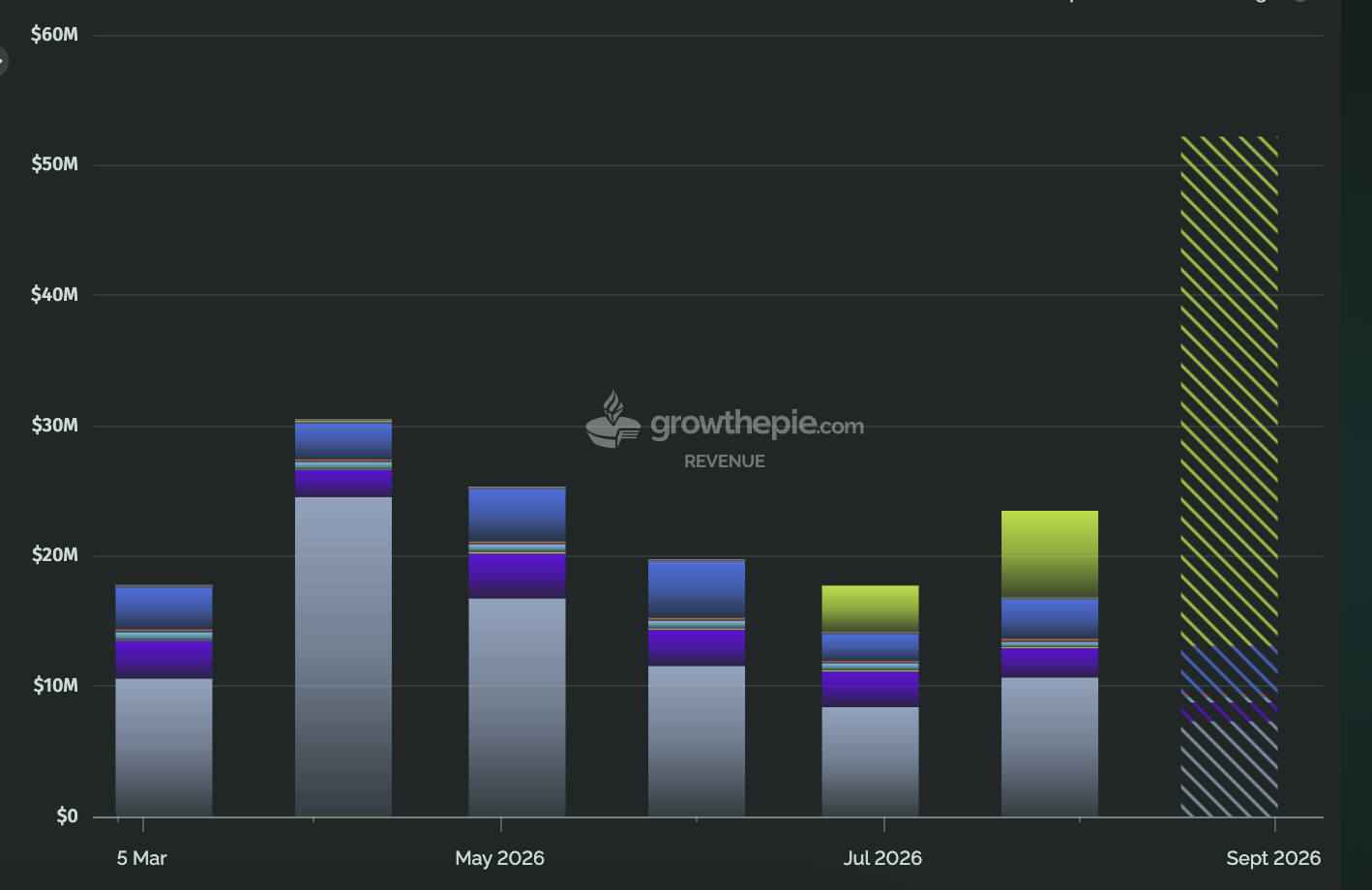
From the data in the past week, there are also very few chains with revenue reaching hundreds of thousands of dollars, with only Robinhood Chain, Ethereum mainnet, Base, Polygon, and Arbitrum, together accounting for 97.6% of overall income.
Whether from a monthly or weekly perspective, the liquidity and income capture of Ethereum's ecosystem are highly concentrated in a few top chains, while many L2 projects are gradually being marginalized. At the same time, the siphoning effect of traffic from top chains is becoming increasingly evident; the more active the trading and the more frequent user participation, the more effectively they can convert on-chain traffic into actual income and further widen the gap with other L2s.
However, the problem is that the more L2 earns, the less Ethereum receives in corresponding dividends.
Data from Growthepie shows that in the past 30 days, the top three chains paying L1 fees to the Ethereum mainnet have been Robinhood Chain, Base, and World Chain, but the corresponding amounts are only about 18,000 USD, 10,000 USD, and 3,700 USD. Compared to the millions or even tens of millions of dollars in revenue for top L2s, the revenue share obtained by Ethereum is negligible.
Taking Robinhood Chain as an example. As one of the most active and highest-income L2s in recent times, Robinhood Chain is also the L2 that pays the most L1 fees to the Ethereum mainnet. Yet even so, its "rent" paid to Ethereum is still almost negligible compared to its own revenue. For instance, on September 4, Robinhood Chain's revenue once reached 8.36 million USD in a single day, while the fees paid to Ethereum during the same period were only about 722 USD.
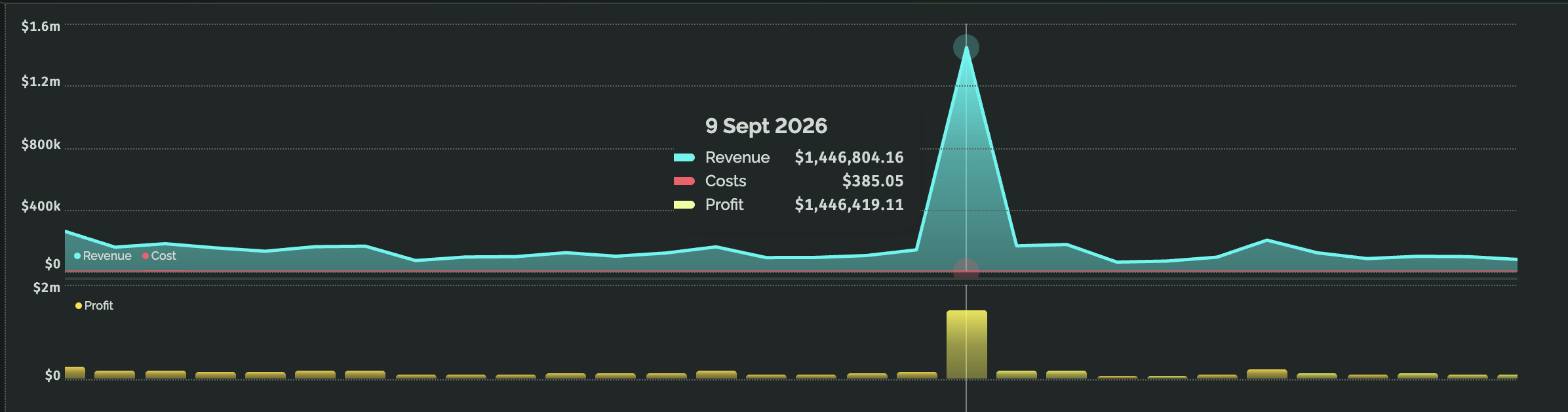
In fact, with the launch of Blob, the settlement costs that L2 pays to Ethereum have further decreased, and the profit margins for L2 have increased even more. In the past 30 days, Robinhood Chain's profits accounted for a staggering 100% of its revenue, Base reached 99.8%, and Arbitrum also reached 99.6%.
This means that for top L2s, the security and settlement services provided by Ethereum are becoming an extremely low-cost infrastructure. L2s only need to pay minimal settlement fees to leverage Ethereum's security to support large-scale on-chain economic activities while retaining the vast majority of their income.
L2 enjoys security dividends at a low price; how can Ethereum improve value capture?
L2 is capturing more and more economic value, while the revenue obtained by Ethereum as the underlying settlement layer is relatively limited, sparking further discussions in the market regarding its value capture model.
Some even suggest that if L2 only needs to pay a small amount of "rent" to Ethereum for its security, finality, and composability, then there's no need for public chain projects to build a sovereign independent L1, as adopting an L2 architecture is a more cost-effective choice.
Noted DeFi researcher Ignas has raised similar questions. He pointed out that this business structure of “platforms making a lot of money while the settlement layer hardly sees any profits" raises the question of whether this is indeed a problem for Ethereum? Ethereum may currently be using low rent to attract TradFi into the ecosystem, planning to increase commissions once the user migration costs are sufficiently high. If the official roadmap genuinely includes a strategy of "first attracting a large number of L2, then monetizing L1 when switching costs rise", this might be favorable for ETH, but there is currently no indication of this strategy in Ethereum's roadmap.
Crypto KOL 0xTodd has also made comparisons regarding the security guarantees obtained by L2 from the perspective of security budgets. He noted that the Ethereum network currently adds about 1,700 ETH daily, which at the time’s price equates to about 3,050 USD of new ETH value every minute. This issuance can be understood as a kind of "security budget" that the Ethereum ecosystem bears to obtain foundational security. In contrast, the weekly fees paid by L2s like Robinhood Chain to Ethereum are said to only be equivalent to about 1.8 minutes of ETH issuance costs for Ethereum, yet they are able to utilize Ethereum's vast validator network for foundational security.
ARK Invest's Director of Digital Asset Research, Lorenzo Valente, has drawn analogies from a business model perspective, comparing Ethereum, Solana, and Hyperliquid to McDonald's, Chipotle, and In-N-Out respectively. In his framework, Ethereum is closer to McDonald's "franchise + landlord" model, achieving low capital-input ecological expansion through Rollup routes while providing foundational security and settlement services for numerous L2s. However, the problem is that after the launch of EIP-4844, the price of Blob space has significantly decreased, and L1 has almost not captured any value from L2 activities.
However, this does not mean that the expansion of L2 itself lacks value for Ethereum.
Crypto researcher Blue Fox noted that after the Dencun upgrade, the expansion speed of Blob capacity exceeds the actual demand from L2, leading to a continuous decline in data availability (DA) prices. Consequently, the business model for L2 is gradually evolving into "block space revenue minus low DA costs," with most of the profits generated at the execution layer ultimately retained by L2 itself. In contrast, some L2 technology stacks have begun to adopt revenue-linked sharing models, such as OP Superchain and Arbitrum ecosystems, while Ethereum's L1 still primarily charges fees based on data bytes and batches. From this perspective, L2 scale expansion is overall beneficial for Ethereum to become the world's settlement layer, but this does not mean Ethereum should provide security premiums at extremely low costs for the long term.
In his view, to improve Ethereum's current value capture capabilities, in addition to waiting for the growth of Blob/DA demand to push data space rents back up from negligible levels to more meaningful proportions, there is also a need to explore pricing mechanisms at the protocol level that are more directly linked to L2 economic scales. Potential solutions include requiring L2s to contribute based on net protocol revenue, setting minimum settlement fees linked to proof frequency, or mandating that more high-value states be retained on L1. Furthermore, ETH's role within L2 may also be further strengthened. Beyond being the default gas asset for networks like Base, OP, Arbitrum, and Robinhood, ETH also needs to become an irreplaceable collateral asset, fee payment asset, and forced exit asset, thereby further enhancing its capacity to capture economic value within the L2 ecosystem.
Ultimately, the challenge currently faced by Ethereum is not whether to develop L2, but how to find a balance between expanding the settlement layer's scale and increasing its own value capture. The more prosperous L2 becomes, the stronger the network effect of Ethereum as a foundational settlement layer; but if the growth of L2’s scale cannot be simultaneously converted into Ethereum’s economic value, the real question remains: how much actual value will this prosperity ultimately bring to ETH?
免责声明:本文章仅代表作者个人观点,不代表本平台的立场和观点。本文章仅供信息分享,不构成对任何人的任何投资建议。用户与作者之间的任何争议,与本平台无关。如网页中刊载的文章或图片涉及侵权,请提供相关的权利证明和身份证明发送邮件到support@aicoin.com,本平台相关工作人员将会进行核查。


