
Author|Yoky
WeChat|yokyliu617
In the past few years, the competitive point of large models has been almost predictable: more parameters, more data, more computing power, leading to stronger intelligence.
Scaling is far from over, but as models begin to shift from "answering a question" to "completing a task that may take several hours," new competitive points also begin to emerge: models must certainly be intelligent enough, but merely pushing the upper limit of capability is no longer sufficient. An equally important question is how much computation and cost are needed to convert this intelligence into results more efficiently.
In other words, the competition for large models must not only continue to scale upwards but also continuously reshape the optimal boundary between intelligence and cost—the Pareto frontier.
The flagship model Step 5 Preview, recently released by Step, has pushed this frontier forward once again.
In the latest evaluation by Artificial Analysis, Step 5 Preview achieved an Intelligence Index score of 44, ranking among the top two of global open-source models; at the same time, its Intelligence Index single-task cost is approximately 0.7 dollars.
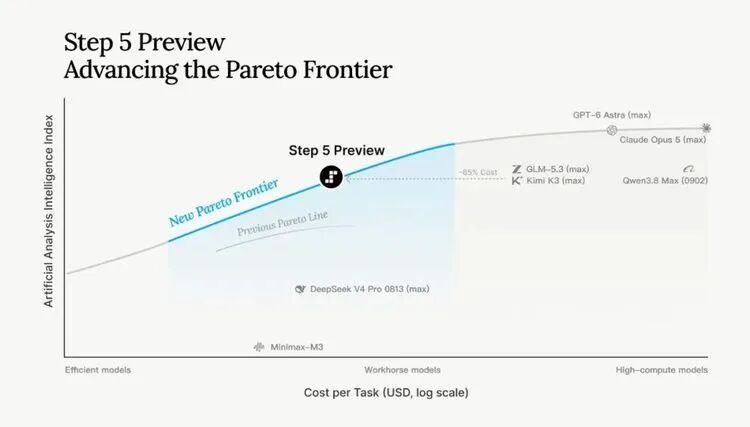
This change primarily comes from the model itself. It has a total of 600 billion parameters but only activates about 27 billion parameters for each generated token.
In AA's test tasks, it generated an average of about 64,000 output tokens, with a weighted average decoding time of about 12.1 minutes. This indicates that the challenge it needs to solve is not how to provide a quicker answer, but how to continuously advance the task over a long inference period.
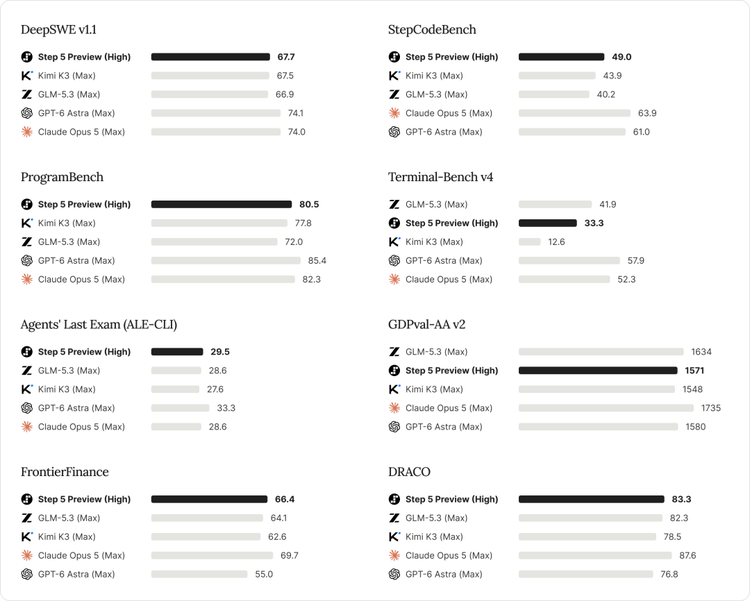
However, to determine whether Step 5 Preview has truly found a balance between capability, efficiency, and completeness, merely looking at the benchmarks is not enough. Real measurements must demonstrate the truth—
1
Finding the "Pareto Frontier" in Real Tasks
The difficulties faced by models in real tasks are diverse: some tasks test spatial understanding and visual implementation, while others test the organizational abilities of complex engineering, and some require models to process specialized knowledge, conflicting information, and verifiable numbers.
We first chose to create a 3D interactive game "Our Island" because 3D development is a scenario that easily exposes the boundaries of model capabilities. It requires the model to simultaneously handle spatial structures, geometric modeling, materials, lighting, camera angles, and interaction states. Any modification can trigger glitches, occlusions, or rendering anomalies. The model must not only write the functionalities but also constantly observe the results, identify issues, and make adjustments.
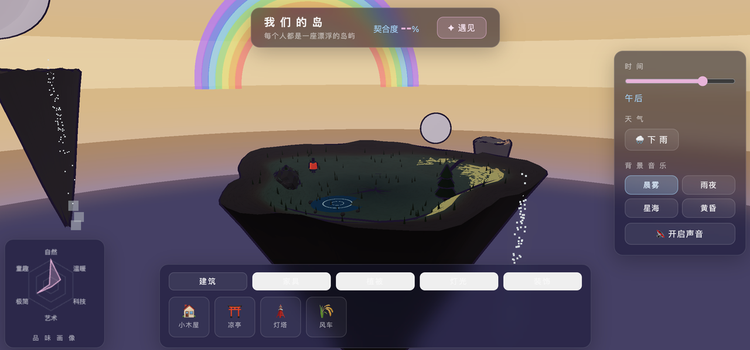
Step 5 Preview ultimately delivered a runnable WebGL game. Players can rotate and zoom the floating island, change the time, weather, and music, and place buildings, furniture, vegetation, and lighting; different choices will also generate a "taste profile" that matches the corresponding island personality.
More importantly, the islands, trees, houses, and lighthouses in the game were not created with external modeling tools like Blender or by calling existing 3D resources, but were entirely generated by Step 5 through code. It set up the scene, gameplay, and feedback mechanisms right from the first delivery, with subsequent adjustments mainly focused on lighting, composition, and interaction details, without overturning the original structure and starting over.
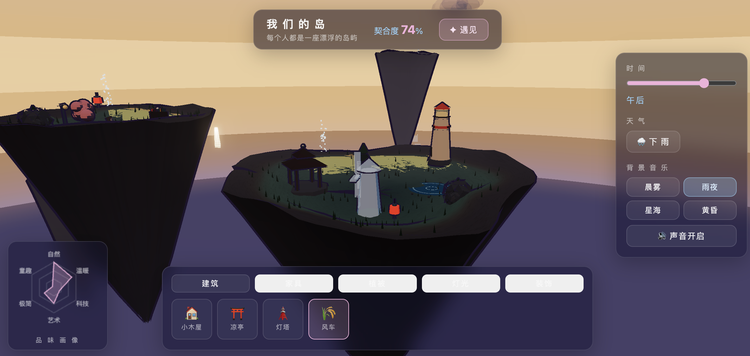
In terms of modeling accuracy alone, it still cannot replace professional artists; directly opening local files can also get stuck on the loading page, requiring operation via HTTP services. However, when considering the generation time, first completion rate, and dependence on external tools together, Step 5 Preview has advanced a task that originally required collaboration among programmers, artists, and product teams to a stage where it can run and be continuously modified in a short time.

If the 3D game tests the model's ability to manage a highly coupled visual system, the Chrome extension test assesses another capability: whether the model can understand the full delivery standards of a real software product.
A web page summary extension does not merely create a summary button. It must also adapt to different web pages, handle long text segmentation, model invocation, streaming output, original text citation, local storage, and browser permissions; after completing the code, it must undergo testing, building, and packaging to be truly installed and used. Therefore, we let Step 5 Preview develop a Chrome AI web page summary extension.
The final deliverable includes text extraction, long text segmentation, streaming summaries, original text Q&A, citation location, history tracking, and model settings, as well as Manifest V3, Service Worker, extension installation package, store materials, privacy policies, and permission descriptions. We actually operated the summary, Q&A, and history pages, and the main processes could be normally completed, with all 13 unit tests provided by the project passing.

This case exemplifies not how complex a piece of code is, but how Step 5 Preview can understand parts of the task that are not explicitly stated, and complete the testing, packaging, and listing materials together. It delivers a structurally complete software project rather than just a displayable interface.
Finally, we tested professional financial issues, as the financial scenario is one of the specialized capabilities showcased by Step 5 Preview: Step set up three types of internal financial assessments focusing on real-time information retrieval, company valuation, and in-depth research; in external FrontierFinance tests, Step 5 Preview's performance was also close to Claude Opus 5. To verify whether this capability can enter real workflows, we chose to have it complete an Nvidia investment analysis.
Nvidia is a challenging research subject. The company grows rapidly, financial metrics vary, and there are many conflicts between actual performance, management guidance, and third-party expectations. The model must not only find numbers but also determine which timeframe the numbers belong to, what metrics are used, and which information is factual versus unverified assumptions.
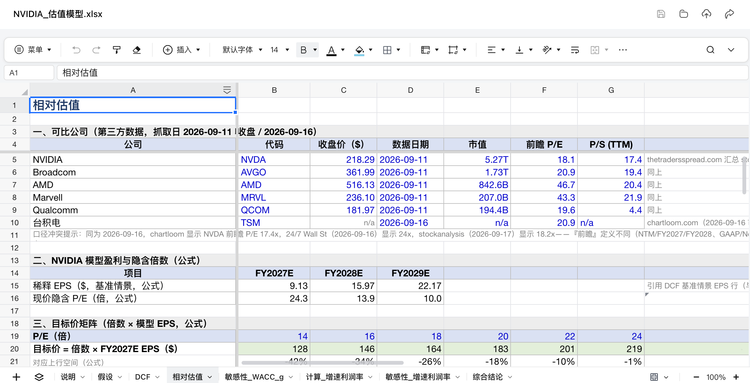
Step 5 Preview ultimately delivered two Excel models, one investment memorandum, and one evidence list. It extracted data from SEC filings, company financial reports, and conference call records, establishing a complete chain from historical finances and revenue forecasts to DCF and relative valuation, testing valuation results through different growth rates, gross margins, and discount rates. The ultimate weighted target price was set at $263.06, 18.4% higher than the benchmark stock price.
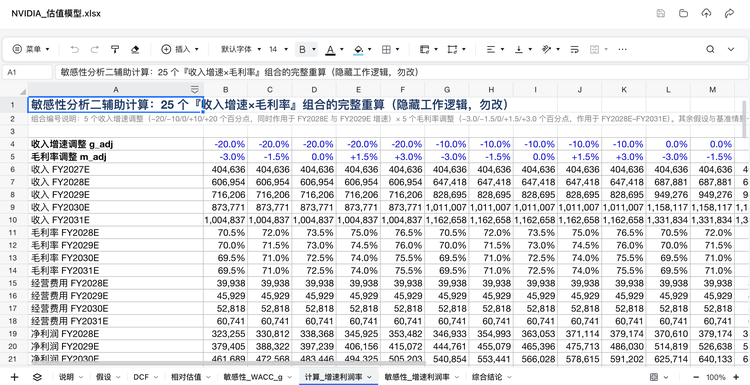
What is truly worth evaluating here is not whether the "buy" conclusion is correct, but whether the model has left a verifiable process behind. Step 5 Preview preserved the sources for key figures, actively listed data conflicts, omissions, and subjective assumptions, while also providing optimistic and pessimistic scenarios. However, manual checks still found some formula errors, indicating that it has already been able to complete research, modeling, and evidence organization, but the final numbers still cannot bypass professional audits.
Based on these results, the characteristic of Step 5 Preview is not that any single capability is absolutely leading, but that it can advance different types of complex tasks to a position close to delivery in a short time. The first generation already has a complete framework, and subsequent work is more about adjusting details rather than resolving problems anew. This is the concrete manifestation of the "Pareto frontier" in real tasks.
1
Understanding Step from Step 5 Preview
Step 5 Preview is not just an upgrade of existing models by Step; it also reflects Step's judgment on the evolution direction of the next generation of models: models can continue to expand, but true breakthroughs cannot rely solely on increasing parameters and computing power, but also on allowing models to think deeper, making computation truly effective, and allowing Agents to enter the data and training loop of the models themselves.
With this goal in mind, Step has adjusted model architecture, sparse computation, data production, and training systems simultaneously. Step 5 Preview employs a 92-layer "narrow and deep" design, aiming to better handle complex Agent tasks' long-chain dependency with sufficient computational depth; each token only activates about 27 billion of the 600 billion total parameters and reduces ineffective computations in long contexts through sparse attention and other methods. Meanwhile, Agents also began to participate in constructing high-difficulty training tasks, allowing trajectories and feedback generated during real execution to re-enter the next round of training.
These changes do not rely on a single point of innovation. They require the model, training, reasoning, and data systems to work together around the same goal, further testing the comprehensive R&D capabilities of a foundational model company.
Therefore, the release of Step 5 Preview also became a window for reobserving Step. In the past quarter, Step has successively updated Step Edge, StepAudio 3, and flagship foundational model Step 5 Preview, completing a new round of model system upgrades. The frontier foundational model continues to break through upwards, with multimodal capabilities covering listening, speaking, seeing, generating, and operating, while the edge models further bring these capabilities to real devices such as phones and cars.
If Step 5 Preview answers "to what extent can the model think," then the multimodal capabilities address how models perceive and understand a richer world, while the terminals determine whether these capabilities can truly enter people's daily lives. According to reports, Step models have now scaled to over 42 million terminals, serving nearly 20 million users daily. For the models, this means that they now face not only benchmarks and experimental environments, but also low latency, complex noise, high concurrency, and continuous real interactions.
Frontier foundational models determine the upper limits of intelligence, multimodal capabilities broaden the boundaries of intelligence, and terminals bring intelligence into reality. When these three capabilities begin to mature simultaneously, the significance of Step 5 Preview is no longer limited to a leaderboard or a single model release; it resembles a node: Step converges back to the main storyline of "Frontier competition," where the capabilities accumulated in multimodal and real terminals also begin to rejoin with the frontier foundational models.
Thus, as the competition among large models transitions from individual capabilities to systemic capabilities, the judgment of a foundational model company no longer depends solely on how high the capability of a single model is, but rather on whether it can continually reach the frontier and bring that ability into the real world.
Now that Step 5 Preview has debuted, the position of Step also needs to be reexamined.
免责声明:本文章仅代表作者个人观点,不代表本平台的立场和观点。本文章仅供信息分享,不构成对任何人的任何投资建议。用户与作者之间的任何争议,与本平台无关。如网页中刊载的文章或图片涉及侵权,请提供相关的权利证明和身份证明发送邮件到support@aicoin.com,本平台相关工作人员将会进行核查。


