Author: agintender
In 2020, those wanting to short GameStop faced an unavoidable hurdle: where to borrow the stock? At that time, this gaming retailer had not yet become a common topic among retail investors worldwide, but borrowing costs had exceeded an annualized 100% in the second quarter. By January 2021, the cost was around 25%. This is not to tell you about the ups and downs of stock prices, but rather how much you would need to pay daily to participate in this trade.
You can think of it as a car rental business. You believe that a $5000 business will come in a month, but the rental cost for that month is $8333, and although the deal is made, you end up losing. Even more troublesome, sometimes there are no cars available from the rental company.
Stocks are similar: just because you are willing to pay doesn't mean someone will lend. Brokerages need to support short selling, your account must have permission, and there needs to be a quantity of that stock available to borrow.
This is the starting point worth discussing for perpetual contracts:
The significance of perpetual contracts lies in allowing more people to participate in this game for different reasons.
Some are optimistic about the company, others question the valuation, while some may have no opinion on the stock price direction but only care whether the funding fees can cover position costs and whether there are opportunities in the spread between spot and contract pricing.
They do not need to believe the same story, and they do not even need to be on the same side; they can become each other’s trading counterparts.
The perpetual contract mechanism applies to all stocks. For small and mid-cap stocks with weaker liquidity and fewer derivative options, it can fill trading combinations that were previously impossible, allowing funds that couldn't enter before to find a way in.
However, to understand this path, don’t rush to think of leverage. Think of the stall owners in the fruit market.
Truths that the Fruit Stall Uncle Understands
The fruit stall owner buys stock because he is preparing to sell the fruit to customers. He doesn’t need to believe that apples will rise in price next month; as long as the selling price can cover the cost of goods, losses, and operating costs, he has reason to buy stock. Market makers in the stock market share similarities: they hold stocks, possibly to serve another client, rather than because they believe the company's prospects are good.
Assume a stock is $10, and someone wants to buy up to 10,000 shares of the upside exposure through a perpetual contract. The market maker sells the contract to him and becomes short on the contract. If the stock price rises, the market maker will lose money. To offset this risk, he buys 10,000 shares in the stock market. Thus, the client receives a long position in the contract, while the market maker holds “long stock + short contract,” resulting in a $100,000 purchase order in the underlying stock market.
This stock purchase arises from someone wanting to trade, and the market maker needs to stock up and hedge. Just like the fruit stall owner buying stock, purchasing does not necessarily indicate confidence in price increases. The difference is that stocks can be matched with contracts to offset most directional risks; however, the risk of spoilage and quality for fruits cannot be directly replicated in this manner.
Reversing the order can also create another path. If the client wants to short the contract, after receiving the order, the market maker becomes long on the contract and may sell existing stocks or borrow stocks to sell, offsetting the risk of a decline. Thus, a sell order appears in the stock market, and a buy order appears in the contract market.
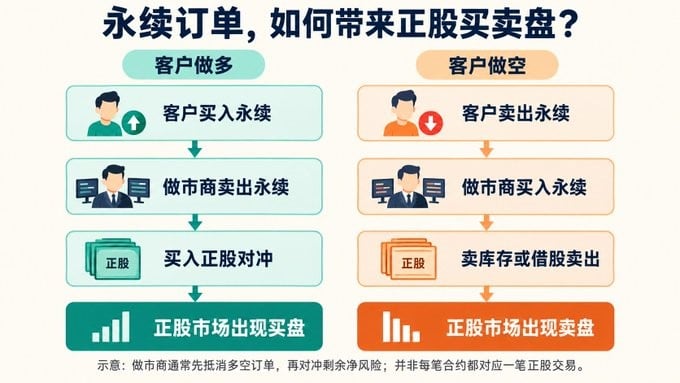
The image shows two possible hedging paths. The market maker will first offset the long and short demands between clients, only processing the remaining net risk; not every contract will correspond to a stock trade. Holding stock inventory does not imply a willingness to take unlimited orders, as restrictions come from capital, stock sources, and risk tolerance.
Four Prices Behind Perpetual Contracts
But how does a perpetual contract keep the prices on both sides connected? If the stock is $10, and the contract rises to $15, doesn’t that create two different markets?
You can think of it as two stalls selling the same product. If one stall becomes more expensive, customers will compare and businesspeople will consider buying cheaper and selling expensive. However, perpetual contracts have a particular feature: they typically do not deliver stocks on fixed dates, so they cannot rely solely on "delivery on the expiration day" to pull prices back. Another set of incentives is needed, one of which is the funding fee.
The funding fee acts like a periodic settlement bill for holding positions. When the contract persists as overly expensive, the mechanism typically raises costs for the long positions, paying fees to the short positions, attracting people to take the opposite side; when it persists as underpriced, the payment direction may reverse. The exchanges do not grant payouts out of thin air; the money comes from the holders on the other side. Every open position contract corresponds to one long and one short position, so it cannot simply be explained as “there are more long positions, so pay money.”
How does the system know whether the contract is expensive or not? It must first distinguish the following types of prices.
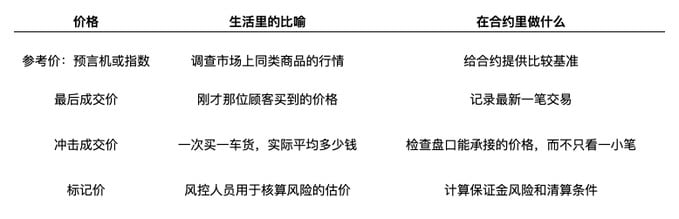
Suppose a bag of rice is priced at $10; it doesn’t mean a whole truck of rice can be bought at $10. Cheap items may have only one bag left, and the subsequent ones cost $10.20. The impact price is calculated based on the order book: how much can actually be traded at the average executable price according to the defined amount.
The usual calculation for impact prices at exchanges looks like this:
[max(impact buy price - reference price, 0) - max(reference price - impact sell price, 0)] ÷ reference price
Here, the impact buy and sell prices refer to the average executable prices on the buy and sell sides (the orders in the order book). Suppose the reference price is $10, and the sides have impact transaction prices of $10.01 and $10.03; from the above formula, this results in 0.1%.
The marked price is responsible for another job: it prevents a small abnormal transaction from determining whether a large number of accounts are subject to forced liquidation. It typically combines the reference price, order book, or smoothed basis to estimate risk. Each platform's formula differs, and these prices are not guaranteed to be equal at every moment.
The reference price tells you what the market is comparing, the funding fee encourages capital to adjust positions, and the marked price determines how risk control deals with risk; the three have different roles.
At this point, traders who specialize in trading funding fees can enter the scene. They neither want to bet on the stock rising nor on it falling; they just want to calculate “is this holding income enough to cover costs?”
Funding Fees and Costs
Still that stock priced around $10. He buys 10,000 shares of the underlying stock and shorts 10,000 shares of the perpetual contract. Assume the contract pays a funding fee of 0.03% to the short every 8 hours, with a principal amount held close to $100,000; counting three times a day, that’s $90 a day, approximately $2700 for 30 days. If the financing cost for buying stocks is annualized at 6%, calculated over 360 days, that would be about $500 for 30 days.
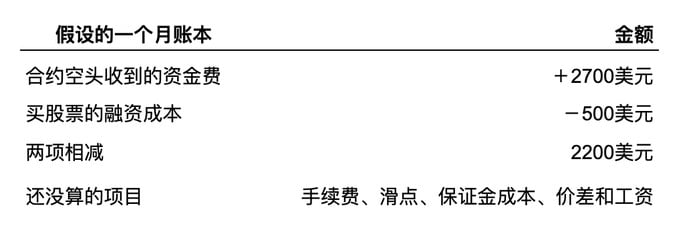
Two thousand two hundred dollars is merely the difference between the funding fee for 30 days and the financing fee; multiplying by 12 and dividing by $100,000, the annualized return is about 26.4% (not accounting for other costs).
This example is to tell everyone: an individual holding a position/stock can generate income through funding fees, not just due to a positive outlook on the company.
If the prices on both sides change in sync, his accounts would look roughly like this: for ease of understanding, let’s assume both the stock and contract are established at $10 for 10,000 shares, disregarding funding fees and costs.
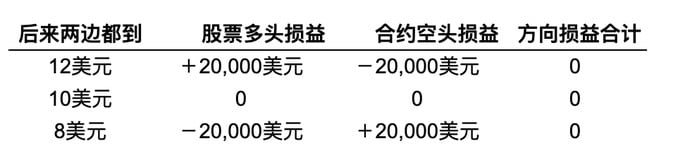
What he cares about is how much income remains after offsetting both sides. Funding fees may appear high, but the financing and other costs must also be deducted to determine if this combination is worthwhile.
The reverse combination works similarly. Shorting stocks, buying perpetual contracts while the funding fee is negative might incur charges for long positions. However, if receiving $2700 in a month, the borrowing fee for stocks at an annualized rate of 30%, with a principal of $100,000 calculated over 360 days, would be about $2500 for 30 days, leaving only $200 to cover other costs; if the borrowing fee reaches $8333, one cannot rely solely on this funding fee to profit.
These two paths are asymmetric. “Buy stocks, short perpetuals” primarily requires capital; while “borrow stock to sell, buy perpetuals” not only requires capital but also needs stocks to be available for borrowing.
Perpetual contracts allow regular traders not to seek out borrowings themselves, as risk is shared between natural longs, stockholders, and professional entities; however, the part needing stock to hedge is still constrained by stock sources, which is not the focus of today’s discussion.
Price Differences and Arbitrage
There is another type of person who only focuses on price differences. Imagine the same standard product: Store A sells for $10, Store B for $10.20; businesspeople would study whether that 20 cents is enough to cover transportation costs. It’s possible to compare stocks with contracts in this manner, but contracts are not delivery vouchers, and prices are not guaranteed to converge timely.
Assuming a stock is $10 and a contract is $10.20, buying 10,000 shares of stock while simultaneously shorting 10,000 shares of the contract. If both reach $11, the stock makes a profit of $10,000, while the contract loses $8000, leaving a gross profit of $2000 from the price difference. If both reach $9, the stock loses $10,000, while the contract gains $12,000, leaving $2000 as well. Funding fees, financing fees, and transaction costs are counted separately.
This person does not need to know whether the company is ultimately worth $9 or $11. What he needs to assess is whether the disparity of 20 cents can narrow and whether the costs and risks he bears are worth it. Since perpetual contracts do not have a fixed expiration date, if the price difference changes from 20 cents to 50 cents, he might initially incur losses, or even be forced to exit before convergence occurs.
Those trading across platforms might compare prices and funding fees on different platforms. Some platforms are expensive, while others are cheap; some platforms have high fees, while others are low. However, their contract multipliers, reference prices, and dividend adjustments should be compatible, and accounts on both sides need to prepare capital. Just seeing two different prices is merely the starting point of a business and cannot directly translate into profits.
An Increase in Strategic Points Out of Thin Air?
The so-called “increase in strategic points out of thin air” becomes less mysterious upon reaching this point. The company remains the same, but the market has more prices, costs, and risks that can be compared separately. The same stock purchase order may come from someone bullish on the company or from an arbitrageur hedging a short position; similarly, a sell order for the contract could come from a bearish trader or from a long-term shareholder looking to temporarily reduce risk while still holding the stock. The same buying and selling actions may have different underlying intentions.
Assume an investor is optimistic about the company and buys a perpetual contract; another trader sells it to him while purchasing the underlying stock to hedge, intending to collect the funding fee. The two people may not agree on the company’s prospects yet still complete a transaction that both are willing to engage in. Additionally, a shareholder might sell the contract to handle short-term uncertainties and could encounter an arbitrageur who feels the discounted contract is worthwhile to buy. Perpetual contracts connect these demands, allowing trades to occur without waiting for another person with an opposing price judgment to appear.
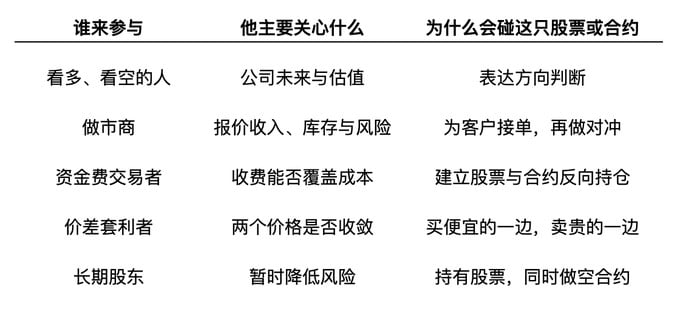
This also explains why some small and mid-cap stocks may receive an added influx. Large-cap stocks typically have more mature options, borrowing, and institutional derivative arrangements, resembling a business area with subways, buses, and multiple roads; adding another road might help, but people already had ways to get there. Small and mid-cap stocks with inadequate tools resemble a small town with only one road; some want to come but give up due to inconvenience.
People wanting to short can’t borrow stocks, shareholders looking to hedge can’t find suitable tools, arbitrageurs can’t assemble both legs, and funding fee traders may not even have products to trade. Perpetual contracts fill a gap and create opportunities for trades that otherwise wouldn’t have happened.
This mechanism applies to all stocks; the extra opportunities for small and mid-cap stocks arise from wider gaps rather than being more suited for leveraging. The hardest-to-trade stocks may not necessarily be the fittest for the first batch to go live. If a town cannot even accommodate delivery trucks, building an attractive entrance may not necessarily help shops do business. Hedge for underlying stocks, stock sources, and market-making capital must at least have basic conditions.
Paths Traveled in the Crypto Market
If you think these mechanisms are merely theoretical, the paths traveled by the crypto market might provide a surprise.
A small market capitalization for an asset does not mean that the trading market surrounding it can also only be small. Here, “malleability” refers to the ability of the same asset to fit into different trading combinations to satisfy different risk needs; the trading scale no longer depends solely on how many people are willing to buy and hold it over the long term.
ALPACA is an extreme case. It is the token of Alpaca Finance (unrelated to the similarly named U.S. securities brokerage infrastructure company). On April 24, 2025, Binance announced it would delist ALPACA: the perpetual contract would settle and stop trading on April 30, and spot trading would end on May 2. This reflects the market situation before the contract stopped trading after the delisting announcement. (See: https://x.com/agintender/status/1954160744678699396?s=20)
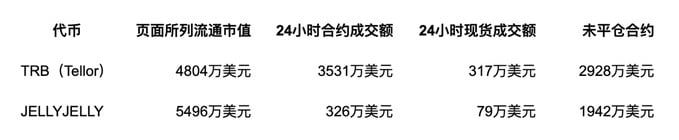
Typically, a mall posting an exit notice would lead to customers leaving. Yet ALPACA attracted another group during this phase: some bet on clearance discounts, some wagered that shorts were overcrowded, and others were willing to take orders and trade the price difference. The event review by BlockBeats recorded that after the announcement, its spot price fell to $0.029 at one point, with a market capitalization of about $5 million. This $5 million is an estimate from the initiation stage, not the market capitalization during peak trading volume later.
ALPACAUSDT spot and perpetual contract trading records:
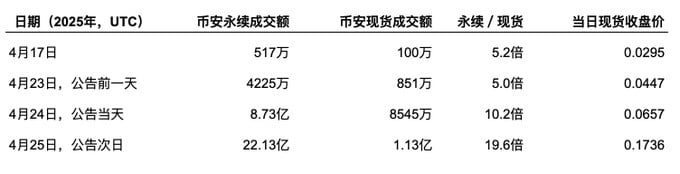
From April 23 to April 25, within two days, the daily transaction volume of contracts became 52.4 times the original, while spot trading became 13.3 times. The most persuasive aspect of this case is not how much the token price increased, but that the two trading channels for the same asset accommodated a nearly 20-fold difference in transaction volume. It illustrates that low market cap does not mechanically limit high-value contract trading.
Why can a “closure notice” attract so much trading?
Because after having perpetual contracts, traders have increased “reasons for trading.”
Before, they only needed to ask, “What is this project worth?”; now they can also ask, “Is everyone too bearish?” “How much do I pay every hour for holding this position?” “Why are quotes different at other exchanges?” “After hedging both sides, is the remaining profit enough to cover costs?”
The funding fee especially functions like a constantly changing parking fee sign. Assume a market has a negative funding fee rate of 0.1% per hour; under usual rules, short positions pay longs. Holding a nominal long position of $100,000 could earn $100 per hour; if the rate and nominal amount remain unchanged, that’s $2400 per day. This number is merely a mechanism example, not ALPACA’s historical actual rate. Someone skeptical about the project might still consider going long on the contract due to this income while borrowing coins to sell the spot for hedging. If borrowing coins is impossible, too expensive, or if rates shift, trades cannot be executed. What the contract increases is the justification for participation, but it does not eliminate the cost of participation.
Similarly, if a trader sees a positive funding rate, they can buy spot stocks and short contracts; another trader might just trade the price difference between two platforms. For them, the target is primarily a set of calculable prices, costs, and risks; only secondarily is it an investment story they need to believe in. This is the significance of perpetual contracts: allowing more people to join this game for different reasons.
Beyond extreme market conditions, small-cap assets can also maintain a considerable scale of derivative trading; for examples from the data of TRB and JELLYJELLY on September 10, 2025:
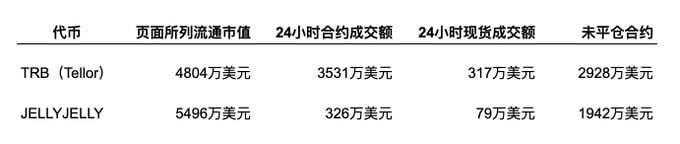
We can see that the open interest (OI) of a cryptocurrency with a market cap of around $50 million accounts for two-thirds of its market cap, while contract trade volume accounts for 70% of the market cap.
This also helps us understand why “trading volume exceeds market cap” is not surprising. Imagine a wholesale store with inventory worth $1 million: inventory can rotate repeatedly, just as traders can open and close positions multiple times. Adding a margin system, a contract nominal amount of $100 does not necessarily need $100 in cash as a margin. The same capital can rotate multiple times, leading to transaction amounts far exceeding the principal. Market cap represents the price of the asset, transaction volume is the daily flow, while open interest is the nominal risk not yet settled, and order book depth is closer to how much inventory can potentially be cleared. These four do not substitute for each other.
Then, if even small-cap cryptocurrencies waiting to be delisted can form such dense contract trading, do fundamentally sound stocks valued in billions or tens of billions have even more opportunities?
You tell me?
The judgment supported by these data is: one cannot simply assume that “small market cap” means it cannot sustain an active derivatives market.
The key is not market cap, but whether the mechanism can gather people with different viewpoints and trading purposes in one place to express their opinions with money.
If stocks want to use perpetual contracts to access new funds, they need to invite not only those optimistic about the company but also those willing to question it and those who can bear risks on both sides with capital.
The market does not need everyone to believe the same story to have a chance to expand participation. Those who are optimistic about the company can gain exposure, while those unwilling to bear the same directional risk can meet their needs with hedging combinations. For small and mid-cap stocks with fewer trading channels, this may bring new buy and sell orders, holding methods, and research momentum, provided that hedging and risk management can support these trades.
The double-lane road hasn’t disappeared; there’s now an elevated bridge above it. People might not go to the same places, but they can all contribute to increasing traffic on this road for their own reasons.
Understanding the why and also the how.
May we always maintain a sense of awe.
免责声明:本文章仅代表作者个人观点,不代表本平台的立场和观点。本文章仅供信息分享,不构成对任何人的任何投资建议。用户与作者之间的任何争议,与本平台无关。如网页中刊载的文章或图片涉及侵权,请提供相关的权利证明和身份证明发送邮件到support@aicoin.com,本平台相关工作人员将会进行核查。


