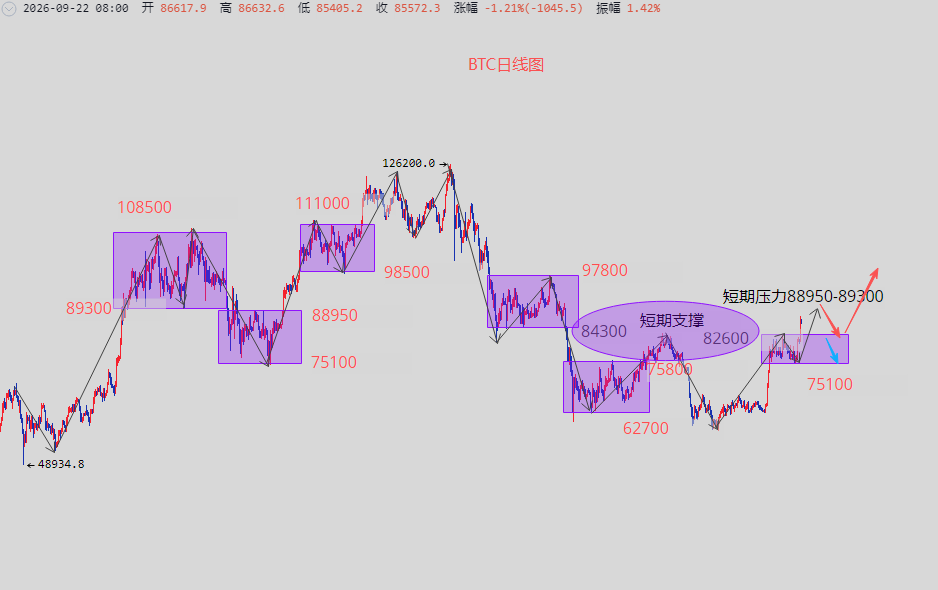
The President of the St. Louis Federal Reserve, Musalem, is leading a shift towards a more "hawkish" stance—he believes that U.S. inflation has evolved from an initial supply-side shock to a persistent high level driven by both demand and supply. To rein in this force, the current policy interest rate "may not be high enough" and needs to be further raised. Accompanying such hawkish statements, the tug-of-war between the Federal Reserve and the market was immediately reflected in the probability distribution on the CME's "Fed Watch" tool: the probability of maintaining the interest rate at 3.75%-4.00% in October dropped to 43.5%, while the probability of a 25 basis point rate hike rose to 56.5%, with rate hike expectations for the first time surpassing half; looking ahead, the probability of keeping rates unchanged in December was priced at only 9.7%, with the market almost evenly split between a cumulative 25 basis point and 50 basis point increase—46.4% for the former and 43.9% for the latter—reflecting unease about "higher rates for a longer time." In this macro context, AMD's market value reportedly surpassed $1 trillion for the first time in history, becoming a sample of tech stocks still embraced by capital amid rising tightening expectations; one side features the officials' game against the market on the interest rate path, while the other sees risk assets and cryptocurrency market sentiment oscillating between the "tightening anchor" and the "shadow of bubbles."
Hawkish escalation: Musalem ignites rate hike expectations
The sudden rise in the probability curve on the CME's "Fed Watch" tool was largely triggered by Musalem. In a recent speech, the St. Louis Fed President stated that U.S. inflation pressures are no longer limited to fluctuations in energy prices but have spread to inflation driven by both demand and supply—essentially signaling to the market that the initial "temporary shocks" attributed to the pandemic, war, and transportation bottlenecks have evolved into endogenous, demand-related price increases that are harder to suppress. For this reason, he emphasized that to curb inflation expectations, the policy interest rate may still need to be further raised, clearly directing the hint of "rates are not yet high enough" to traders.
Musalem is not alone. Almost concurrently, other Federal Reserve officials publicly stated that monetary policy may still need to be tightened further, this coherent hawkish rhetoric has pulled the market's originally vague imaginings of "how far to hike" and "how long to hike" back to a higher, more enduring endpoint. For funds positioned in highly valued tech stocks and crypto assets, these statements are not just news; they are signals that force them to redraw the yield curve and adjust discount rate assumptions. The re-pricing of the interest rate path is essentially testing whether the judgments of Musalem and others regarding "demand-driven inflation" will evolve into a longer-term tightening reality.
56.5% versus 43.5%: The two paths the market bets on
As Musalem pulls the endpoint interest rate upward, interest rate futures have already provided their own fork in the road. The CME's "Fed Watch" tool shows that in the October meeting, the probability of maintaining rates at 3.75%-4.00% is 43.5%, while the probability of a 25 basis point rate hike is 56.5%. This is not an "absolute certainty" bet; rather, traders have nearly split their chips down the middle on two paths: one is to hit the pause button and see if inflation falls back on its own; the other is to push rates higher again following the officials' hawkish statements. The structure of 56.5% to 43.5% reflects hesitance on the short-term path—the market acknowledges that the likelihood of another hike is greater, but still reserves nearly half of the narrative for "waiting and seeing."
What is truly alarming is the probability distribution for December. The same tool shows that by December, the probability of keeping rates unchanged is only 9.7%, with the probability of a cumulative 25 basis point rate hike at 46.4% and a cumulative 50 basis point hike at 43.9%. In other words, in the world of interest rate futures, "at least one more hike by December" has almost become an assumed premise, while the weight for "two more hikes" is nearly equivalent to that of "only one hike." This probability structure is essentially a scenario assumption penned by traders in price: they are no longer debating whether to hike again, but rather weighing whether to "hike once and then peak" or "hike several times, extending the tightening cycle." When these numbers are mapped onto discount rates and asset valuations, the divergence of 56.5% versus 43.5% is no longer just a simple probability game but a collective vote on the length of the entire rate hike cycle and the height of its endpoint.
In the shadow of rate hikes, AMD’s trillion-dollar countertrend
While traders are still deliberating whether to "hike once more" or "hike several more times," another price curve has already provided an entirely different answer—reports indicate that AMD’s market value has surpassed $1 trillion for the first time in history. Against the backdrop of rising rate hike expectations and increasing discount rates, the tech sector, which should be the most sensitive to interest rates, has surprisingly seen a structural rally led by a few major players, achieving both market cap and valuation increases. This contrast of "macro tightening while individual stocks rally" indicates that risk appetite has not completely retreated from the market but has been heavily concentrated on a few tech blue chips regarded as "high growth + high moat," with capital trading at a higher valuation premium for a seemingly safer certainty of future growth.
In this scenario, so-called "safe havens" are no longer traditionally defined risk-free assets, but rather those few tech stocks selected by consensus; conversely, other high-beta assets can only compete for attention in the remaining liquidity. For crypto assets, which also rely on liquidity and risk appetite, this means a new weighing: in an environment of rising interest rates and re-priced corporate earnings, would capital bet on U.S. tech giants supported by cash flow and a clearer regulatory framework, or on more volatile crypto assets with stronger narrative flexibility? AMD's trillion-dollar countertrend challenges traditional valuation frameworks and acts as a mirror reflecting the intense competition for the same pool of risk capital between U.S. stocks and cryptocurrencies under the same interest rate expectations.
U.S. tightening, loosening elsewhere: Global rhythm misalignment
As U.S. officials continue to hint that monetary policy may be further tightened, attempting to suppress demand-driven inflation with higher rates, other major countries are adjusting their rhythms in a completely different coordinate system. The Russian government has announced the exemption of grain export taxes until the end of this year, aiming to stabilize domestic agricultural supply chains and overall export volumes, which is a form of "soft control" that bypasses interest rates to directly influence food supply and exports. Almost simultaneously, Trump publicly called the ongoing Russia-Ukraine conflict "absurd," urging for a quick resolution to the conflict—this voice brings geopolitical issues back to the center of the inflation narrative—an extended war means food and energy uncertainties linger for a longer time; meanwhile, with the Russian side choosing to ease export burdens and the U.S. still responding to rising prices with high rates, the global price system is pulled in different tensions between war and policy.
China, on another timeline, has arranged its agenda. The Political Bureau has decided that the fifth plenum of the 20th Central Committee will be held in Beijing from October 26 to 29; this meeting is broadly seen as a key juncture for top-level design regarding mid-to-long term development paths. In response, the People's Bank of China held a seminar with foreign financial institutions, reaffirming its commitment to steadily expanding the two-way opening of financial markets, providing global capital with a coordinate system independent of the Federal Reserve's rate hike rhythm amid tightening external conditions. On one side, the U.S. continues to tighten through interest rate leverage; on the other side, Russia reduces burdens on grain exports, while China advances its agenda of high-quality development and financial opening at its own pace. The three forces’ different responses to inflation, growth, and openness combine to form a backdrop of macro rhythm misalignment and lay the groundwork for subsequent structural divergences in the direction and volatility of risk asset prices.
From rate game to asset choice: After 56.5%
As officials like the President of the St. Louis Federal Reserve repeat "rates may need to go up further," the CME probabilities reflect a path filled with hesitation: the probability of a 25 basis point hike in October stands at 56.5%, while by December, the market is almost evenly split between one more hike or two. The officials’ notion of "inflation driven by both demand and supply" supports the narrative of "higher rates for longer,” while CME probabilities reflect a consensus among traders that rate hikes are not yet finished, but there is still a lack of certainty regarding endpoints and rhythms; this divergence in resonance makes the interest rate path itself the greatest macro uncertainty. For investors, especially participants in crypto assets, the focus needs to tighten on three clues: first, how CME probabilities rearrange before and after each meeting; second, whether inflation data continues to show stickiness; third, whether employment indicators slide from "overheating" to "cooling." In past rate hike cycles, risk assets have often reacted magnified to slight changes in these expectations. In scenarios where actual rate hikes fall at or even above the current market pricing cap, risk assets may face double contractions in sentiment and liquidity, subsequently lowering the volatility center in the crypto market; conversely, if data unexpectedly weakens and rate hikes stagnate around the median provided by CME, a potential "sigh of relief" rebound may occur in the short term, where the true direction of prices will depend on how these data rearrange risk premiums between the interest rate game and asset choices.
Join our community to discuss together and become stronger!
AiCoin exclusive Hyperliquid benefits: https://app.hyperliquid.xyz/join/AICOIN88
AiCoin exclusive Aster benefits: https://www.asterdex.com/zh-CN/referral/9C50e2
On-chain Telegram community: https://t.me/AiCoinWhaleData
On-chain community: https://www.aicoin.com/link/chat?cid=N6OVMor5g
AiCoin on-chain Twitter: https://x.com/aicoinwhaledata
免责声明:本文章仅代表作者个人观点,不代表本平台的立场和观点。本文章仅供信息分享,不构成对任何人的任何投资建议。用户与作者之间的任何争议,与本平台无关。如网页中刊载的文章或图片涉及侵权,请提供相关的权利证明和身份证明发送邮件到support@aicoin.com,本平台相关工作人员将会进行核查。