
Author|Ethan @IOSG
TL;DR
Since 2026, Binance has delisted 42 tokens from spot trading, surpassing any complete year since 2022; 28 tokens were removed from U-based perpetual contracts. On average, there has been a batch announcement of delistings every 28 days, indicating that delisting is accelerating.
The tokens delisted from spot trading are older tokens, while those from contracts are newer tokens. The median lifespan of spot tokens at the time of delisting has increased from 4.1 years in 2022 to 5.1 years in 2026, while for contracts it has decreased from 1.3 years to 0.8 years.
For tokens that have been delisted from both Binance's contracts and spot trading, the typical delisting path is from Perps to Spots.
The key deciding factors for survival are FDV and OI, not trading volume. Among spot tokens with an FDV below $10 million, 49% were delisted in 2026; none with an FDV above $100 million were delisted. Additionally, 10.6% of tokens in the daily trading volume range of $1 million to $3 million were delisted. The delisting rate for OI below $1 million is 31%, while it is 0% for OI above $20 million;
Binance's self-issued tokens provide no protection. Among the contract tokens delisted in 2026, 63% originated from Binance Alpha, and of the 42 delisted spot tokens, 11 came from either Launchpool or Launchpad.
This article's data comes from Binance official announcements, the Binance exchange, and CoinGecko, covering a complete historical record of 144 spot delisting events and 150 contract delisting events from February 17, 2022, to August 11, 2026. It primarily focuses on the 2026 Binance token delisting events, aiming to analyze the elimination logic behind them, examining the key influences on token survival from aspects such as token source, fully diluted valuation (FDV), and trading volume, providing quantitative references for secondary market investors to identify delisting risks and for project teams to conduct shelf management.
The Number of Spot Delistings in 2026 Has Set a New High Since 2022, with Accelerating Delisting Batches
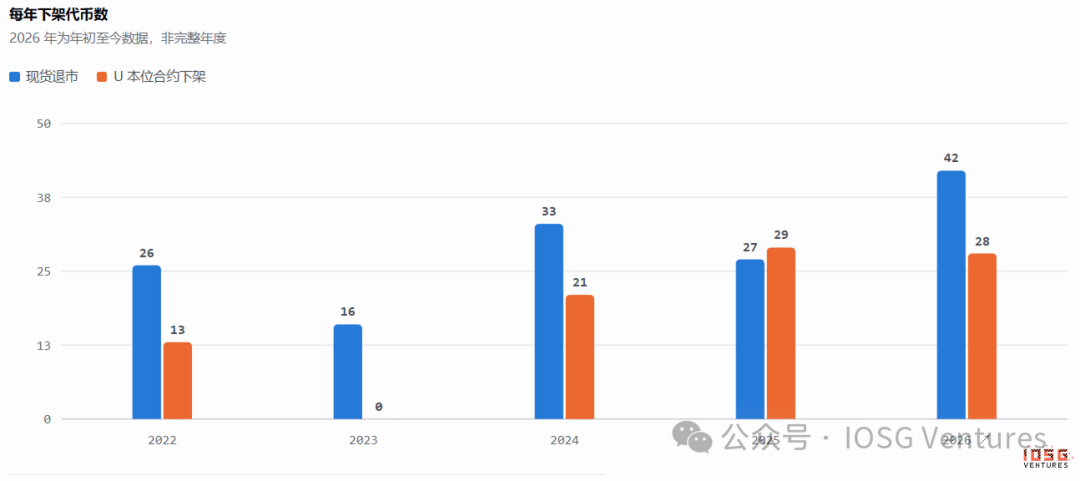
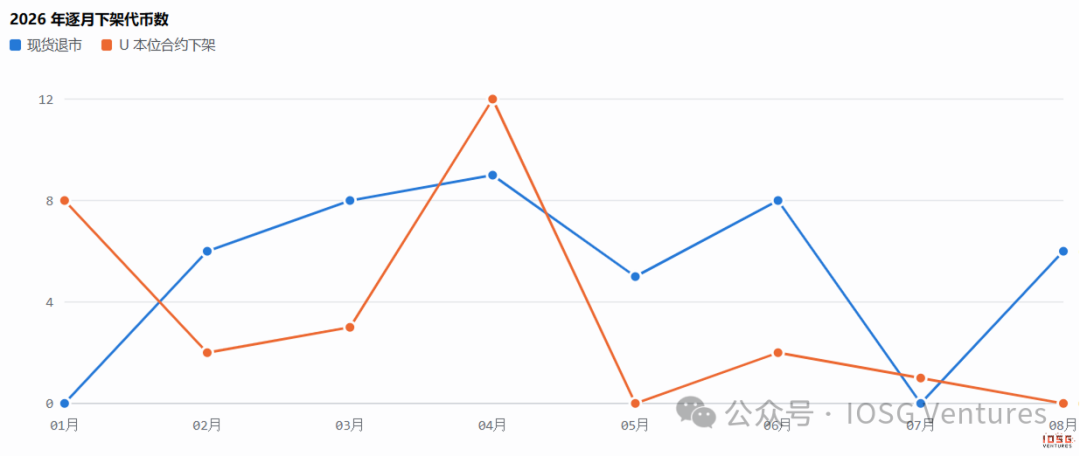
42 from spot and 28 from contracts; this is the delisting count over the past 8 months. The spot delistings have already exceeded the peak number from the previous four years, and with the impact from the U.S. stock market, this figure is expected to continue to grow significantly by the end of this year.
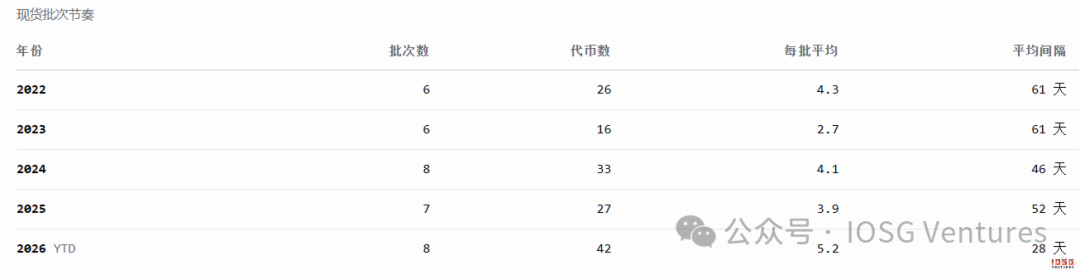
The delisting batches are accelerating: in 2026, there has been an average of one batch every 28 days, compared to just an average of 52 days per batch in 2025. Each batch consists of more tokens, with an average of over 5 per batch. The time intervals between eight batches of announcements range from 8 to 44 days, with the shortest being two batches on April 9 and April 17, resulting in 9 tokens delisted in a single month.
Older Tokens Are Being Delisted from Spot, while Newer Tokens Are Being Removed from Contracts
The median lifespan at the time of delisting is 4.1 years for spot (2022) → 5.1 years (2026), and for contracts it is 1.3 years → 0.8 years. Among the 42 delisted spot tokens, 31 were listed in 2021 or earlier, with PIVX, FUN, and LRC lasting 8.6 years. All 28 contract delisting events are from contracts that were launched after 2024, with 23 launched in 2025, and 11 of them lasted less than six months.

Within the same exchange, the elimination logic of the two shelves is opposite.
Binance has historically listed 1114 assets, of which 284 were only listed on spot, 474 were listed on both shelves, and 356 were only on contracts. Among the contract tokens delisted in 2026, 93% had never been listed on spot; they never entered the pool that requires custody, node maintenance, and compliance commitments.
The contract layer is a low-commitment pricing layer: cash settlement, no custody required, and no endorsement required, which allows for quick listing of popular narratives and quick removals. The spot layer involves custody and endorsement, with every token listed representing long-term wallet, node, and compliance responsibilities. The different delisting rhythms of the two shelves are due to the differing costs associated with listing.
Therefore, viewing these two lines together: spot delistings are cleaning up historical inventory, while contract delistings are retracting speculative exposure.
Delisting Path: From Perps to Spot
Statistics for projects delisted from one of the two shelves:
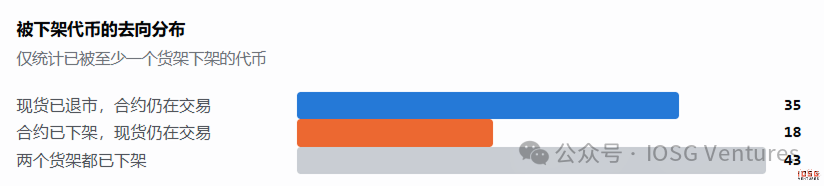
There are 35 tokens that “have been delisted from spot but are still trading on contracts," whereas only 18 are in the reverse situation, and 43 tokens have been delisted from both shelves.
Delisting from spot saves real operational costs, while also reducing regulatory and reputational exposure; delisting from contracts does not save costs and requires forgoing potential returns, including volatility, funding rates, and liquidations. An asset that has completed its fundamentals can still generate profits as a pure financial derivative.
Which Projects Are Disappearing
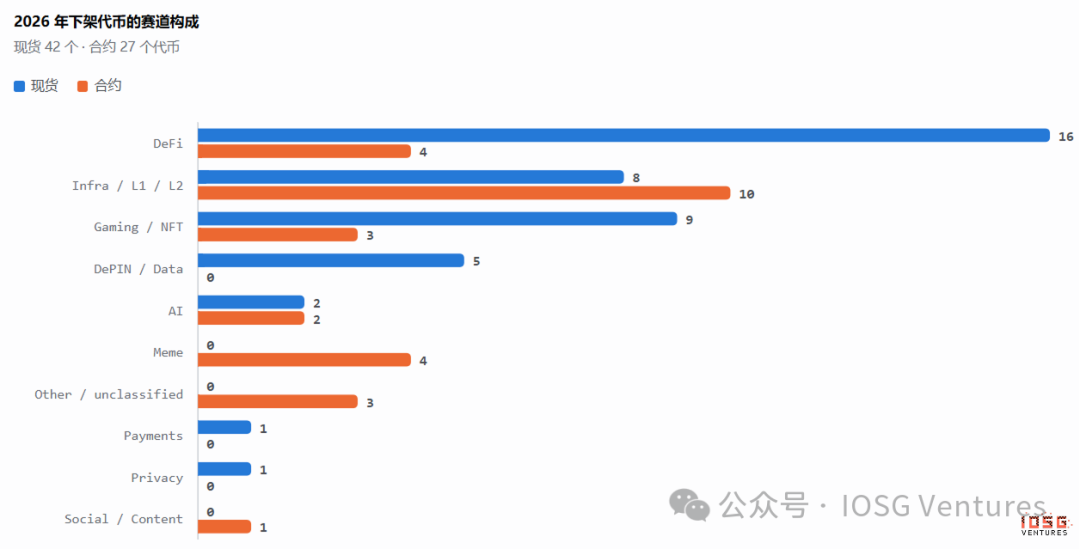
The composition of the 2026 spot delistings: 16 from DeFi (38%), 9 from Gaming/NFT (21%), 8 from Infra/L1/L2, and 5 from DePIN/Data. The first two categories account for nearly 60%, with the vast majority being assets listed from 2020 to 2021, with 20 out of 42 concentrated in these two years.
The contract delistings show a completely different composition: 10 from Infra/L1/L2, 4 from DeFi, and 4 from Meme, primarily cleaning up narratives from the past two years.
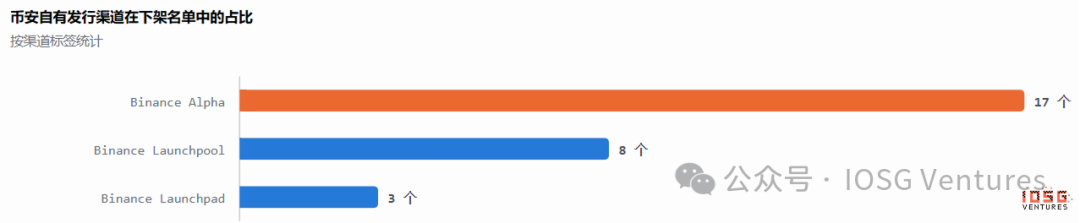
Binance's self-issued channels account for a significant proportion of the list. Among the contract tokens delisted in 2026, 63% came from Binance Alpha Spotlight, including ZKJ, PUFFER, TANSSI, and YALA; of the 42 delisted spot tokens, 11 (26%) came from Launchpool or Launchpad, including NTRN, RDNT, HIGH, MBOX, and HFT. The most extreme case is A2Z, a Launchpad project that was listed on spot in July 2025 and delisted in April 2026, surviving for just 8 months.
Going through Alpha or Launchpool provides only a one-time distribution and a period of exposure, not a long-term seat.
The Key Factors for Survival Are FDV and OI, Not Trading Volume
For Binance spot trading, comparing the tokens delisted in 2026 with those that remained listed in the same intervals based on FDV and trading volume metrics shows the delisting rates in each interval.
Delisting Rates for Spot Based on FDV
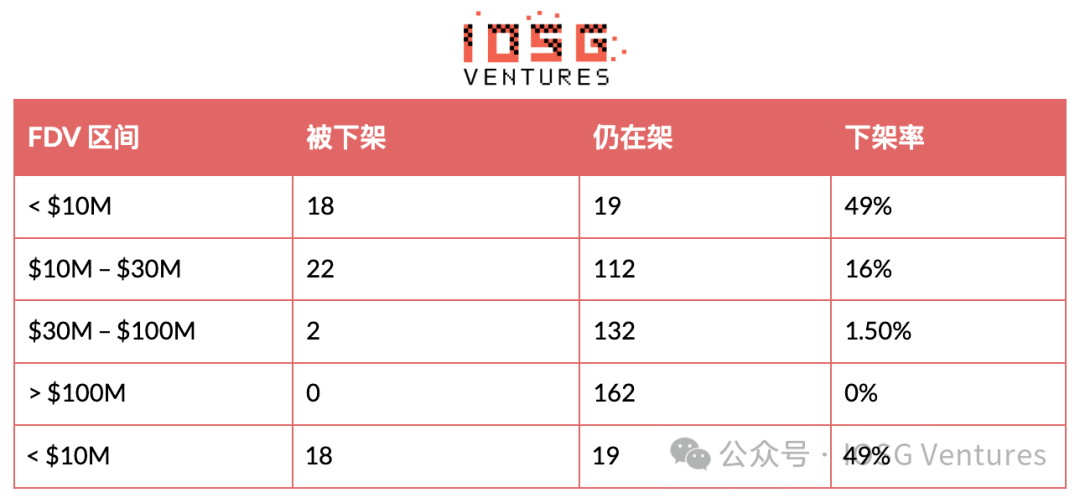
Delisting Rates for Spot Based on Daily Average Trading Volume
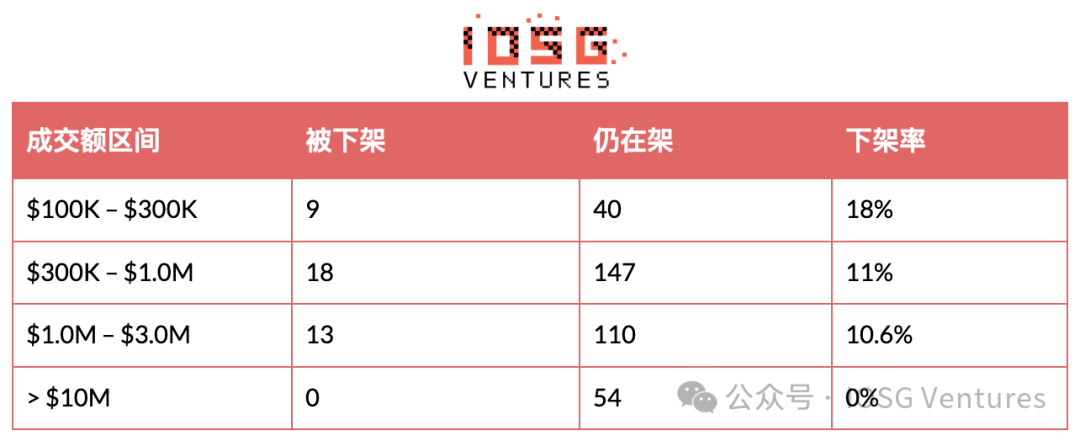
The distinction in delisting rates among the delisted projects based on FDV is very clear. The threshold of $10 million FDV sees a drop in the delisting rate from 49% to 16%, crossing two orders of magnitude in between; the delisting rates for trading volumes between $100K m and $3 million are nearly a flat line, ranging between 10% and 18%. Checking the quartiles also reflects the same: the median FDV for the spot delisting group is $10.53 million, while for the listed group it is $56.88 million, a difference of 5.4 times; the median trading volume is $650,000 compared to $1.19 million, only 1.8 times apart.
Regarding contracts, we mainly focus on the Open Interest (OI) indicator.
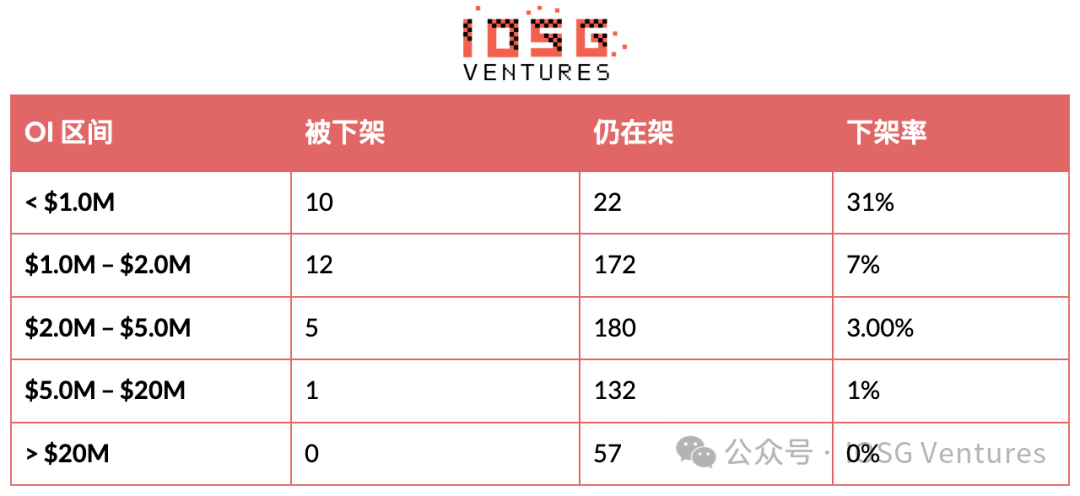
U-based Contracts Delisting Rates Based on Open Interest (OI)
U-based Contracts Delisting Rates Based on Daily Average Trading Volume
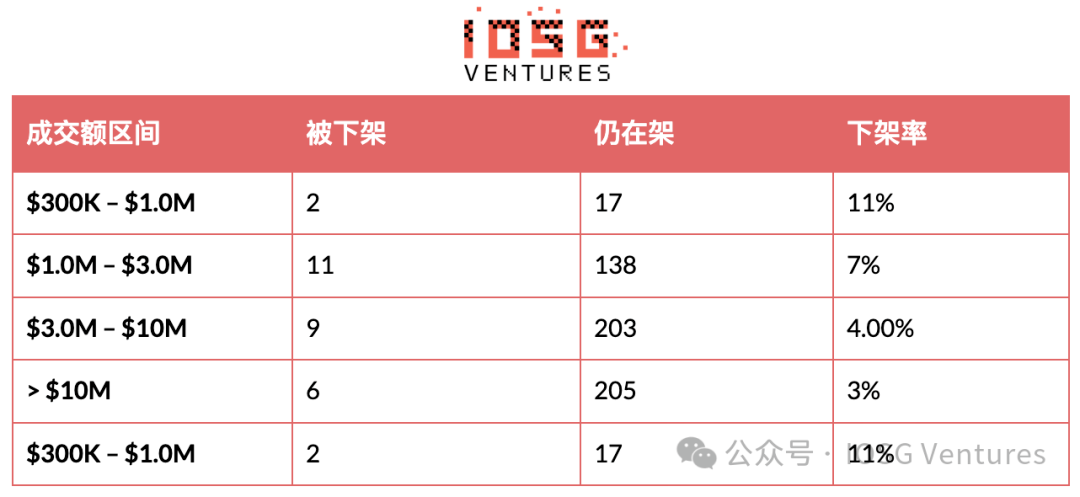
The delisting rate for OI below $1 million is 31%, while for OI above $20 million it is 0%; the median OI for the delisted group is 1.21 million, while for the non-delisted group it is 3.13 million. Moreover, contracts with trading volumes over $100 million still have a 2.8% delisting rate; COMMON had a daily average trading volume of $29.35 million, and RVV had $2.854 million in trading volume, yet were still removed from Binance contracts.
Trading volume is easily manipulated by wash trading, high-frequency quant, or frequent short-term turnover, meaning that even daily trading volumes showing millions of dollars may just be low-cost “wash noise” within a small pool, failing to reflect the asset's true health. In contrast, FDV represents the overall capital sunk into the project and its pressure resistance base, determining the support for spot; OI represents the actual margin and speculative funds accumulated in the market, determining the depth and risk control safety of contracts. Hence, FDV and OI are the hardest indicators reflecting an asset's long-term survival value and risk threshold.
Inspiration
#
For Project Teams: Focus on Capital and Fund Accumulation, Abandon False Volume Manipulation
Abandon False Volume Manipulation: Trading volume cannot cover liquidity exhaustion. Trading volumes created by market makers and quantitative wash trades cannot serve as a shield; risk control solely looks at fund retention.
Guard the FDV/OI Defense Line: For the spot, the project must maintain market value and capital accumulation (FDV above $10M); for contracts, it must bring in real hedge and speculative funds (OI above $1.0M).
Channel Exposure Does Not Equal Protection: Binance Alpha or Launchpool/pad only provide initial exposure; if there is no real ecosystem and funds following the listing, tokens can also be quickly delisted.
#
For Investors: Beware of False Liquidity, Track Hard Risk Control Indicators
Avoid High Trading Volume Traps: Stay vigilant towards assets with high trading volumes but low FDV or low OI, as such assets are often false appearances created by volume manipulation and are at risk of liquidation and delisting at any time.
Set Delisting Warning Lines: Maintain spot FDV at $10M and contract OI at $1.0M as high-risk delisting lines; promptly liquidate or reduce leverage to avoid liquidity depreciation and liquidation losses.
Differentiate Shelf Elimination Logic: Established DeFi/Gaming projects with shrinking FDV should guard against spot delistings; new narrative projects from recent years lacking OI in contracts should be wary of the chain sell-off risks from derivatives delisting.
免责声明:本文章仅代表作者个人观点,不代表本平台的立场和观点。本文章仅供信息分享,不构成对任何人的任何投资建议。用户与作者之间的任何争议,与本平台无关。如网页中刊载的文章或图片涉及侵权,请提供相关的权利证明和身份证明发送邮件到support@aicoin.com,本平台相关工作人员将会进行核查。


