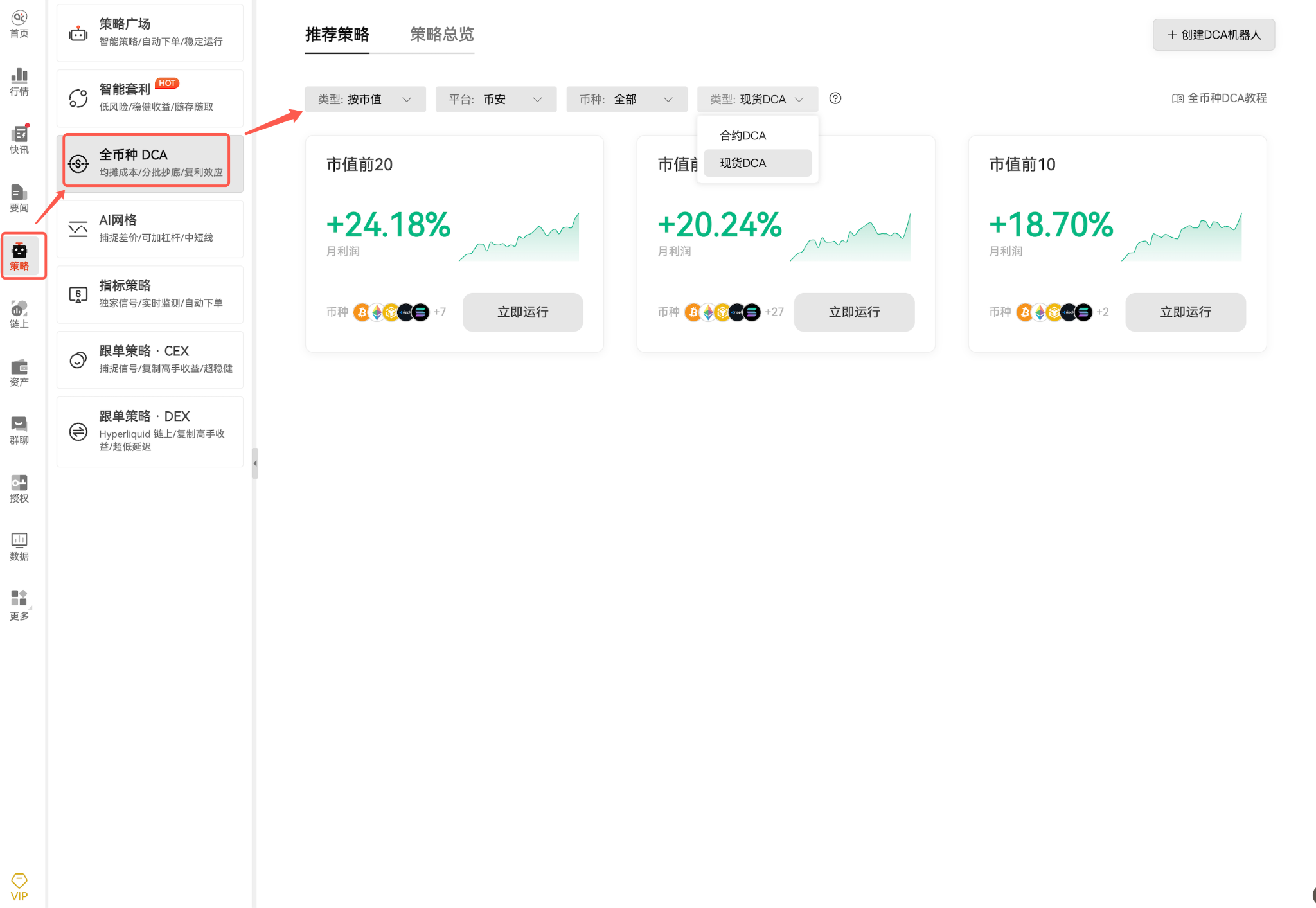
If all promotional pages of perpetual DEXs were put together, the content seen would be almost indistinguishable: lower fees, faster speeds, more trading pairs, and higher capital efficiency.
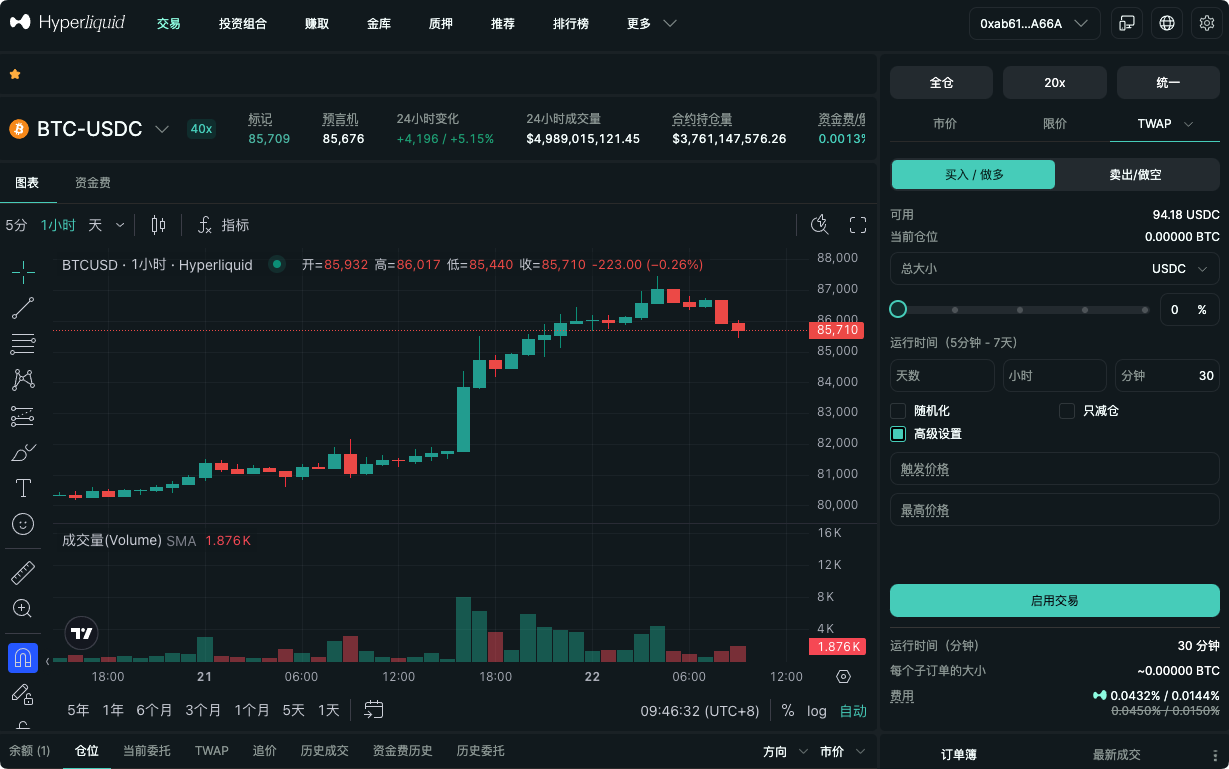
When it comes to making a choice, these words are of little help.
The question traders need to answer is another: When the market suddenly moves, am I willing to entrust my positions, collateral, and execution to this system?
This is where Hyperliquid differentiates itself from most on-chain trading platforms.
It does not simply outperform other DEXs on a particular metric, but brings together several previously conflicting demands: the order book experience is close to that of centralized exchanges, assets and transaction records remain verifiable on-chain, funds are controlled by users themselves, and the trading targets extend from crypto assets to stocks, commodities, indices, and other real-world assets.
Choosing Hyperliquid is not merely picking an interface from a DEX list, but rather selecting a set of on-chain infrastructure that is closer to a complete exchange.
While competitors are searching for differentiation, Hyperliquid has become the default reference point
A valuable observation about the new generation of perpetual DEXs: the Matthew effect in this space is already quite pronounced. Latecomers will find it difficult to break through if they simply create another order book similar to Hyperliquid; they must find unique advantages in areas like channels, asset classes, liquidity forms, or AI.
His classification is quite specific: Lighter attempts to gain channels through the Robinhood ecosystem, Travix expands into Asian assets and computational assets, and Variational establishes different liquidity structures through request-for-quote (RFQ) and traditional financial hedging.
What seems to be about finding "the next Hyperliquid" actually illustrates Hyperliquid's position:
New platforms must not only prove that they perform well but must also explain why users should not directly choose Hyperliquid.
This is the default choice power.
It does not mean Hyperliquid is suitable for everyone. Some users may require assets from specific regions, broker channels, or institutional RFQ services. But in the general on-chain perpetual market, competitors increasingly need to provide additional reasons, while Hyperliquid itself has already become a benchmark.
First reason: It reduces the compromise between "on-chain" and "user-friendly"
In the past, using on-chain derivatives, traders often had to accept a set of compromises: matching is not fast enough, orders require frequent signatures, Gas costs are unpredictable, large transaction slippage is evident, and complex orders are not as complete as those on centralized exchanges.
Hyperliquid's core product choice is to use a Central Limit Order Book (CLOB) rather than relying on automated market-making curves. Limit orders, cancellations, executions, and settlements all occur on-chain, but the user experience is much closer to that of a professional trading terminal.
Hyperliquid officially positions itself as financial liquidity infrastructure and states that the underlying system can handle up to 200,000 transactions per second. Its goal is not to make users endure on-chain friction in exchange for decentralization but rather to allow transparency and performance to coexist.
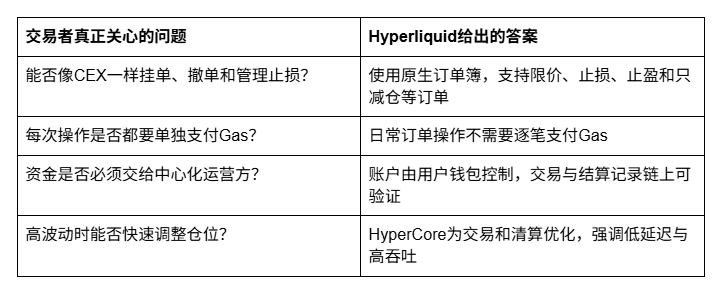
This is not a victory in technical parameters but a victory in usage habits.
Ultimately, traders will not stay due to a chain being more "pure," but rather because it interferes less with them in real market scenarios. Hyperliquid has gradually transformed on-chain trading from a specialized experience that requires adjustment to an order book product that ordinary traders can understand.
Second reason: Liquidity is not just a result but also the hardest product to replicate
Perpetual contracts have a clear network effect.
The better the depth, the lower the slippage for large orders, which attracts more professional traders; the more professional traders there are, the more willing market makers are to allocate funds; more market-making funds further improve the order book and execution. This is a typical "liquidity-user-liquidity" cycle.
This is also the most realistic aspect when choosing a trading platform:
Features can be replicated, but liquidity cannot be replicated through product documentation.
A new platform can produce similar candlestick charts, order books, and fee pages, but it cannot replicate a mature trading structure, market-making funds, API users, arbitrageurs, and settlement networks in a short time.
Thus, choosing Hyperliquid does not require believing in grand narratives first. As long as one is concerned about spreads, slippage, and exit capabilities in extreme market conditions, liquidity itself is already a reason.
Third reason: It provides not just more assets, but a set of open listing capabilities
If Hyperliquid only ever traded BTC, ETH, and SOL, it would still just be a relatively efficient crypto perpetual exchange.
What truly changes the platform's boundaries is HIP-3.
HIP-3 allows Builders to deploy independent perpetual markets and define contracts, oracles, leverage limits, and settlement methods themselves; new markets inherit HyperCore's order book, margin, and API infrastructure. Deployers need to stake 500,000 HYPE, and may face reductions for malicious or severely abnormal operations.
This means Hyperliquid does not have to be governed by a central team deciding all tradable assets. Different teams can connect stocks, commodities, indices, or other assets with reliable price sources to the same trading backbone.
The value of perpetual contracts is expanding from crypto speculation to broader continuous pricing tools. They have no expiration date and can express directions or hedge risks 24/7; as standard US stocks and commodities become widespread, the next round of competition will enter new categories like Asian assets, Pre-IPO, computational power, chips, and electricity. Hyperliquid's advantage is not that it has listed all future assets, but that it has established a mechanism that allows other teams to continue expanding the boundaries of assets.
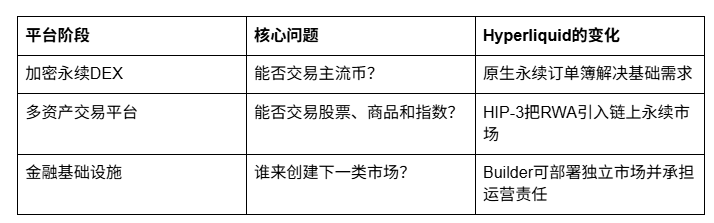
Having more assets doesn't necessarily mean better. HIP-3 still faces oracle, market manipulation, deployer capability, and regulatory risks. The official documentation also explicitly states that assets suitable for cross-margin must have observable liquidity, reliable external price sources, and strong resistance to manipulation.
However, from the user's perspective, choosing Hyperliquid means opting for a trading boundary that is still expanding, rather than a fixed list of tokens.
Fourth reason: It begins to answer "what money to trade with," not just "what to trade"
Mature traders choose platforms not only by looking at the number of markets but also at whether funds can be reused.
Hyperliquid’s Portfolio Margin incorporates spot balances and perpetual positions into a unified margin system. Spot and perpetual PnL can offset each other, and all HIP-3 DEXs are included in the portfolio margin framework. Eligible HYPE and BTC can be used as collateral, allowing users to supply stablecoins to earn interest or borrow funds when needed.
This allows the platform to start possessing collateral management and financing capabilities beyond being simply an execution venue.
For example, users holding BTC can establish corresponding perpetual short positions for hedging without having to prepare entirely separate funds for both legs; users holding HYPE but unwilling to sell directly can also gain purchasing power in stablecoins within acceptable risk limits.
Of course, capital efficiency has never been free. Borrowing incurs interest, falling collateral increases account risks, and portfolio margin may bring multiple positions into the same settlement system. The higher the efficiency, the more users need to understand the correlations between assets.
Therefore, the reason for choosing Hyperliquid is not "to have a larger leverage," but rather: the same capital can take on more functions among spot, perpetual, HIP-3, and lending.
Fifth reason: Users are not passive income contributors; Builders can also participate in the distribution
The logic of traditional trading platforms is simple: users provide trading volume, and platforms earn income.
Hyperliquid attempts to reshape this relationship into a more open economic network.
Official documents reveal that trading fees flow to HLP, the Assistance Fund, and market deployers. The Assistance Fund automatically converts trading fees to HYPE during L1 execution; the HYPE it holds is permanently removed from circulation and total supply according to existing rules. Deployers of HIP-3 and spot markets can share part of the fees generated by the markets they create.
Hyperliquid has also disclosed that independent teams have earned over $65 million through Builder Codes. Mobile applications, trading terminals, and self-custody wallets can serve their own users on top of Hyperliquid's liquidity without needing to rebuild an entire exchange.
This explains why Hyperliquid's goal is not simply to "defeat another DEX."
It aims to become a layer that other products can call upon for trading and liquidity foundation: HyperCore handles market, margin, and settlement, HyperEVM is responsible for programmable applications, and Builders manage user experience, assets, and distribution.
When more teams can build businesses around the same liquidity, platform growth will no longer be fully dependent on the official front end. This openness is harder to replicate than merely having a few more trading pairs.
Why choose Hyperliquid instead of mythologizing it?
Choosing a platform does not mean ignoring its drawbacks.
Hyperliquid's self-custody model returns private keys, signatures, and address security to users. It reduces the risks of centralized custody, but it also means that mis-signed transactions, mnemonic phrase leaks, and erroneous transfers often have no customer service to reverse them.
Moreover, the quality of HIP-3 markets depends on deployers and oracles; portfolio margin, while enhancing capital efficiency, can also amplify account-level liquidation risks; different jurisdictions may restrict access to certain products.
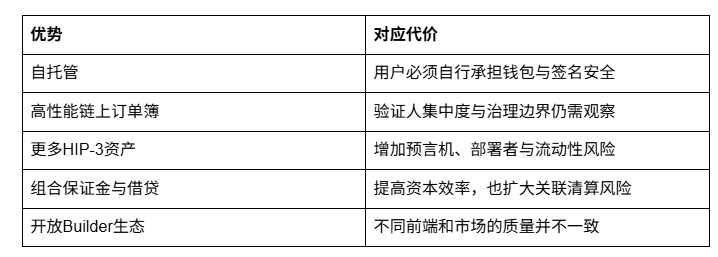
A truly reliable choice is never "this platform has no risks," but rather that the capabilities it offers are worth taking on understandable and manageable risks.
The value of AiCoin is transforming "choosing a platform" into a complete decision-making process
After choosing Hyperliquid, traders still face two questions: when to trade and who is driving the market.
Through the AiCoin mobile app, one can first observe whether price, trading volume, open interest, and funding rates verify each other, and then use smart money tracking to determine whether large holders are building positions, hedging risks, or retreating due to market sentiment. When faced with HIP-3 stock, commodity, or index markets, one can confirm liquidity and large order changes before deciding to enter.
Once judgment is made, connect to Hyperliquid through AiCoin to execute trades, managing different assets and positions uniformly on the mobile app. In this way, Hyperliquid provides the underlying liquidity and execution while AiCoin connects market behavior, fund actions, and mobile decision-making.
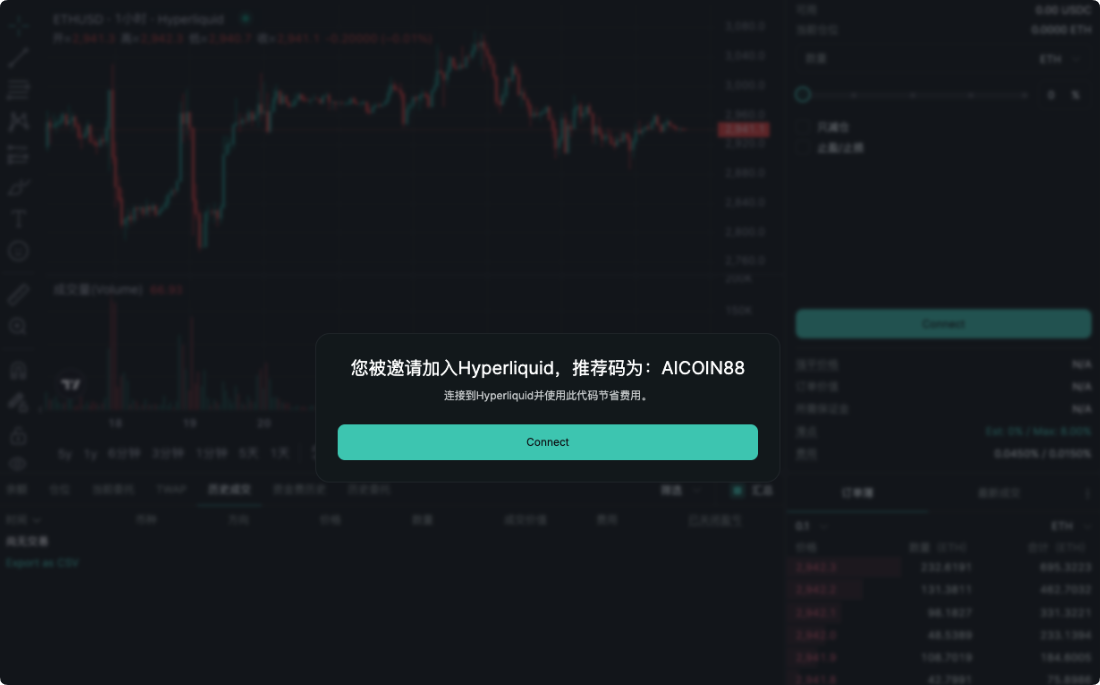
By entering Hyperliquid through the exclusive AiCoin portal and using the invitation code AICOIN88, you can receive 4% fee rebates according to the activity rules:
Exclusive link:
https://app.hyperliquid.xyz/join/AICOIN88
A 4% rebate will not change the outcome of a mistaken trade, but for long-term genuine traders, reducing the repeatable execution costs is part of what should be factored into choosing a platform.
Final judgment
Reasons to choose Hyperliquid can be summarized in one sentence: It allows on-chain trading for the first time without sacrificing too much trading experience for being "on-chain."
It has order books and execution efficiency close to centralized exchanges while retaining asset custody and public settlement; it expands from crypto perpetuals to the HIP-3 multi-asset market, and integrates spot, lending, and portfolio margin into the same capital system; it not only serves terminal traders but also allows Builders to establish new front ends, markets, and financial products around the underlying liquidity.
If later entrants wish to gain a foothold, they must offer something that Hyperliquid does not have in channels, assets, liquidity, or AI.
This does not mean Hyperliquid has won all future battles but rather indicates that it has achieved the most challenging position to establish – becoming the benchmark that others must explain "why not use it."
Good trading platforms help you complete a trade; truly worthy infrastructure allows assets, collateral, liquidity, and strategies to continuously work within the same system.
This is the most compelling reason to choose Hyperliquid today.
Exclusive benefits for AiCoin users
👉 Enter the invitation code AICOIN88 when binding your Hyperliquid account to enjoy a 4% fee rebate.
🔗 Exclusive registration link:
https://app.hyperliquid.xyz/join/AICOIN88
📖 Beginner tutorials:
"AiCoin PC Hyperliquid Authorization Trading Tutorial":
https://www.aicoin.com/zh-Hans/article/514197
"AiCoin Mobile Hyperliquid Authorization Trading Tutorial":
https://www.aicoin.com/zh-Hans/article/541383
"Zero-based Introduction! Hyperliquid First Trade Extremely Detailed Illustrated Tutorial":
https://www.aicoin.com/zh-Hans/article/510225
📖 Community exchanges:
Telegram:
https://t.me/AiCoinWhaleData
Discord:
AiCoin-Group Chat:
https://www.aicoin.com/link/chat?cid=N6OVMor5g
The content of this article represents the author's personal opinion and does not represent the position of this platform. The views, conclusions, and suggestions in the article are for reference only and do not constitute any investment advice related to this platform. Investing in US stocks still requires self-bearance of market risks, regulatory risks, and local legal and regulatory compliance risks (especially foreign exchange controls, offshore investment declarations, etc.)
免责声明:本文章仅代表作者个人观点,不代表本平台的立场和观点。本文章仅供信息分享,不构成对任何人的任何投资建议。用户与作者之间的任何争议,与本平台无关。如网页中刊载的文章或图片涉及侵权,请提供相关的权利证明和身份证明发送邮件到support@aicoin.com,本平台相关工作人员将会进行核查。