The Federal Reserve has just raised interest rates, and officials are sending hawkish signals
The Federal Reserve announced on September 16 that it had raised interest rates by 25 basis points, increasing the target range for the federal funds rate to 3.75%-4.00%.
This is the first time the Federal Reserve has raised rates again in more than three years.
However, the market has not fully digested this interest rate hike, and new hawkish signals are coming in.
St. Louis Fed President Bullard stated that the current inflation pressure in the United States is no longer just a result of supply-side shocks like energy prices and tariffs, but is spreading to a broader demand-side.
His assessment is very direct:
If inflation continues to exceed the target, the Federal Reserve may need to raise interest rates further.
This means that the issue the market now has to confront is no longer just "Why raise rates in September."
Instead, it is:
How far will this round of rate hikes go?
Inflation is no longer just about oil prices
One important signal from Bullard is his belief that the current inflation cannot be simply attributed to energy prices.
In July, the U.S. PCE price index rose by 3.7% year-on-year, significantly higher than the Federal Reserve's long-term target of 2%.
Meanwhile, the Federal Reserve's latest forecast shows a median PCE inflation rate of 3.7% for 2026, with core PCE at 3.4%.
More concerning is that corporate cost pressures are being passed on to consumers.
Fuel, raw materials, transportation, insurance, and some skilled labor costs are all rising, and some companies have already planned to further increase prices.
This creates a rather troublesome cycle:
Cost increase → Companies raise prices → Inflation persists → Federal Reserve continues tightening.
Therefore, Bullard believes that rather than waiting for inflation to solidify further before tightening significantly, it is better to implement small, gradual rate hikes sooner.
📌 If you want to continue tracking the impact of BTC, ETH, and macro data on the market, you can follow the public account "Crypto Lao Ding," which explains important market changes and the underlying logic every day.
Why an interest rate around 4% might still not be enough?
This may be the most impactful statement from this speech for the market.
Bullard believes that the current policy interest rate of 3.75%-4.00% is still relatively loose and has not reached a level that significantly restricts economic activity.
This differs from some previous views in the market.
Traditionally, many investors would assume that after the Federal Reserve experienced a long period of high interest rates, a rate around 4% would be enough to constrain the economy.
But the issue is:
The U.S. economy is not experiencing a clear slowdown.
The Federal Reserve's latest projections raised the actual GDP growth rate for 2026 from 2.2% to 2.3%, while the unemployment rate forecast was lowered from 4.3% to 4.1%.
In other words:
The economy is still relatively resilient, employment has not significantly worsened, and inflation remains above target.
This leaves room for the Federal Reserve to continue raising rates.
Will there be further rate hikes this year?
This question has already started to become a new focus for the market.
The Federal Reserve's latest dot plot shows that among the 18 decision-makers, 16 expect that at least one more rate hike of 25 basis points will be required before the end of 2026.
The median policy rate is expected to be 4.1% by the end of the year, corresponding to a range of 4.00%-4.25%.
In fact, the market pricing is even more aggressive.
Data from Reuters shows that investors currently expect that about three of the next five meetings may see a 25 basis point hike.
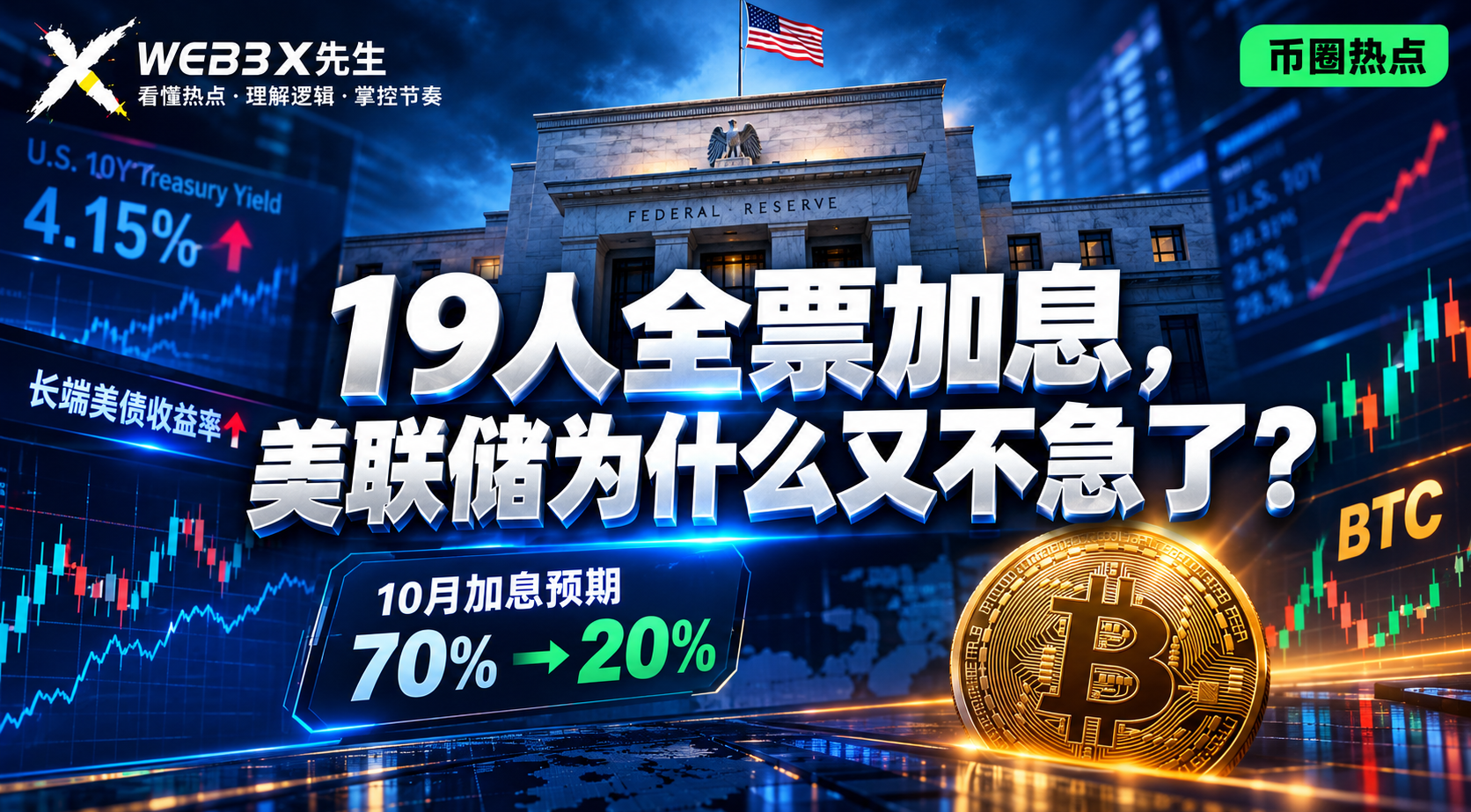
As for whether there will be another rate hike in the October meeting, the market pricing is nearly a coin toss.
So the market is undergoing a change:
Previously, the discussion was:
"Will the Federal Reserve raise rates again?"
Now it has shifted to:
"How many more times will the Federal Reserve hike? Where will the final rate end up?"
What does this mean for BTC?
For the crypto market, changes in the interest rate path are extremely important.
Because BTC and other risk assets are sensitive to U.S. dollar liquidity and market risk appetite.
If the market starts to reprice the Federal Reserve's terminal rate, it usually signifies:
Rate cut expectations are delayed, and high rates may persist for a longer time.
This would increase the potential support for U.S. Treasury yields and the dollar, while putting pressure on the valuations of risk assets.
BTC would also face greater liquidity challenges as a result.
Of course, this does not mean "if the Federal Reserve continues to raise rates, BTC will definitely decline."
The market is truly trading on:
Expectation differences.
If rate hikes have already been digested by the market, and subsequent economic data does not worsen further, BTC might still experience a rebound.
Conversely, if inflation continues to exceed expectations, and the market suddenly raises its pricing for future rate hikes, risk assets may come under renewed pressure.
📌 If you want to continue tracking the impact of BTC, ETH, and macro data on the market, you can follow the public account "Crypto Lao Ding," which explains important market changes and the underlying logic every day.
What really matters now is not just whether there will be a rate hike in October
For crypto investors, at least three variables are worth continuous tracking going forward.
First, U.S. inflation data.
Especially CPI and PCE.
If inflation continues to remain high, the Federal Reserve will have more room to tighten policy further.
Second, U.S. employment and economic growth.
If the economy and employment continue to show resilience, the Federal Reserve may not be in a hurry to shift towards easing.
Third, U.S. Treasury yields and the dollar.
These two variables often directly reflect the market's repricing of the Federal Reserve's interest rate path.
So what BTC really needs to watch next is not just whether the Federal Reserve raises rates in October, but rather:
Will the market's expectations for "higher rates for a longer time" further intensify?
📌Mr. Web3 X: The real change at the Federal Reserve is that the market is starting to reprice "how long high rates will last."
The most noteworthy aspect of Bullard's speech is not that "another official is being hawkish."
But rather:
The Federal Reserve's internal assessment of inflation is becoming more cautious.
If inflation has spread from supply shocks like energy prices and tariffs to the demand side, then the rate hike in September may not be a one-off policy action.
For BTC, what truly matters is not the statement of one official.
But rather:
Will inflation continue to stay high, can the economy maintain resilience, and will the market further delay expectations for easing.
These three variables ultimately determine the future liquidity environment of the crypto market.
—— I am Mr. Web3 X, with six years of growth in Web3, focused on Bitcoin, the crypto market, macroeconomics, and industry trends. If you wish to continue tracking the impacts of BTC, ETH, HYPE, and macro data on the market, you can follow the public account "Crypto Lao Ding." Understand the hotspots, insights, and logic, and develop your own judgments, rather than just focusing on price fluctuations.

免责声明:本文章仅代表作者个人观点,不代表本平台的立场和观点。本文章仅供信息分享,不构成对任何人的任何投资建议。用户与作者之间的任何争议,与本平台无关。如网页中刊载的文章或图片涉及侵权,请提供相关的权利证明和身份证明发送邮件到support@aicoin.com,本平台相关工作人员将会进行核查。