Written by: Rita
The market is concerned that the return cycle of AI capital expenditure is too long, but Microsoft's roadshow demonstrates that the corporate AI platform transformation is validating strategic decisions made over the past three years. Goldman Sachs maintained its buy rating (conviction buy list) for Microsoft in the NDR roadshow summary released on September 20, 2026, with a 12-month target price of $640. The current price is $493.78, indicating an upside potential of 29.6%. Goldman Sachs believes that several key decisions by Microsoft in the AI field are beginning to yield returns, including early investments in long-term capital expenditures, balancing capital expenditures between first-party applications and third-party customers, and balancing capital expenditures between frontier labs and enterprise customers.
Goldman Sachs analyst Gabriela Borges noted in her report that Microsoft has stronger control over the supply chain and capacity ramp-up than a year ago. The proportion of long-term capital expenditures in total capital expenditures has decreased from about 50% to about 33%, partly because Microsoft invested early in long-term assets like land, buildings, and shell structures. In short-term capital expenditures, CPU has replaced GPU as the largest component, with decisions made as late as possible in the binding process, resulting in a 50% reduction in GPU onboarding time. Microsoft has never indicated being limited by CPU or GPU; the constraints are more about the space for inserting chips.
Enhanced Capital Expenditure Control
Microsoft's control over capital expenditure is evident in several areas. The reduction in the proportion of long-term capital expenditures allows for greater flexibility in short-term capital expenditures. Microsoft believes that if the constrained portion of capital expenditures forms a small part of total capital expenditures, then Microsoft is generally better able to adjust the unconstrained portion to meet demand. Microsoft has clear visibility over the expansion of its most mature AI customers over the past three to five years, allowing for reasonable baseline forecasts of enterprise demand in the next three to five years.
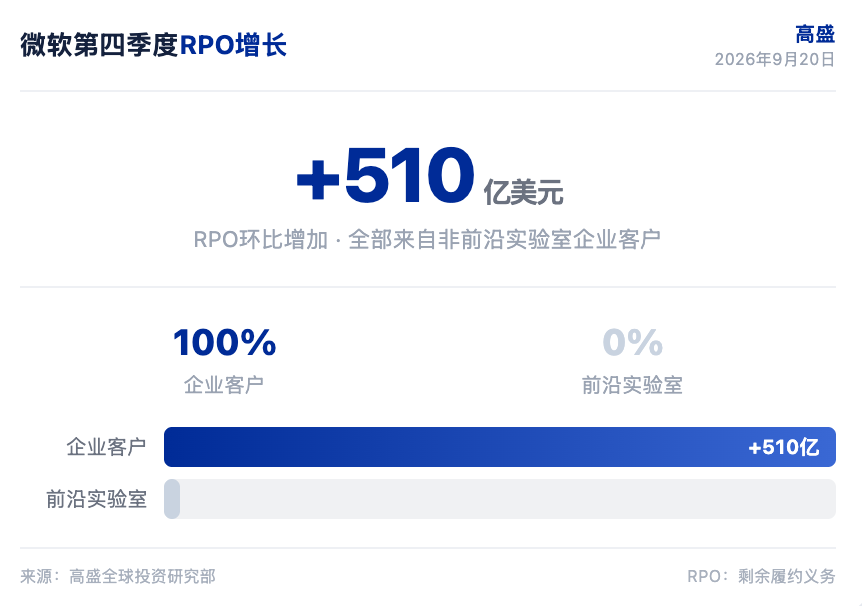
In pricing, Microsoft employs various pricing levers to optimize the lifetime value of long-term customers. Renewal discount rates are more moderate than usual. New SKUs (Stock Keeping Units, referring to product specifications or versions), such as in the CPU side, are launched at higher price points, altering the dynamic of price declines seen over the past decade. Weekly capacity is dynamically allocated between first-party applications, first-party model development, product roadmaps, and a broad customer base. In the fourth quarter, RPO (Remaining Performance Obligations, referring to the amount of contracted revenue not yet recognized) increased by $51 billion quarter-over-quarter, all from enterprise customers not in frontier labs.
Unit Economics Healthier than Cloud Cycle
Goldman Sachs believes the unit economics of Microsoft AI are healthier than those of the original cloud cycle at the same stage. A key insight is that Azure and first-party applications utilize a unified tech stack. Different tech stacks require more fine-grained matching, leading to lower ultimate utilization. Microsoft began capturing AI-native customers from the first year, whereas in the cloud cycle, it was a latecomer. Microsoft may provide more details on ROIC (Return on Invested Capital) in the coming months. The logic from Goldman Sachs is that if each cohort in this round leads the previous round, ROI will lead as well, unless rent allocation is uneven, such as flowing to semiconductor and token companies.
In the semiconductor area, Microsoft believes chip layers will become more diverse, much like CPUs. In terms of token rents, Microsoft thinks it can deliver sufficient value above third-party tokens and orchestrate between first-party and third-party tokens, minimizing the impact of margins over time. Microsoft believes there are no structural reasons preventing AI gross margins from approaching cloud gross margins. Revenue growth in the cloud will outpace capital expenditure growth, which is consistent with the maturing industry. The challenge is that demand signals are still rising, pushing up crossover time points.
Silicon Strategy Pursuing Minimum Cost Tokens
Microsoft aims to provide tokens at the lowest possible cost. Microsoft holds the intellectual property for Jalapeno and has a second option in the chip race besides MAIA. The recent progress of MAIA 200 is equivalent to that of the Trainium benchmark. Microsoft's vertical integration strategy, including model layers, allows for mixed silicon to avoid over-reliance on any single solution or architectural generation, especially during a time when new chip technologies are still evolving. This also gives customers the option to choose older generation silicon when reasonable.
On the self-built model strategy, Microsoft reiterates that it has benefited from leading-edge learnings from OpenAI, building on that foundation while seeking to architect its model independence after 2032. Microsoft has a clear model stack genealogy, reflecting OpenAI's learnings, but does not depend on OpenAI. MAI (Microsoft's self-developed model series) focuses on pairing leading-edge intellectual property with fields where Microsoft has substantial domain experience: knowledge workers (with 17EB of data in the M365 system), coding, and security. Benchmark tests have shown significant improvements in cost/performance. A recent example is Project Perception in the security field, used for ongoing penetration testing.
Leading Edge Pace Does Not Affect Current Demand
Microsoft points out that any new technology must drive social and economic value and that there is a long-standing history of regulatory encouragement to support safety and security. The bottleneck today is applying performance to enterprise use cases; original performance at the frontier is no longer the main constraint. Even in extreme thought experiments where frontier progress stops, there remains ample room for growth. On model diversity, Microsoft reiterates that the model ecosystem is evolving in real-time into a heterogeneous set of models across performance and price points; currently, Foundry hosts 11,000 models with an intentional multi-model approach. Microsoft did not provide directional color on cross-model economics, other than reiterating it does not pay OpenAI or MAI token fees and is comfortable with models that may require fees for support, as it has the ability to cross-sell higher-margin platform services.
Microsoft’s Scout, an autonomous agent, is based on OpenClaw but is enterprise-grade. Enabling low-cost and open-source models, in turn, frees up budgets for more usage or further transformations. Internally, Microsoft has successfully experimented with restricting frontier usage within engineering teams to optimize engineers who truly benefit from the frontier, avoiding those who see no obvious benefit. Regarding whether changes in frontier pace affect capital expenditures, Microsoft’s capital expenditure decisions reflect current demand signals, and changes in frontier pace do not impact current demand signals. Microsoft can opt to allocate new capital expenditures to frontier models but prioritizes capacity serving a broad customer base and various potential workloads. Closing Stargate capacity is a good example; the growth in the fourth quarter RPO entirely coming from non-frontier customers is another example.
M365 Enters Acceleration Year
Microsoft emphasizes that FY27 is the first year in recent history to guide acceleration. In terms of penetration rates for E5 and E7, new additions skew towards the lower end, namely frontline workers and small and medium enterprises. The E7 release has performed well, partly due to the visibility and value bundled with Agent 365. AI adoption will present itself differently across the entire base; penetration rate disclosures may be less useful. Application pricing software will evolve: more value will be embedded in seat-based SKUs, while consumption elements will accumulate over time as software more comprehensively addresses labor units/outcomes, replacing seat-additional value. In the long run, dollar opportunities in consumption outweigh dollar opportunities per user.
On the risks of software abstraction versus frontier models, Microsoft notes that frontier competitive dynamics are dynamic, and enterprises do not want to be locked into any single frontier model. Meanwhile, agents create more artifacts within the existing software ecosystem, making ecosystems like M365 more valuable. Microsoft’s core belief is that there is substantial value at the harness level, including persistent safety, context, and cost optimization, which may not be replicable by model companies in a model-agnostic manner.
Target Price of $640 Maintained for Buy
Goldman Sachs maintains a 12-month target price of $640, based on a 28x P/E (unchanged) multiplied by Microsoft’s adjusted net profit for SNTM. Key downside risks include longer-than-expected internal silicon ramp-up times, which could limit market share growth or margin expansion; project investments exceeding expectations; key leadership changes; and more significant shifts toward custom software may negatively impact application business.
Microsoft's corporate AI platform transformation is validating the strategic decisions made three years ago. If unit economics continue to lead the cloud cycle, and AI gross margins approach cloud gross margins, Microsoft's valuation premium will have fundamental support.
Disclaimer
This article is a summary and interpretation of a third-party brokerage research report (Goldman Sachs Group, September 20, 2026) by Chao Xiang Research, combined with publicly available market information. The ratings, target prices, earnings forecasts, and related judgments quoted in this article are solely the opinions of the analysts from that brokerage, representing their respective institutions' stance, not Chao Xiang Research's view, and do not constitute any investment advice.
The market has risks, and decisions should be made independently. This article should not be used as a basis for buying or selling any securities.
免责声明:本文章仅代表作者个人观点,不代表本平台的立场和观点。本文章仅供信息分享,不构成对任何人的任何投资建议。用户与作者之间的任何争议,与本平台无关。如网页中刊载的文章或图片涉及侵权,请提供相关的权利证明和身份证明发送邮件到support@aicoin.com,本平台相关工作人员将会进行核查。


