OpenAI released two new models, GPT-6 Sol and GPT-6 Luna, on Tuesday. It happened minutes after Anthropic launched Claude Opus 5.5, its own new flagship.
Sol and Luna sit below GPT-6 Astra, the model OpenAI called "the most intelligent and aligned model in the world" when it launched on September 3. Astra is still OpenAI's top pick for the hardest jobs; Sol and Luna are the cheaper, faster options built for everyday work.

Myriad: Which company IPOs next? Click to make your prediction.
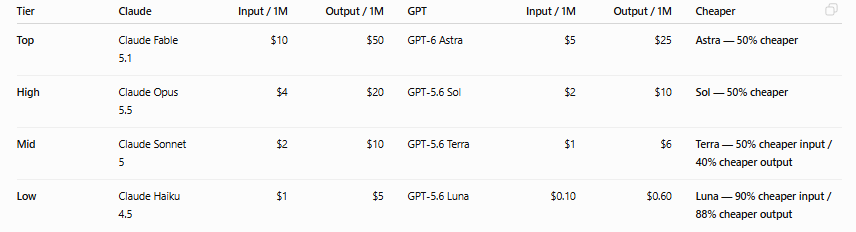
So it’s very similar to the same strategy Anthropic has applied. Astra being the equivalent to Fable, Sol being the equivalent to Opus, Terra being the equivalent to Sonnet, and Luna being the equivalent to Haiku (when it’s upgraded).
OpenAI also tweaked the price to remain competitive. The API costs for both models was reduced by 50% compared to GPT-5.6's promotional rates per token. Tokens are the chunks of text a model reads and writes, usually a bit less than a full word, and companies pay by the million because that's how AI bills add up at scale.
Sol now costs $2 per million input tokens and $10 per million output tokens, down from $4 and $20. Luna drops to $0.10 and $0.50, down from $0.20 and $1.20. Overall, OpenAI is the cheaper offer per tier when compared against Anthropic.
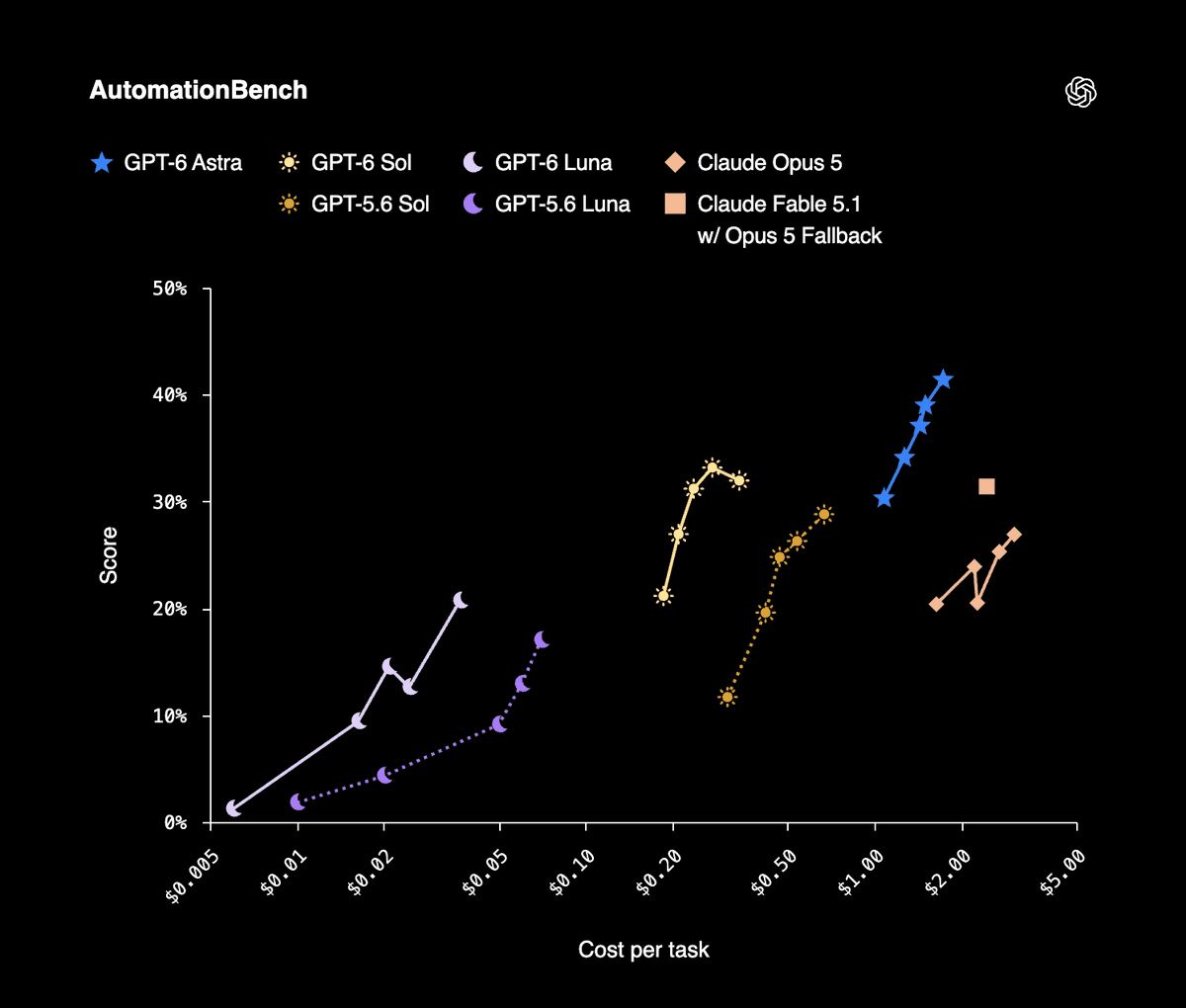
The performance case leans on AutomationBench, a benchmark built by Zapier that tests whether an AI agent can carry out a full business workflow using 47 tools spanning sales, marketing, operations, support, finance, and HR, scored as a pass rate. GPT-6 Sol at its highest reasoning setting scored 33.2% for $0.27 per task.
Claude Opus 5 at its own top setting scored 26.9%, but cost more than 11 times as much per task, according to OpenAI's own numbers. GPT-6 Sol also edged out Claude Fable 5.1, Anthropic's pricier flagship, on the same test.
On Agents' Last Exam, which evaluates AI agents on long, economically valuable work across 55 sub-industries and grades the results as a percentage completed, GPT-6 Sol at its highest effort scored 56.4%. OpenAI says that beats Claude Opus 5's best score at a 60% lower cost per task.
Reasoning effort is a dial OpenAI added: turn it up and the model spends more time and computing power double-checking itself before answering, which tends to raise accuracy and cost together.
For computer use—an AI agent clicking, typing, and navigating software the way a person would—GPT-6 Sol on OSWorld 2.0 nearly tied Claude Opus 5's medium-effort score, 60.5% to 60.3%, at about 80% less cost. OSWorld tests long, realistic computer tasks and reports a partial score based on how much of the job got done correctly.
GPT-6 Sol and Luna are live now in ChatGPT Work and Codex for Plus, Pro, Business, Enterprise, and Edu subscribers, with Luna also reaching free and Go users through the desktop app.
Neither model is in the plain ChatGPT app yet, and OpenAI says it's rolling both out gradually throughout the day to keep the service stable.
免责声明:本文章仅代表作者个人观点,不代表本平台的立场和观点。本文章仅供信息分享,不构成对任何人的任何投资建议。用户与作者之间的任何争议,与本平台无关。如网页中刊载的文章或图片涉及侵权,请提供相关的权利证明和身份证明发送邮件到support@aicoin.com,本平台相关工作人员将会进行核查。


