CoinW Research Institute
Blonskr is an on-chain circuit project created by 16-year-old developer Blonskr on August 15, 2026, initially launched on the BNB Chain with a four-bit on-chain processor called Behemoth, constructing executable digital circuits using NAND gates and LATCH flip-flops. CZ subsequently liked, commented, and followed related content, allowing Blonskr to swiftly enter the market's view. Within a month, Blonskr launched the TapeOut protocol, designproof mining, BEM reward tokens, and the TapeHub launch platform, expanding the project narrative from on-chain CPU to circuit assets, token issuance, and decentralized applications.
According to official data, the total transaction volume of the protocol has surpassed 34,054 BNB, including 3,120,984 on-chain transfers, 8,879 unique wallets, 24,360 completed circuits, and 14,964 registered mining machines. TapeHub is a token launch platform that disclosed revenue of 154.25 BNB in fees three days after launch, with 77.13 BNB used for public market buybacks, acquiring 1,405.08998549 BEM, which has been transferred to a burn address. The official announcement also stated that 50% of fees would be used for BEM buybacks and burns. Meanwhile, Blonskr is facing market skepticism regarding the "Ponzi scheme," and participants need to remain cautious of the price decline and exit risks resulting from a slowdown in new buying after rewards continue to be distributed and liquidity shrinks.
What is Blonskr, and how did a 16-year-old developer turn an on-chain CPU into a protocol?
Blonskr was initially the account name used by the developer, and later the market commonly referred to the entire ecosystem built under this name. There are four separate concepts within the ecosystem: Behemoth, the earliest publicly announced four-bit on-chain processor; TapeOut, the underlying protocol for manufacturing and invoking on-chain digital circuits; BEM, the reward token for design proof mining; and TapeHub, which integrates component subscriptions, mining machine generation, token releases, and transaction pool establishment into a complete project issuance tool.
TapeOut starts from the most basic logical units of digital circuits, where NAND is responsible for Boolean operations and LATCH is responsible for storing state. The protocol creates two types of components as ERC-1155 on-chain assets. Users connect components on a canvas, confirm the design, then destroy the corresponding components to generate ERC-721 NFTs that record the circuit structure, a process known as "taping out." The resulting circuits can be transferred, combined, and invoked, and they can also participate in task verification. The on-chain CPU here belongs to a digital circuit system executed jointly by smart contracts and on-chain data, unrelated to physical wafer manufacturing.
However, currently, the order of project development also reflects its change in positioning. Early Behemoth was used to prove that on-chain circuits could operate, and design proof mining, launched on August 21, began rewarding circuit designs and component contributions with BEM. The TapeHub launched in mid-September transformed this structure into a reusable template for issuing tokens and mining. Recently, developers have also released tools like TapeKit and TapeSend, deploying some modules to X Layer, attempting to extend circuit containers to on-chain websites, messaging, and application services. At present, the most mature activities in the ecosystem remain focused on component trading, mining machine competition, and project issuance; paid applications have just started to emerge, and whether stable business formation can be achieved in the future still requires data validation.
From components to mining machines, how does Blonskr's core mechanism operate?
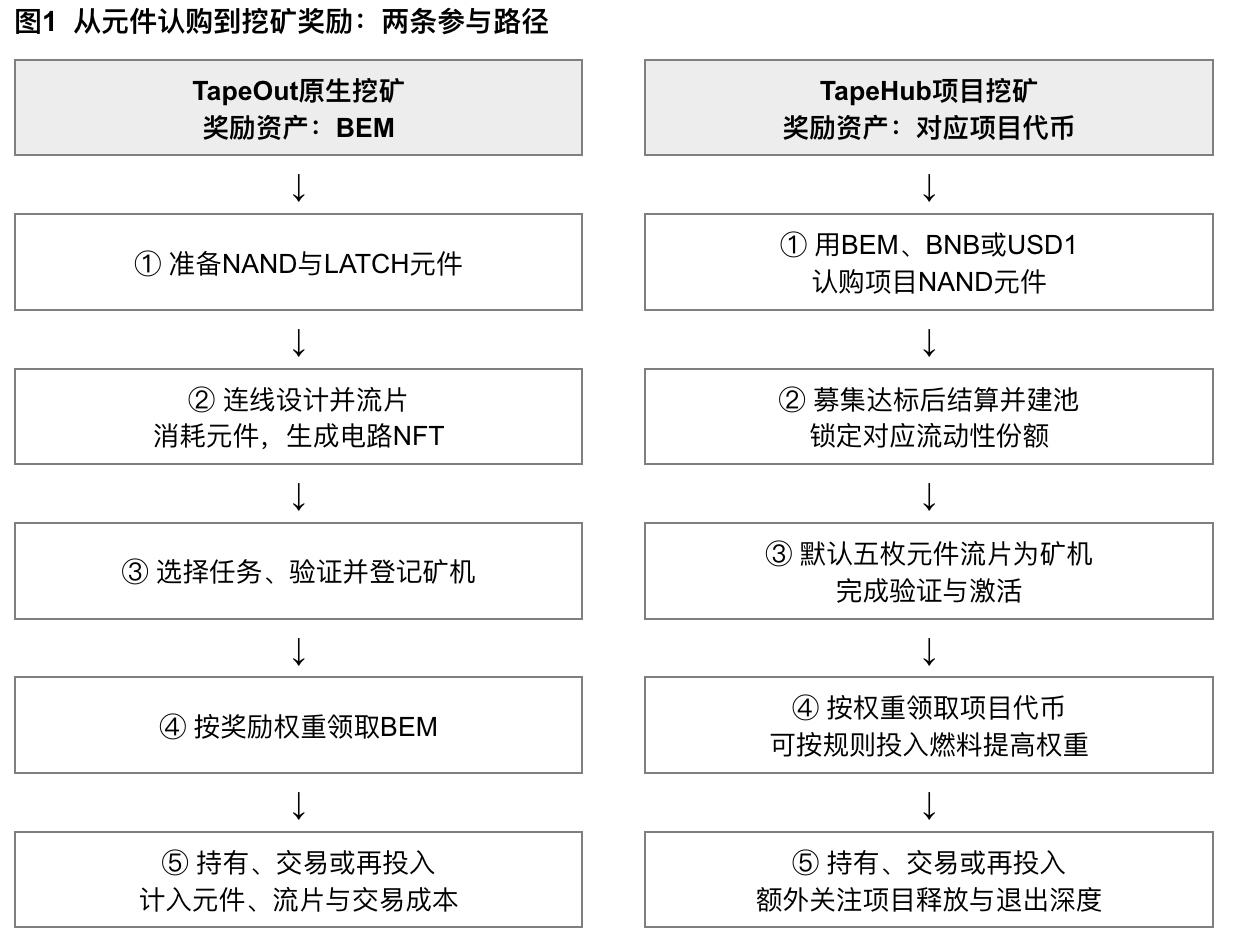
The participation process in TapeOut begins with converting components into circuit assets. Users prepare NAND and LATCH components, complete their connections on the canvas, and then generate circuit NFTs through the taping out process. At this point, what has been obtained is the circuit design recorded on-chain, not automatic eligibility for primary mining rewards. To enter the main reward pool, users need to choose corresponding tasks, pass contract tests, and complete mining machine registration. Here, "mining machine" refers to the on-chain circuit participating in reward distribution, not real-world mining devices.
Source: CoinW Research Institute
Design proof mining, or PoD, primarily considers component contributions and design inputs. According to protocol rules, the components that are actually destroyed constitute the foundational reward weight; under the same task and processor, original designs that meet requirements and have lower design costs can compete for additional design weight. Design costs are related to the number of components and the computation levels. When a better solution appears, the previously leading design may lose its additional weight; however, compliant base component weights are still retained. Therefore, mining machine earnings depend on their own weight and their proportion in the reward pool, rather than being fixed after creation.
The issuance cap of BEM is set at 21 million tokens, with initial issuance rules suggesting an approximate daily output of 7,200 tokens, halving roughly every four years; 99% of new rewards are allocated to verified mining pools, while the unverified pool receives 1%. Under unchanged conditions, an increase in total weight in the reward pool will decrease the share that individuals can obtain.
TapeHub adds a project issuance component to this structure, where creators can choose BEM, BNB, or USD1 as fundraising assets. Participants subscribe to project NAND components, which default to generate one mining machine for every five components. The total token supply for each project is 1 billion tokens, with 5% used for initial liquidity and the remaining 95% released through mining over 1,908 days in nine phases, with production gradually halving between phases. The online version of TapeHub adopts standardized tasks, not continuing the optimal design weight competition of the original PoD; the mining output of project machines yields the corresponding project tokens, not BEM.
The fundraising and pool creation also have independent rules. According to the TapeHub online plan, reaching 100% subscription can complete fundraising early; if not fulfilled, after a six-hour window, if 50% is reached, settlement can occur; if the threshold is not met, refunds will follow the rules. After successful settlement, 99% of the raised assets will be paired with 50 million project tokens to establish a PancakeSwap trading pool, locking in corresponding liquidity shares.
Meanwhile, the fuel mechanism adds extra competition for weight to mining machines; eligible mining machines can destroy corresponding project tokens to gain double weight for a continuous period of 10 to 30 days; after additional payments in BNB, weight can be increased to triple. If other miners also increase weight, the total weight of the reward pool will increase accordingly; ultimately, the amount of rewards one receives still depends on relative shares.
The fee return of TapeHub needs to be understood separately from the project token burn. According to the launch announcement, income from circuit taping out, the 1% of fundraising received at project launch, and BNB income generated by triple fuel will enter the platform treasury, with 50% used for buyback and burning of BEM. The fuel mechanism destroys the corresponding project’s own tokens. The former converts part of the platform income into BEM buy orders, while the latter is used to obtain mining reward weights for project machines, with the two paths affecting different assets. Additionally, developers disclosed that TapeHub gained 154.25 BNB in protocol fee income in the first three days of launch, with 77.12 BNB allocated for public market buybacks, purchasing 1,405.09 BEM which has been sent to the burn address. Furthermore, the official components and circuit trading market for TapeOut also announced that 50% of transaction fees would be used for BEM buybacks and burns.
For participants, the costs of component purchases, taping out, fuel, on-chain trading, and selling slippage are included. The number of rewards displayed on the mining machine page only indicates the expected token output, and does not directly represent how much BNB or stablecoins can be recovered. Liquidity locks restrict the withdrawal of corresponding liquidity shares but do not prevent holders from selling, nor do they guarantee price stability; when market buy orders are insufficient, even with liquidity still locked, selling may lead to significant price impacts.
On-chain trading has reached a scale, but transactions still predominantly involve BEM
According to official data, the total transaction volume of the protocol has surpassed 34,054 BNB, of which BEM accounted for 26,476 BNB, and transactions related to transistors, circuits, and minting totaled 7,578 BNB. BEM accounts for approximately 77.7% of the total transactions, indicating that token trading remains the main source of transactions within the ecosystem, while the circuit and component market has formed a scale but has not yet dominated capital activities.
The transaction data for the 7,578 BNB of components, circuits, and minting can be broken down further. First-level Mint transistors accounted for 898.6 BNB, about 12%; the official transistor market reached 4,228.8 BNB, around 56%; Firsto accounted for 1,713.8 BNB, about 23%; TapeOut.Market accounted for 149.3 BNB, about 2%; and the official circuit market had transactions amounting to 587.4 BNB, about 8%. The total transaction volume of the secondary transistor market reached 6,092 BNB, with two third-party markets contributing about 31%.
On participant data, there are officially recorded 3,120,984 on-chain transfers, 8,879 unique wallets, 7,707 first-level Mint transactions, and 898.6 BNB of first-level Mint transaction volume; a separate listing shows 233,322 transactions, and 23,207 transactions specifically for transistors. During the same period, 855 projects were created, of which 425 had actual Mints, representing about 49.7%; and 24,360 circuits were taped out on-chain.
PoD mining registered 14,964 mining machines within 19 days, of which 14,367 entered the verified pool, with a verification ratio of about 96.0%. Meanwhile, the Firsto on-chain panel shows 1,548 active miners and a total network hash rate of 1,527,397H, with 139 new circuits generated in the past 24 hours and 12,627 transistors consumed, estimating an approximate daily production of 7,200 BEM for the whole network.
This data indicates that Blonskr has already accumulated a certain transaction volume and on-chain operations, with third-party markets and active miners suggesting that participation is not entirely concentrated within official channels; meanwhile, transactions still evidently lean toward BEM, and the number of users, mining machines, and circuits cannot directly prove external application demand. Future observation focus should gradually shift from "how many people create and mine" to "how many circuits are continuously invoked, how much independent payment is generated, and whether these revenues can cover token emissions and buyback costs."
Opportunities for participation in Blonskr and skepticism around Ponzi schemes
The phased participation opportunities in Blonskr mainly stem from BEM buying pressure formed by fee recirculation and the differences in mining reward under different entry costs. When project subscriptions and ecosystem transactions expand, relevant fee income may increase, and part of the income used for buybacks may provide more buying support for BEM; participants obtaining components and mining machines at lower costs may also recover their investments faster once rewards can be smoothly sold. However, TapeHub supports fundraising with BEM, BNB, or USD1, and not all subscriptions will lead to BEM purchase demand; the buyback scale also depends on actual charges and execution status.
At the same time, Blonskr has also faced market skepticism over participants' sources of repayment, primarily questioning whether mining rewards excessively rely on subsequent funding continuance. Purchasing components, generating mining machines, and adding fuel allows participants to obtain tokens or increase reward shares but does not automatically increase the BNB or stablecoins available for absorbing sell orders. If these inputs are mainly aimed at acquiring more tokens to sell later, and platform fees primarily originate from subscriptions, mining, and internal trading, then buybacks effectively channel some participation costs back into the market rather than introducing income independent of this cycle. During price increases, such capital recirculation may enhance participation enthusiasm; conversely, when new input slows, who absorbs the cashing demands of current miners and token holders becomes the crux of these concerns.
Within this funding structure, obtaining rewards at lower costs versus chasing higher outputs can lead to drastically different return outcomes. The same amount of capital can immediately secure a definite number of tokens when buying directly, while investing in mining machines requires waiting to release rewards and bears the risk of share changes. Superior designs in the native PoD may replace the additional weight of existing schemes, and increases in total weight of reward pools can dilute individual outputs; TapeHub's periodic production cuts and fuel competition can further alter the relationship between input and rewards. Only if the comprehensive costs of obtaining rewards are advantageous, will mining potentially be more attractive than direct coin purchasing. If component prices have already surged, adding fuel may only sustain existing shares, and more vibrant ecosystems do not necessarily mean newcomers can recover their investments more easily; rather, it could result in increased inputs and extended recovery cycles.
Once recovery cycles lengthen and market buy orders weaken, competition for rewards may evolve further into exit pressure. A drop in token prices will reduce mining incomes, diminish the willingness to subscribe and add inputs, and related fee incomes and buyback budgets may shrink accordingly, whereas existing miners still have demands to sell rewards and recover costs. Project tokens from TapeHub need to rely on transactions in their respective pools for support and cannot directly benefit from BEM buybacks; fuel demand may also decrease as mining attractiveness declines. At this point, even if liquidity shares remain locked, concentrated selling could still cause price shocks; the listed valuations for components, circuits, and mining machines also require actual buyers to realize. Different projects’ fundraising, activation, and capital management authorities may influence operational conditions, so it cannot solely rely on rewards and quotes displayed on the page to calculate exit values.
In summary, Blonskr may form phased participation opportunities through project launch expansions, differences in reward acquisition costs, and fee recirculation, while also facing market scrutiny over mining machines and Ponzi scheme allegations. High entry costs, reward dilution, and falling token prices could lengthen recovery cycles; a slowdown in new funding may further increase selling and exit pressures, requiring participants to carefully assess input costs and liquidity risks.
免责声明:本文章仅代表作者个人观点,不代表本平台的立场和观点。本文章仅供信息分享,不构成对任何人的任何投资建议。用户与作者之间的任何争议,与本平台无关。如网页中刊载的文章或图片涉及侵权,请提供相关的权利证明和身份证明发送邮件到support@aicoin.com,本平台相关工作人员将会进行核查。