Written by: Rita
The trading volume of prediction markets has grown from about $50 billion in 2025 to about $300 billion from 2026 to date. Bernstein noted in a report published on September 22, 2026, that the debate surrounding prediction markets has focused on the labeling of sports event contracts as state-regulated sports gambling or “swaps” regulated by the Commodity Futures Trading Commission (CFTC). Legal issues remain unresolved, but structural opportunities are undervalued. The exchange model transforms sports betting into a flow business, without bookmaker positions, featuring a global order book, strong liquidity, and institutional market making. The bank expects prediction market trading volume to reach about $410 billion in 2026, growing to $10 trillion by 2035, covering sports, financial assets, politics, and economics.
Bernstein analyst Gautam Chhugani pointed out in the report that the prediction market is expanding the customer acquisition funnel, creating incremental sports trading liquidity. About 80% of Kalshi users have never used a sports betting app, and the overlap between DraftKings Predictions and DraftKings Online Sports Betting (OSB) users is only about 1%. This broader customer base, combined with consumer access in non-OSB states, supports a larger long-term opportunity than the penetration rates implied by sports betting alone.
Prediction Markets as Exchanges
Prediction market contracts are financial instruments traded on exchanges, that is, binary claims on future objectively verifiable events. Each contract settles for $1 if the event occurs and $0 if it does not, trading between $0.01 and $0.99 on the exchange order book before expiration. Since the payout for “yes” is fixed at $1, the price reads directly as the market-implied probability. A contract at $0.60 implies a 60% probability of the event occurring. Prediction markets transform questions about the world into tradable, exchange-listed prices that serve as both probabilities and signals.
Sports betting acts as a counterparty to each position, setting odds and taking the opposite side, profiting from the built-in margin. Prediction markets do not hold positions and do not embed bookmaker advantages; prices are determined by supply and demand. Contracts can be bought and sold at any time before event resolution, allowing for profit locking, stop-loss, or hedging. These contracts are standardized, exchange-traded, fully collateralized, and regulated as derivatives by the CFTC. From an economic substance perspective, the product is a binary option. Regardless of how the platform labels it as “event contracts,” “event futures,” or “binary options,” the payout structure remains the same, with a fixed payment of $0 or $1 for a defined outcome.
Looking to $10 Trillion by 2035
Bernstein expects the trading volume of prediction markets to reach about $410 billion in 2026, with a compound annual growth rate of about 70% from 2025 to 2035, reaching about $10 trillion by 2035. Growth is driven by enhanced regulatory clarity, mainstream distribution partnerships, and structural liquidity advantages. Global liquidity, long-tail event markets, real-world asset markets, and broader institutional participation are expanding the addressable market.
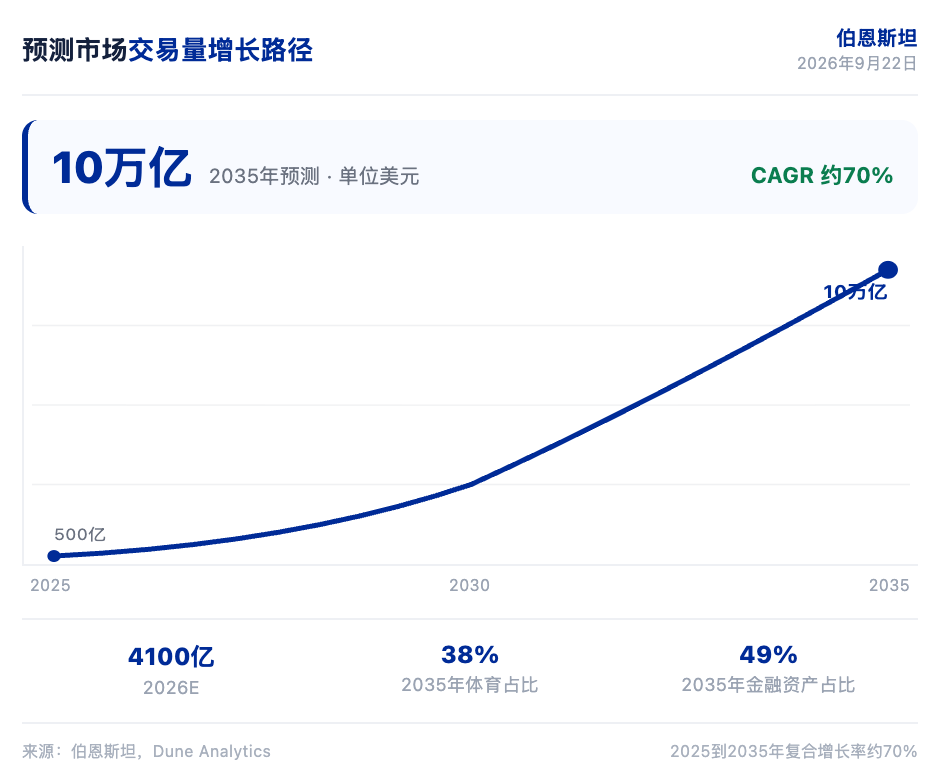
By category, sports accounted for about 61% of trading volume in 2025, rising to about 75% from 2026 to date, driven by the World Cup and parlay growth. However, the bank expects the sports share to fall to about 38% by 2035, with financial assets becoming the largest category at around 49%, and other categories at about 14%. Non-sports categories are expected to grow from about 39% in 2025 to about 62% in 2035, representing about $6 trillion of approximately $10 trillion.
Sports prediction market trading volume has reached about $275 billion annualized on Kalshi and Polymarket from 2026 to date, exceeding approximately $160 billion in U.S. sports betting handled in 2025. The bank expects sports trading volume to compound grow by about 61% from 2025 to 2035, reaching about $3.6 trillion. Financial assets accounted for about 12% in 2025 and are expected to become the largest category by 2035 at about 49%, with a compound growth rate of about 93% to approximately $4.7 trillion. Short-term binary options and long-term perpetual futures are converging on the same platform. Cryptocurrency's share of trading volume on Kalshi has risen from less than 5% in January 2026 to about 20% in August. Commodities have grown from zero to approximately $410 million by August 2026. Perpetual futures have added about $50 billion in nominal trading volume since their launch in June 2026.
Other categories accounted for about 26% in 2025, dropping to less than 10% from 2026 to date, but expected to compound grow by about 58% to about $1.3 trillion by 2035, representing about 14%. Growth is primarily driven by new market creation rather than the replacement of existing products.
Regulation is the Core Variable
The regulatory framework has evolved from theoretical jurisdiction debates into a broad legal competition involving the CFTC, state gaming regulators, federal and state courts, tribal interests, and potentially Congress. The Ninth Circuit's unanimous ruling on Kalshi is the strongest opinion to date against Kalshi, ruling that sports event contracts are not swaps and rejecting the notion that the Commodity Exchange Act prevails over Nevada gambling law. This directly conflicts with the Third Circuit's ruling in New Jersey, creating the first meaningful circuit split. The Ninth Circuit also elevated the major questions doctrine from a secondary consideration to one of the core legal issues of the case.
New Jersey has petitioned the Supreme Court to review the Third Circuit's ruling, with a timeline that could lead to oral arguments in the spring of 2027, with a ruling before June 2027, should the writ of certiorari be granted. Kalshi is seeking an en banc rehearing in the Ninth Circuit, delaying finality. Additional appellate rulings from the Second, Fourth, and Sixth Circuits, as well as the Massachusetts Supreme Court, could reinforce or weaken the existing split. The CFTC's proposed Rule 40.11(a) amendment could create a clearer regulatory framework for sports event contracts, but any efforts to expand CFTC power could provoke challenges from state and tribal interests under the Administrative Procedure Act. The bank's current view is that 2027 is more likely to serve as a transitional year, with the ultimate solution increasingly shifting toward 2028.
Kalshi and Polymarket Lead the Way
Kalshi has accounted for about 60% of the global prediction market share from 2026 to date, up from 35% in 2025. Monthly trading volume grew from less than $1 billion in August 2025 to about $40 billion in August 2026. Sports remain the dominant category, accounting for around 83% of total trading volume from 2026 to date, though its share has declined from about 90% in January to about 78% in August. Cryptocurrency is clearly the second category, with its share rising from less than 5% in January to about 20% in August. Commodities are the fastest-growing category, increasing from under $200 million in 2025 to about $590 million from 2026 to date.
The monthly trading volume on Polymarket's international platform increased from $1.1 billion in August 2025 to $4.6 billion in August 2026, accounting for about 10% of the global prediction market trading volume. Polymarket’s share has decreased from about 44% in 2025 to about 22% from 2026 to date, but Polymarket US is rapidly expanding, with August monthly trading volume reaching about $4 billion, accounting for approximately 7% of global volume and about 46% of Polymarket's total volume. Sports is the largest category, accounting for about 52% from 2026 to date, while politics dropped from about 32% in 2025 to 22%, although Polymarket continues to dominate the political prediction market, accounting for about 60% of politically related trading volume.
Robinhood Integrates Full Stack
Robinhood entered the prediction market in the fourth quarter of 2024, initially routing through ForecastEx as a pure distributor, expanding through Kalshi from the first quarter of 2025. By the second quarter of 2025, over 50% of Kalshi's trading volume was routed through Robinhood. In November 2025, Robinhood announced a joint venture with Susquehanna International Group to operate its own CFTC-licensed exchange and clearinghouse. The joint venture acquired MIAXdx, renaming it Rothera, with Robinhood/SIG holding a 90% stake. By acquiring a pre-licensed entity, Robinhood immediately gained regulatory infrastructure, accelerating its entry into the prediction market.
Rothera self-certified its first contracts in May 2026, launching economic data and baseball markets. During the World Cup, match results, tournament champions, and total scores moved to Rothera, while player props, parlays, and complex multi-legged contracts continued to route to Kalshi. Management expects that most of the volume will migrate to Rothera in the medium term, while Robinhood will continue to distribute contracts from multiple exchanges. Since launch, Rothera has processed about 5 billion contracts, with approximately 99% of the trading volume concentrated in sports.
Robinhood event contracts hit a record 13.6 billion in the second quarter of 2026, supported by the World Cup. Event contract revenue was $156 million, growing 50% quarter-over-quarter and more than 10 times year-over-year, accounting for 20% of trading revenue and 12% of total revenue. Rothera launched in June and is now the third-largest exchange in the U.S., trading over 3.5 billion contracts to date, with second quarter revenues of $17 million.
Institutional Adoption is Accelerating
Institutional trading is still in its early stages, but there is evidence and real trades supporting the trend. It is categorized into three types: executed block trades, dedicated institutional trading desks providing liquidity, and data and distribution agreements.
Kalshi cleared the industry's first institutional block trade in April 2026, brokered by Greenlight Commodities with liquidity provided by Jump Trading, helping a Houston-based hedge fund hedge California carbon allowance pricing. Polymarket facilitated its first on-chain institutional block trade in June 2026, a hedge between FalconX and Aneralabs to offset H100 GPU computing leasing costs. Galaxy Digital executed approximately $10 million of Kalshi trades in June 2026, linked to the outcomes of the CLARITY Act, while launching an institutional over-the-counter prediction market trading desk.
Galaxy Digital launched an institutional OTC prediction market trading desk allowing institutions to privately trade large positions. BitGo Prime and Susquehanna Crypto launched institutional OTC access allowing hedge funds, family offices, and ultra-high-net-worth clients to trade listed contracts over $100,000 bilaterally. Marex launched bond-like notes linked to prediction market outcomes. Wintermute began quoting two-sided markets in main prediction market venues. Clear Street became the first institutional futures commission merchant (FCM) of the Kalshi exchange and clearinghouse. Talos integrated with Kalshi, allowing institutional clients to trade Kalshi event contracts and perpetual futures on the same platform.
The Intercontinental Exchange (ICE) agreed to invest up to $2 billion in Polymarket at a post-money valuation of $9 billion, becoming the exclusive global distributor of Polymarket event data to institutional clients. Electronic trading platform Tradeweb announced a strategic partnership and minority equity investment in Kalshi, bringing prediction market data and analytics to institutional investors.
Should the Supreme Court take up and rule on the regulatory status of sports event contracts in 2027, the $10 trillion trajectory of prediction markets will either accelerate or be impeded, depending on the ruling's interpretation of federal preemption.

Disclaimer
This article consolidates and interprets the third-party brokerage research report (Bernstein, September 22, 2026) by Trend Research, combined with public market information. The ratings, target prices, earnings forecasts, and related judgments quoted in this text represent the views of the analysts at that brokerage and do not reflect the views of Trend Research, nor do they constitute any investment advice.
Markets carry risks, and decisions should be made independently. This article should not be used as a basis for buying or selling any securities.
免责声明:本文章仅代表作者个人观点,不代表本平台的立场和观点。本文章仅供信息分享,不构成对任何人的任何投资建议。用户与作者之间的任何争议,与本平台无关。如网页中刊载的文章或图片涉及侵权,请提供相关的权利证明和身份证明发送邮件到support@aicoin.com,本平台相关工作人员将会进行核查。


