Author: Gu Yu, ChainCatcher
On the evening of September 22, Circle submitted an 8-K filing to the SEC revealing a significant transaction: Binance purchased 1,237,011 shares of Class A common stock from Circle at a price of $80.84 per share, totaling $100 million. The transaction was completed on September 17. The same document also disclosed that both parties signed a new five-year commercial agreement to replace the old agreements from November 2024 and August 2025—Binance will promote USDC on the platform, while Circle will pay Binance monthly incentive fees based on the amount of USDC held.
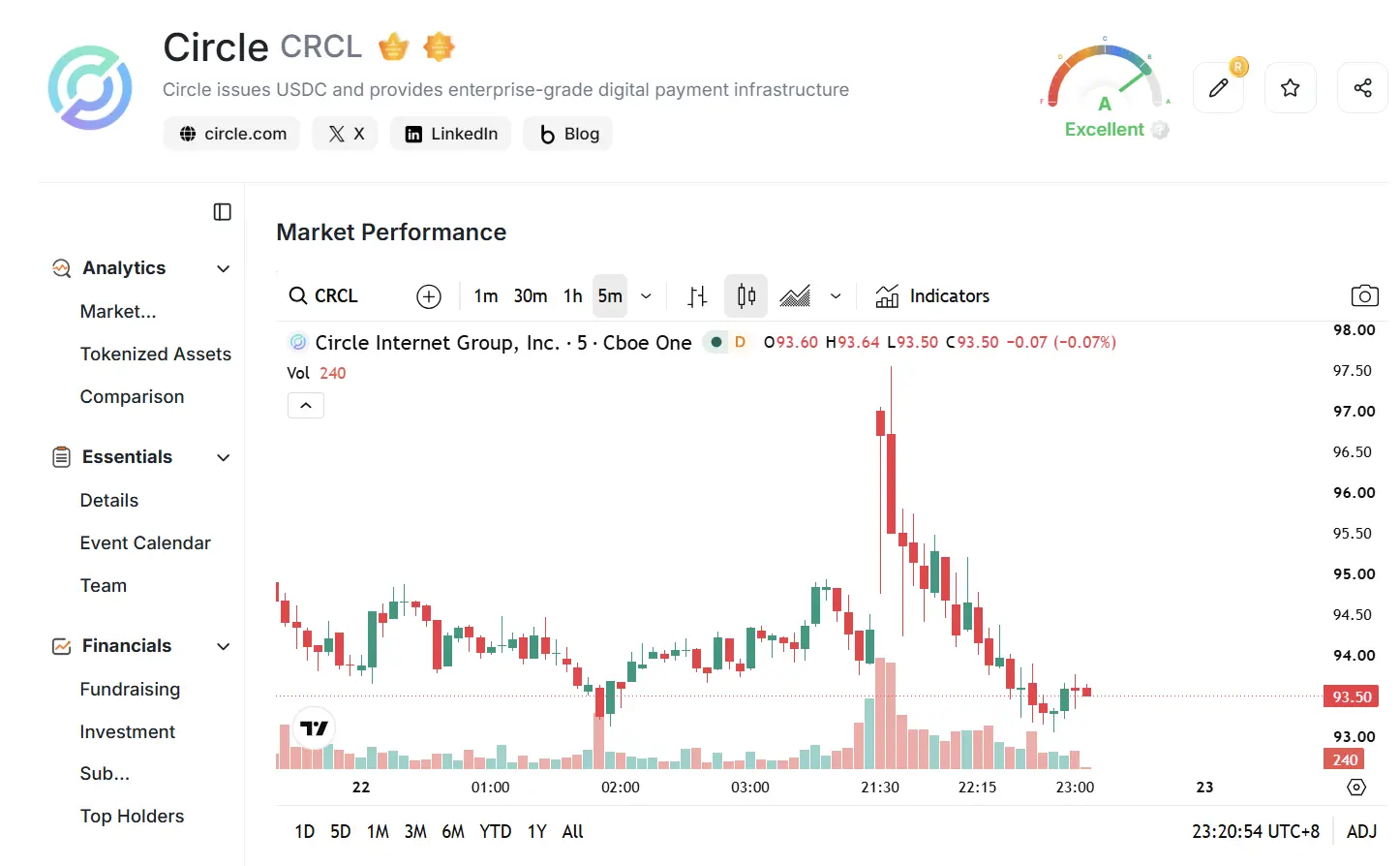
However, the market's initial reaction was not positive. On the day the news was released, CRCL briefly rose before falling to $93, down about 1% from the previous day's closing price.
The lukewarm response is understandable. Because this is not a $100 million transaction; it is a transaction about 'shelf space.'
Discount, Lock-in, Conditional: An Unusual Equity
The terms of this investment emphasize "long term" in almost every clause.
Based on the CRCL closing price of $85.09 on September 17, the purchase price of $80.84 represents about a 5% discount; if measured against the closing price of $94.49 on September 21, the discount widens to about 14%. Binance promises not to sell, transfer, pledge, or hedge these shares for a maximum of two years post-delivery, with exceptions only for transfers to related parties, board-approved acquisitions, or legally mandated disposals; during the lock-up period, voting rights belong to Binance.
In other words, what Binance receives is a share that is "locked in as long as the cooperation remains"—if the relevant commercial arrangements are terminated early as agreed, the transfer restrictions are lifted. The equity serves as collateral for the commercial agreement, not as an independent investment.
The real focus is on the agreement itself. According to the 8-K, the monthly incentive fee that Circle pays to Binance is based on the "amount of USDC held through Circle's modular smart contract wallet infrastructure services," and the fee rate is undisclosed. This is consistent with the structure of the agreement from August 2025; while in the first version of the agreement from November 2024, Circle paid Binance an upfront fee of about $60.3 million. Circle's 2025 annual report revealed that distribution costs related to Binance increased by $152.1 million that year.
In 22 months, agreements with the same pair of partners have been rewritten three times. The distribution price of stablecoins is being repeatedly re-priced.
Who is Paying Whom
The public narrative places Binance's investment in the forefront, but the direction of cash flow is the opposite.
From an accounting perspective, Binance is a shareholder; from a cash flow perspective, Binance is the payee. Circle pays Binance promotional fees while making Binance its shareholder. This structure has precedent in Coinbase— as a co-founder of USDC, Coinbase has always taken half of the interest from USDC reserves.
Numbers better illustrate the weight of distribution costs. Circle's total revenue from Q2 and reserve income was $701 million, up 7% year-on-year; distribution and transaction costs were $410.4 million, of which $324.6 million flowed to Coinbase. After deducting distribution costs, the revenue (RLDC) stood at $289 million, with a profit margin of 41.2%. During the same period, the reserve return rate fell to 3.5%, down 66 basis points year-on-year.
This means Circle's profit formula is extremely fragile: revenue = volume × reserve yield - distribution cost. Volume growth can be offset by falling interest rates or consumed by revenue sharing. When Compass Point initiated coverage on Circle in June 2025, it issued a neutral rating precisely because its distribution partners are highly concentrated on crypto-native institutions—now this list has added another exchange, which is also seated at the shareholder's table.
Binance has its own accounts as well. The exchange launched BUSD with Paxos in 2019, pushing its market cap to $20 billion, but it was halted from issuance by the New York State Department of Financial Services in February 2023, subsequently shifting to Hong Kong's First Digital's FDUSD—whose circulation has now shrunk to about $350 million. The failure of its own stablecoin route made "promoting someone else's dollar" a realistic choice.
The Position of USDC: Second Place, but with a Hardening Base
In terms of scale, USDC remains second: USDT's circulation is about $183 billion, USDC's is about $75 billion, together taking about 85% of the approximately $300 billion stablecoin market. However, the structure is changing—ARK Invest's Digital Asset Research Director Lorenzo Valente released a grouped chart on September 9 showing that there were once four stablecoins with a market cap over $10 billion, but currently only Tether and Circle remain, with the third place lingering around $6 billion.
On Ethereum, the share gap between USDC and USDT has narrowed from a 34.2 percentage point difference in November 2024 to 17.8 percentage points in September 2026—USDT grew 22% during the same period, while USDC grew 83%. In 2025, the adjusted on-chain transaction volume of USDC first exceeded USDT, at $18.3 trillion to $13.3 trillion; this figure reached $14.8 trillion in Q2, a year-on-year growth of 151%.
More critically is retention. By the end of Q2, the USDC remaining on Circle's own platform was $12.4 billion, up 106% year-on-year, and the daily weighted proportion increased from 7.4% in the same period last year to 19.5%. The more USDC remains in scenarios controlled by Circle, the more the bargaining power for distribution shifts towards Circle. This is also why Binance's agreement charges based on the "USDC balance in Circle's wallet infrastructure"—Circle is using the fee structure design to guide increments toward its own territory.
And the new increment is flowing in from another side. Stock tokenization is the steepest curve this year: on September 10, Nasdaq announced plans to invest $100 million in Kraken's parent company Payward to jointly promote tokenized stock infrastructure; on September 21, the European Central Bank launched Pontes to support the settlement of wholesale tokenized asset trading using central bank currency.
For USDC, this is a new demand locked by regulation. Crypto KOL Kuai Dong commented: "Currently, Binance's US stock business, due to compliance, must trade and exchange using USDC, which has stimulated the need for people to first obtain the stablecoin USDC before buying and selling US stocks. Although Binance offers one-click matching, like you can place orders with stablecoin USDT or platform coin BNB, the final trading path must all convert to stablecoin USDC before matching with US stocks on the platform."
In other words, every transaction of tokenized stocks creates a mandatory exchange demand for USDC. USDT and BNB are merely entry currencies along this path, and ultimately all must pass through the gate of USDC. When stocks begin to go on-chain, USDC is no longer just a trading medium but the default pricing layer of this new pipeline.
On the product side, there is also an increase. On September 16, Circle's Layer 1 public chain Arc launched its public mainnet, using USDC to pay gas fees, with founding validators including BlackRock, Visa, Mastercard, DTCC, Intercontinental Exchange, and Standard Chartered; on July 10, the U.S. Office of the Comptroller of the Currency (OCC) finally approved Circle's national trust bank license.
"Relying on USDC, Arc, and the infrastructure to reshape cross-border value transfer, Circle has already entered the ranks of the world's most credible issuers," Binance co-CEO Richard Teng stated, "Our investment of $100 million and five-year commitment represent a long-term belief." Jeremy Allaire's wording was even more straightforward: "We see a tremendous opportunity—using USDC to expand dollar access and reach global emerging markets."
The emerging markets are the true target of this agreement. USDT's moat happens to be there: cross-border transfers on low-fee networks, contract margins, and dollar savings in countries with currency depreciation. Circle paying money to the exchange with the most emerging market users is equivalent to launching a direct attack on Tether's home turf.
Discrepancies and Timing: Who is Buying, and Why Now for Binance
This investment has been reinterpreted repeatedly, partly because Circle's shareholder list has been highly topical over the past six months.
Duan Yongping is the most contrasting figure. On July 29, 2025, he stated clearly on Xueqiu: "I don't understand things without cash flow and I'm not interested in stablecoins." Nine months later, his managed H&H International Investment disclosed for the first time in their Q1 13F filing a position in Circle: 200,000 shares at an average price of $95.41, approximately $19.08 million, accounting for about 0.095% of its approximately $20 billion portfolio. In the same quarter, but Bin's Dongfang Hongyuan Overseas Fund also established a position of about 31,700 shares for the first time; on May 5, Bin wrote on Weibo, "Due to a researcher's strong recommendation, I laid out a little in Circle," and on that day, CRCL briefly rose more than 16% during trading.
ARK Invest's rhythm has been more coherent. Its ARK Venture Fund had already invested in Circle back in May 2024, continuously adding to its position after the IPO, at one point holding about 4.51 million shares; on March 24, when CRCL dropped about 20% in a single day, ARK's three ETFs collectively bought 161,513 shares; on July 23, when the stock price fell below $64 and below all major moving averages, they bought another 220,012 shares. Of course, ARK also reduces its positions—on September 14, it sold a total of 142,350 shares from ARKK and ARKW.
Discrepancies have always existed. SoftBank Group completely liquidated its entire position in Circle of 95,659 shares (about $10.8 million) in a single instance in its Q1 13F, publicly stating it wanted to concentrate funds on AI; on the other hand, the California State Teachers' Retirement System (CalSTRS) increased its stake in Circle by 3,456.8% in Q2. By mid-May, institutions reporting to hold Circle had reached 485, with 353 increasing their stakes and 192 decreasing; on September 8, Jeremy Allaire reduced his holdings by 56,200 shares under the 10b5-1 plan, cashing out approximately $5.5 million.
Chip discrepancies are reflected in the stock price: the IPO price in June 2025 was $31, opening at $69 on the first day, peaking at $298.99, dropping to a low of $49.90 on February 5, 2026, and returning to $94.49 on September 21—down about 34% over the past 12 months, while the S&P 500 rose 16.5% during the same period. The target average price given by 26 institutions is $104.31, with a maximum of $243 and a minimum of $37, a discrepancy that is almost absurd.
Binance precisely entered at the point of greatest disagreement. On September 15, the Senate failed to pass the motion to end debate on the CLARITY bill with a vote of 49 to 50, causing CRCL to drop about 11% that day; the following day Arc's mainnet went live, and the market responded with "sell the facts," dropping more than 7%; on September 17, the transaction was completed—purchasing an entry point at a 5% discount, with an unrealized gain of about $16.9 million by September 21, but unable to realize during the lock-up period. On the same day, the SEC also issued a five-year conditional stock tokenization "innovation exemption."
The motivation is also easy to decipher. This exchange revealed in July that its registered users had reached 323 million; its January 2026 reserve report showed a total reserve of about $155.64 billion, of which stablecoins accounted for $47.47 billion; however, by August, CryptoQuant analyst Darkfost pointed out that its stablecoin reserves had fallen below $42 billion, reaching a new low since October 2025. Dollar liquidity on the platform is draining, and liquidity of the dollar is the blood of an exchange.
Conclusion
In recent years, competition among stablecoins has been understood as a war over reserve transparency and regulatory licenses. Circle leveraged this narrative to obtain the OCC license, NYSE listing, and BlackRock's endorsement. However, as USDC circulation lingered between $73 billion and $77 billion for over a year, and with every Federal Reserve rate cut directly pressuring reserve yield, Circle had to admit one thing: Compliance can get you in the door, but it cannot sell your goods.
$100 million is not a valuation anchor, but a channel fee. It cannot buy the growth of USDC's circulation; it can only buy a priority position on Binance's shelf—which requires renewal payments every month.
The true measure is singular: Circle's net take rate. If in the coming quarters, the USDC balances resulting from Binance's partnership indeed increase, yet the profit margin after deducting distribution costs continues to flatten or even decline, this transaction represents Circle exchanging equity for an expensive form of exposure. Conversely, if USDC truly settles as collateral, savings, settlement balances, and the pricing layer for tokenized assets, rather than just a rapidly turn over inventory in exchanges, then Binance will become Circle's first puzzle piece in transitioning from "interest income tool" to "network."
And for Binance, the calculations are much simpler: regardless of whether USDC ultimately shakes USDT’s hold, the promotional fees arrive monthly, and the equity has two years’ time.
In the war of stablecoins, issuers are betting on the future, while channel players have already collected their money.
免责声明:本文章仅代表作者个人观点,不代表本平台的立场和观点。本文章仅供信息分享,不构成对任何人的任何投资建议。用户与作者之间的任何争议,与本平台无关。如网页中刊载的文章或图片涉及侵权,请提供相关的权利证明和身份证明发送邮件到support@aicoin.com,本平台相关工作人员将会进行核查。


