Host: Thank you, Mr. Qiu, for the wonderful sharing.
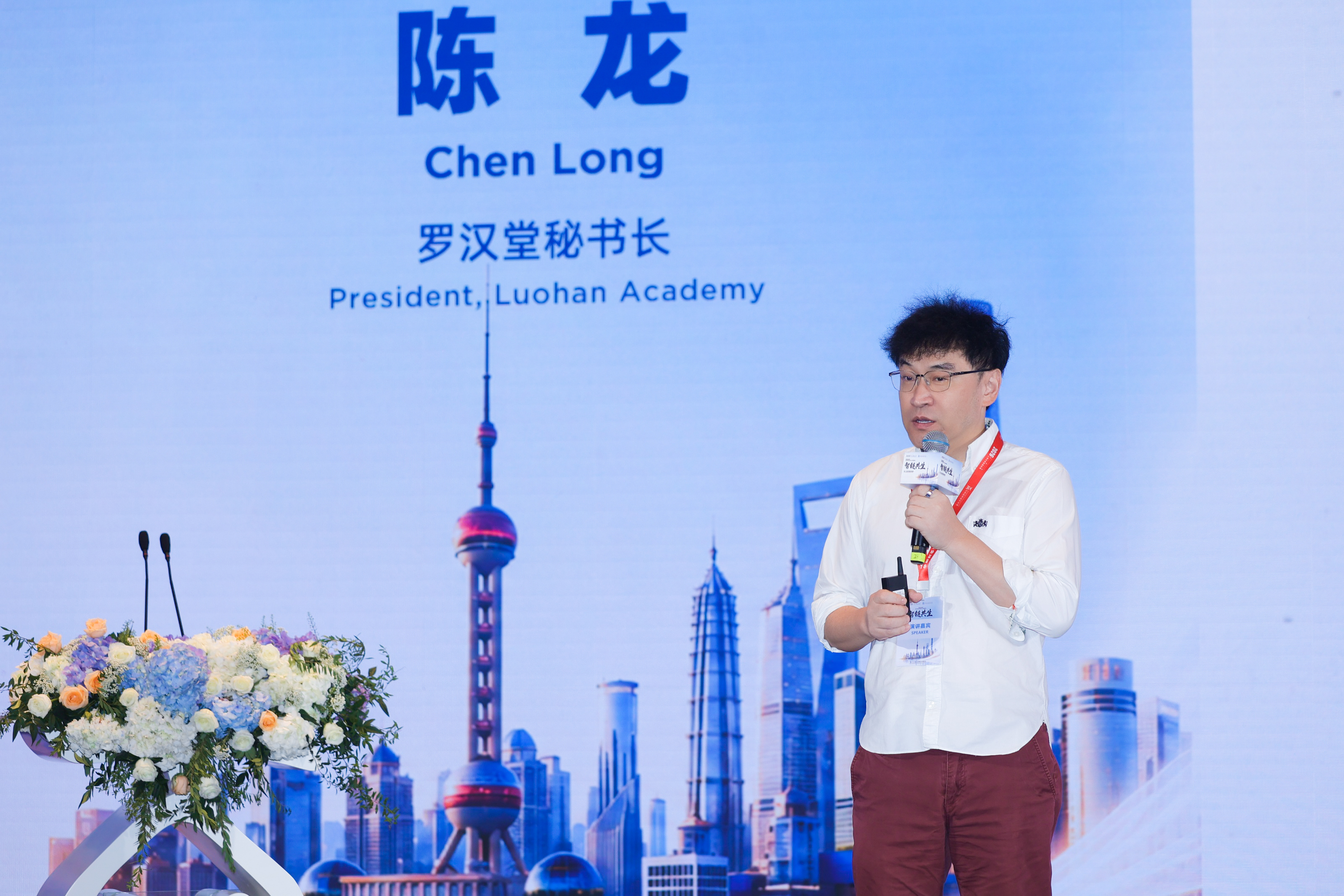
Next, let's welcome Secretary-General of Luohan Hall, Mr. Chen Long, to deliver a keynote speech titled "The Third Wave of Financial Technology Driven by Smart Chains."
Let's give a round of applause for Professor Chen.
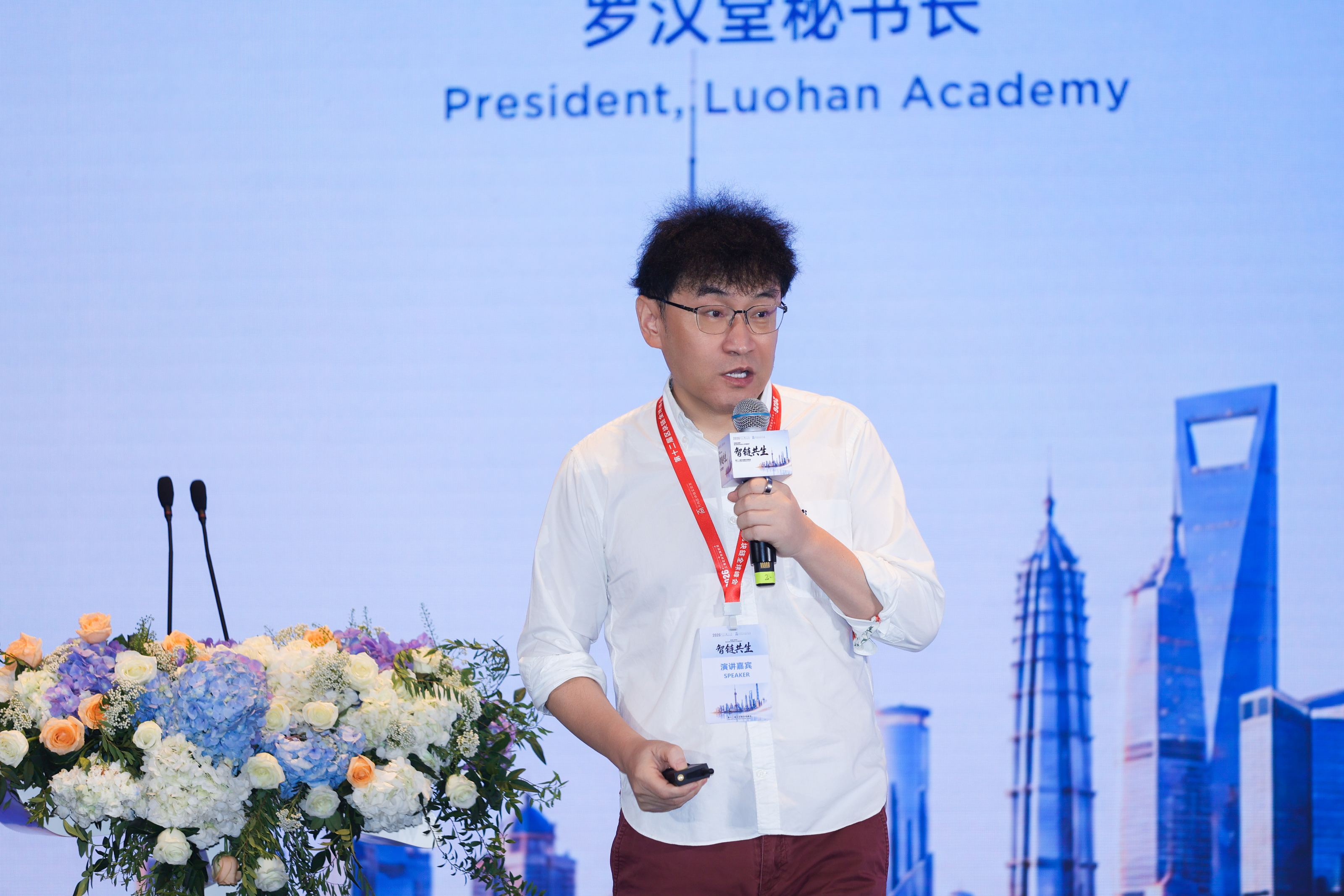
Chen Long: Good morning, Mr. Xiao Feng, distinguished leaders, and friends!
I actually anticipated that the name "Smart Chain" is too consensual, so I made a slight change. Today, I would like to spend about ten minutes discussing what I see happening in the "future," specifically the topic "The Third Wave of Financial Technology Driven by Two Types of Tokens."
The financial industry is fundamentally based on information. Looking back in history, we find that every major technological revolution in information inevitably signifies a transformation in finance. Long ago, in the 19th century, the opening of the telegraph brought about money transfers based on the telegraph system and the birth of futures exchanges. The technological changes of the 1970s in digitization and information led to the establishment of SWIFT settlement networks and the NASDAQ electronic trading market, which were very advanced for that time.
With the internet technology bringing payment and credit, the combination of data and models significantly changed the overall financial experience and made it inclusive. At this point, everyone suddenly realized that finance has very important technological attributes, hence the term "Financial Technology" was introduced during the internet wave and has always had technological attributes.
Since the information technology revolution is very critical, we want to ask which aspects of the primary principles of information are the most important when we look back, and there are three: Information can be used to connect; it can be used to think; and it needs to be trusted. Thus, all information technology revolutions revolve around these three dimensions: connection technology, trust technology, and thinking technology.
Over the past 40 years, we have experienced three waves of financial technology, perfectly aligned with the three dimensions of information technology:
The first wave, internet finance, was a revolution in connection technology. Many of us have experienced the way it changed reachability, making it very inclusive, and transformed risk control and financial decision-making. There was a Nobel Prize-winning economist named Bengt Holmström, who is a good friend of mine. He visited Alipay and made a great remark: data is the new collateral. This was a significant change that profoundly altered our lives, resulting in over 3 billion digital financial users globally; this is the first wave.
The second wave was a relatively hidden line, driven by blockchain information digitization. Blockchain allows information to be tokenized through encryption technology because it cannot be breached, thus possessing unique value, enabling the generation of assets or converting assets into trusted tokens that can be digitized.
Several stages were experienced:
The first stage was where many assets could be tokenized through trust technology;
The second stage allowed for programmability and platformization, where more tools became available for practical applications, not just assets, but various functions could be performed;
The third stage involves developing to replace existing functions and channels.
In fact, these stages are very similar to the process we are discussing about AI technology's harness. With large models, the challenge is how to implement them functionally, transitioning into systems and engineering. This reflects the phases traversed by trust technology. Since finance is a highly regulated field, it must integrate with mainstream finance.
The third phase is evidently very relevant to AI. I want to briefly discuss the essence of AI—what is artificial intelligence? Artificial intelligence is about processing data in specific scenarios to create value in those scenarios. There are always three critical elements: intelligence, data, and scenarios.
Intelligence refers to the breakthroughs in large models we discuss every day, but it must manifest in data and scenarios. The key method is the harness system. Earlier this year, there was a little lobster event where everyone experimented with it, realizing it wasn't a great harness, but it opened the possibilities. What I previously mentioned about blockchain trust technology went through a similar process. The top layer of reasoning is the large language model, while the foundational system is the entire harness.
This morning, many guests shared good insights on governance frameworks and legal feasibility advancements. Personally, I am more concerned about industrial progress. Like many of us here, I am curious about where the breaking point lies. Where is the rhythm for the future? I want to discuss some products.
For example, Anthropic is continuously transforming into financial products and capabilities through harness. In July last year, it launched a feature allowing agents to access traceable data within limited permissions. In October last year, Anthropic had already released various features that could incorporate financial methods, formats, behaviors, and practices seamlessly. In May of this year, Anthropic simultaneously launched ten directly usable agent capabilities, which can perform tasks in investment research, investment banking, valuation, financial settlement, auditing, and KYC, forming a comprehensive task capability system.
About a week ago, GPT-6 was released, causing a significant surge in the US stock market. I wonder how many in the audience are familiar with it. The most significant breakthrough of GPT-6 is its ability to allow agents to operate computers and various software at a working level. If Anthropic's financial system resembles a capability system, the financial functions produced by GPT-6 are more like "financial employees" that can perform tasks at a working level, marking an enhancement in AI's capability.
Let me talk about the so-called two types of tokens. Each significant technological revolution brings about a birth of critical productive factors and a dramatic decrease in costs, allowing for their application across an increasing number of fields. During the electrical era, we recall Ford Motor Company, which marked a significant explosive moment. In the internet era, we often think about Netscape, which led to the widespread adoption of various applications. For me, the most critical explosive moment in AI was earlier this year with Anthropic's breakthroughs in coding capabilities and the realization of agent capabilities.
Since earlier this year, regardless of whether one understands AI or not, everyone has started to discuss the term token, with AI's measurement unit referred to as "burn brain value" (Token). The term token has been discussed in the blockchain field for a long time because it serves as our measure of trust, transforming into various data information that, through encryption technology, can become a token. From then on, this element gains the trait of being non-replicable. Verification costs become extremely low; a token is both a unit of trust technology and a unit of thinking technology. At this time, if we want to see the expansion of these two types of tokens, their usage rate and economic value will indicate how quickly they can be utilized.
We will find that thinking technology and trust technology have not yet fully converged in the finance sector. Concepts like AI finance and on-chain finance are clearly evolving into "Smart Chain" finance. The integration is evident; it can turn various elements and assets into trustworthy assets if they have value, enabling continuous trading and allocation through intelligent means—this is a possibility that must be pursued and an irreversible future. However, they are not yet that integrated.
Next, I will discuss some of the most interesting developments in the industry:
First, Meta.
A few days ago, Meta released its earnings report, resulting in a significant rise. They launched several products, prominently showcasing their Muse application. Over the past few days, it became the top free download on the Apple Store, allowing everyone to shop and letting agents help them buy strollers, presenting options if they were interested with a click, possibly requiring no approval for small amounts. They employed several technologies, including Stripe's Link technology, which uses one-time virtual cards, where card numbers cannot be replicated. Additionally, there is a personal virtual space, allowing data to correspond directly with cloud computing, ensuring the safety and encryption of agent usage concurrently, without necessarily needing blockchain, but that is also an option.
Second, Robinhood.
Robinhood is a very interesting company that deserves attention, including stock purchases. Robinhood now allows agent trading; agents can access data for research and trading, and they already have credit cards with set limits. Similar to setting limits for my son, it can’t be too high, and there is a chain through which traditional assets can be linked to blockchain. Additionally, there is venture capital, and pre-IPO assets can also circulate; for instance, if SpaceX could have been linked before going public, it could have circulated as well, thus aggregating assets.
If young people are entering the market, we see a significant transformation brought about by the Smart Chain integration in AI, bringing together various on-chain and traditional assets. This influences not just entry into the market but financial decision-making as well; the assets available and the platforms for trading can all be operated, representing the mindset of the new generation of market players.
Third, Stripe.
Stripe is an intriguing enterprise; beyond payment intelligence, they have a large model payment agent capable of handling various shop operations, including their Link technology. The technology used by Meta, a one-time card, is utilized even further by recognizing the many pathways of payment that arise from large models to applications. They have also developed native billing systems that help calculate tokens, and recently acquired OpenRouter, the well-known third-party scheduling routing platform. This aids in deciding when to use expensive or cheap models, thereby encompassing various elements of the value chain and financial processes, making payments integrated into diverse scenarios and serving as a vital Smart Chain infrastructure.
In the realm of blockchain, institutions are quickly integrating various channels, including wallets and accounts for agents, along with the issuance of stablecoins on-chain. We observe these institutions rapidly combining efforts, some through incubation, others through mergers and acquisitions. Together, they are forming the vision of Smart Chain business logic, and we anticipate HashKey to lead in Asia.
Alipay has executed a series of foundational capabilities in the smart agent domain within the country. Generally speaking, domestically, they were the first movers but have not yet fully progressed. They are still awaiting further developments; this is the future unfolding.
Technology will change, finance will change, but the functions of finance have always remained constant, those primary functions. Today, AI and blockchain technology will certainly change finance.
More than a hundred years ago, the famous economist Keynes said: London residents could lie in bed sipping morning tea, ordering various goods from around the world by phone, while also directing their wealth to natural resources and new enterprises in any corner of the world.
This statement can be modified today: every person worldwide can have agents continue working for them while they sleep, and upon waking, they no longer need to use the phone; they can simply speak to the agent, which can proactively communicate with me, allowing for asset allocation to any desired destination while breaking free from all limitations of time, space, monetary amounts, and asset classes, facilitating instantaneous transfer. Moreover, if I have creative ideas, various assets can converge towards me.
The most important aspect is the security of my assets. They can withstand all cycles, and various upheavals are inconsequential; I can sleep soundly. This is the dream of today’s residents supported by the Smart Chain.
Thank you, everyone!
免责声明:本文章仅代表作者个人观点,不代表本平台的立场和观点。本文章仅供信息分享,不构成对任何人的任何投资建议。用户与作者之间的任何争议,与本平台无关。如网页中刊载的文章或图片涉及侵权,请提供相关的权利证明和身份证明发送邮件到support@aicoin.com,本平台相关工作人员将会进行核查。


