Author: Tanay Ved
Translation: ShenChao TechFlow
ShenChao Summary: Cryptocurrency exchanges are transforming from pure crypto gambling houses to "all-in-one trading venues" covering stocks, commodities, and derivatives. Binance's tokenized stock trading volume has surpassed $3.7 billion in a single month. This transformation is not just an expansion of product lines; it may also change the revenue cycles of exchanges. The SEC's latest "Innovative Exemption" policy may lead tokenized stocks from the gray area to legalization.
The Race for Tokenized Stocks, Real Asset Perpetual Contracts, and "All-in-One Exchanges"
Digital asset exchanges are expanding from pure crypto platforms to "all-in-one exchanges," integrating spot, derivatives, tokenized assets, and on-chain infrastructure under one roof. Leading platforms are now converging towards a full-stack infrastructure that covers both native cryptocurrencies and traditional markets.
Kraken and its parent company Payward are excellent examples of this transition. Through xStocks, its own Ethereum Layer 2 network Ink, and the newly announced compliant on-chain derivatives business, Payward is positioning itself along the entire chain of tokenized stocks. In September this year, Nasdaq Ventures agreed to invest $100 million in Payward to deepen the collaboration on tokenized stock infrastructure. Meanwhile, Payward also announced plans to offer regulated, licensed on-chain perpetual futures to U.S. customers through Hyperliquid's HIP-3 mechanism.
These actions occurred in the same month: the SEC released the "Innovative Exemption" policy. This is a signal that exchanges, issuers, and market infrastructure providers are converging from different directions towards tokenized stocks. This issue of "Network Status" will dissect how tokenized stock trading and real asset perpetual contracts have expanded across major exchanges this year, the role of the SEC's innovative exemption in this, and how the race for "all-in-one exchanges" is unfolding.
The Race for Tokenized Stocks
Exchanges are entering the field of tokenized stocks from different angles. The commonality is that they are all trying to integrate spot tokenized stocks, derivatives, and blockchain infrastructure into a broader multi-asset trading system.
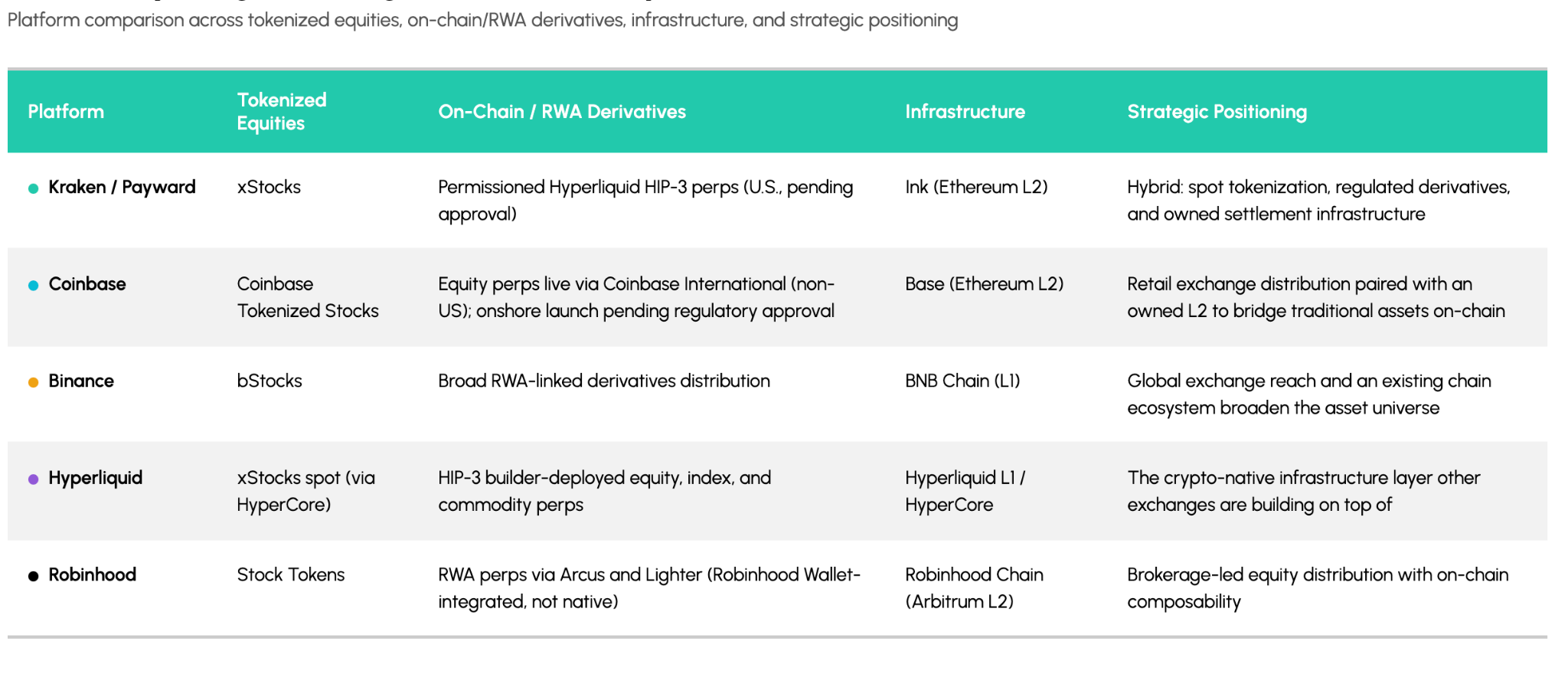
Kraken/Payward offers spot exposure through xStocks and is entering the U.S. compliant derivatives market with Hyperliquid's HIP-3. xStocks is issued by Backed Finance and delivers dividends to holders via a rebase mechanism, providing economic exposure to stocks. Kraken’s partnership with Nasdaq promotes its evolution towards a rights-retention model (NETs), which will coexist with xStocks.
Binance launched bStocks in June, and within seven weeks, its asset management size surpassed $500 million. Similar to xStocks, bStocks are certificates representing financial rights of the underlying stocks, without voting rights, and redemption is limited to market trading hours.
Coinbase issues tokenized stocks through the B20 standard, designed specifically for real assets on the Base chain. Coinbase describes each token as a direct claim against the underlying stock, held by Alpaca through a special purpose vehicle regulated by ADGM, but only "attributed holders" who complete KYC can redeem or vote. Dividend rights are open to all holders.
Hyperliquid is an infrastructure and liquidity layer on which third parties can build applications. Since August, Hyperliquid has launched part of the xStocks spot market and allowed external developers to deploy perpetual contracts for stocks, indices, and commodities through HIP-3. Kraken plans to introduce compliant U.S. perpetual contracts to Hyperliquid through its CFTC-regulated subsidiary Bitnomial, which exemplifies this model clearly.
Robinhood launched stock tokens on the Robinhood Chain in July, structured as debt securities using special purpose vehicles from Jersey. Dividends are conveyed through an on-chain multiplier mechanism, and currently, there are no voting or shareholder rights, but Robinhood has indicated that it is advancing a roadmap for physical stock redemption and voting rights.
Other platforms are also entering this track. OKX launched "Unified Tokenized Stocks" on the OKX X Layer blockchain, while Backpack introduced tokenized stocks on Solana, using a structure similar to U.S. brokerages, which is closer to traditional shareholder rights than most of the above models.
Tokenized Stocks and Perpetual Contracts: Current Adoption Status
Despite a decline in cryptocurrency trading volume this year, there has been significant growth in tokenized stock trading and perpetual futures linked to real assets across major exchanges.
The trading volume of spot tokenized stocks from xStocks, Ondo, and bStocks has surged this year, with Binance's entry being a major driver. Since its launch in June, trading volume for bStocks on Binance has grown from nearly zero to over $3.7 billion within months. The rise in issuance has also driven secondary market activity to decentralized exchanges and automated market makers, particularly on Uniswap v4 on the Robinhood Chain, where activities related to stock tokens are continuously accumulating.
The changes in the perpetual futures market have been even more dramatic. The proportion of stock and commodity perpetual contracts in futures trading volume has been steadily increasing, with the relevant shares for Binance and Hyperliquid each rising to over 20% and 40% this year. Exchanges are diversifying their revenue sources and trading volume base from pure crypto trading. This suggests that future cyclicality may weaken, and as the market gradually shifts to 24/7 trading, exchanges will gain a broader, more constant growth engine.
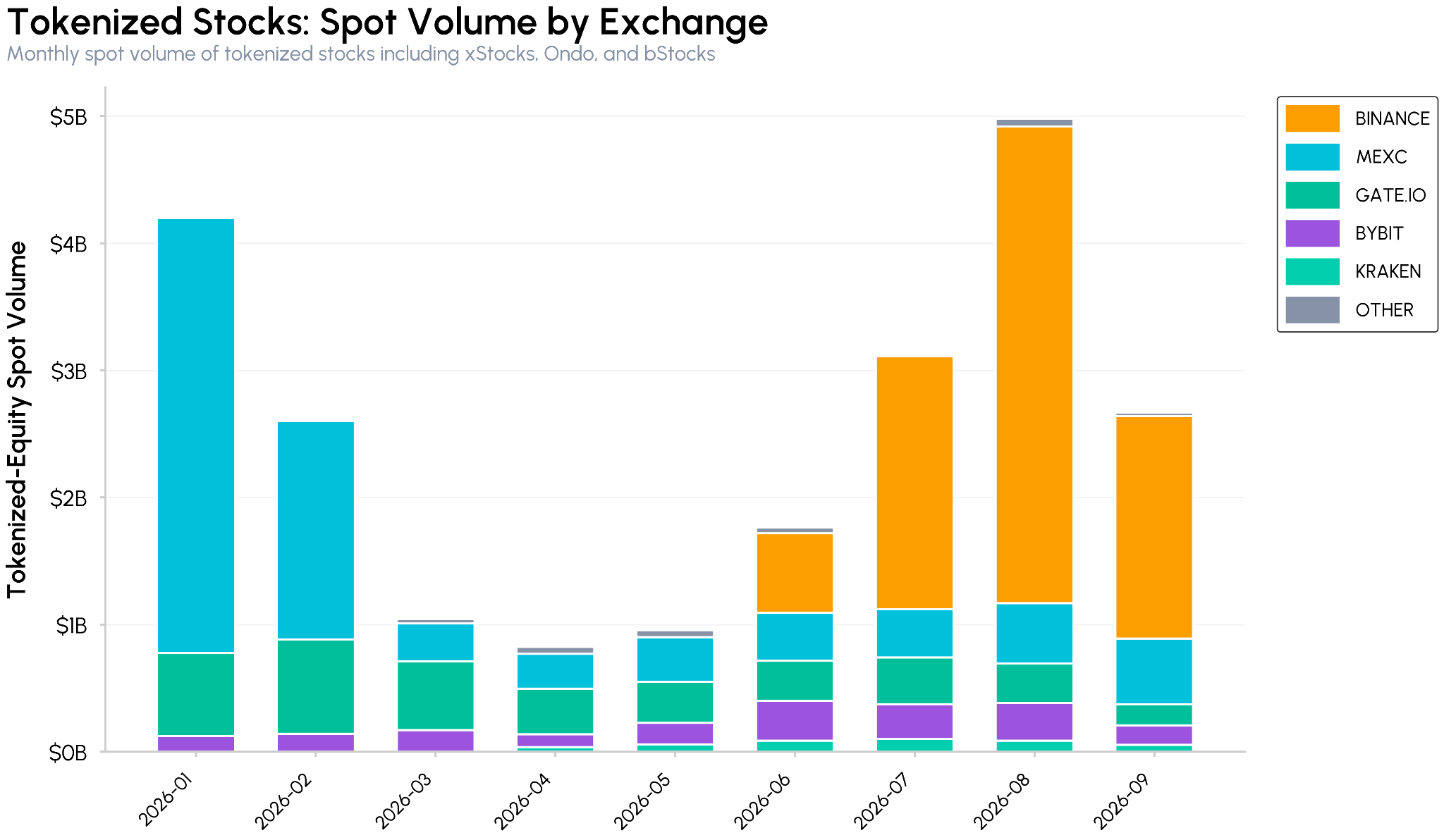
Chart: Source Talos CM Market Data
With just Kraken's xStocks, over $3 billion has been accumulated in on-chain market capitalization on Ethereum and Solana. The number of active addresses interacting with xStocks has also soared in September, as the distribution and usage of these assets expand from on-chain and centralized exchanges to scenarios such as vaults and lending.
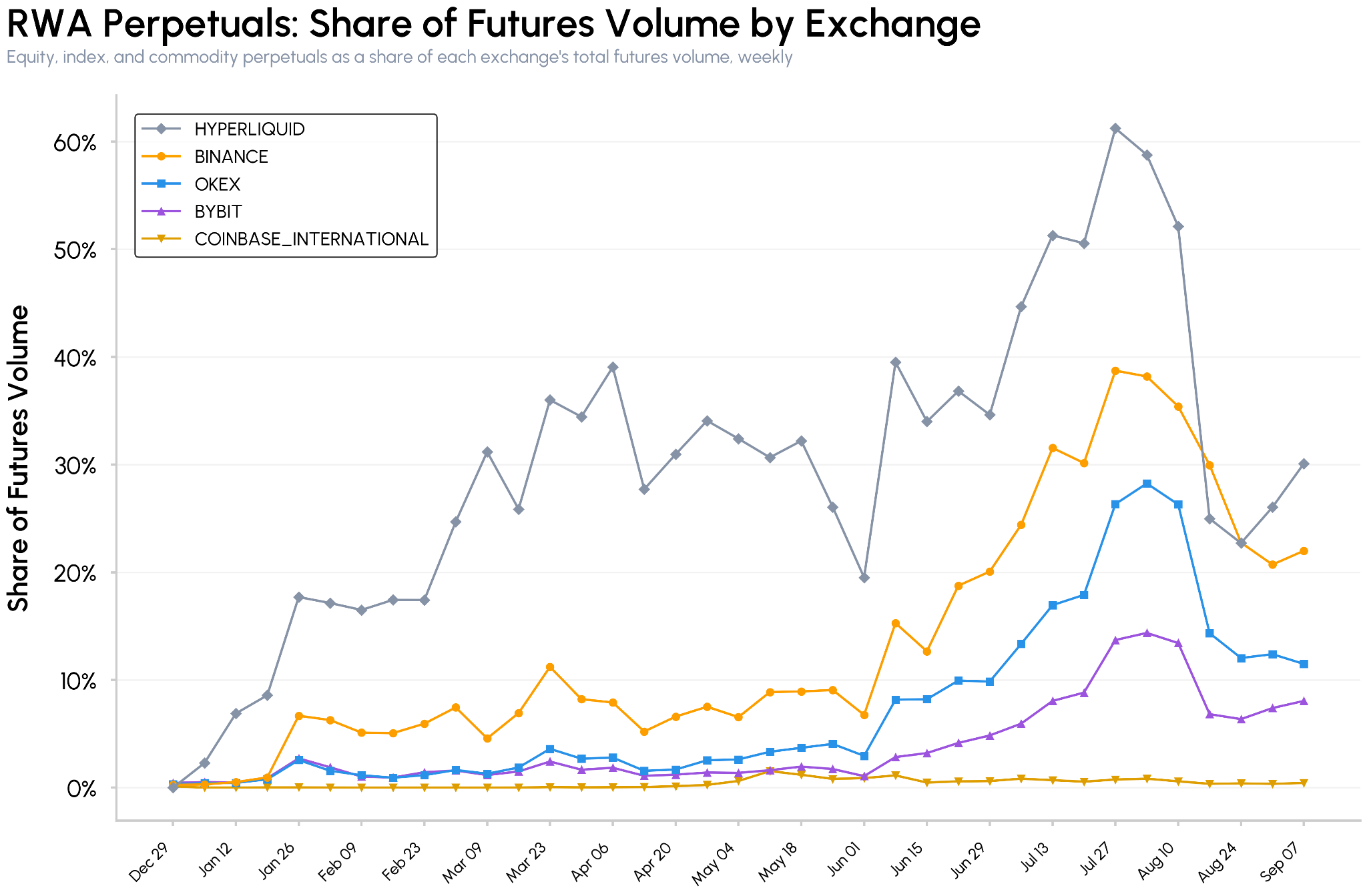
Chart: Source Talos CM Market Data
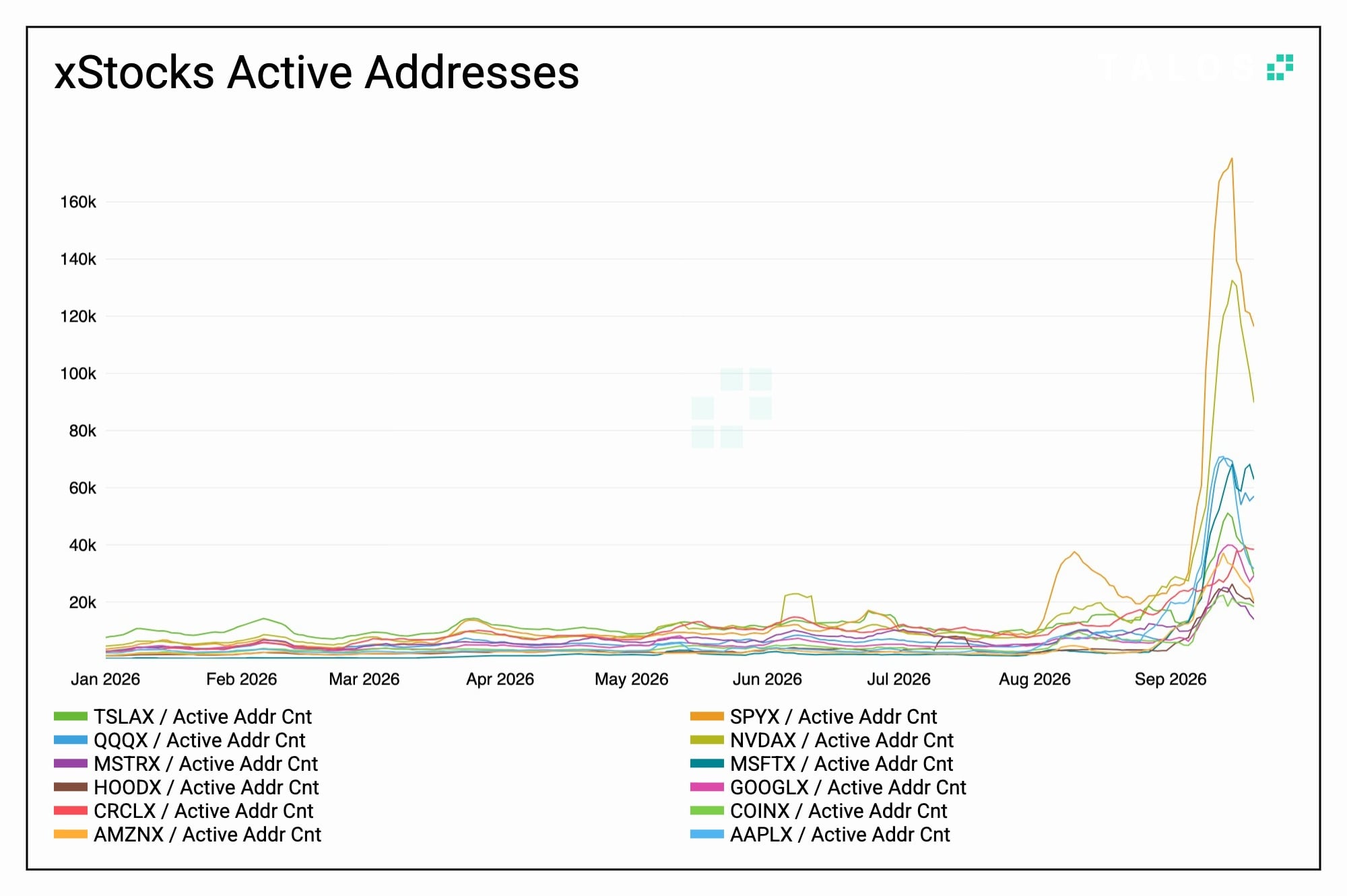
Chart: Source Talos CM Network Data Pro
SEC's Innovative Exemption: Who Stands to Benefit Most?
On September 17, 2026, the SEC launched a five-year "Innovative Exemption," allowing qualified tokenized securities trading venues to trade tokenized stocks on-chain through licensed automated market makers without registering as exchanges. To qualify, tokens must come with traditional shareholder rights, including dividends and voting rights, and must be issued by companies or on behalf of companies, or issued by unaffiliated third parties without objection from the issuer.
Infrastructure that corresponds directly to the SEC's description includes the issuer-native and transfer agent models of Securitize and Superstate, Dinari's custody frameworks, and DTCC's own pilot for tokenizing DTC-held securities. The whitelist pool for Uniswap v4 will benefit from this, while Kraken's Nasdaq Equity Tokens (NETs) and Coinbase's B20 indicate that exchanges are constructing their own rights-retention models. xStocks, bStocks, and Robinhood's Stock Tokens drive most of the current trading volume, but under the existing structures, they seem to be outside this framework.
The overall market's response has been positive, with tokens and stocks related to tokenized stock infrastructure generally rising, regardless of how closely their underlying models correspond to the exemption requirements.
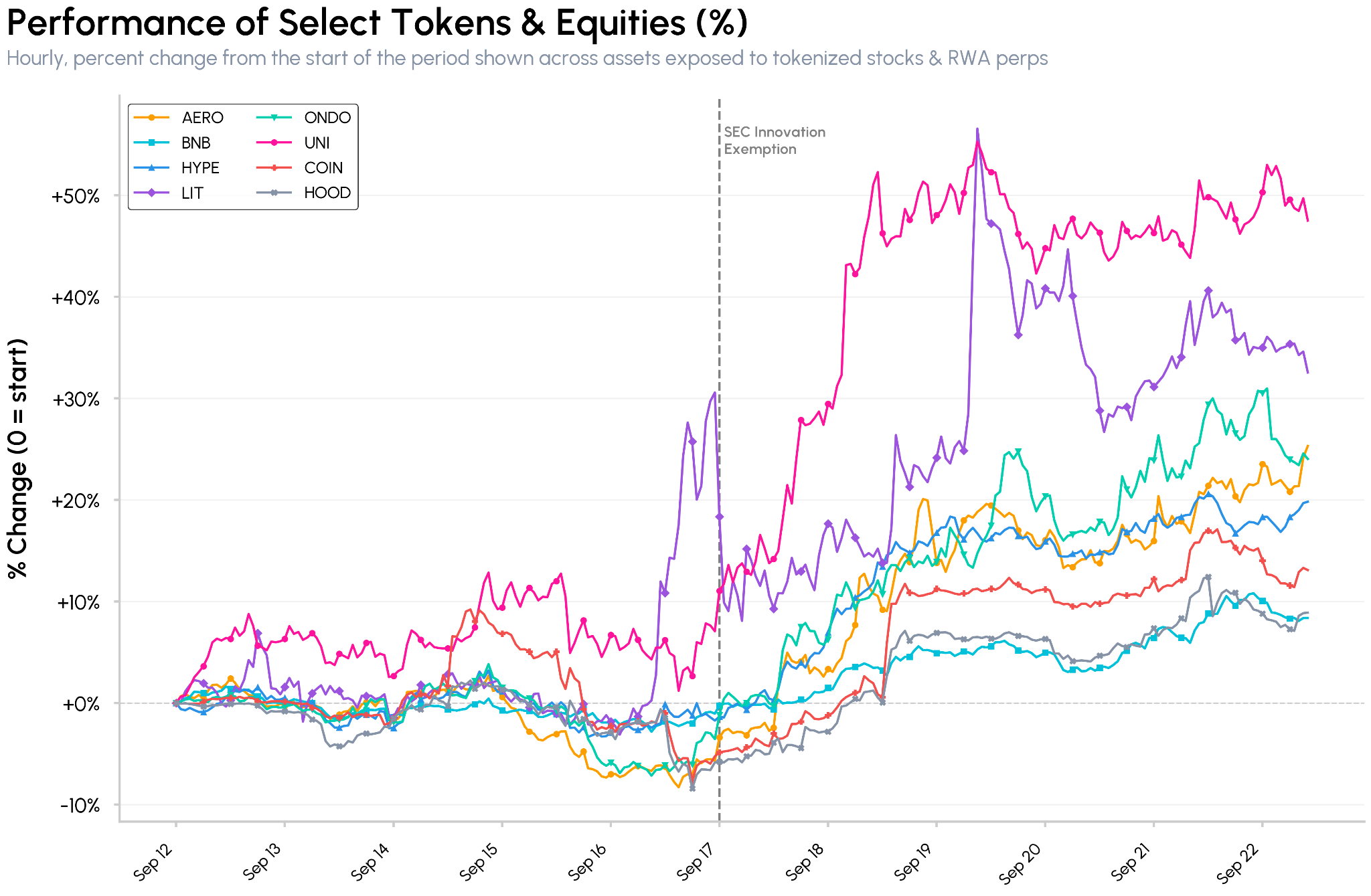
Chart: Source Talos CM Reference Rates
Cryptocurrency trading venues are becoming multi-asset platforms, and traditional assets are adopting the 24/7 programmable structures pioneered by the crypto industry. The growth of xStocks, bStocks, Coinbase’s B20, Robinhood Stock Tokens, and RWA perpetual contracts indicates that there is emerging demand for stock exposure in both spot and derivative forms.
Tokenized models are spread across a spectrum, from issuer-native equity to custody exposure and pure derivatives. Each model exchanges ownership for accessibility. Which model will ultimately prevail remains to be seen, as adoption is still in the early stages. For exchanges, the opportunity lies in a more diversified revenue base; for the market, the boundaries between crypto assets and traditional assets continue to blur.
免责声明:本文章仅代表作者个人观点,不代表本平台的立场和观点。本文章仅供信息分享,不构成对任何人的任何投资建议。用户与作者之间的任何争议,与本平台无关。如网页中刊载的文章或图片涉及侵权,请提供相关的权利证明和身份证明发送邮件到support@aicoin.com,本平台相关工作人员将会进行核查。


