Written by: Rita
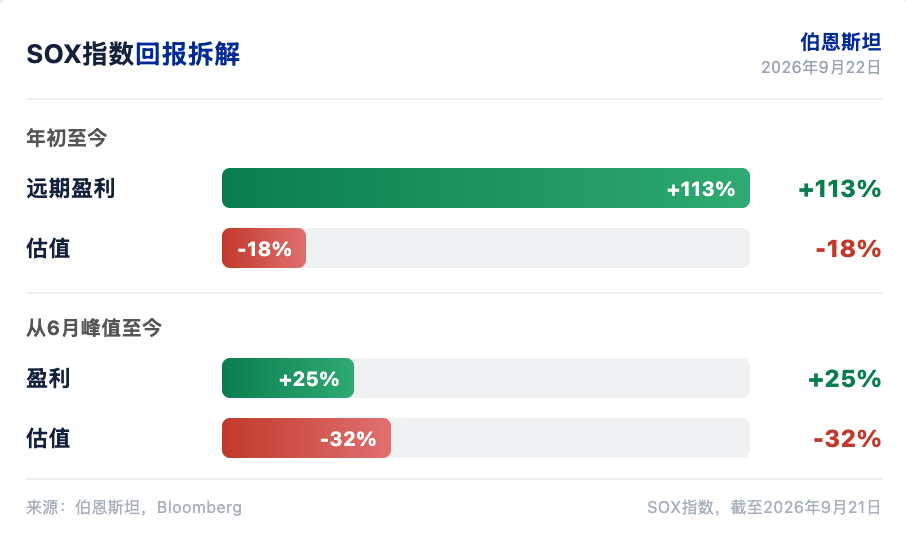
The market has only seen stock prices pull back 15% from the June peak, but Bernstein emphasizes that the fundamentals are still improving. In the semiconductor cycle data report released on September 22, 2026, Bernstein pointed out that the SOX index's forward earnings have been revised up by 113% for the year, with valuations down by about 18%. During the process of pulling back 15% from the June peak, earnings have still been revised up by about 25%. The firm believes that market sentiment and narratives drive short-term stock price volatility while fundamentals continue to improve. There are no signs of a slowdown in AI demand, and the supply-demand tension covers almost all key components.
Bernstein analyst Stacy Rasgon noted in the report that the characteristic of semiconductors this year is the coexistence of two extremes, very strong returns and very high volatility. Spending outlook visibility has improved, even as concerns about financing and sustainability coexist. The firm maintains a bullish outlook on AI demand, especially for computing chips (GPU, CPU) and semiconductor equipment. The former has become increasingly attractive as guidance continues to support strong growth into 2027, 2028, and even longer.
Earnings Revised Up, Valuation Revised Down
The SOX index's forward earnings have been revised up by 113% year-to-date, with valuations revised down by about 18%. During the pullback of 15% from the June peak, valuations have been revised down by 32%, and earnings revised up by 25%. Bernstein pointed out that this breakdown indicates that market sentiment and narratives drive short-term stock price volatility while fundamentals continue to improve. The semiconductor sector's valuation premium relative to the S&P 500 has decreased from about 62% in the previous quarter to about 17%, with crowding significantly declining, currently just slightly above historical average levels.
Semiconductor sales grew by 144% year-on-year in June and by 131% year-on-year in July. Memory sales increased by 452% year-on-year in July, while non-memory sales grew by 35% year-on-year. Bernstein noted that memory is the main driver, with non-memory also showing steady growth. AI demand continues to be robust, and most companies are well-prepared for growth, with widespread upward revisions in revenue this quarter. Analog chip companies have also generally returned to year-on-year growth, with some achieving double-digit growth, indicating that demand outside the AI domain is also improving.
No Signs of a Slowdown in AI Demand
AI demand continues to show no signs of slowing down. All signals point to several years of visibility, as well as tight supply and capacity for nearly all required components. Many non-AI companies are also able to build AI narratives. Bernstein remains bullish on AI demand, especially for computing chips and semiconductor equipment. Nvidia is guiding for over 70% growth in 2027, and Broadcom suggests that its revenue may double by 2027 and double again in 2028 or even more.
Bernstein believes that both Nvidia and Broadcom are worth holding. Both companies have strong growth visibility even in constrained environments, and their valuations are very attractive. If AI sentiment reverses, low valuations may provide a buffer. However, the firm is skeptical about continued spending. Nvidia and Broadcom are both rated as outperforming the market.
AMD and Intel Are Optimistic
AMD is worth buying in both CPU and AI directions. Bernstein is optimistic about AMD's CPU business, benefiting from use case drive and AI business, having deals with OpenAI, Meta, and Anthropic; there is upside potential if the Helios rack ramps up on schedule. Intel’s fundamentals remain challenging, but the market is increasingly supportive of the narrative around CPUs and foundry services, and Bernstein's view on Intel is more positive than it has been in some time. AMD is rated as outperforming the market, and Intel is rated as market perform.
Semiconductor equipment remains attractive. If data center construction continues, even with wafer fabrication equipment (WFE) expectations rising, the firm forecasts WFE to exceed $250 billion by 2028, and to reach over $300 billion by 2030. Bernstein prefers Applied Materials based on its DRAM exposure and valuation. PDF Solutions (PDFS) is a target involved with increasing complexity and investment. Applied Materials, KLA, Lam Research, and PDF Solutions are all rated as outperforming the market.
Qualcomm and Analog Chips Remain Cautious
Bernstein has a conflicted view on Qualcomm. The firm likes the data center story but believes that the smartphone business faces demand destruction and margin headwinds, and the renewal of Apple's QTL (Qualcomm Technology License) is also an undecided factor. Qualcomm is rated as market perform. Regarding analog chips, Bernstein prefers Analog Devices, as its industrial business contributes more structurally in the long term, and the data center story remains robust, with valuations having come down. Texas Instruments may have more margin upside, but it is highly cyclical, with more PE exposure and valuations approximately 5 times expensive. NXP is cheaper but has too much automotive exposure. Analog Devices is rated as outperforming the market, while Texas Instruments and NXP are rated as market perform.
Bernstein noted that rising memory prices are impacting demand for PCs and smartphones. In the second quarter, PC shipments declined year-on-year by 4% to 5%, slowing by 8 to 10 percentage points compared to the previous quarter. Taiwan ODM laptop shipments fell by 24% year-on-year in July and decreased by 31% month-on-month. Global smartphone shipments in the second quarter decreased by 7% year-on-year and by 6% month-on-month, below pre-pandemic seasonal levels. The firm remains concerned about PC and smartphone sales for the second half of the year and beyond.
The semiconductor sector's valuation premium relative to the S&P 500 has decreased to about 17%, with crowding receding to near historical average levels. Earnings revisions are still ongoing, and valuation revisions have already occurred. Whether this cycle can continue depends on whether AI demand can stay ahead of supply by 2027.

Disclaimer
This article is a compilation and interpretation of third-party brokerage research reports (Bernstein, September 22, 2026) by Chao Xiang Research, combined with public market information. The ratings, target prices, earnings forecasts, and related judgments cited in this article are the opinions of the brokerage analysts and only represent the positions of their respective institutions, not the views of Chao Xiang Research, and do not constitute any investment advice.
The market carries risks, and decisions should be made independently. This article should not be used as the basis for buying or selling any securities.
免责声明:本文章仅代表作者个人观点,不代表本平台的立场和观点。本文章仅供信息分享,不构成对任何人的任何投资建议。用户与作者之间的任何争议,与本平台无关。如网页中刊载的文章或图片涉及侵权,请提供相关的权利证明和身份证明发送邮件到support@aicoin.com,本平台相关工作人员将会进行核查。


