
Dario spreads anxiety, Ultraman sits dazed, major models have dominated for over ten days, amid a wave of FOMO, every business owner who loves and hates AI realizes: it's time to take down the plaque of diligence and enroll in a corporate Agent crash course.
Enterprise Agents are the next big market after coding, and there is already a strong consensus on the unification of supply and demand. Therefore, the AI office battle has finished with elevator advertisements on the eastern front and quickly shifted to the core battlefield on the western front: getting bosses to issue invoices.
However, when bosses pull out their budgets and equip each employee's desktop with Agents, they find that the improvement in company operations seems to be stuck on a "last mile." The first batch of companies to catch the trend has also realized one issue:
An Agent that helps employees write weekly reports is not necessarily an Agent that can get the job done well.
At the Yunqi Conference on September 22, Chen Yusen, CEO of Qianwen Office, mentioned this issue: “Agents need to land in real enterprise scenarios, understanding the business while collaborating like humans within enterprises and organizations, and each task execution must have boundaries and be traceable.”
As one of the participants in the office battle, Qianwen Office has not followed the route of heavy investment but has focused its main energy on the backend. At the Yunqi Conference, Qianwen Office released a series of solutions including Agent hosting capabilities, digital employees, collaboration, applications, and security centers, all pointing to one question:
How should a true enterprise Agent work?
What is your context?
Among the many solutions released by Qianwen Office, the focus is probably not on the Agent itself, but on the "context problem."
What is context? It refers to the specific setting in which work occurs.
For example, when a boss says, “Let’s assign this project to Xiao Chen,” the context of this decision includes who Xiao Chen is, what this project is, what projects Xiao Chen has done before, and why Xiao Chen is suited for this project, etc.
Chen Yusen gave an example at the press conference: asking what the gross profit margin was in East China for the last quarter? No Agent can answer that because the Agent doesn’t even know what kind of company it is, and there's no starting point. It’s like hiring a researcher but not giving them an access card, forcing them to collect parcels at the front desk.
This is essentially the last mile for Agents transitioning from personal to enterprise:
Chatbot-type products can solve "general" problems, but once they enter the "special" contexts of enterprises, they struggle due to lack of context. For example, asking how many days of annual leave the company offers, the Agent can only tear apart the labor law to give a standard answer without seeing the company’s management regulations.
Currently, the most widely used applications for Agents such as weekly and daily reports, or creating PPTs, are characterized by thin context; by uploading a few documents and writing a few keywords, the Agent can manage. However, in large-scale enterprises, the complexity of context is unimaginable.
For instance, the data calibration issue for a restaurant business can stump many Agents: is sales referring to stores or same-store sales? Is it counting dine-in or takeout? Which data point from different departments should be selected? Without complete context, the Agent can crash on the spot.
When individuals use AI, the model can automatically remember user habits in long-term memory. But "corporate memory" within organizational settings is very complex.
Deloitte pointed out in its previous reports that the "dispersed context" is a problem. Corporate context is deposited in ERP systems, business logic is embedded within ABAP codes and daily communications among employees, understanding a company’s knowledge with an Agent is a major project in itself.
This raises a new question: Having context is not enough, this context must also be callable by the Agent.
Writing a weekly report as an individual is merely uploading a few documents and allowing the corporate organization to turn fragmented context into structured documents and data; even with the willingness from employees, once completed, ASI has already accomplished that three times.
Model capabilities can vary with business needs; harness capabilities of different Agents will gradually converge, and all participants in the office battle have realized that if they want to penetrate the internal workings of companies, context is key. As shown in Chen Yusen's presentation, Context is all you need.
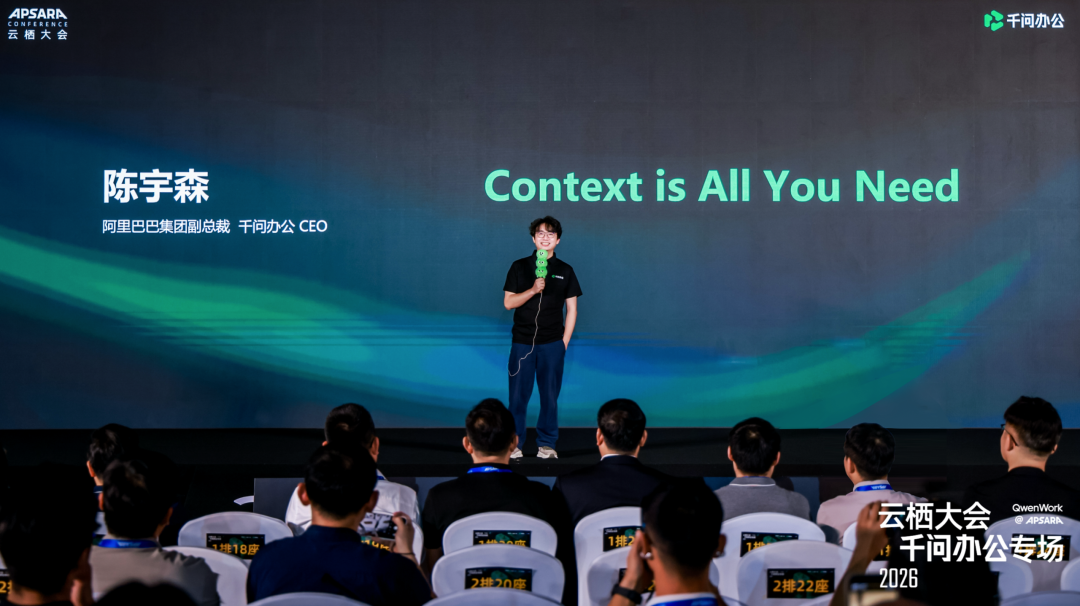
Therefore, at the Yunqi Conference, Chen Yusen quickly outlined the focus of Qianwen Office: a product called Enterprise Context.
Let me see!
Software used by people and tools used by AI are literally two different species.
SaaS software's buttons, menus, and views perfectly match human interaction habits, but Agents need structured, callable validation interfaces. However, large companies’ SaaS software has been running for decades, and they cannot afford to act recklessly; whether an Agent can call smoothly is key to improving efficiency.
In other words, the relationship between Agents and SaaS is not a life-and-death struggle; it's a synergistic existence. The connection between the two is a key step in bridging context.
During the Yunqi Conference, a signal was sent: Qianwen Office is advancing cooperation with two global software giants, SAP and Salesforce, becoming the first official partner for enterprise Agents in China for both companies, allowing a large amount of enterprise context to be activated by Agents.
Having solved the context source issue, it is also necessary to address how to connect the "context accumulated by humans" with the "context callable by Agents."
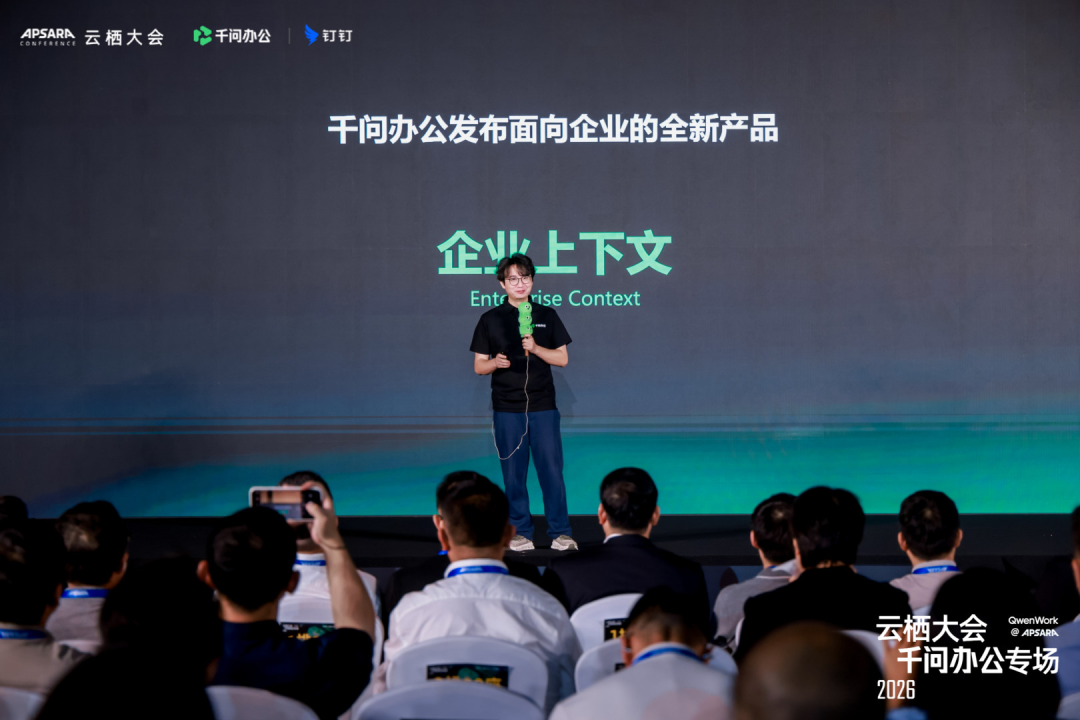
The focus of Qianwen Office rests on context
Most formally operated enterprises have two basic characteristics regarding context:
First, it isfragmented. Even in companies with a strong document culture, context tends to be scattered in various corners and unorganized, including but not limited to structured data in SaaS software, impromptu discussions in group chats, ad-hoc meetings initiated by clients, and summaries from chat records, etc.
Just like in historiography, besides the official historical records, many administrative documents, personal diaries, and local chronicles also hold significant research value. The challenge lies in collecting these fragmented historical materials, which is a sore point for enterprise-level context.
Second, it is large-scale. Chen Yusen provided an example: based on the data condensed in DingTalk, the internal data scale for medium to large enterprises is around 150PB, which even the strongest context window cannot accommodate.
In other words, the context of slightly older enterprises is a literal stacked historical burden. If employees need to actively organize massive and scattered data into structured information, it doesn’t just depend on whether they can complete it; anyone with the willpower and resolution could achieve it without an Agent.
To address these two problems, Qianwen Office has prescriptively offered a solution for enterprise context products: connection and compression.
The purpose of connection is to integrate the knowledge accumulated by enterprises with Qianwen Office, systematically linking know-how from documents, meetings, and chats into a corporate context that can be flexibly called by Agents.
Once connected, Qianwen Office can retrieve context according to permissions, truly understand corporate knowledge, and perform tasks like humans.
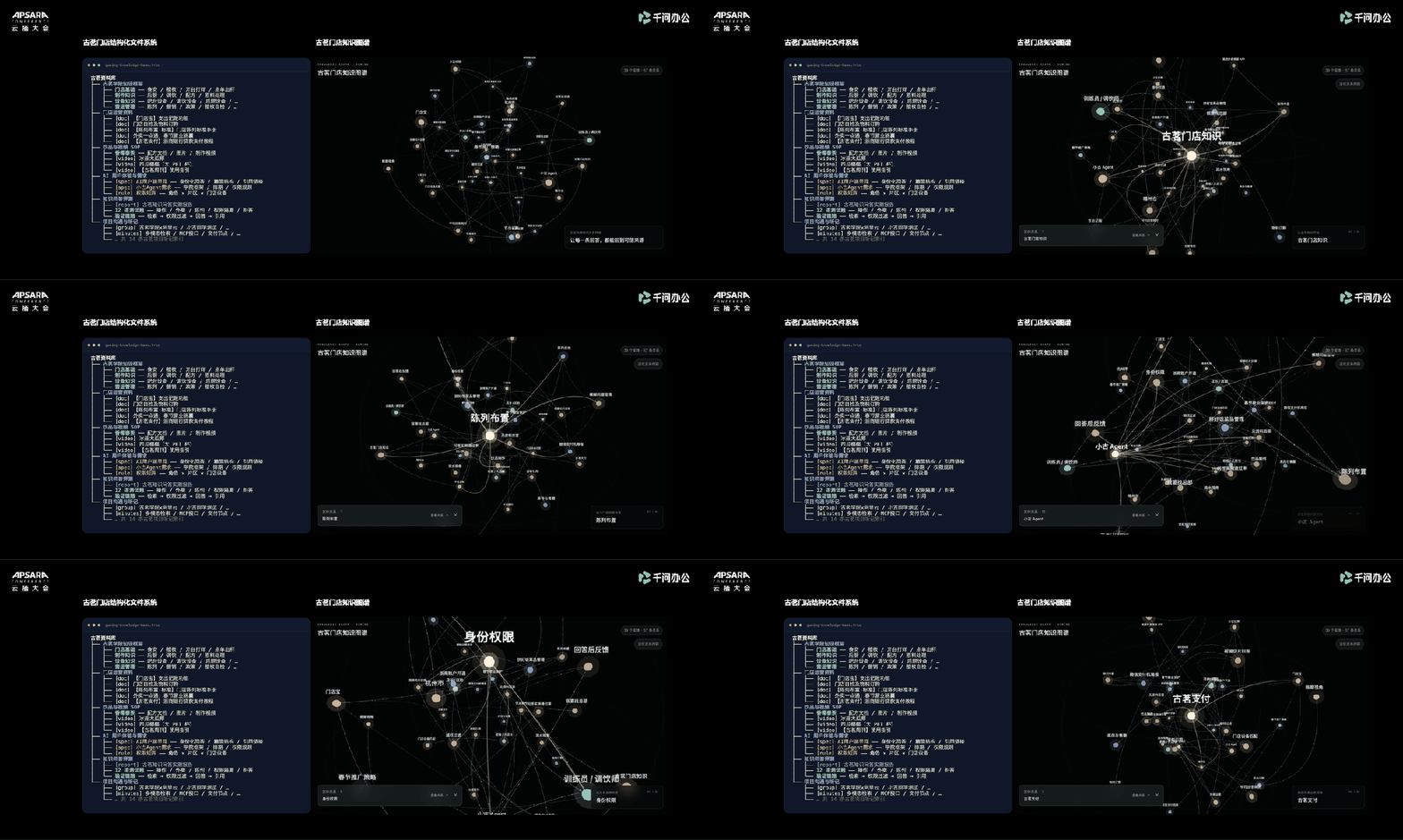
Guming structures original materials using Enterprise Context
The goal of compression is to systematically store fragmented knowledge, establishing associative relationships between data that can be understood by Agents, thereby improving calling efficiency further.
Data is the foundation of all intelligence; whether data resides on servers or on A4 paper directly determines the level of digitalization in companies. The transition of organizational and business processes to online digital construction has only been a few years in the industry.
The Enterprise Context product from Qianwen Office effectively builds the “prerequisite condition” for Agents to enter companies—establishing the necessary infrastructure.
Once the infrastructure is in place, can companies move in with bags in hand? The answer is no, not yet.
Who let it in?
Grab any AI enthusiast and ask them what capability they care most about in Agents; the answer will likely be the model.
For individual users utilizing Agents, the cost of rephrasing a question after a wrong answer is virtually zero, thus the evaluation focus is on product and model; however, when corporate context is scattered across five departments and three systems, a single wrong number can lead to compliance issues, so what enterprises truly care about is reliability.
This reliability has two very specific measurement indicators:
First, Token consumption. A trend in Silicon Valley has sometimes seen a surge in Token leaderboards—Meta once released a ranking to see who utilized AI the most internally. The top-ranked individual burned through $500,000 in just a month.
Operating costs are a key metric for enterprises; if employees use the highest inference mode of GPT-6 Astra just to polish copy, how can any businessman not feel a heart attack about that?
Second, data security. Any legitimate enterprise strictly manages employee use of personal AI tools for this reason: data security. You might want to spark a grand AI revolution within the company, but the risk management department may not want to accompany you at the detention center.
Consequently, an independent Agent product cannot meet enterprise needs; what they truly require is a complete and reliable solution. Without a safety valve to let Agents in, no matter how many points you offer, the boss wouldn’t dare to accept.
Thus, beyond the Enterprise Context, Qianwen Office is preparing a solution composed of different products; only after setting up access control and installing cameras can the boss feel secure while issuing invoices.
For example, Managed Agents are responsible for configuring models, commands, tools, and operating environments, allowing enterprises to uniformly define and manage different Agents; Security Center is used to centrally manage Agent data access, tool invocation, and task execution, preventing AI from wandering chaotic in the database.
Digital employees and collaboration functions point towards specific business scenarios, with the former granting Agents clear identities, positions, permissions, and responsibilities, while the latter brings together employees, digital employees, and project information in the same space.

Qianwen Office launches the “collaboration” feature
In this way, the interaction between individuals and Agents transforms into organizational-Agent interactions, allowing the positioning of Agents to change from assistants to colleagues. As for becoming a leader? That can wait for now.

Qianwen Office launches the “application” feature
Combined with QwenNote A2 hardware, it enables direct integration of enterprise Agents in offline scenarios such as meetings and client visits, automatically collecting context and broadening the boundaries of Agent effectiveness.
With context-based infrastructure, applications connect to business systems, digital employees connect to organizational roles, collaboration spaces connect interpersonal collaborations, and QwenNote hardware connects offline scenarios.
A press conference at the Yunqi Conference has given shape to what enterprise Agents can genuinely become.
Claim your position
The AI office battle is a resurgence of a significant industry conflict in China's internet sector after many years. The reason is not hard to understand; the market is enormous.
Specifically, Agents will reshape the enterprise market in China, which broadly qualifies as an industry consensus. Earlier this year, discussions in the US capital market labeled “SaaS is dead,” while in China, it was quiet. The simple reason is: China’s SaaS has always been lying in ICU, barely alive.
Historically, domestic companies have kept their distance from the subscription fees for standardized products, but in the era of Agents, the industry has generally formed a consensus: when Agents can access business systems and participate in organizational collaborations, the business model may pivot towards paying based on the number of Agents, task execution volumes, or business outcomes.
Simultaneously, the collaboration with Qianwen, SAP, and Salesforce also indicates a possible new mode of cooperation between enterprise-level Agents and SaaS software: specialized software carries business tasks while Agents connect cross-system tasks, allowing employees to avoid repeatedly switching software, searching for information, and transferring data, thereby pushing work forward more directly and achieving results.
The status of SaaS software in the era of Agents will not decrease, and it may even continue to increase.
As more SaaS vendors and service providers connect, enterprise-level Agents may also form an application and service ecosystem, opening new avenues for revenue through the exchange of models, tools, digital employees, and industry capabilities.
On the other hand, the stickiness of the enterprise market is not comparable to that of the consumer market.
Generally speaking, large enterprises do not easily change suppliers, especially when Agents have accumulated significant enterprise context and have established extensive collaboration links with organizations. When AI deeply integrates with corporate workflows, the stickiness of corporate users will become increasingly stronger.
Therefore, for large manufacturers, losing an enterprise order might mean losing several years' worth of revenue, and the cost is extremely high, which drives the unabated conflict in the AI office battle.
However, one thing is certain: to impress enterprise bosses, it relies neither on distributing red envelopes nor offering points; it requires examining product capabilities, measuring data security, and also necessitating in-depth integration with existing systems (like ERP and CRM).
As various major players unveil their solutions from their arsenals, the office battle may truly enter the main battlefield. To borrow Churchill's words:
This is not the end, nor is it even the beginning of the end; it is perhaps the end of the beginning.
免责声明:本文章仅代表作者个人观点,不代表本平台的立场和观点。本文章仅供信息分享,不构成对任何人的任何投资建议。用户与作者之间的任何争议,与本平台无关。如网页中刊载的文章或图片涉及侵权,请提供相关的权利证明和身份证明发送邮件到support@aicoin.com,本平台相关工作人员将会进行核查。