Last month, a friend accompanied her mother to the bank for a fixed deposit renewal.
When she deposited three years ago, the three-year interest rate was over 2%; this time, as it matured and was renewed, the interest rate had clearly dropped.
The elderly lady calculated with her savings book:
“For the same 1 million, a few years ago there was an interest of 20,000 or 30,000 a year, now there’s just over 10,000 left. The money hasn’t decreased, so why does it feel like it’s becoming less valuable?”
This is actually a change that many families are facing.
In the past, having money meant depositing it in the bank, which was the simplest and most secure choice. But as deposit rates continued to decline, new problems arose: the principal hasn't decreased, but purchasing power may be slowly shrinking.

1. Deposits are very safe, but safety also has a cost
Assuming 1 million:
● Annualized 3%, annual interest of 30,000;
● Annualized 2%, annual interest of 20,000;
● Annualized 1.25%, annual interest of 12,500;
● If the interest rate approaches 1%, the annual interest will only be around 10,000.
For emergency funds and short-term money, liquidity and principal safety should come before yield.
What really deserves thought is: what will happen if a sum of money sits in a low-yield account for 10 years without being touched?
Assuming long-term inflation is calculated at 2.5%, 1 million left for 10 years: 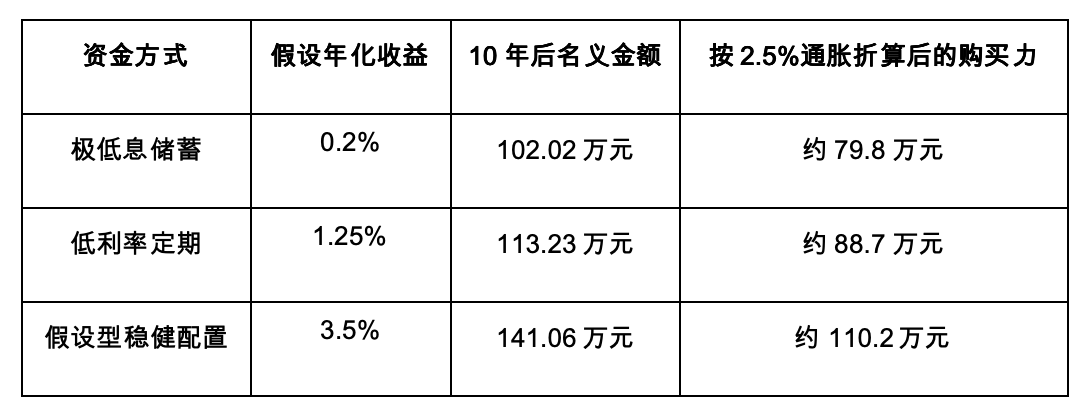
Calculation note: The above data is based on assumed yields and a 2.5% annual inflation rate and is used solely to showcase the differences in long-term accumulation at different yields. It does not represent the actual returns of any specific product, nor does it constitute investment advice. Actual rates, inflation levels, and investment returns may fluctuate.
This illustrates a very real question:
In a low-interest-rate era, the risks of assets are not just loss, but also failing to keep up with purchasing power over the long term.
Thus, deposits remain important, but they primarily address safety and liquidity issues.
2. What truly needs adjustment is the allocation of funds
Many families' assets share a common characteristic: all the money is taking on too many tasks.
Deposits must be available for emergencies while also seeking high returns;
Investment accounts aim for long-term growth yet might need to be accessed at any time;
Money that's not needed for the long term is still parked in low-yield accounts.
When the market drops, people who need cash are forced to sell.
Therefore, the first step in asset allocation is not to seek the “highest-yielding” product, but to clarify first:
When will this money be needed? How much volatility can it tolerate?
Money needed in the short term should prioritize liquidity.
For money that will definitely be needed in the next few years, focus on principal safety and matching timelines.
Long-term idle money is what can bear some volatility in pursuit of long-term growth.
Assets like gold, equities, overseas assets, and digital assets should also be viewed within the entire portfolio.
First determine the tasks of the funds, then decide on the choice of assets.
3. When traditional asset yields decline, broaden the perspective on allocation
For a long time, many families' asset allocation was quite simple: house + deposits.
The house was expected to bear long-term wealth growth, while deposits provided a sense of security.
However, with changes in the real estate market environment, deposit interest rates, and the global interest rate landscape, more people are starting to pay attention to gold, overseas assets, equity markets, and digital assets.
Among these, Bitcoin is an unavoidable new asset category.
In January 2024, the U.S. Securities and Exchange Commission approved the listing and trading of spot Bitcoin exchange-traded products, thus providing Bitcoin with a more direct investment channel in traditional financial markets.
Yet this hasn't changed its high volatility characteristics.
Therefore, the real question worth discussing in asset allocation is not “Should everyone buy BTC,” but rather: what are the characteristics of this new asset that differs from stocks, bonds, and real estate?
Bitcoin has attributes like global trading, a 24-hour market, and a supply cap, which is why it has entered the research scope of some investors and institutions.
But it also carries risks such as price volatility, market cycles, and regulatory changes.
If a family doesn't even have emergency funds or has clear large expenditures in the coming years, discussing how much BTC to allocate is of little significance.
For those who already have a certain asset base and can bear high volatility, it can be seen as a worthy asset category to research.
As for whether to allocate and how much, it ultimately depends on individual asset scale, cash flow, investment duration, and risk tolerance.
Zero allocation is also perfectly fine.
4. True asset allocation starts with understanding
Not having previously engaged with digital assets does not mean they are not worth understanding.
Similarly, understanding gold and overseas stocks does not mean one must buy in immediately.
The more important skill in asset allocation is knowing what assets are available in the market and what roles they each play.
If you want to further understand digital assets, you can start by clarifying a few basic questions:
● What are BTC and ETH;
● What roles do USDT and USDC play;
● What are the differences between spot and contracts;
● Why do digital assets experience dramatic volatility;
● How do platforms ensure account security and asset management.
Understand first, then decide whether to participate.
If you are looking for a relatively mature platform to learn about this market, Binance covers multiple markets and products, including spot, stablecoins, and digital asset trading.
For those just starting to learn about digital assets, you can first register an account and familiarize yourself with the products and trading rules.
👉 Binance registration link:
https://jump.do/zh-Hans/xlink-proxy?id=3
(Invitation code: aicoin668, enjoy a 10% rebate)
Moreover, there’s a small benefit for recently registered users:
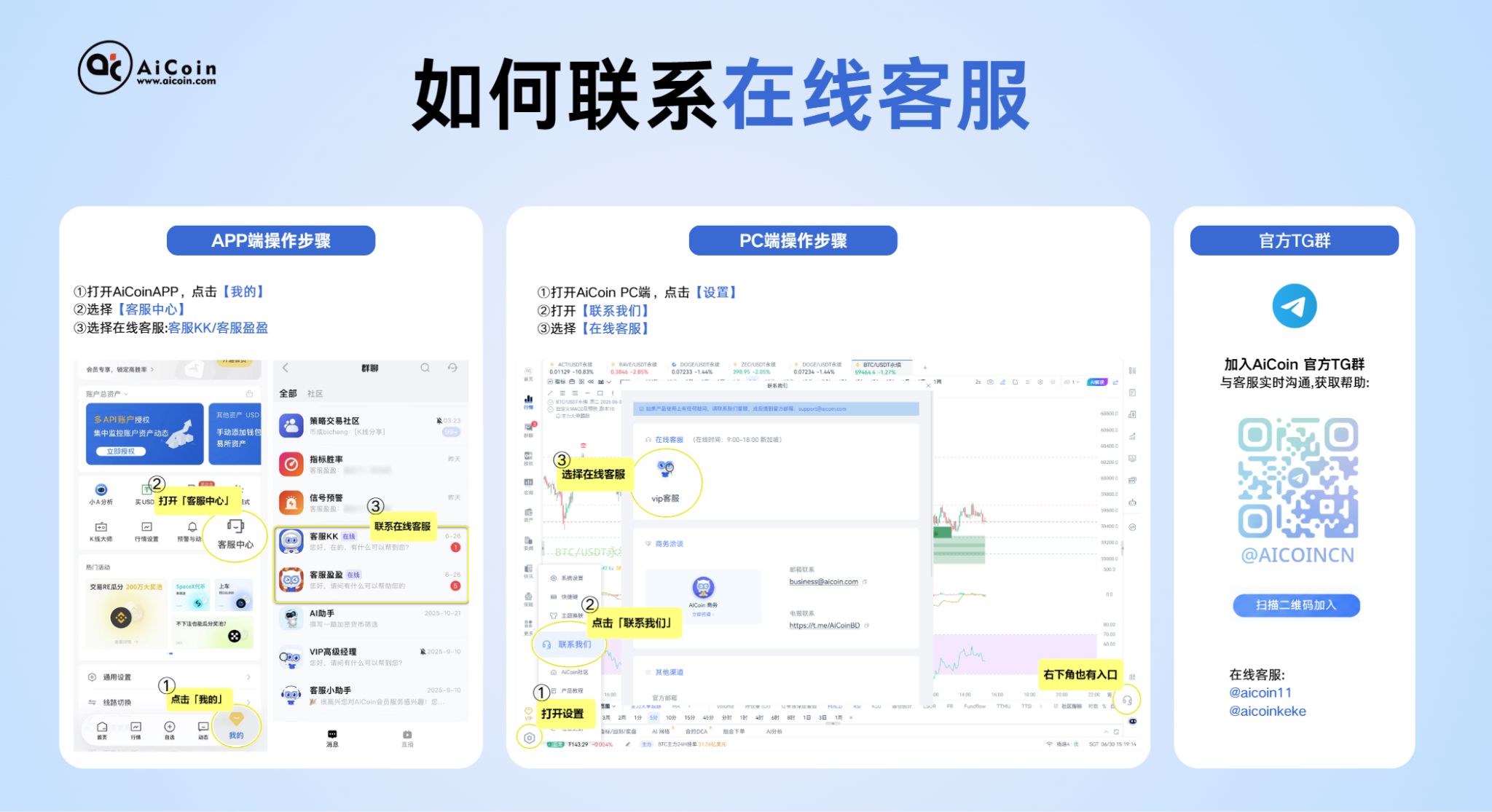
After registration, contact customer service to receive 3 days of AiCoin membership feature experience.
5. In a low-interest-rate era, recalculate your asset structure
Returning to the elderly lady mentioned at the beginning.
What truly perplexed her wasn’t so much the interest rate dropping from 2% to over 1%, but rather:
Why does it feel like money hasn’t decreased, yet it is becoming less valuable?
This is precisely the change that a low-interest-rate environment brings to household asset management.
Deposits remain important, serving liquidity and security.
At the same time, there is a need to seek more suitable placements for long-term funds: some allocate bonds, some allocate equities, some allocate gold, and some start researching overseas assets and digital assets.
Different money can take on different tasks.
What really deserves recalculating isn’t just “how much can this money earn in a year,” but also when it will be needed in the future, how much volatility it can withstand, and whether there is sufficient choice space.
As deposit interest rates continue to decline, asset allocation is no longer just a matter of “how much to save.”
More importantly, it is about understanding where each slice of money should go.
Join our community to discuss and grow stronger together!
Official Telegram community:
AiCoin Chinese Twitter:
Binance benefits group:
https://www.aicoin.com/link/chat?cid=gmLgwvKD1
Risk warning: This article is compiled based on publicly available information, solely for market observation and asset allocation knowledge sharing, and does not constitute investment advice. The yield rates, inflation, and purchasing power data mentioned in the text are hypothetical calculations, and actual results may vary. Digital assets are highly volatile and investments should be carefully judged based on individual circumstances.
免责声明:本文章仅代表作者个人观点,不代表本平台的立场和观点。本文章仅供信息分享,不构成对任何人的任何投资建议。用户与作者之间的任何争议,与本平台无关。如网页中刊载的文章或图片涉及侵权,请提供相关的权利证明和身份证明发送邮件到support@aicoin.com,本平台相关工作人员将会进行核查。