CoinW Research Institute
Summary
Last week, QNT surged by more than 300%, driven by the acceleration of tokenized bank deposits moving from proof of concept to real financial scenarios. The U.S. Clearing House has chosen Quant to build on-chain monetary infrastructure, seven banks in the UK have completed real customer transactions through the Quant platform, and six major banks in Canada have begun exploring tokenized deposits. Unlike stablecoins, tokenized deposits still belong to bank deposits, but they have gained capabilities such as 24/7 transfer, programmable payments, and digital asset settlement. Quant's opportunity lies in connecting different bank ledgers, payment systems, and blockchains. However, the biggest expectation gap currently exists around QNT. The institutional adoption of Quant is being validated, and whether this commercial value can continuously translate into the demand for QNT usage, purchases, or locking is the core that truly needs to be observed in the next phase.
1. Behind the Surge of QNT: Banks Start Moving Deposits on Chain
In the past week, the long-dormant QNT suddenly became one of the best-performing assets in the crypto market, with a weekly increase exceeding 300% and trading volume rapidly expanding. The direct catalyst for this round of market activity appeared on September 24. On that day, the U.S. banking core payment institution, The Clearing House (TCH), announced that it had chosen Quant to provide interoperability, transaction orchestration, and transaction management technology for its On-Chain Money Initiative. This program aims to allow banks to settle and clear tokenized deposits on-chain while continuing to connect with traditional payment systems like RTP and CHIPS, which is expected to be open to participating institutions in the first half of 2027. TCH processes over $2 trillion in payments daily, which has allowed Quant to move from being a familiar interoperability project in the crypto market to further enter the sight of traditional U.S. bank payment infrastructure.
More notably, the UK has begun to turn similar concepts into real transactions. Seven banks, including Barclays, HSBC UK, Lloyds, Monzo, Nationwide, NatWest, and Santander, have completed the first batch of real customer transactions on the Great British Tokenised Deposit (GBTD) platform built by Quant, including two mortgage refinancings and one consumer conditional payment. For example, funds can be locked in advance and released automatically once the conditions stipulated in the contract are met. Unlike the previous concepts that remained in experimental environments, these transactions have begun to involve real customers, real accounts, and real funds.
Canada provides a third signal. Six banks, including BMO, CIBC, RBC, Scotiabank, TD, and National Bank, have announced a joint exploration of tokenized deposits in Canadian dollars, with the goal in the first phase being to allow deposits to flow between different financial institutions. The Canadian project has not disclosed Quant's involvement, so it cannot be directly viewed as a positive for QNT, but it indicates that this is no longer just Quant's own story. Major banks in the U.S., UK, and Canada are all simultaneously exploring how to bring traditional deposits into new digital financial infrastructures. Thus, behind this round of QNT's increase, the market is focused not merely on the large institutional cooperation Quant has secured but rather on the fact that tokenized bank deposits are transitioning from proof of concept to real transactions and cross-bank infrastructure; "bank deposits on-chain" has begun to become a new financial narrative that can be continuously validated.
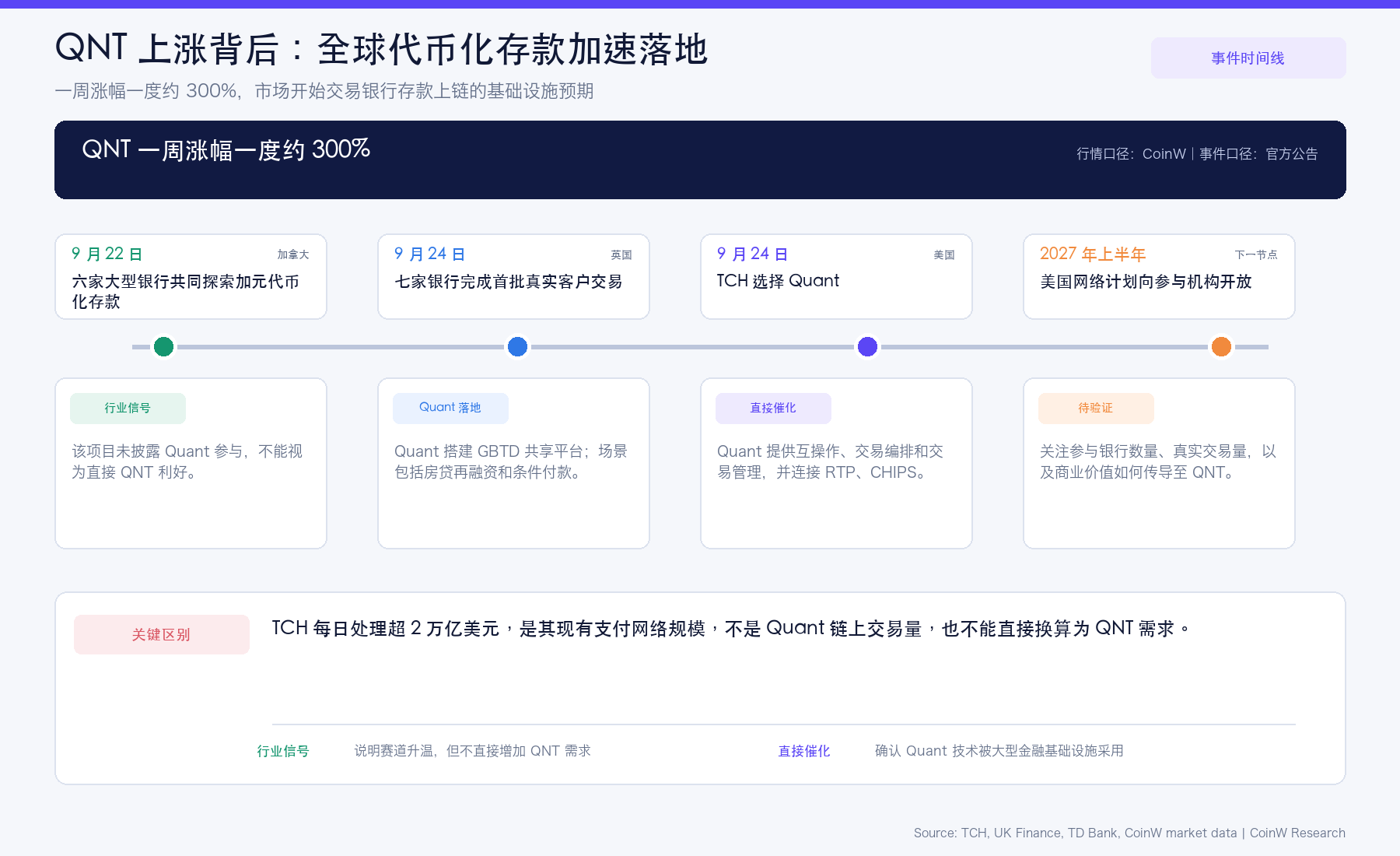
Figure 1. QNT's Rise and the Global Tokenized Deposit Event Timeline. Source: CoinW Research Institute
2. What are Tokenized Bank Deposits and Why Don't Banks Use USDC Directly?
Tokenized deposits sound very similar to stablecoins, but their starting points are different. Simply put, it records and transfers deposits that customers originally held in bank accounts in the form of tokens. The customer still holds the deposit claim against the bank, and the funds still belong to the banking deposit system; they have merely added a form that can circulate and settle on a digital ledger. Take $100 as an example. After a customer deposits $100 in the bank, the bank can generate corresponding deposit tokens in a controlled digital network. When the customer uses these tokens for payment, the essence of the transfer is still a bank deposit, rather than exchanging dollars for another crypto. The Dallas Fed has also pointed out that tokenized deposits still belong to commercial bank liabilities, can be redeemed at face value, and remain within the bank's regulatory framework; whether deposit insurance applies depends on the specific jurisdiction and product design. Stablecoins like USDC and USDT have a different structure. For instance, with USDC, users hold a stablecoin issued by Circle, which is backed by cash and short-term U.S. Treasury securities. This means stablecoins are issued as new digital currency instruments outside the banking system, while tokenized deposits add a new digital track on top of existing bank deposits.
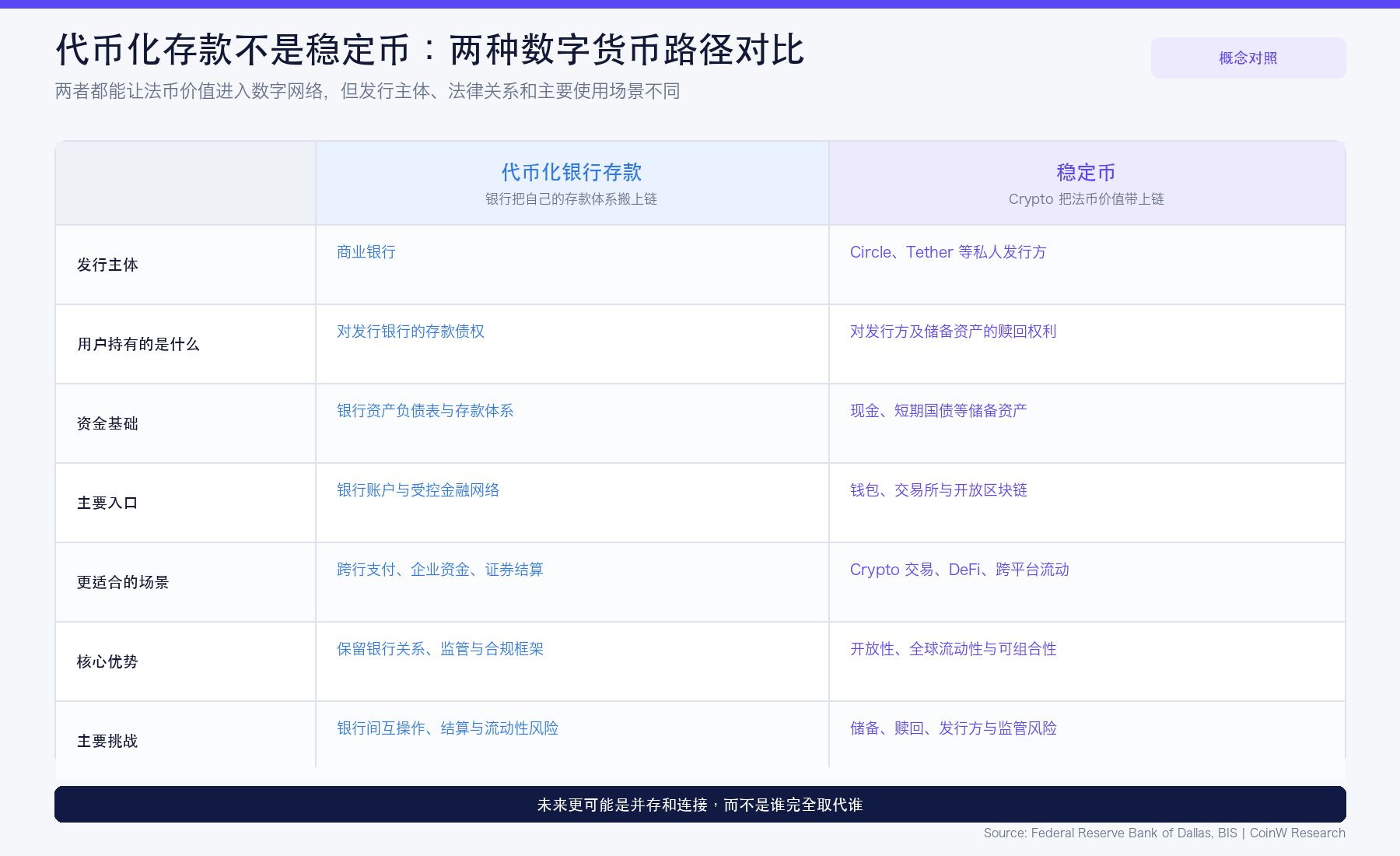
Figure 2. Comparison of Differences Between Tokenized Deposits and Stablecoins. Source: CoinW Research Institute
This is why banks want to promote Tokenized Deposits themselves. Traditional banks already possess a large amount of deposits, customers, and compliance systems. If more and more funds are paid and settled through third-party stablecoins, part of the deposits and payment activities may gradually shift outside the banking system. In contrast, tokenized deposits allow banks to maintain existing account and deposit relationships while gaining access to some on-chain funding capabilities, including 24/7 transfer, programmable payments, and more efficient settlement with digital assets. These capabilities are not merely technical concepts. For instance, in real estate transactions, funds can be locked in advance, and automatically released once the property rights and contract conditions are met; in digital bond transactions, funds and assets can be delivered closer to synchronized settlements, reducing the risk where one party has paid while the other has not delivered the asset. The conditional payment in the first batch of real customer transactions on the UK GBTD has begun to validate similar scenarios.
Therefore, banks are not simply "rejecting USDC," but are exploring a digital currency infrastructure that better aligns with their regulatory, compliance, and balance sheet systems. If stablecoins are the means by which crypto brings fiat currencies like the dollar on-chain, then tokenized deposits resemble banks moving their own deposit systems on-chain. But new problems arise from this. If banks like Barclays, HSBC, and JPMorgan all have their own deposit tokens, running on different ledgers and systems, how can these "on-chain bank deposits" transfer between each other, and how do they connect blockchains, RTP, CHIPS, and other traditional payment networks? Once bank deposits are on-chain, interoperability may become the true infrastructure problem that needs to be solved, which is precisely where Quant enters this field.
3. Why Quant? From Bank Interoperability to QNT
Transforming deposits into tokens is just the first step; the more challenging task is to truly enable this money to "go out." Suppose bank A and bank B both issue their own deposit tokens, but the two banks use different systems. Can bank A's token be directly transferred to a customer of bank B? If a client wants to use this money to purchase a digital bond on-chain, how will the bank system know that the asset has been delivered and complete the payment synchronously? This is where the real quandary lies after tokenized deposits seek to scale. Banks, blockchains, securities platforms, and traditional payment networks each have their own technical standards, and if they cannot connect, they are likely to form new "digital islands."
What Quant aims to solve is this problem. It does not seek to create a public chain where all banks transfer their operations; instead, it builds a connection layer between different bank ledgers, blockchains, and traditional payment systems through its core interoperability platform, Overledger. Overledger is essentially an API-based enterprise-level software platform that can connect systems using different technical standards. It can be understood as the "translator and traffic control center" in the financial network, allowing banks to continue using their core systems while blockchains maintain their original technical architecture. Overledger ensures that different networks understand each other's commands and coordinates the transfer of funds and assets according to agreed conditions.
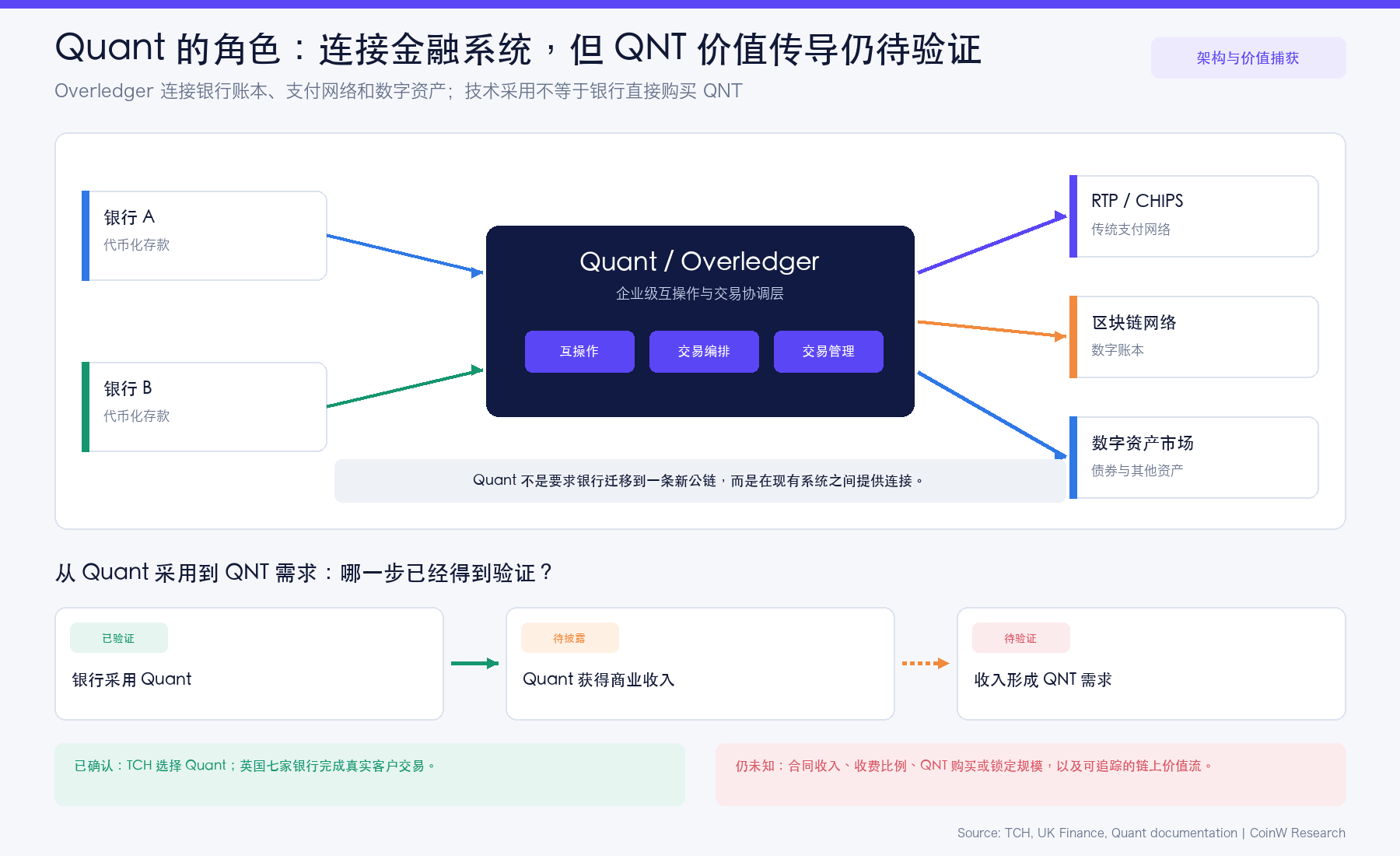
Figure 3. How Quant Connects Banks, Blockchains, and Payment Networks. Source: CoinW Research Institute
The Clearing House's project is a typical example. Suppose bank A wants to transfer a tokenized deposit to bank B; Quant first needs to ensure that the systems on both sides can "understand" each other; if the payment is also tied to a digital asset transaction, it must coordinate the order of "asset delivery" and "fund payment"; ultimately, the transaction may also require linking to traditional payment networks like RTP and CHIPS. From a technical perspective, this is the interoperability, transaction orchestration, and transaction management that Quant is responsible for in the project. For banks that have yet to build tokenized deposit capabilities, Quant also plans to offer relevant infrastructure directly through Tokenised Deposits-as-a-Service (TDaaS). The UK GBTD has taken this logic from a technical proposal to real transactions. Seven banks, including Barclays, HSBC UK, and NatWest, have already processed real customer funds through the shared infrastructure built by Quant. In the next phase, this network also plans to further explore digital asset settlement, allowing tokenized deposits to achieve more efficient synchronized delivery with assets like digital bonds.
This is also an important reason why Quant has recently regained market attention. In the past, when discussing "blockchain interoperability," the market often thought about how different public chains, like Ethereum and Solana, interacted. But Quant is now targeting a bigger connectivity issue: how to connect bank ledgers, tokenized deposits, traditional payment networks, and digital asset markets. If more and more banks issue their own deposit tokens in the future, what may become truly scarce is not just the ability to "issue tokens," but rather the infrastructure that allows these tokens to flow across banks and networks. However, it is essential to distinguish between Quant and QNT. QNT is a functional token within the Quant ecosystem, which can be used for licensing, subscriptions, and related services on Overledger, but corporate clients can also use fiat currencies like dollars to pay part of the platform fees. Therefore, the adoption of Quant by banks does not mean they need to purchase large amounts of QNT from the secondary market. The clearer change at present is that Quant is gaining real adoption within traditional financial infrastructures. As for how these businesses will ultimately form demands for the usage, purchase, or locking of QNT, that is another question, one of the expectations the market most needs to verify following this round of increase.
4. Behind the Surge of QNT, What is the Market Really Trading?
The recent rise in QNT is not just an ordinary bounce driven by a single cooperation announcement. Following the continuous progress of tokenized deposits in the U.S., UK, and Canada, the market is, in fact, trading on three layers of expectations at the same time, including Quant's institutional adoption being fulfilled, tokenized deposits potentially becoming a new banking infrastructure, and whether this commercial value can ultimately be conveyed to QNT. The first two layers have already begun to show real support. Quant has moved from "possibly being adopted by banks" to real financial scenarios, and tokenized deposits have transitioned from internal trials at a single bank to real transactions and cross-bank networks. If more banks issue their own deposit tokens in the future, the needs for connections across banks, ledgers, and payment networks may increase, placing Quant precisely at this infrastructure layer.
The real uncertainty lies in the third layer: how much value can QNT capture? If Quant's banking business continues to expand, the demand for platform licensing, transaction management, and network services may grow, leading the market to trade in advance potential demands for QNT usage, purchase, or locking. However, publicly available information has not disclosed how much QNT participating banks need to purchase or lock, nor has it provided a directly calculable relationship between the scale of banking business and QNT demand. A common misconception can easily arise here. The Clearing House processes over $2 trillion in payments daily, referring to the overall scale of its existing payment network, not the on-chain transaction volume already generated by Quant, and it cannot be directly converted into QNT demand. For QNT, what matters is not the payment scale of TCH itself but how much revenue Quant can ultimately derive from these projects and whether corporate payment fees will lead to sustainable demand for QNT purchasing, usage, or locking. Therefore, what has been validated so far is that Quant is entering real banking infrastructures, while what remains to be validated is the extent to which these commercial values can be translated to QNT. The story of bank deposits moving on-chain has already begun to take shape, but for QNT, the next stage requires data to prove how much token value this increasingly large story can ultimately consolidate.
5. Will Tokenized Deposits Replace Stablecoins?
The rapid rise of tokenized deposits does not mean that banks aim to replace USDT or USDC. While both are addressing the issue of "how to bring fiat value into the digital network," they excel in different scenarios. The strength of stablecoins lies in openness and liquidity. Users don’t need to open accounts at the same bank and can transfer assets globally through wallets, exchanges, and DeFi protocols; thus, they are more suitable for crypto trading, on-chain applications, cross-platform liquidity, and some cross-border payments. Tokenized deposits, on the other hand, represent a digital upgrade of the banking system itself. Customers still interact with banks, funds still belong to bank deposits, and identity verification, anti-money laundering, and customer management continue to operate within the banks' existing compliance frameworks, making it easier to fit into regulated scenarios such as enterprise fund management, interbank payments, digital bonds, and securities settlements.
Thus, the future may see not "who will replace whom" but rather the coexistence of various digital currencies. Stablecoins will continue to circulate in open blockchains, while tokenized deposits will enter more bank and institutional scenarios, with infrastructures like Quant attempting to connect bank ledgers, traditional payment networks, and blockchains. The truly important question may no longer be which type of digital dollar is the largest in scale, but who can safely and efficiently enable the flow of different forms of money. Of course, moving bank deposits on-chain will not automatically resolve all issues. If deposit tokens issued by different banks cannot be seamlessly exchanged, the original banking system may merely become new "on-chain islands." Fast transfers 24/7 also mean that in times of market stress, deposits could flow out of banks more quickly than before. Another often overlooked issue is that just because a user sees a token has completed a transfer on-chain, it does not necessarily mean that final funds settlement between the two banks has also been completed synchronously. How these issues are handled will determine whether tokenized deposits can genuinely transition from trials to large-scale financial infrastructure.
Moving forward, whether this narrative can continue can be gauged by several more practical signals. After the U.S. network opens in 2027, how many banks will truly join and how much real transaction volume will be generated; whether the UK's GBTD can expand from current mortgage and consumer conditional payments to enterprise payments, digital bonds, and securities settlements; and whether Quant can disclose clearer revenue and fee structures and demonstrate that growth in banking operations can create traceable demand for QNT usage, purchases, or locking. The rise of QNT this round has made "bank deposits on-chain" the first concentrated trading narrative for infrastructure in the crypto market. However, the decision on whether this main narrative can continue in the next phase will rely not on more concepts and cooperation announcements but on several more practical questions: whether tokenized deposits can achieve scale, whether Quant can obtain sustainable revenue from this, and how much of this commercial value can genuinely translate to QNT.
References
1.The Clearing House × Quant: On-Chain Money Initiative
2.The Clearing House: On-Chain Money Initiative Official Introduction
3.UK Finance: UK Banks Complete First Batch of Tokenised Deposits Real Customer Transactions
4.National Bank: Six Canadian Banks Explore Canadian Dollar Tokenized Deposits
5.Dallas Fed: Tokenized Deposits and the Traditional Banking System
6.Quant: What is a Tokenised Deposit?
7.Quant: Frequently Asked Questions
8.Quant: Above the Ledger — Tokenised Deposits Whitepaper
免责声明:本文章仅代表作者个人观点,不代表本平台的立场和观点。本文章仅供信息分享,不构成对任何人的任何投资建议。用户与作者之间的任何争议,与本平台无关。如网页中刊载的文章或图片涉及侵权,请提供相关的权利证明和身份证明发送邮件到support@aicoin.com,本平台相关工作人员将会进行核查。