All 19 officials agree on an interest rate hike, but the real focus is not on "rate hike"
In the early hours of October 8th Beijing time, the Federal Reserve released the minutes of the FOMC meeting held from September 15 to 16.
The clearest signal from this meeting is: All 19 officials supported a 25 basis point rate hike, raising the federal funds rate target range to 3.75%–4%.
This is the first interest rate hike by the Federal Reserve since July 2023.
On the surface, this set of minutes is quite hawkish.
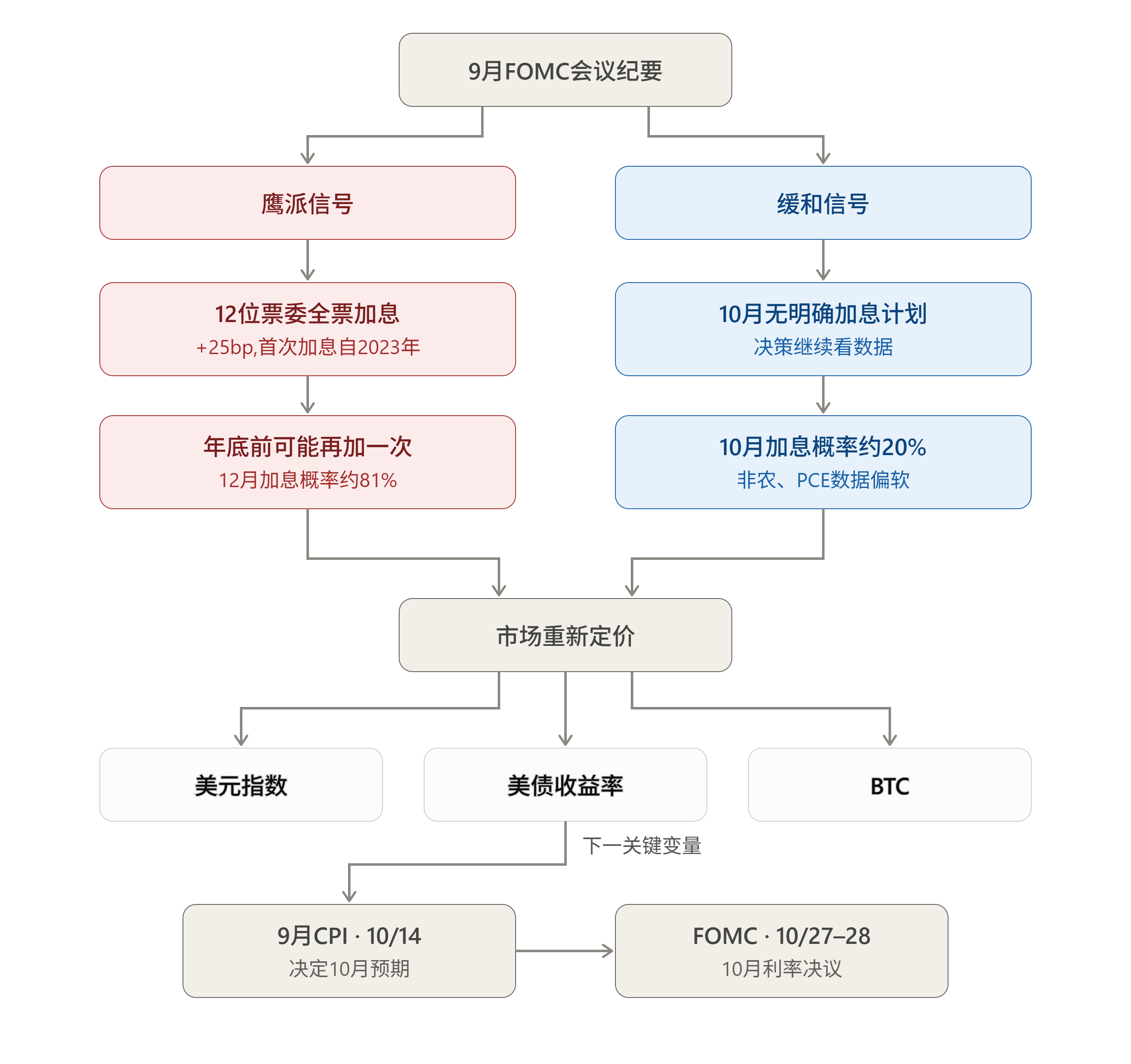
Moreover, most officials believe that another rate hike before the end of this year may be appropriate. Some officials even expect rate hikes in both the October and December meetings.
However, if one only focuses on this, it is easy to overlook the truly interesting part of the minutes:
While the Federal Reserve believes that further tightening of policy is necessary, it has not made the October rate hike a definitive option.
Why have expectations for an October rate hike quickly cooled?
After the September rate hike, the market quickly bet on the Federal Reserve continuing to raise rates in October.
At that time, the market’s expectation for a 25 basis point hike in October approached 70%.
However, subsequently, the statements from the Fed officials began to change.
Federal Reserve Vice Chairman Philip Jefferson and New York Fed President John Williams both conveyed a similar signal: The Federal Reserve has time to observe economic data before deciding whether to further raise rates.
As of now, federal funds futures indicate that the market expects the probability of another rate hike in October has fallen to about 20%.
This means the market is re-evaluating a possibility:
The September rate hike may have been an early fulfillment of tightening commitments, but an immediate follow-up in October may not be necessary.
Why?
An important reason is that U.S. Treasury yields themselves have already been tightening financial conditions.
📌 If you want to continuously track BTC, ETH, and the impact of macro data on the market, you can follow the public account "Crypto Lao Ding," which explains important market changes and the logic behind them every day.
Long-term U.S. Treasury yields are acting as "brakes" for the Fed
This is one detail in the FOMC minutes that I believe deserves attention.
The Federal Reserve does not only influence the economy through policy rates.
If long-term U.S. Treasury yields continue to rise, the costs of mortgages, corporate financing, and other borrowing will also increase.
In other words:
Even if the Federal Reserve temporarily does not raise rates, the financial market itself may be helping it tighten financial conditions.
The minutes show that some officials have already noticed the impact of rising long-term U.S. Treasury yields on the real economy. Former Philadelphia Fed President Patrick Harker also believes that the Federal Reserve does not urgently need to raise rates because the long-end of the yield curve is already constraining economic activity.
This creates an interesting policy combination:
High short-term policy rates + rising long-term U.S. Treasury yields = continued tightening of financial conditions.
In this case, the Federal Reserve can completely choose to observe first, rather than raise rates every month.
But this does not mean the Fed has turned dovish
This needs to be highlighted.
A decline in October rate hike expectations does not mean the Federal Reserve has turned towards easing.
On the contrary, the minutes show that concerns about inflation within the Federal Reserve remain very evident.
Some officials believe that inflationary pressures may intensify further, and others believe that the current policy rate does not have a restrictive nature or is only slightly restrictive.
Meanwhile, although the September employment data did not show notable overheating, the year-on-year growth of wages has dropped to 3%, indicating that the labor market is cooling but has not shown signs of a significant slowdown.
Therefore, the Federal Reserve currently finds itself in a rather awkward position:
Inflation is not completely resolved, but employment is no longer strong enough.
This is also why there are significant differences among officials.
For BTC, what truly matters is the "rate path"
So what does this FOMC minutes mean for BTC?
The answer is not simply "hawkish is bearish, dovish is bullish".
What BTC is truly trading is the future rate path and financial conditions.
If subsequent data continues to show cooling inflation and weakening employment, and the Federal Reserve can continue to wait, then market expectations for further rate hikes may continue to decline.
A drop in rate expectations usually indicates reduced pressure on the dollar and U.S. Treasury yields, potentially improving the liquidity environment for risk assets.
This creates a relatively friendly environment for BTC.
However, if inflation heats up again, especially if energy prices, wages, or core inflation see a notable rebound, then the market may bet again on the Federal Reserve continuing to raise rates.
At that point, the pressure facing BTC will return.
So, what this evening's minutes really changed is not a specific price of BTC, but the market's judgment on the rate path in the coming months.
📌 If you want to continuously track BTC, ETH, and the impact of macro data on the market, you can follow the public account "Crypto Lao Ding," which explains important market changes and the logic behind them every day.
📌Mr. Web3 X: The real signal is that "rate hikes" and "waiting" coexist
The biggest highlight of this FOMC minutes is actually not the unanimous support for a rate hike from 19 officials.
Rather, it is:
Although there is a strong consensus within the Federal Reserve on further tightening policy, there is not a complete consensus on when to continue the rate hikes.
On one side is inflation pressure, making the Federal Reserve wary of easing;
On the other side is a cooling labor market, with long-term U.S. Treasury yields already significantly rising, so the Federal Reserve does not need to raise rates immediately every time.
Therefore, what the market really needs to pay attention to next is October's CPI, employment data, the dollar, and U.S. Treasury yields.
For BTC, the core variable remains:
Will the Federal Reserve continue to raise rates, and will financial conditions continue to tighten.
Understanding this is more important than simply judging whether a set of FOMC minutes is "hawkish or dovish".
—— I am Mr. Web3 X, with 6 years of growth in Web3, focusing on Bitcoin, the crypto market, macroeconomics, and industry trends. If you want to continuously track BTC, ETH, HYPE, and the impact of macro data on the market, you can follow the public account "Crypto Lao Ding". Understand the trends, insight into the logic, and establish your own judgment, rather than just focusing on price fluctuations.

免责声明:本文章仅代表作者个人观点,不代表本平台的立场和观点。本文章仅供信息分享,不构成对任何人的任何投资建议。用户与作者之间的任何争议,与本平台无关。如网页中刊载的文章或图片涉及侵权,请提供相关的权利证明和身份证明发送邮件到support@aicoin.com,本平台相关工作人员将会进行核查。