In the past, users often needed to switch back and forth between multiple applications:
- Viewing discussions about a certain token on social platforms;
- Checking prices and holdings in wallets or market tools;
- Copying contract addresses, confirming networks and trading pairs;
- Then returning to the trading page to complete buy and sell.
The problem with this pathway is that information and trading are disconnected from each other. Users see opinions but have a hard time judging whether the speaker truly holds the token; they see a certain token but must verify addresses, judge market conditions, and perform trading actions themselves.
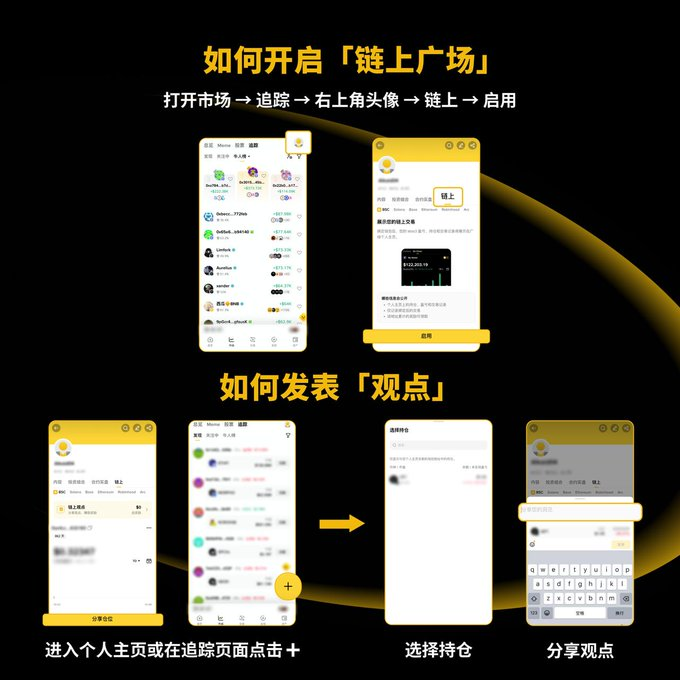
According to recent publicly available experience content, Binance Wallet is currently undergoing a grayscale test for a feature called “On-chain Plaza”: Users can view certain holdings and opinion content on the discovery page and can also enable related features to share their holding opinions; through transactions generated by sharing, the sharer has a chance to earn a certain percentage of service fee income according to the rules.
If this model further matures, it may change not only the wallet interface but also the way on-chain information is organized: holding records, personal opinions, trading entrances, and incentive mechanisms are placed into the same product closed loop.
However, the most worthy aspect of such products to study is not whether "you can earn income through sharing" but rather: how the platform designs incentives to reward valuable research instead of purely stimulating high-frequency trading and emotional calls?
1. What is the “On-chain Plaza”?
From the publicly available images and experience information, the On-chain Plaza includes two core functions:
1. View on-chain holdings and user opinions
Users can browse other users' displayed holdings, assets of interest, and opinion content on the discovery page or related pages.
Compared to traditional social platforms, the distinction of the On-chain Plaza is that opinions may link to on-chain addresses, holding information, or specific assets. For readers, this brings a valuable observation dimension: Is an opinion really coming from an actual holder, or is it just a spectator's comment?
Of course, the holding display itself cannot directly prove a person has sustainable profitability. It can only provide a verifiable observation window and cannot replace complete trading records, cost structures, and risk analysis.
2. Publish personal opinions and connect to trading entrances
Images show that users can enter their personal homepage or follow page, click “+”, select related holdings, and then fill in and share their opinions.
This means that content is no longer just textual expression; it can also be associated with a specific asset, holding, or trading behavior. After seeing an opinion, users theoretically can enter the corresponding page more quickly to check market conditions or complete trades without needing to copy contract addresses and search repeatedly across different platforms.
For users of memes, on-chain trends, and highly volatile assets, this integrated path of “view opinions—view holdings—view market conditions—perform trades” may indeed reduce operational costs.
2. What insights does it provide for media and data analysis platforms?
The value of the On-chain Plaza lies not only in adding a social entrance but also in turning “content” into an observable data.
Traditional articles and social posts usually contain only the opinions themselves, making it hard for readers to judge:
- Does the author really hold that asset;
- What was the holding cost at the time the opinion was released;
- Did they continue to hold after the opinion was posted;
- Did the opinion lead to actual transactions;
- Did the followers end up with profits or losses.
If the platform can protect privacy while combining on-chain addresses, holding changes, opinion timestamps, and trading results, there’s a future opportunity to establish more comprehensive research dimensions, for example:
- The holding proportion at the time of the opinion release;
- Changes in holdings after the release;
- Liquidity of the asset corresponding to the opinion;
- Average cost of following transactions;
- Maximum drawdown after trading;
- Actual gains and losses over different periods;
- Whether the opinion is valid in the long term rather than just coincidentally successful in one market situation.
This is also where information media and data analysis platforms can play a role: not just forwarding “who called it right again” but further tracking the quality of opinions, time windows, and outcome data.
3. The value of holding displays: Adding a layer of verification to opinions
In high-volatility markets, one of the most common misinformation tactics is to show only the profit results without full context.
For example, if a user posts a screenshot saying “a certain token has risen 10 times,” readers still do not know:
- At what price did they buy;
- What proportion of total assets is held;
- Did they continue to increase their position during the rise;
- Have they already sold;
- Can other followers trade at similar prices;
- Is there sufficient liquidity to support an exit.
If the On-chain Plaza can relate opinions to holdings, costs, and time, it at least helps users to reduce pure reliance on slogan-style marketing.
However, a crucial distinction must be noted: holding transparency does not equal investment capability transparency; real profit screenshots do not mean followers can replicate them.
The same token, different buying times, position sizes, and exit disciplines can lead to completely different outcomes. Users should not take others' realized profits as direct potential gains for themselves.
4. What changes could the profit-sharing mechanism bring?
An important design of the On-chain Plaza is that through transactions generated from sharing content, the sharer may earn a certain percentage of service fee income according to the rules.
This will create a new content incentive model:
- Sharers are responsible for discovering assets, expressing opinions, and attracting attention;
- Readers decide whether to trade based on their judgment;
- The platform provides information, trading, and settlement infrastructure;
- Sharers earn profits based on the actual trading activities they generate.
Compared to traditional advertising or one-time promotions, this model is closer to “binding content to trading results.” For those who truly research a particular sector over the long term and can continuously provide effective information, it may offer new creative incentives.
However, from a data analysis perspective, the profit-sharing mechanism could also change creator behavior. The platform needs to answer a core question: Is it rewarding more valuable research or merely increasing trading frequencies?
If profit-sharing is mainly linked to trading volume or frequency, creators may be more inclined to:
- Publish opinions frequently;
- Create a sense of urgency;
- Encourage users to frequently change positions;
- Repeatedly emphasize short-term opportunities;
- Pursue clicks and transactions instead of long-term results.
This could lead to a potential conflict of interest: sharers and the platform may earn income from trading, while followers bear the risks of price fluctuations, slippage, gas fees, and liquidity risks.
Therefore, a truly mature incentive mechanism should not only look at “how much trading is generated” but also observe whether followers achieved reasonable risk-adjusted outcomes.
5. Evaluating an on-chain opinion cannot only focus on whether it “hit or missed”
For users, when using the On-chain Plaza, it is recommended to establish a basic framework for opinion evaluation.
1. Look at the opinion release timing
Was it posted after the asset has significantly risen, or was it clearly expressed before the market started? Timing can directly affect the reference value of an opinion.
2. Look for disclosures of holdings and costs
Simply saying “I’m optimistic” is not enough. It’s more important to understand whether the author has holdings, how large the position is, where the cost approximately lies, and whether they might sell immediately after the release.
3. Look at liquidity and exit conditions
When small-cap tokens rise, the price may increase quickly, but exiting can also be very difficult. It's essential to observe trading depth, holding concentration, pool liquidity, and buy-sell price spreads.
4. Look at complete results, not just hit rates
One success does not prove the strategy is effective. Longer samples, maximum drawdowns, losing trades, and performance across different market environments have more reference value.
5. Look at whether the content excessively induces trading impulses
Expressions like “get in now,” “last chance,” “don’t miss out” commonly stimulate emotions instead of providing complete analysis. Frequent reminders do not equal high-quality research.
6. The correct way to open the On-chain Plaza
If you want to try this feature, you can use it with the following ideas:
- First treat it as an on-chain information discovery tool;
- Observe the differences in opinions about the same asset from different users;
- Verify holdings, time, price, and liquidity information;
- Do not directly follow any user just because they have a large fan base;
- Independently check the network, contract addresses, and fees before any trade;
- Use small amounts of funds to test, not concentrating all assets in one hot spot;
- Record the prices when you see opinions to avoid judging only by results afterward;
- Focus on actual gains and losses and drawdowns, rather than solely on profit-sharing or trading volume.
For information media and data platforms, there is also the opportunity to further establish a “opinion tracking” mechanism: recording opinion release times, prices at the time of release, subsequent price ranges, changes in the creator's holdings, and results of follower trades, striving to turn emotional calls back into verifiable data.
Conclusion: Making holdings more transparent also makes incentives more verifiable
The emergence of the On-chain Plaza indicates that wallets are gradually transforming from simple asset management tools into comprehensive entrances for “information discovery, opinion expression, and trading execution.”
It may bring three positive changes:
- Making it easier for users to discover on-chain assets and real holding information;
- Connecting opinions with trading entrances, reducing information switching costs;
- Providing new incentive methods for users who continuously output research content.
However, it also raises more difficult questions: how to prevent profit-sharing mechanisms from stimulating meaningless high-frequency trading? How to distinguish genuine research ability from one-time market luck? How to make the actual results of followers also part of the platform's evaluation of content quality?
For users, the most important thing is not to find someone who “always hits it right” but to learn to judge: Is the information complete, are the interests transparent, are the risks controllable, and can the results be verified in the long term?
Exclusive Benefits for AiCoin Users
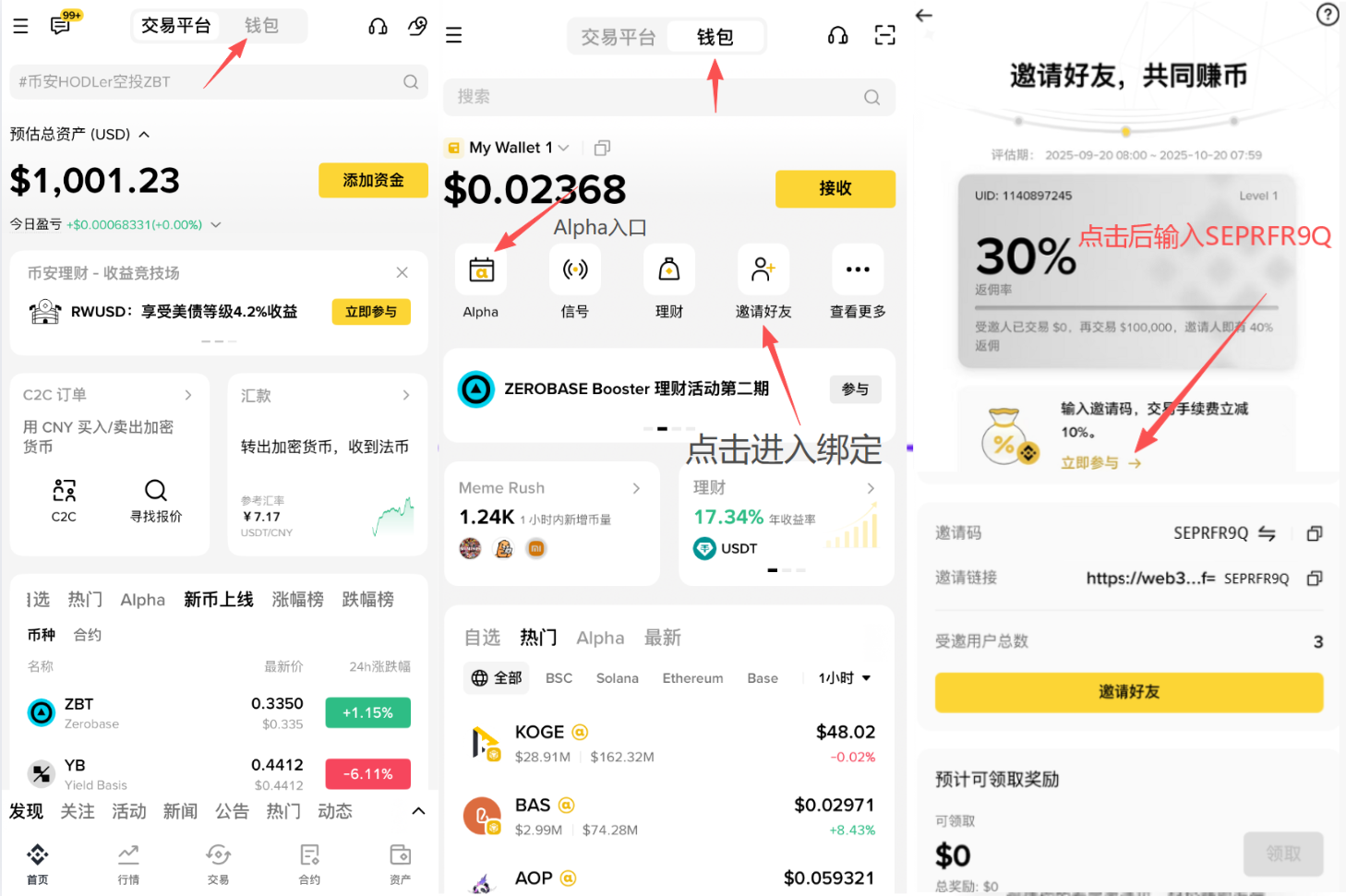
👉 Enter the invitation code SEPRFR9Q while using Binance Wallet to enjoy a 10% rebate on fees, making meme investment more cost-effective and profitable
🔗 Exclusive link:
https://web3.binance.com/referral?ref=SEPRFR9Q
免责声明:本文章仅代表作者个人观点,不代表本平台的立场和观点。本文章仅供信息分享,不构成对任何人的任何投资建议。用户与作者之间的任何争议,与本平台无关。如网页中刊载的文章或图片涉及侵权,请提供相关的权利证明和身份证明发送邮件到support@aicoin.com,本平台相关工作人员将会进行核查。