Recently, Hyperliquid briefly surpassed Pump.fun in the on-chain revenue rankings.
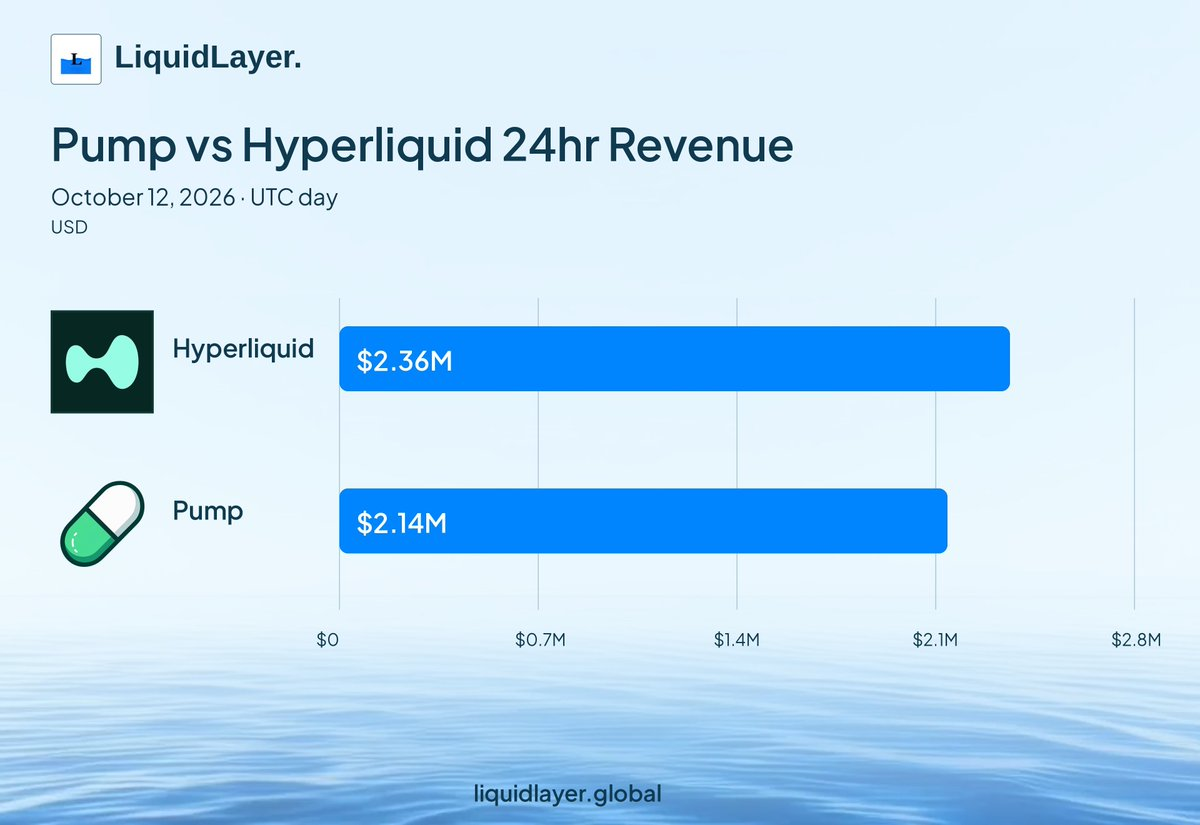
According to market data, Hyperliquid's 24-hour protocol revenue is approximately $2.36 million, while Pump.fun's is about $2.14 million. The former leads by about $220,000, with an advantage of about 10.3%. This data was relayed by HypedLaunches on October 14th.
By looking at this set of numbers, it merely represents a daily revenue ranking change.
However, if we look at the two protocols together, the meaning is different:
· Pump.fun's core business enables users to create and trade a large number of tokens, with revenue highly reliant on the issuance excitement and speculative activity;
· Hyperliquid's core business involves perpetual contracts, spot trading, and related on-chain financial products, with revenue primarily deriving from ongoing trading activities and the use of financial infrastructure.
This is not a prediction of "who will always win," but a very valuable comparison of business models: both are on-chain revenues, but the underlying demand quality is not the same.
1. First, let's look at the numbers: $220,000 lead does not equal a reversal of the landscape
Comparison of daily revenues:
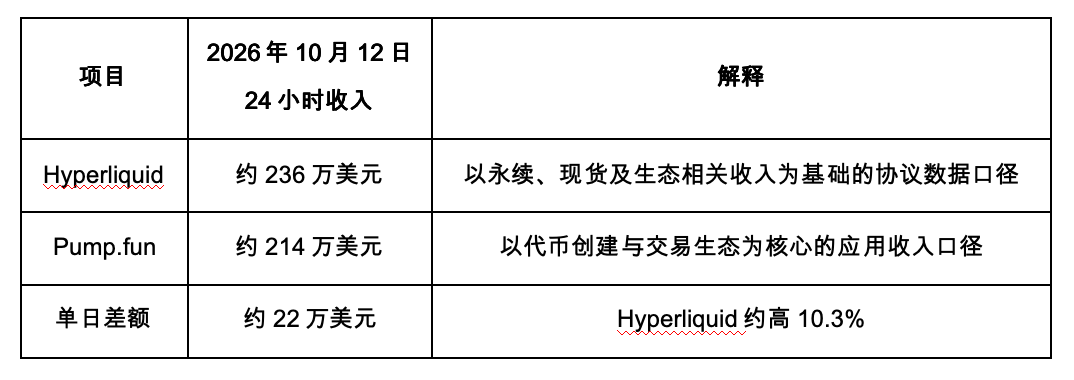
This set of data requires a correct understanding of three things.
First, this is a daily snapshot.
It can illustrate the revenue competition at a certain point in time but cannot directly draw conclusions about monthly, quarterly, or yearly results. Pump.fun may rapidly amplify its revenue due to a surge in new token issuances, and Hyperliquid might experience peaks due to market volatility and active leveraged trading.
Second, this is revenue, not profit.
Protocol revenue still needs to consider market maker rebates, Builder Code distributions, HIP-3 deployer allocations, HLP costs, and other expenses. One cannot simply state that $2.36 million is the net profit available for the team to dispose of freely.
Third, the revenue definitions and business structures of the two protocols are different.
The LiquidLayer chart is suitable for horizontal observation but should not be regarded as strictly comparable financial statements. The more valuable question is not "who has $220,000 more," but rather: what activities generated this $220,000? Can this activity be repeated?
2. Pump.fun sells issuance efficiency, Hyperliquid sells risk transfer efficiency
Pump.fun's official website positions itself as a platform allowing anyone to create tokens and trade them from the start, while clearly reminding that prices may fluctuate rapidly.
Its business logic is very straightforward:
More token creation → More trading attempts → More trading fees → Increased platform revenue
The advantage of this model is its fast launch, low participation threshold, and strong propagation speed. Once a hot narrative arises, the platform can quickly accept large new asset issuance and trading demand.
However, its revenue is also inherently more dependent on market sentiment. Without enough new token creation, speculative trading, and attention influx, revenue may rapidly cool off.
Hyperliquid's revenue logic is different. Users are not just looking for a new token, but rather using a market that can accommodate various risk expressions:
- Go long or short on BTC, ETH, and other crypto assets;
- Get leveraged exposure through perpetual contracts;
- Use the spot market for trading and hedging;
- Participate in extended markets like HIP-3;
- Access lending, synthetic trading, and other financial applications within the HyperEVM ecosystem.
This means Hyperliquid is closer to a trading infrastructure. Users use it not necessarily because of a particular hot project, but perhaps because they need to manage positions around the clock, hedge risks, or improve capital efficiency.
Both models can generate high revenue, but the revenue drivers differ:
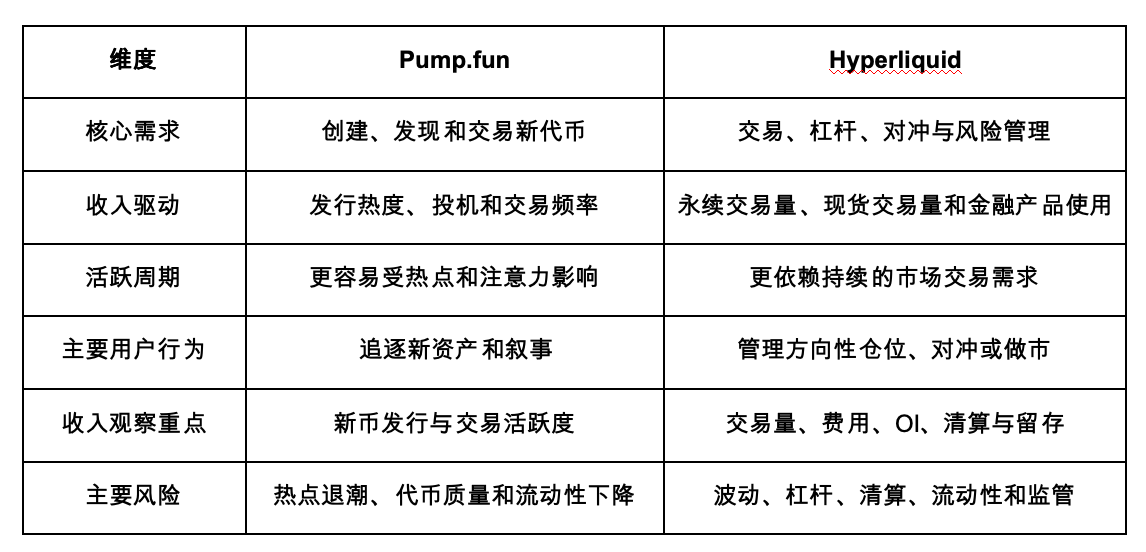
Therefore, the real discussion worth having regarding this daily revenue comparison is not "Pump.fun was defeated," but rather that on-chain financial revenue is beginning to compete for the same pool of capital and attention as on-chain issuance revenue.
3. Hyperliquid's key advantage: Revenue comes not just from a single trade, but from an entire capital cycle
Hyperliquid's official fees document shows that the platform adopts a tiered fee structure for perpetual and spot trading, and the fee tier is determined by the user's rolling trading volume over 14 days; the platform also sets maker rebates, HYPE staking discounts, and fee distribution rules for different markets.
This establishes a three-tiered income structure for Hyperliquid.
1. Trading generates fees
When users trade perpetual and spot assets, the protocol charges fees based on its fee rate. The more active the trading, the larger the fee pool; changes in user trading volumes and market structures will affect the actual fee rate and rebates.
2. Trading fees enter ecological distribution
According to Hyperliquid's official documents, fees mainly flow to ecological participants like HLP, the Assistance Fund, and market deployers, rather than simply all going to a centralized team.
This means that when considering revenue, one must distinguish:
- The total fees paid by users;
- The protocol revenue after deducting rebates and ecological distributions;
- The final amount used for HYPE repurchases or other mechanisms.
3. Revenue can be transformed into ongoing purchases and destruction of HYPE
The official fees document indicates that the Assistance Fund will automatically convert eligible trading fees into HYPE, and the HYPE in the fund will be destroyed, permanently removed from circulating and total supply.
This forms a value flow chain that differs from ordinary application revenues:
User trading → Generates fees → Ecological distribution and Assistance Fund → Purchases HYPE → HYPE is removed
This does not mean HYPE prices will necessarily rise. Market prices can still be affected by supply and demand, unlocks, macro conditions, changes in trading volume, and risk appetites. But from a protocol design perspective, Hyperliquid's trading revenue is not solely about "how much money the platform made" but is connected to ecological participants and HYPE supply mechanisms in observable ways.
4. DefiLlama's data tells us: Don't just look at one-day rankings
As of October 15, 2026, Hyperliquid's fees over the past 24 hours were approximately $2.76 million, revenue around $2.18 million; fees for 30 days were roughly $88.45 million, with revenue around $71.65 million. The page also shows that the 30-day volume for perpetual trading is approximately $208.7 billion.
These two data points highlight a fact:
Hyperliquid's revenue is not merely driven by a one-day hot trend, but is connected to ongoing high-frequency perpetual trading activity.
Therefore, when judging Hyperliquid's business quality, at least four indicators should be considered simultaneously:
1. Are fees stable, rather than just peaking in a single day;
2. Is the difference between revenue and fees unusually wide;
3. Is the growth in trading volume accompanied by increases in open interest, liquidations, and active users;
4. Can trading activity continuously translate into HYPE repurchases or ecological revenue.
Simply stating "Hyperliquid's revenue exceeded Pump.fun in one day" carries limited informational value. Putting these indicators together allows for a judgment on whether it is a short-term fluctuation or whether product demand is becoming stronger.
5. From the income ranking to HYPE: Three questions the market will genuinely ask
If this revenue comparison continues to ferment, the market will ultimately focus on the questions surrounding HYPE. However, it is important to avoid equating revenue data directly with token valuations.
Question one: Is the revenue repeatable?
If revenue primarily comes from liquidations and high-frequency leveraged trading during extreme market conditions, it may drop after volatility recedes. Conversely, if users regard Hyperliquid as a regular tool for position management and hedging, the sustainability of revenue will be stronger.
Question two: Does the revenue have real ecological backflow?
Hyperliquid's official fee mechanism provides observable paths for fee distribution and HYPE purchases and destructions, but this does not mean every dollar of user fees is proportionally transmitted to HYPE, nor that repurchases can offset all new supply and selling pressure.
Question three: Is the trading volume healthy trading volume?
High trading volume may stem from genuine risk transfer, or it may arise from short-term high leverage, liquidations, wash trading, or extreme volatility. To assess quality, one must consider open interest, funding rates, position concentration, liquidation volumes, and trader retention, rather than just a singular volume number.
This is also the value that information and data platforms should provide: not to shout "up" for users, but to dissect the sources and transmission chains of revenue.
6. How can ordinary users utilize AiCoin to observe this revenue competition?
For regular traders, there is no need to replicate institutional strategies, nor should one chase high HYPE prices just because of a revenue ranking.
A more practical approach is to establish one’s own observation framework on the AiCoin mobile app:
- First, look at the real-time transactions and candlestick charts for Hyperliquid's perpetual and spot trading;
- Then, observe changes in open interest, to judge if new transactions have created real positions;
- Combine funding rates to identify if leverage is excessively crowded;
- Watch for large order anomalies and smart money addresses, to distinguish between active position building and passive liquidations;
- Finally, observe revenue, fees, trading volume, and HYPE repurchases on the same timeline.
Invitaion Code: AICOIN88. Qualified transactions can receive 4% fee rebates, subject to qualifications, scope, and timing as per activity rules.
Rebates are just part of optimizing trading costs and cannot offset risks from leverage, funding rates, slippage, liquidations, or market volatility.
Conclusion: The real comparison is not who has higher revenue today, but who can make revenue a habit
Pump.fun and Hyperliquid have both proven one thing: on-chain products are no longer solely reliant on token narratives to gain attention; they can also generate considerable revenue through real usage.
However, the sources of their revenues differ.
Pump.fun acts more like a highly efficient conduit for on-chain issuance and speculative attention; Hyperliquid is attempting to settle sustained trading, leverage, hedging, and financial application demand into protocol cash flows.
The $220,000 daily revenue gap on October 12th does not prove that Hyperliquid is permanently ahead, nor does it confirm that Pump.fun's model is ineffective.
What it genuinely offers is a more worthwhile long-term research question:
After market sentiment recedes, who can still continuously gain real fees that users are willing to pay?
If Hyperliquid can further convert high trading volumes into stable revenue, verifiable ecological backflow, and continued financial application use, then its competition with Pump.fun will become more than just a one-day ranking, but rather a durability comparison of two on-chain business models.
Exclusive benefits for AiCoin users
👉 Enter invitation code AICOIN88 when binding your Hyperliquid account to enjoy a 4% fee rebate
🔗 Exclusive registration link:
https://app.hyperliquid.xyz/join/AICOIN88
📖 Beginner tutorials:
《AiCoin PC Hyperliquid Authorised Trading Tutorial》:
https://www.aicoin.com/zh-Hans/article/514197
《AiCoin Mobile Hyperliquid Authorised Trading Tutorial》:
https://www.aicoin.com/zh-Hans/article/541383
《Zero-based Entry! Hyperliquid First Trade Extremely Detailed Tutorial》:
https://www.aicoin.com/zh-Hans/article/510225
📖 Community communication:
Telegram:
Discord:
AiCoin-Group Chat:
https://www.aicoin.com/link/chat?cid=N6OVMor5g
The content of this article represents the author's personal views and does not represent the platform's position. The viewpoints, conclusions, and suggestions in the article are for investors' reference only, and do not constitute any investment advice related to this platform. Investing in U.S. stocks still requires self-assessment of market risks, regulatory risks, and compliance risks with local laws and regulations (especially foreign exchange control and overseas investment reporting, etc.).
免责声明:本文章仅代表作者个人观点,不代表本平台的立场和观点。本文章仅供信息分享,不构成对任何人的任何投资建议。用户与作者之间的任何争议,与本平台无关。如网页中刊载的文章或图片涉及侵权,请提供相关的权利证明和身份证明发送邮件到support@aicoin.com,本平台相关工作人员将会进行核查。


