On October 14, the official Binance Chinese account announced that the Binance Wallet TRON Carnival Season 3 is in progress. Users can participate in the JustLend DAO activity pool through the Binance Wallet DeFi to enter for subscription, with the time-limited annualized return displayed on the activity page being as high as approximately 27.7%.
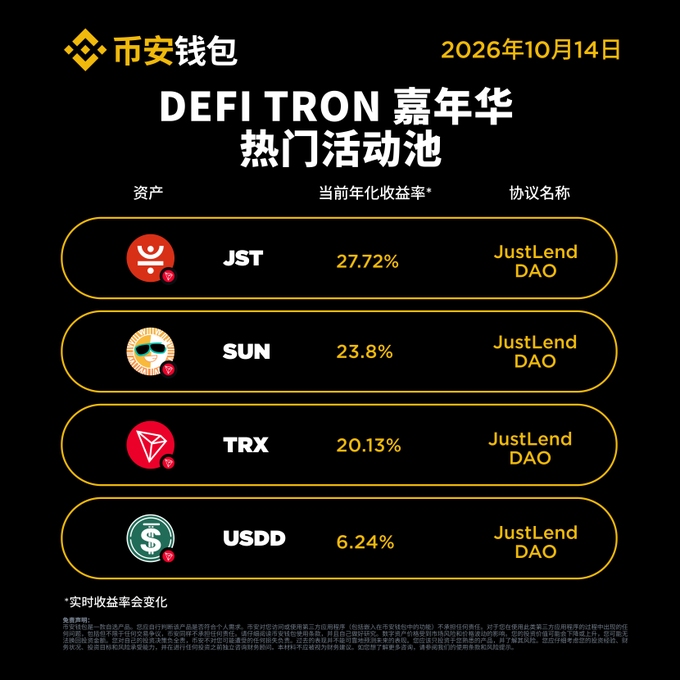
The accompanying figures further list several assets in the activity pool at that time and the annualized returns displayed on the page:
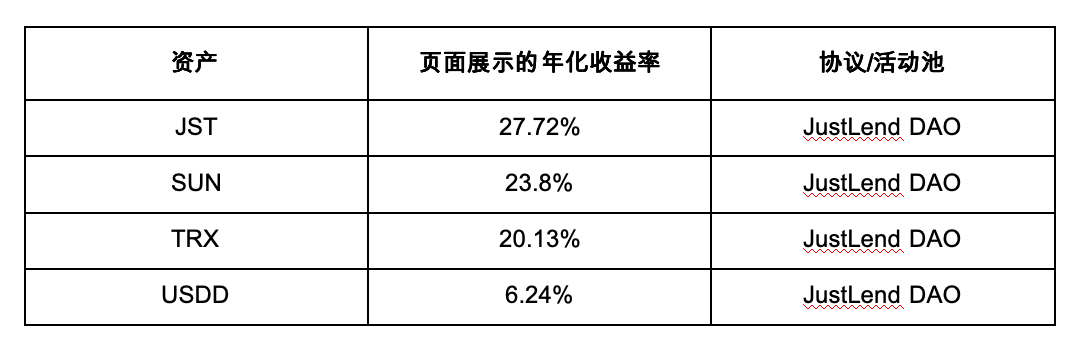
It is important to emphasize: the numbers in the images are current annualized return displays at specific points in time, and are not fixed rates or guaranteed returns. The official dynamic also states that real-time annualized returns will fluctuate.
Therefore, this event is better understood as a DeFi activity pool worth researching, rather than a traditional wealth management product where "depositing assets guarantees a stable return of 27.72%."
1. What is the core of this TRON Carnival event?
According to publicly available information, users need to access the DeFi gateway of the Binance Wallet to enter the activity pool of JustLend DAO for subscription.
This includes three key elements:
1. Binance Wallet: The entry point for users to connect on-chain assets and DeFi applications;
2. JustLend DAO: The on-chain protocol that hosts the activity pool;
3. Time-limited activity pool: Displays corresponding reward rates for different assets within a specific activity period.
It differs from fixed-term wealth management within exchange accounts. Users participate in relevant activities related to the on-chain protocol and need to confirm the network, assets, authorizations, subscription rules, and exit methods on their own.
From the product pathway perspective, Binance Wallet lowers the operating threshold for users to enter DeFi; however, a simpler entry does not mean the risks of the underlying protocol disappear. Users still need to understand what assets they are participating in, which protocol is involved, and what mechanisms support the returns.
2. Why is there such a large difference in return rates among different assets?
In the same activity pool, the annualized return rates displayed for different assets can vary significantly: JST and SUN show return rates exceeding 20%, TRX is about 20%, while USDD is around 6.24%.
This difference is usually related to the following factors:
1. Different reward budgets
The activity pool may set different incentive amounts for different assets. If a certain asset receives more promotional incentives, the displayed return rate may be higher.
2. Different participation scales
If the activity reward pool is relatively fixed, and the scale of participating assets changes, the return rate distributed to each user may subsequently change. The more funds participate, the lower the reward rate per unit of asset may be.
3. Different market demands for assets and protocols
The borrowing demand, liquidity demand, and asset utilization in DeFi protocols will affect the return structure of different assets. The displayed return rates are not solely determined by the asset names.
4. Time-limited activity factors
Carnivals typically have time and budget limits. To attract user participation during the activity period, the reward rates may be temporarily increased; after the activity ends, the budget is consumed, or rules are adjusted, the displayed numbers may change significantly.
Thus, one should not simply think that “the higher the return rate, the more worth it is to buy the asset.” High return rates often correspond to higher uncertainties and may also reflect changes in asset volatility, liquidity, or incentive mechanisms.
3. How should the 27.72% annualized return be correctly understood?
Assuming the displayed annualized return rate on the page is 27.72%, it only indicates a reference number for annualization under the condition that current rules and interest rates remain unchanged.
It does not mean:
- Users will definitely hold for a full year;
- The return rate is fixed at 27.72% for the entire year;
- Asset prices will not depreciate;
- There will be no principal losses;
- Returns will definitely be distributed in stable coins or fiat currency;
- The final returns will definitely exceed Gas fees and other costs.
For example, if a user holds an equivalent of 1,000 USD in JST, and the page shows an APR of 27.72% for a short time, the estimated daily reward would be:
1,000 × 27.72% ÷ 365 ≈ 0.76 USD/day
But this number is only a static mathematical estimate. The actual results may be affected by the following factors:
- Real-time changes in APR;
- Activity budget and personal subscription limits;
- Reward distribution cycle;
- Subscription and redemption conditions;
- Asset price volatility;
- Network Gas fees;
- Protocol, contract, and wallet operational risks.
If JST declines by 10% during this period, short-term rewards may not compensate for the asset price drop. For users, what they should really focus on is the total return, rather than an isolated APR figure.
4. What does the participation pathway in JustLend DAO mean?
JustLend DAO is a DeFi protocol within the TRON ecosystem. By subscribing through the activity pool, users are essentially participating in related products or incentive plans provided by an on-chain protocol, rather than depositing assets into a traditional bank account.
This means users need to pay attention to:
- Whether assets need to be authorized to a smart contract;
- What status the assets are in after subscription;
- Whether rewards come from protocol earnings, activity subsidies, or token incentives;
- Whether there is a minimum holding period or exit restrictions;
- Whether redemption requires waiting;
- Whether reward tokens can be freely exchanged;
- Who bears the losses in case of contract anomalies.
If the page only highlights "high returns" but does not clearly display the sources of returns, lock-up periods, exit rules, and risk warnings, users should not make decisions based solely on promotional images.
5. How should the four types of assets be distinguished and observed?
JST: High return display, but focus on volatility
The accompanying image shows JST with an annualized rate of about 27.72%, which is the highest among the four assets. The high APR may stem from activity incentives, but the market price and liquidity changes of JST itself will directly affect users' final gains and losses.
It is better viewed as "high volatility assets combined with activity rewards," rather than a stable income asset.
SUN: High return rate, but do not overlook market depth
The SUN page displays an annualized rate of about 23.8%. For high APR assets like this, users should not only consider returns but also focus on transaction depth, price slippage, concentration of positions, and liquidity after the activity ends.
High returns may attract significant funds, but if rewards decrease or funds are withdrawn after the activity ends, it could also lead to substantial volatility.
TRX: Eco-native asset still has price risk
The TRX page shows an annualized rate of about 20.13%. Even being a native asset in the ecosystem does not guarantee price stability, nor does it mean that rewards can offset price fluctuations.
Users need to evaluate TRX's market trends, holding periods, and activity returns together.
USDD: Relatively low return rate, but that does not mean no risk
The USDD page displays an annualized rate of about 6.24%, which seems lower than the other three assets, but stablecoins or dollar-pegged assets may still face depegging, liquidity, and protocol risks.
"Price volatility may be small" and "absolutely safe" are two different things. Users need to confirm USDD's exchange channels, liquidity, protocol mechanisms, and risk disclosures.
6. Eight questions to verify before participation
Before entering the activity pool, it is recommended to confirm the following items:
- Is the current APR changing in real time, or locked in for a certain period?
- Does the activity have a start and end time?
- What are the minimum subscription amounts and personal limits for each asset?
- Is there a lock-up period after subscription, and is there a waiting period for redemption?
- In what asset are the rewards distributed, and can they be exchanged directly?
- How much Gas fee is required for subscription, receipt, and redemption respectively?
- What funding sources support the activity rewards?
- Who bears the losses if protocols, contracts, or assets encounter anomalies?
If these questions cannot be clearly answered on the page, it is advisable not to subscribe based solely on the highest APR in the promotional image.
Conclusion
The Binance Wallet TRON DeFi Carnival activity pool attracts attention with high displayed annualized return rates, as JST, SUN, TRX, and USDD showcase different levels of returns and also reflect the relationship between "asset types, market demands, and incentive budgets" in DeFi activities.
However, what users really need to do is not chase the highest numbers, but break down these questions: Where do the returns come from? Can I exit at any time? Will the rewards change? How will asset prices behave? Can the final returns cover Gas and slippage?
For data analysis platforms, the most valuable thing is not to reiterate "up to 27.7%", but to continuously track APR, fund flows, liquidity, and actual return changes.
In DeFi, return rates are a dynamic indicator; only by placing returns, risks, costs, and exit paths on the same table can more rational judgments be made.
AiCoin Exclusive Benefits for Users
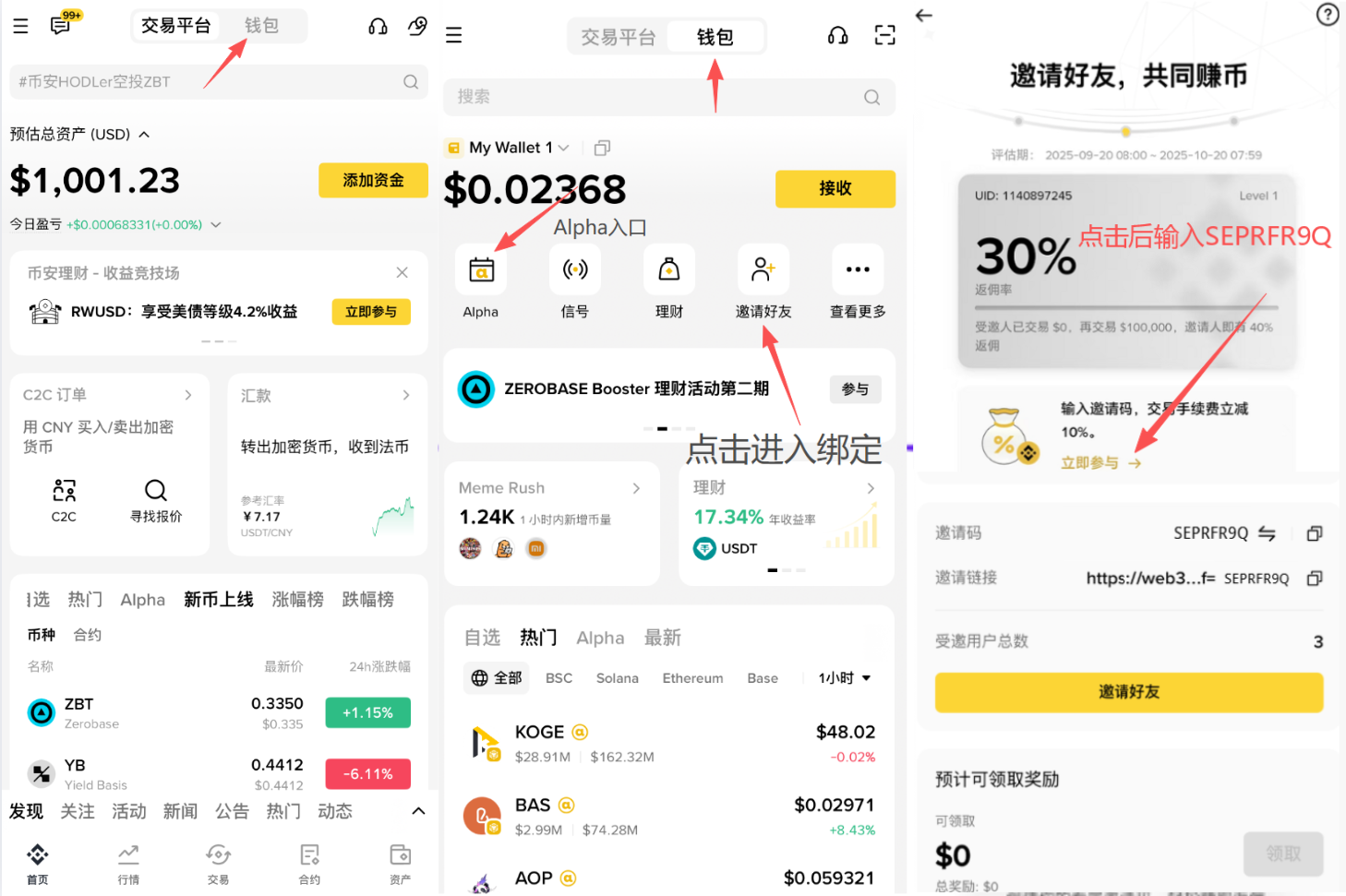
👉 Use the invitation code SEPRFR9Q when using Binance Wallet to enjoy a 10% commission rebate, play memes at lower costs and earn more
🔗 Exclusive link:
https://web3.binance.com/referral?ref=SEPRFR9Q
免责声明:本文章仅代表作者个人观点,不代表本平台的立场和观点。本文章仅供信息分享,不构成对任何人的任何投资建议。用户与作者之间的任何争议,与本平台无关。如网页中刊载的文章或图片涉及侵权,请提供相关的权利证明和身份证明发送邮件到support@aicoin.com,本平台相关工作人员将会进行核查。


