Recently, the global financial markets have exhibited typical characteristics of a "confused period." U.S. tech stocks have fluctuated significantly amid sustainability debates surrounding AI capital expenditures, with the Nasdaq index recording the worst performance since April 2025 during several trading weeks. The S&P 500 index experienced a pullback, and the VIX volatility index rose to around 20, reflecting investors' concerns about interest rate trajectories, AI investment returns, and geopolitical risks. European sovereign bond yields increased due to fiscal pressures and high energy prices, with French 10-year government bond yields briefly touching around 5%. The Asian markets oscillated between improved AI sentiment in South Korea and related sectors in China. Bitcoin prices fluctuated around $82,000, down about 35% from the high of approximately $126,000 in October 2025, reflecting both the consolidation after deleveraging and retaining relative resilience compared to traditional risk assets. Gold and commodities received support due to geopolitical factors, while changes in traditional stock-bond correlations increased the difficulty of diversified allocations. The IMF and several institutions pointed out that the current environment combines resilience with transformation pressures: growth expectations remain decent, but persistent inflation, capital competition, and policy uncertainty coexist.
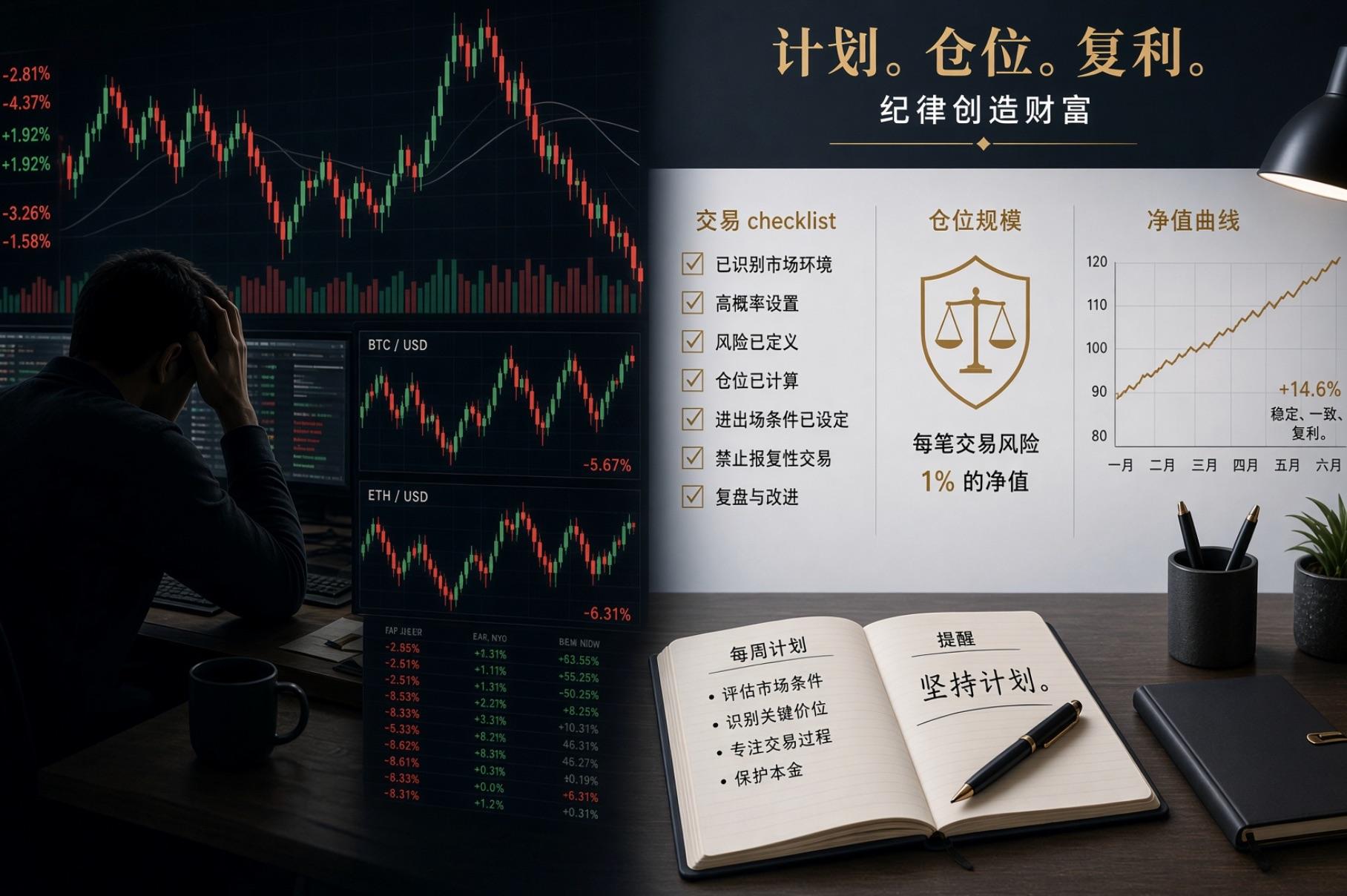
In this context, many traders feel at a loss. The trading principles and plans previously established are questioned after consecutive losses, with account net values fluctuating with market movements, resulting in a mindset akin to a roller coaster. Some make profits today and give it back tomorrow, eager to learn new methods or switch trading systems, but the result is often "a change in the soup but not in the medicine," with performance still unstable. Professional institutions' analyses and long-term trading practices repeatedly prove that the most fatal aspect of trading is not a lack of skills but a lack of "consistency." Consistency means executing each trade according to the same set of predefined rules, rather than arbitrarily adjusting based on emotions, the latest trends, or single outcomes. It is not about rigidity but about establishing a repeatable decision framework amid uncertainty, thereby transforming probabilistic advantages into long-term results. The following details how to specifically implement this from four aspects: position, levels, entry signals, and exit signals, supplemented by data and case studies.
Why Consistency is More Important Than Skills
Technical methods can be quickly learned, but consistency in execution determines whether an account can survive long-term. Typical manifestations of a lack of consistency include: increasing position size after losses in an attempt to recover, randomly switching time frames to find signals, temporarily changing entry conditions based on emotions, and moving or canceling stop-loss orders. These behaviors disrupt the statistical foundation of the system, causing trading results to approach randomness.
Professional organizations emphasize risk-adjusted returns in portfolio management, essentially controlling risk exposure through fixed rules. For individual traders, establishing consistency from the beginning is less costly than correcting habitual behaviors later.
Module One: Position Consistency – Fixed Risk Exposure
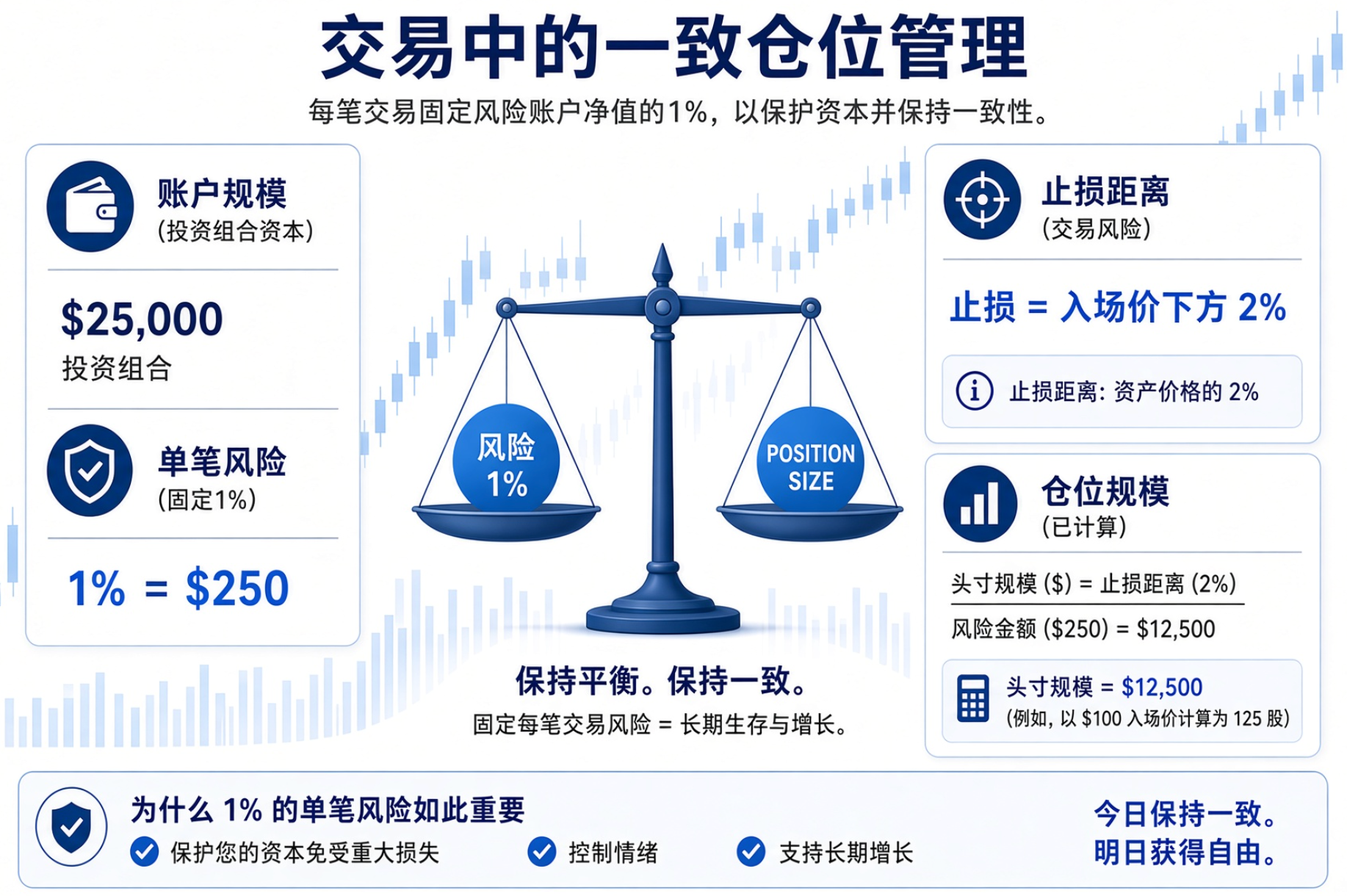
Position consistency refers to maintaining a fixed proportion of the risk amount for each trade relative to the account net value. It is usually recommended that beginners start with 0.5% and can increase to 1% after becoming more proficient. The core principle is: regardless of how "certain" the signals are, the maximum loss for a single trade is pre-set.
Operational Steps:
- Determine the total net value of the account (e.g., $100,000).
- Set the risk percentage per trade (recommendation: 0.5%–1%).
- Calculate the maximum loss amount per trade: account net value × risk percentage. For a $100,000 account with a 1% risk, the maximum loss would be $1,000.
- Calculate position size based on the distance to the stop-loss. Formula: position size = maximum loss amount ÷ distance to stop-loss price.
- Use a spreadsheet or position calculator to automate calculations to avoid manual errors.
- Record each planned risk in the trading log and verify execution afterwards.
Key Rules:
- Doubling up on positions after losses is strictly prohibited.
- Randomly increasing position size after profits due to "good feeling" is strictly prohibited.
- Before opening a position, the stop-loss level must be determined first, and then the position is calculated from that.
Beginner Case:
Assuming the Bitcoin price is around $82,000, with a stop-loss set at $80,000 (a distance of $2,000). For a $100,000 account with a 1% risk, the maximum loss is $1,000. The position size would be about 0.5 Bitcoin ($1,000 ÷ $2,000). If the risk is increased to 2.5% due to emotions, the individual loss would reach $2,500, equivalent to 2.5 losses under normal rule, leading to potential subsequent irrational operations.
The advantage of a fixed risk percentage is that even with consecutive losses, the account drawdown is controllable, allowing for sufficient funds to continue executing according to the original plan. This is the foundational method for professional traders to control maximum drawdowns.
Module Two: Level Consistency – Unified Time Frame
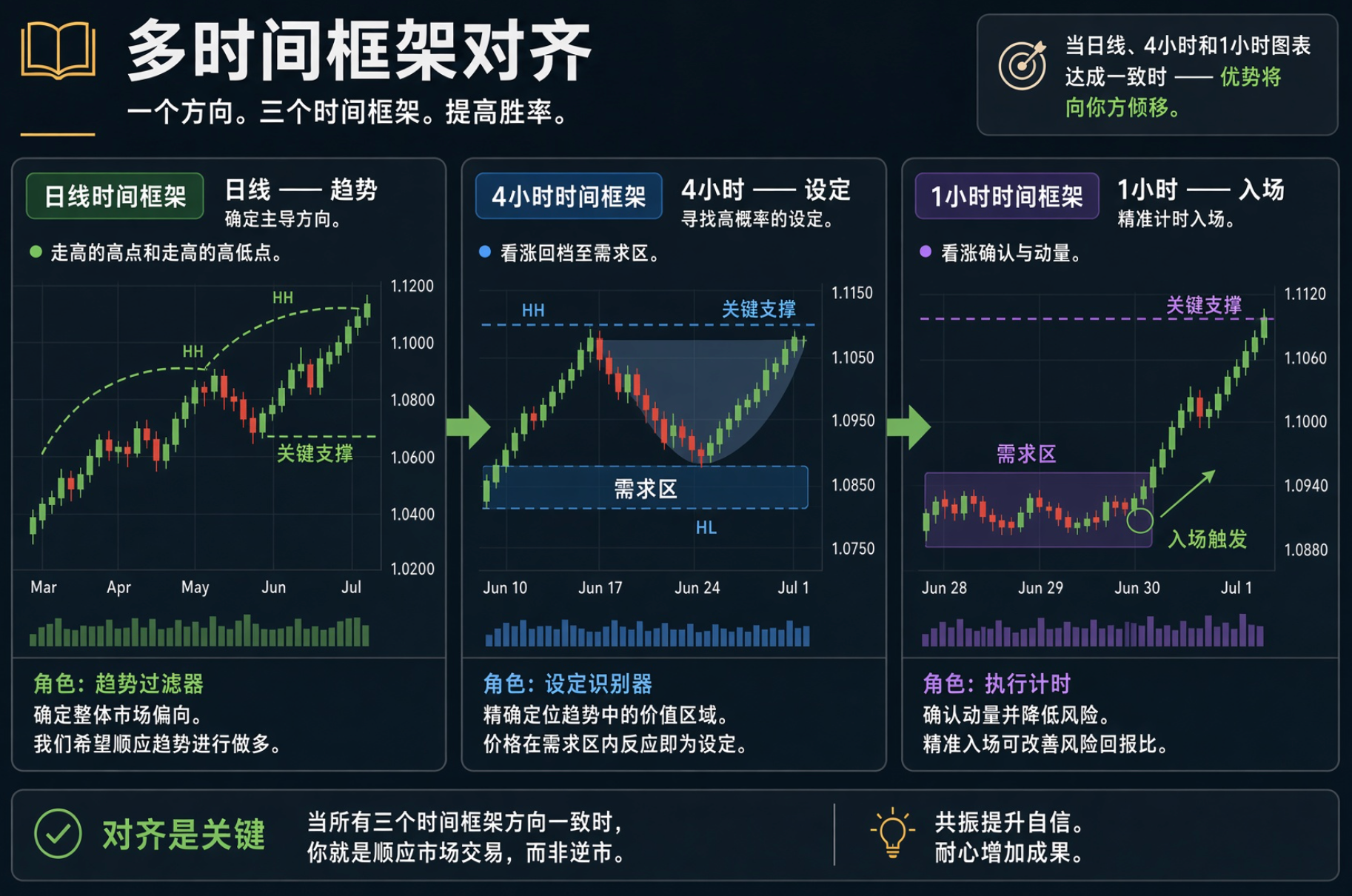
Level consistency requires using a fixed combination of time frames for analysis and execution to avoid arbitrary switching between daily, 4-hour, and 15-minute charts. Random switching can lead to conflicting signals and introduce excessive market noise.
Recommended Beginner Framework (can be adjusted by instrument):
- Main decision level: 4-hour chart (used to find trading opportunities).
- Trend filtering level: daily chart (to confirm the overall direction).
- Precise entry level: 1-hour chart (used only to optimize entry points, not to generate standalone trading signals).
Operational Steps:
- Clearly state the roles of the three levels in the trading plan.
- Pre-trade check: Does the daily trend align with the direction? Is there a suitable structure on the 4-hour chart? Does the 1-hour chart provide a reasonable entry position?
- If there is no clear signal at the main level (4-hour), abandon the trade, and do not force opportunities by looking at smaller levels.
- Create a "level check list" and check each item before opening a position.
Common Errors and Corrections:
- Error: Bullish on the daily but exiting early on the 15-minute chart due to a slight pullback.
Correction: Exit decisions must be based on main level rules, not noise from smaller levels. - Error: After a loss, switching to minute charts in an attempt to "quickly recover."
Correction: Maintain the original level, accept the current transaction result, and wait for the next signal that meets the rules.
In choppy markets (such as Bitcoin in the $80,000–$85,000 range), fixed levels can significantly reduce the frequent trades caused by false breakouts, lowering transaction fees and slippage costs.
Module Three: Entry Signal Consistency – Quantifiable Trigger Conditions
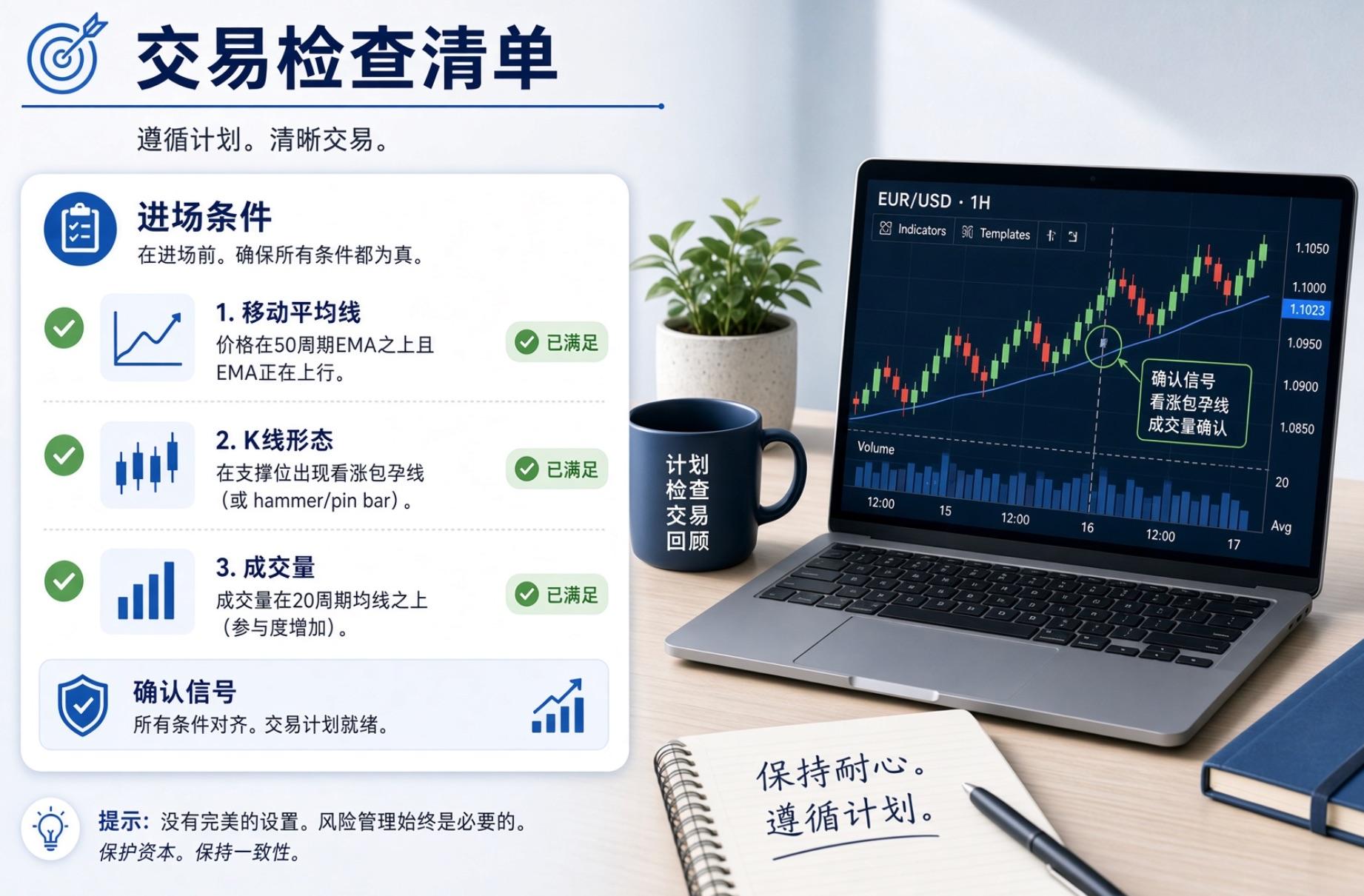
Entry signals must be predefined, objective, and repeatable to avoid reliance on subjective feelings. Beginners are advised to choose 1-2 simple signals and write them into a clear checklist.
Signal Design Principles:
- Quantifiable (e.g., price position, indicator values, candlestick patterns).
- Multiple conditions must be met simultaneously to permit entry.
- Number of conditions should not be excessive to avoid difficulty in execution.
Example Entry Rules (can be directly referenced and modified):
- Condition A: Daily closing price above the 20-day moving average.
- Condition B: A clear reversal candlestick (such as a hammer or engulfing pattern) appears on the 4-hour chart after a definite pullback.
- Condition C: Volume exceeds the average of the last 5 candlesticks.
- Entry is allowed only when all A, B, and C conditions are met.
Operational Steps:
- Write the rules as a checklist, print it or save it next to the trading software.
- Confirm each item before entering a position, none can be missing.
- No temporary additions or deletions of conditions are allowed.
- Record whether each trade strictly met the checklist for later review.
Beginner Practice Suggestions:
First execute at least 20-30 trades that fully comply with the checklist in a demo account or with a very small position. After accumulating samples, evaluate whether the system has a positive expectation. Trades with inconsistent signals should not be included in statistics to avoid data distortion.
Module Four: Exit Signal Consistency – Discipline in Stop-Loss and Take-Profit
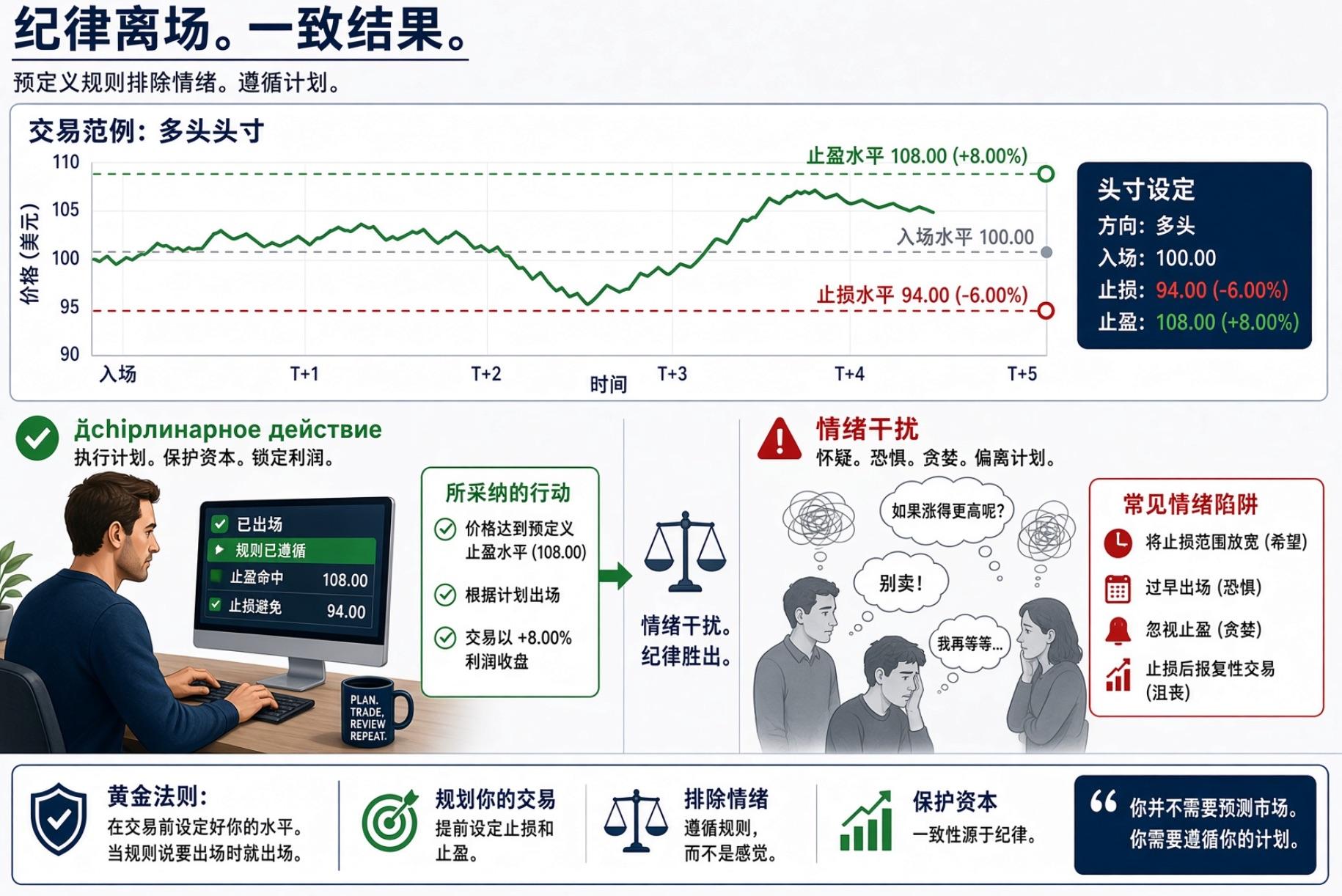
Exit rules are equally important as entry rules and must be established before opening a position. Exiting includes fixed stop-loss, target take-profit, and trailing stop (if applicable).
Basic Exit Rule Examples:
- Stop-Loss: Based on technical structures (such as previous lows, key supports/resistances) or fixed volatility range; set an order immediately after opening a position.
- Take-Profit: Set a profit-loss ratio target (such as 1:1.5 or 1:2) and exit partially or fully when achieved.
- Trailing Stop (optional): After the price moves favorably for a certain amount, move the stop-loss to the entry price or recent structural level.
Operational Steps:
- Simultaneously determine the stop-loss and target before opening a position.
- Immediately set stop-loss orders after entering a position; do not rely on manual monitoring.
- Strictly execute exit when the take-profit conditions are met; do not cancel due to "feeling it can rise further."
- Do not move stop-losses to broaden loss ranges; only allow moving in favorable directions according to preset rules.
Common Violations and Consequences:
- Cancelling stop-losses to wait for a reversal: a single significant loss may wipe out multiple small gains.
- Exiting early: disrupts the profit-loss ratio, reducing the system's expected value.
- Correct practice: Treat exiting with the same strictness as entering, and log whether it was executed.
Comprehensive Implementation: Establish Your Trading Plan and Review Mechanism
Integrate the four modules into a written trading plan that includes the following content:
- Account risk ratios and position calculation methods.
- Fixed time frame combinations.
- Entry signal checklist.
- Exit rules (stop-loss, take-profit, trailing stop).
- Daily/weekly review questions: Did all trades this week comply with the rules? If there were deviations, what were the reasons?
Beginner Start Suggestions:
- First execute at least 30 trades that fully comply with the plan in a demo account.
- Record each trade's planned risk, actual execution status, and results.
- Only evaluate system performance after sufficient samples, not adjust rules based on single profits or losses.
- If the long-term expectation of the system is negative, optimize based on data in a planned manner, instead of changing systems due to emotions.
Common Traps and Prevention
- Trap 1: Changing rules after consecutive losses. Prevention: preset a maximum number of consecutive losses (e.g., 5); after that, pause trading and review instead of immediately modifying the system.
- Trap 2: Chasing trending signals. Prevention: only trade within the planned instruments and signals.
- Trap 3: Ignoring trading costs. Prevention: consider fees and slippage in position calculations, especially for high-frequency or small-level trading.
During periods of high market uncertainty, sticking to the same set of rules is more effective than searching for "better" methods. Techniques can be continually learned, but consistency is the bridge that transforms learning into stable results. It is recommended to write down your trading plan starting today and strictly execute it from the smallest position. In the long run, repeatable processes are more valuable than occasional highlight trades.
This tutorial is for educational reference only and does not constitute investment advice. Trading involves risks of loss; please only use funds you can afford to lose and continuously learn about risk management.
免责声明:本文章仅代表作者个人观点,不代表本平台的立场和观点。本文章仅供信息分享,不构成对任何人的任何投资建议。用户与作者之间的任何争议,与本平台无关。如网页中刊载的文章或图片涉及侵权,请提供相关的权利证明和身份证明发送邮件到support@aicoin.com,本平台相关工作人员将会进行核查。