Back to the market on October 22, 2026, let's discuss some opportunities that could be seen at that time. Mainly focusing on three aspects: whether BTC can hold above 80,000 dollars after the surge and retracement; the value logic of HYPE and UNI, which have recently garnered significant attention from funds—what each represents, and which one is more likely to be validated by the market; and how to arrange positions while there are still divergences in market direction, so as to not miss opportunities while leaving room for market adjustments.
Reviewing the judgment from October 13, the first target above was looking at 84,000 dollars. To alleviate the pressure brought by the death cross on the three-day line, BTC needs to stabilize above 87,000 dollars. The key support zone below is set between 75,100 and 77,200 dollars; if the market continues to decline, this range is where I will observe mid-term buying interest.
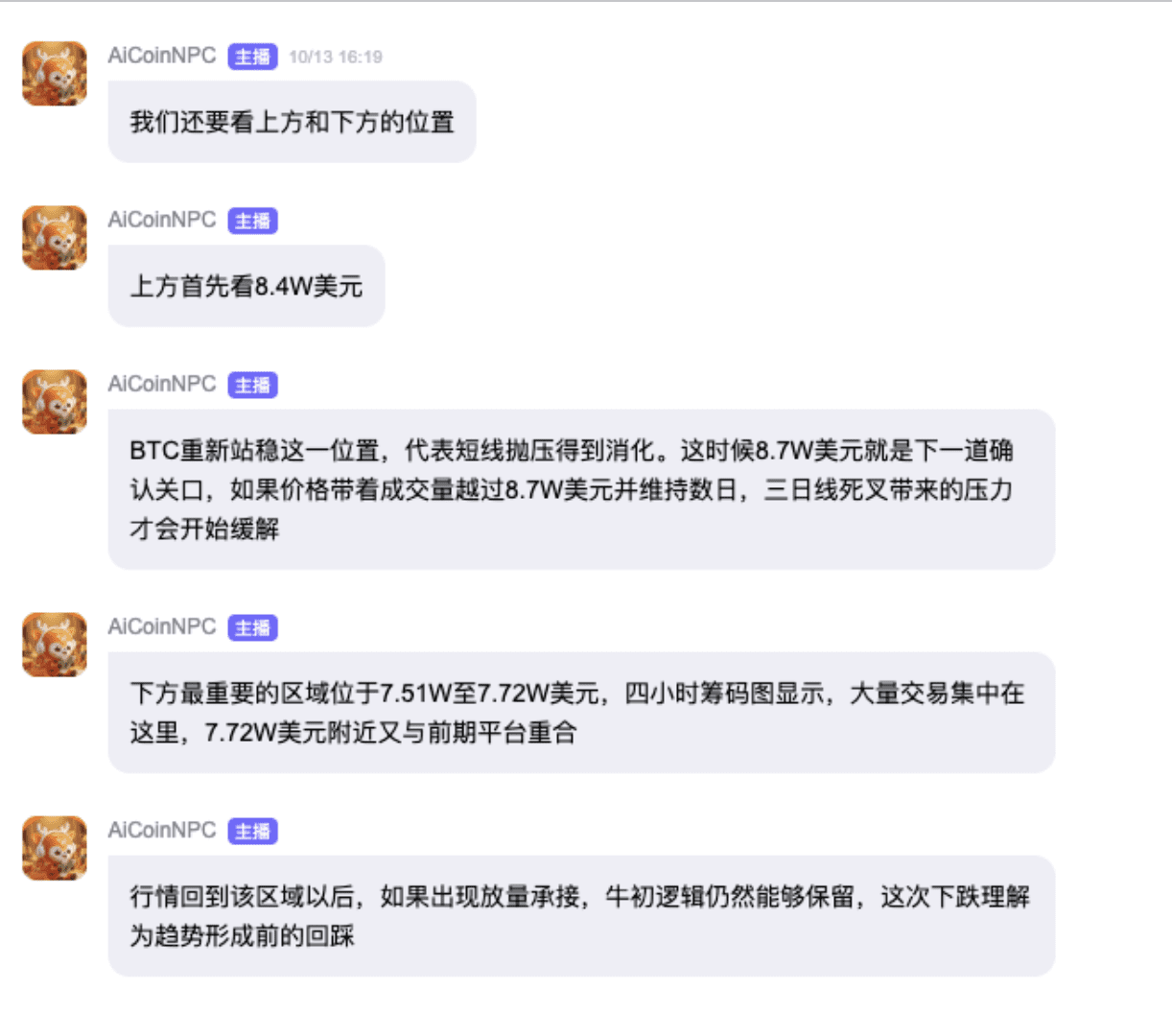
Following the market observation, the price movements in recent days also provided us with verification results. BTC hit a low of 79,753 dollars, failing to probe down to the 75,100 to 77,200 dollar range, then rebounded to around 84,870 dollars. The price could not hold above 84,000 dollars, and retraced to around 82,790 dollars. Near 80,000 dollars, buying interest has appeared, while the selling pressure from the 84,000 to 85,000 dollar range has also been confirmed.
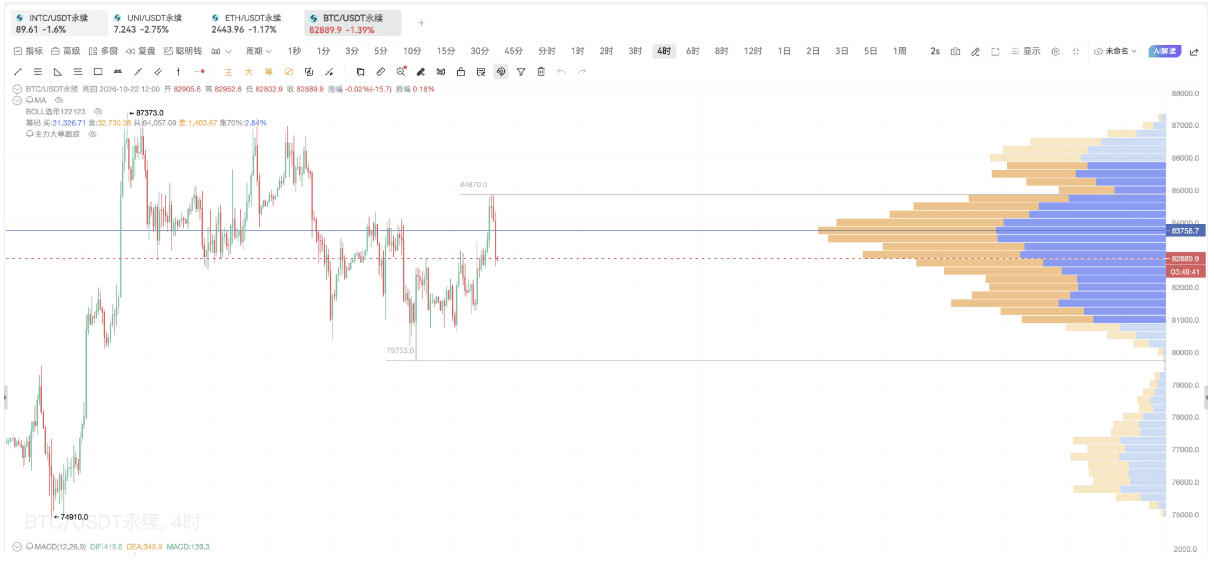
At that time, the price was stuck oscillating between 79,753 and 84,870 dollars. Honestly, the buying interest around 80,000 dollars came in earlier than I expected; I was originally planning to wait until near 76,000 dollars to acquire more. Now the pressure at 84,000 dollars has been validated, and after the surge, the price has once again retraced.
My view is that BTC will continue to oscillate in this range for some time. If it can manage to break above and stabilize at 84,000 dollars, it will be able to look towards 87,000 dollars. If the market breaks below 80,000 dollars again, the short positions will look towards the support levels of 77,200 and 75,100 dollars.
The logic around BTC is roughly this, now let's discuss HYPE and UNI. To understand these two assets, one must first understand how the project's earnings are transmitted to the token's value itself.
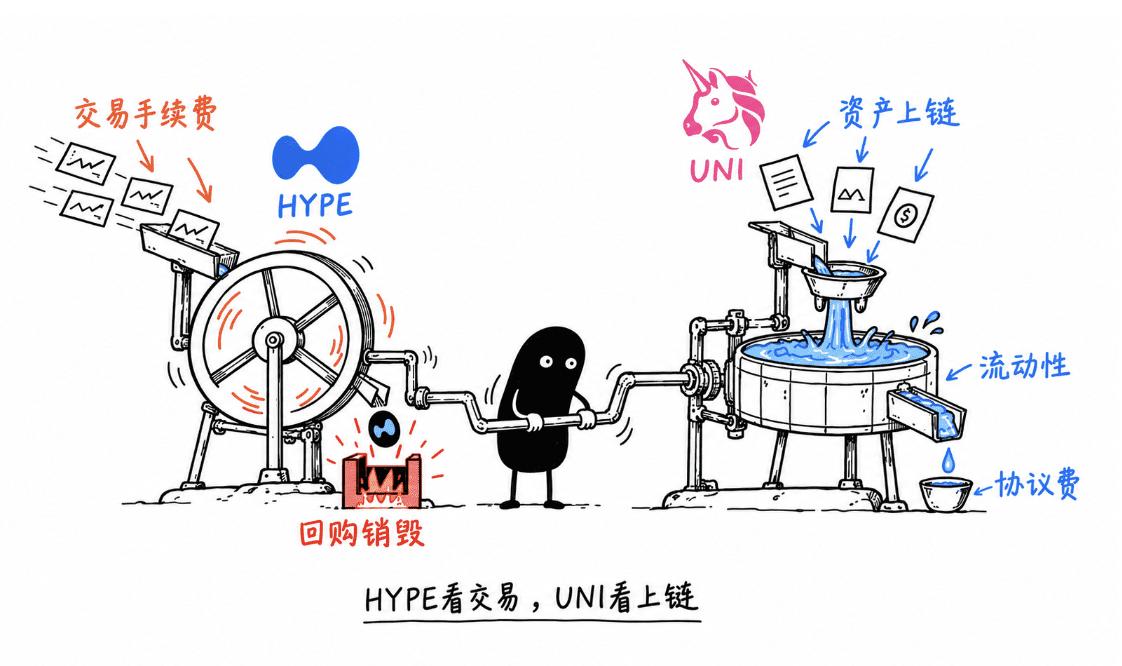
First, talking about HYPE, the core revenue of Hyperliquid comes from on-chain trading. Users trading perpetual contracts, spot, and other market categories on the platform generate transaction fees. A portion of these fees is used to buy back HYPE, which is then allocated to a support fund and subsequently burned. To simplify, the hotter the platform's trading volume, the higher the fee income, and the stronger the motivation for buyback and burn. The value logic of HYPE is related to the platform's trading enthusiasm, revenue scale, and ecological expansion progress.
As HyperEVM and HIP related markets continue to expand, HYPE will also take on roles such as staking, fee discounts, and gas consumption; these uses also form demand-side observation clues. Its ability to sustain growth will depend on actual usage.
At that time, HYPE's business data performance was good. According to the previous day's data, Hyperliquid's perpetual contract transaction volume over the past 24 hours was approximately 9.17 billion dollars, about 58.08 billion dollars over the past seven days, with an open interest of about 7.5 billion dollars, which is sufficient to demonstrate strong trading demand, with substantial funds deposited on the platform. The platform has launched approximately 647 trading markets, of which 341 are perpetual contract markets, and the HIP-3 proposal supports developers in creating new trading markets, with asset categories also expanding towards stocks and commodities.
The transaction-induced fees consistently convert into HYPE buyback funds, with an actual buyback scale of approximately 67.4 million dollars over the past 30 days, cumulatively buying about 790,000 HYPE, with an average daily buyback amount exceeding 2.2 million dollars. The more active the platform's users are in trading, the greater the buyback pressure on HYPE, thus strengthening the token's buying support; of course, buybacks themselves do not guarantee that prices will rise.
Next, looking at UNI, it's essential to distinguish between the UNI token and the Uniswap protocol itself. Uniswap is an on-chain automated exchange pool; when users exchange tokens, they trade with the fund pools, paying the corresponding transaction fees. In the early days, most of these fees were allocated to the liquidity providers (LP), and the correlation between the UNI token and the platform's earnings was minimal. After the protocol fee mechanism was implemented, a portion of the fees would enter the UNI burn channel, and similarly, the more active the platform's trading is, the more fees are generated, leading to more funds available for burning UNI.
At that time, UNI was under the focus of capital for another core clue regarding tokenized stocks. I was looking at the policy experiment on September 17, and the connection between Robinhood Chain and Uniswap: if eligible tokenized stocks can enter the approved on-chain fund pools, the protocol could gain new trading demand. Here, it's essential to distinguish between experimental scope and full openness; one must not directly equate policy expectations with concrete revenue.
In the future, traditional assets like stocks and funds may have opportunities to migrate to on-chain trading, and Uniswap can provide exchange and liquidity services for these assets. The more assets on-chain, the higher the potential trading volume of the platform will be, and thus the more fees that the protocol can capture for UNI burn.
This policy was still in the experimental stage, with clear limitations on accessible assets, issuing entities, and trading volume. The market traded more on future expectations; whether these commitments can be realized ultimately depends on the number of assets that are implemented and whether they can bring stable and sustainable trading flow.
Comparing the two logical pathways of HYPE and UNI, HYPE relies on trading fees for token buybacks, and the feedback speed of business data is faster; UNI's narrative requires waiting for more traditional assets to go on-chain, relying on trading volume and protocol fees to drive token burn, with a longer realization cycle.
Now let's talk about my thoughts on position arrangement. With the market returning to an oscillating range, BTC is testing the buying strength around 80,000 dollars, and HYPE and UNI are attracting funds with new narratives. This phase is suitable for a three-layer funding structure, with each part of the fund serving a different role.
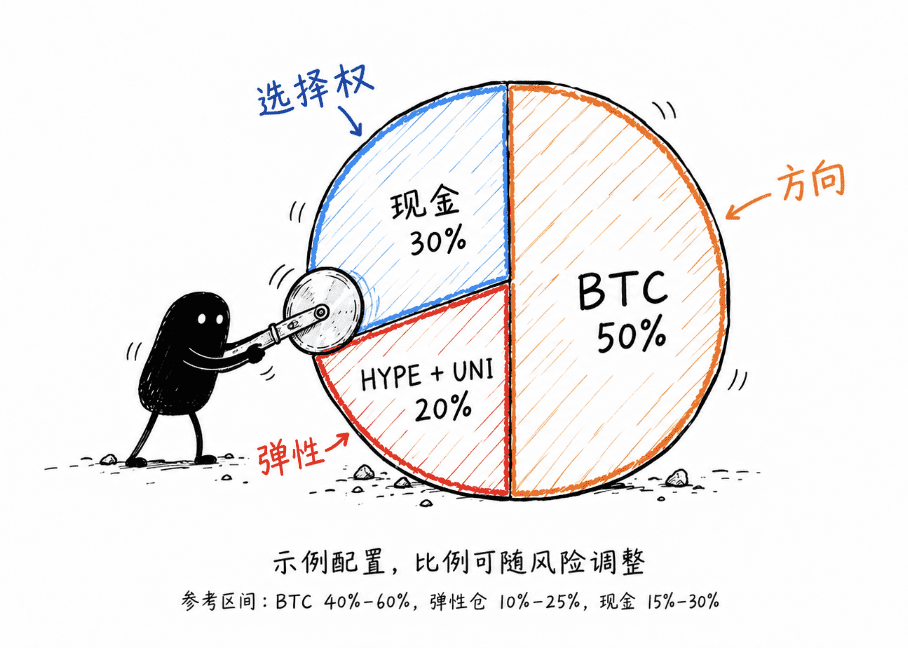
The first layer is the core position, with BTC reference allocation between 40% and 60%; this serves as the base of the whole portfolio, and the position size depends on your judgment of BTC's mid-term trend. If BTC stabilizes at 87,000 dollars, the logic of the core holdings will increase in certainty; when the price retraces to 80,000 dollars, adjustments need to be made flexibly based on the strength of the buying interest.
The second layer is the flexible position, which can include strong altcoins I am optimistic about; I have chosen HYPE and UNI, with a combined reference ratio of 10% to 25%. This part of the position is speculative on narratives and structural trends, with HYPE focusing on platform trading heat and UNI focusing on the progress of traditional assets going on-chain; you can also select assets you understand more thoroughly. The flexible layer should not exceed the core position to avoid significant volatility in a single theme dragging down the overall account.
The third layer is the tactical position, held in cash, with a reference range of 15% to 30%, to respond to market volatility and reserve operational options. After key position signals are confirmed, positions can be increased; when market trends deviate from expectations, there is also room to reduce positions calmly for adjustments.
The 50% BTC, 20% HYPE and UNI, and 30% cash depicted are just a sample configuration; the three layers summed up to 100%. Each person's risk tolerance and trading cycle are different, so the ratios must be adjusted according to personal circumstances.
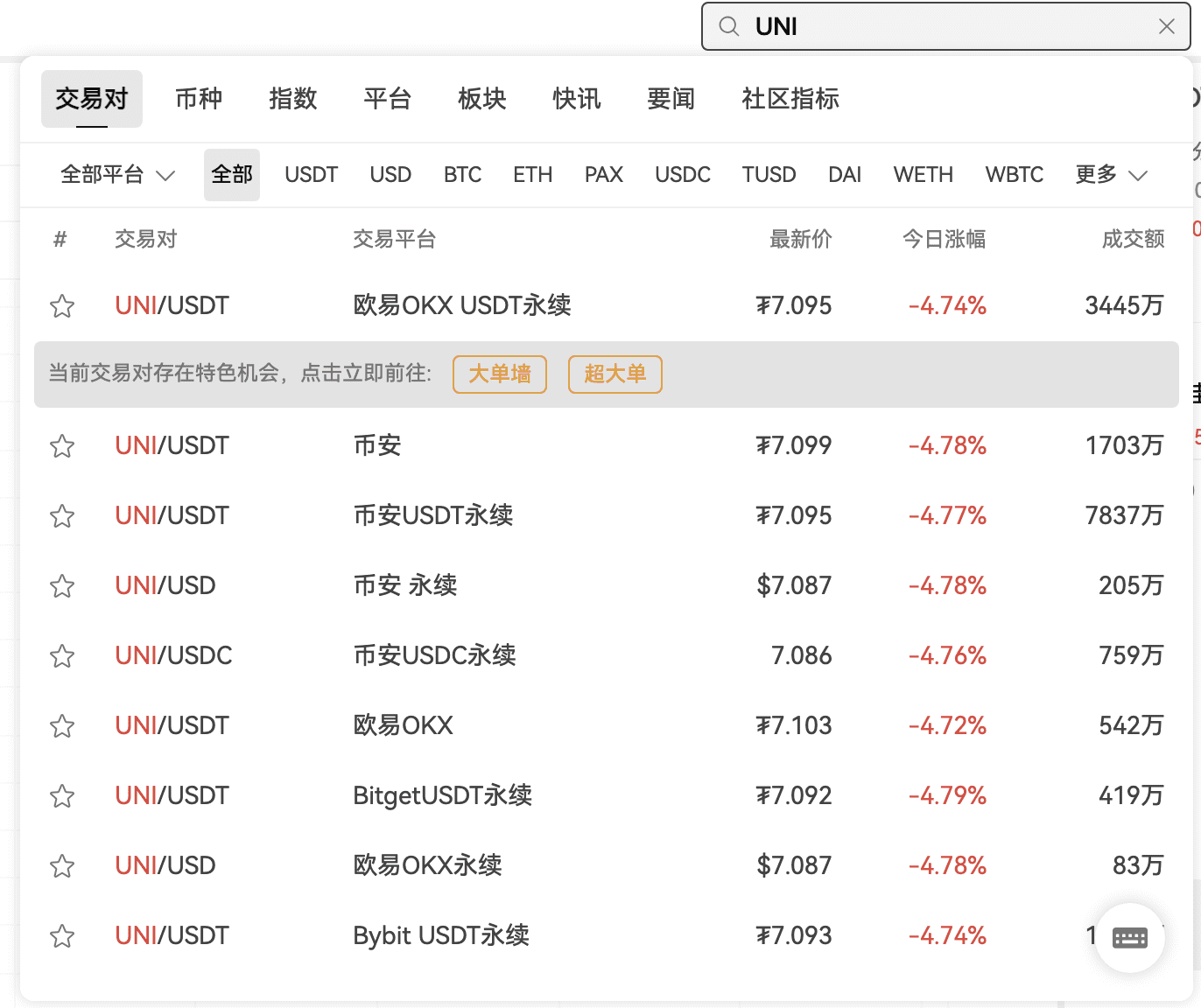
When searching for products, it is also important to distinguish between the UNI token and the Uniswap protocol itself. The protocol provides exchange and liquidity services, and whether UNI can capture corresponding value depends on the protocol fees, burn mechanism, and actual trading demand.
Currently, there is a live stream every day, and you are welcome to continue following AiCoin friends! Make an early reservation 👇
https://www.aicoin.com/zh-Hans/live/list?tab=upcoming
Join our community to discuss together and become stronger!
Official Telegram group:
AiCoin Chinese Twitter:
Hype rebates:
https://app.hyperliquid.xyz/join/AICOIN88
Binance rebates:
https://jump.do/zh-Hans/xlink-proxy?id=3
Invitation code: aicoin668
Coinbase rebates:
https://jump.do/xlink?checkProxy=true&proxyId=25
Invitation code: Y8L23JL
免责声明:本文章仅代表作者个人观点,不代表本平台的立场和观点。本文章仅供信息分享,不构成对任何人的任何投资建议。用户与作者之间的任何争议,与本平台无关。如网页中刊载的文章或图片涉及侵权,请提供相关的权利证明和身份证明发送邮件到support@aicoin.com,本平台相关工作人员将会进行核查。