Author: AiPlot Research Institute
Focus: RWA / Digital Assets / In-Depth Analysis of Financial Infrastructure
Website:https://aiplot.com/?utm_source=aicoin
If industry conferences are only viewed as press releases and social events, the density of activities in November can easily be interpreted as "another round of conference hype." However, from AiPlot's event data, November 2026 is forming a more notable structure: financial regulation, traditional institutions, base layer public chains, developer communities, and trading platforms are all showcasing their next phase roadmap almost within the same month.
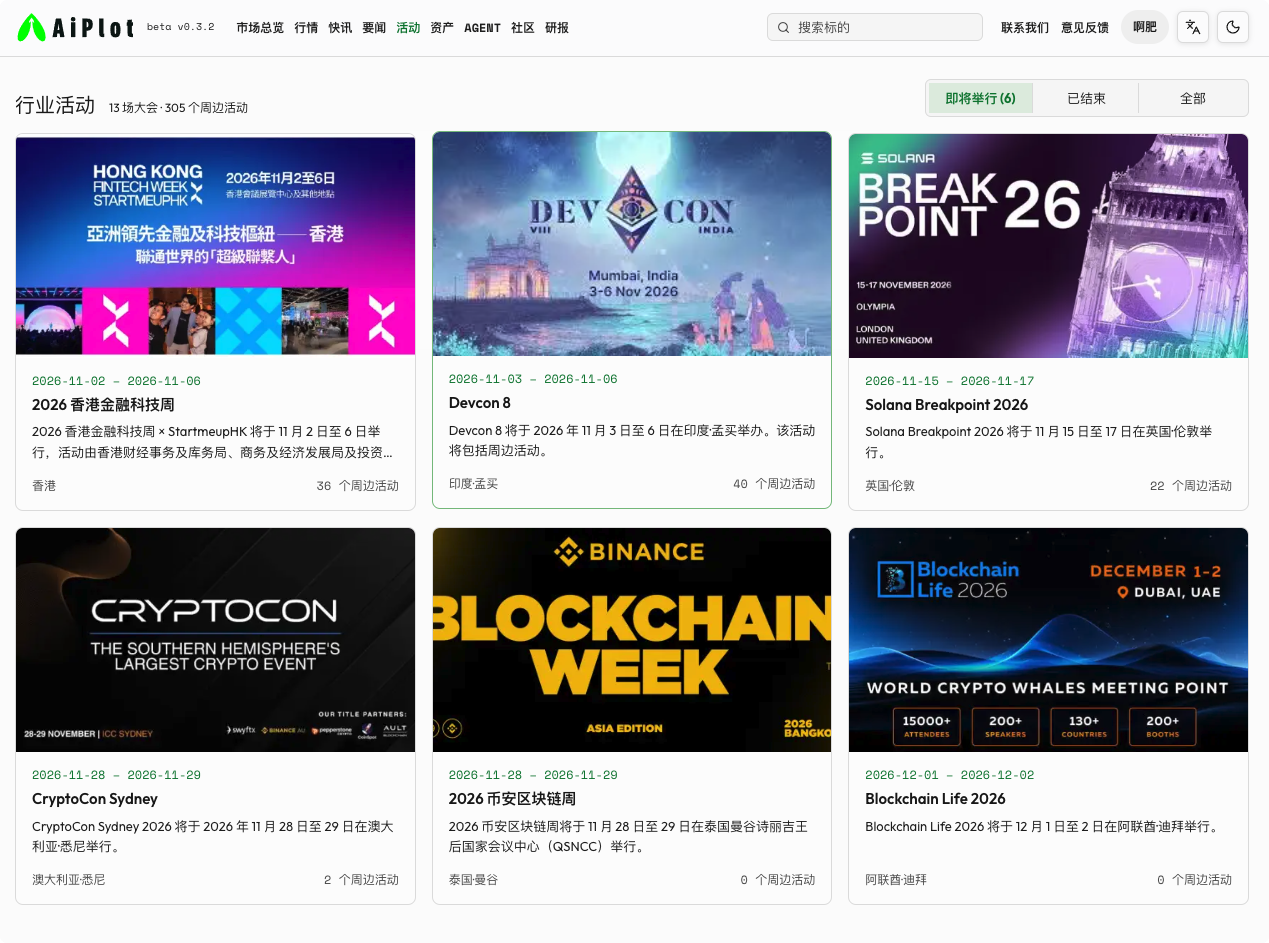
According to the AiPlot event page, key conferences taking place in November include Hong Kong FinTech Week, Devcon 8, Solana Breakpoint 2026, CryptoCon Sydney, and Binance Blockchain Week 2026. The page also lists 13 industry conferences and 305 related activities.
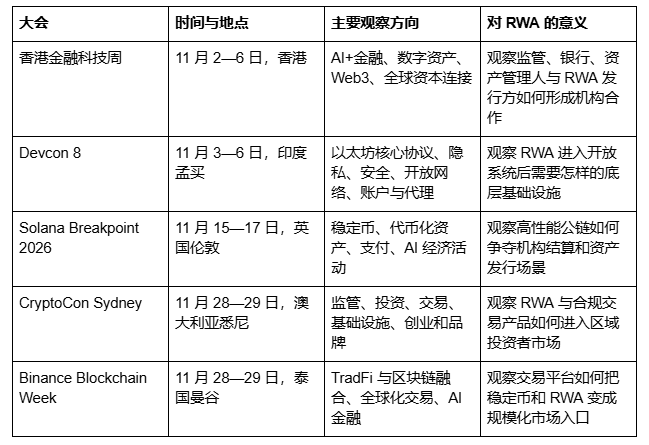
These conferences are not of the same type. Hong Kong FinTech Week is closer to a platform connecting government, financial institutions, and global capital; Devcon 8 focuses on the underlying construction of Ethereum and open systems; Solana Breakpoint directly incorporates stablecoins, tokenized assets, and payments into the main narrative of the "Token Supercycle"; CryptoCon Sydney reflects the compliance and popularization of regional markets; while Binance Blockchain Week discusses TradFi, blockchain, and AI-driven financial activities from the same trading platform perspective.
Therefore, what is truly worth tracking in November is not which conference has the loudest voice, but whether different factions start to provide answers to the same question: how will real assets and digital dollars enter the next phase through what networks, what applications, and what compliance structures?
1. Five Key Conferences in November and What Industry Lines They Represent
On December 1-2, Dubai will also host Blockchain Life 2026. Although it is not part of the November activities, it follows up on the November cycle of Asian conferences, serving as an extension to observe year-end market sentiment and project financing trends.
2. First Stop Hong Kong: The Competition for RWA is Shifting from On-Chain to Financial Connectivity
Hong Kong FinTech Week will be held from November 2 to 6, organized by the Hong Kong Financial Services and the Treasury Bureau, the Commerce and Economic Development Bureau, and the Invest Hong Kong agency. The official positioning of this event is as a platform connecting finance, technology, and entrepreneurial ecosystems, focusing on three areas: AI+, Finance+, and Go Global.
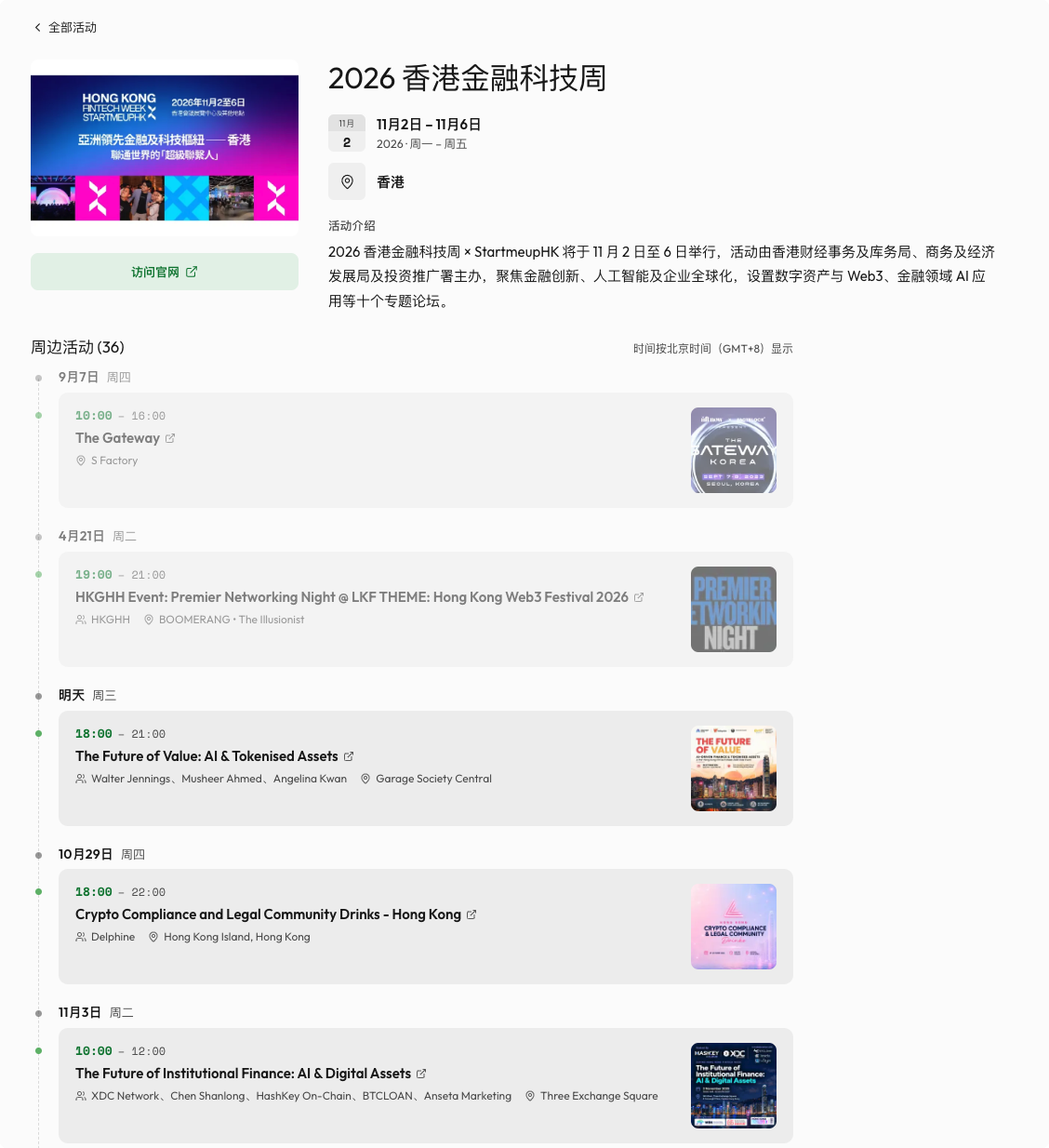
Official information indicates the event plans to gather over 45,000 global participants, more than 1,000 speakers, over 800 sponsors, exhibitors, and startups, as well as representatives from more than 120 economies.
The value of this conference for RWA does not lie in whether it will announce a new token, but in whether it can create genuine connections between digital asset projects and banks, brokerages, insurers, asset managers, and cross-border capital.
As RWA has developed to this point, putting assets on-chain is no longer the only challenge. The real difficulties lie in post-issuance distribution, custody, compliance sales, investor suitability, cross-border mobility, and secondary market liquidity. Even if a government bond fund or stock product is tokenized, without institutional distribution and compliant settlement, it is still hard to achieve scale.
Thus, Hong Kong FinTech Week deserves attention for three signals.
First, whether traditional financial institutions will shift from "discussing Web3" to showcasing real products. Second, whether digital asset regulation will further clarify the boundaries between stablecoins, tokenized securities, and professional investor markets. Third, whether Hong Kong will continue to play the role of a "super connector" between mainland Chinese capital, the Asian financial market, and global Web3 companies.
From AiPlot's perspective, Hong Kong FinTech Week is also the most suitable conference to observe the relationship between RWA issuers and financial institutions. It corresponds not to a single public chain, but to the institutional entry point of RWA.
3. Devcon 8: The Core Issue of RWA is Ultimately Open System Issues
Devcon 8 will take place from November 3 to 6 in Mumbai, India. The official definition of Devcon is a global developer conference focusing on open, free, private, and verifiable systems. This year's agenda includes core protocols, privacy and consent, security, application cryptography, permissionless networks, and open and verifiable technology stacks.
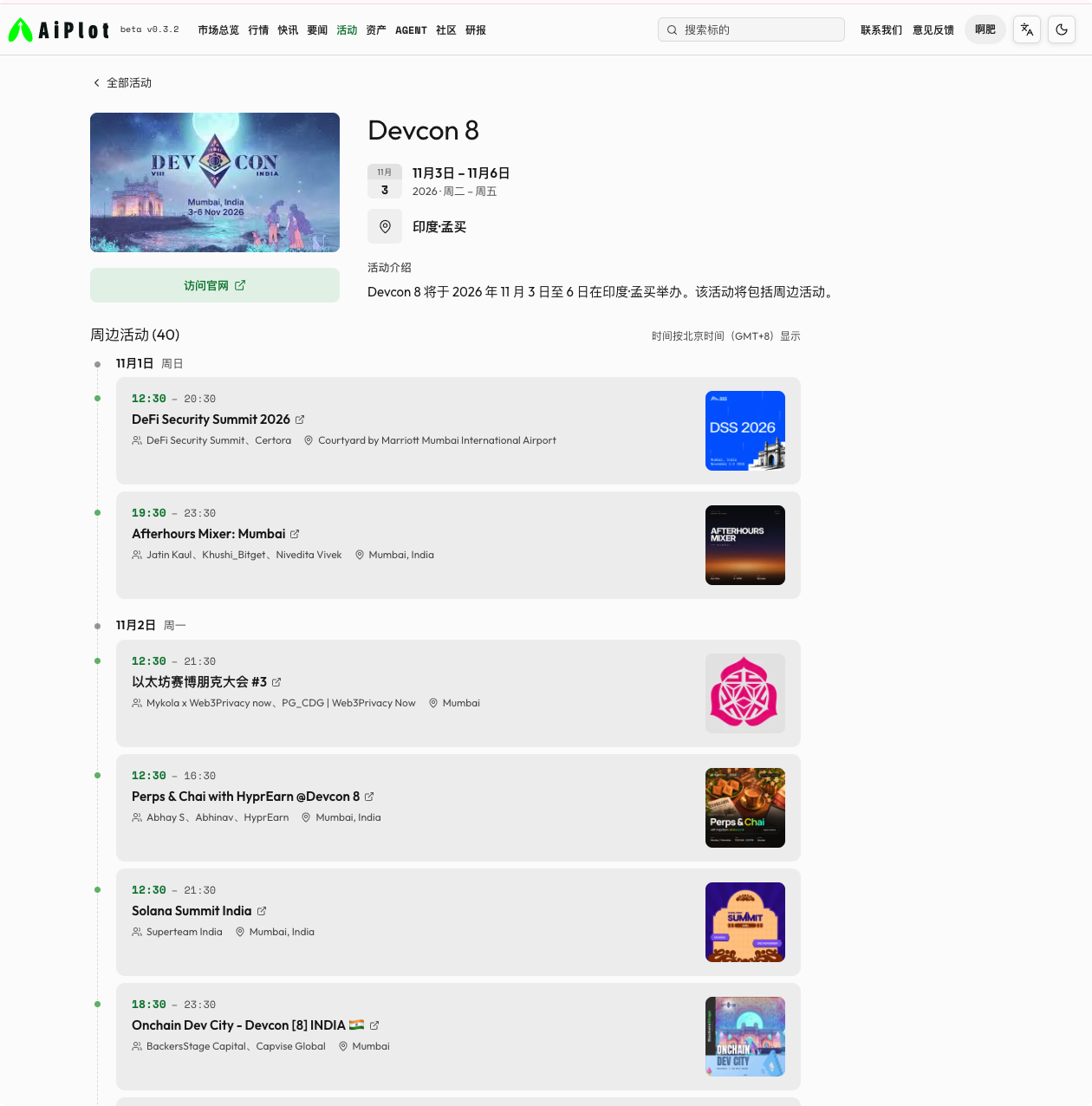
This differs from the institutional perspective of Hong Kong FinTech Week. The core discussion at Devcon 8 is not "which financial institutions will issue assets," but rather whether the system can meet the security, privacy, and governance demands of the real world once assets and financial activities migrate to open networks.
As RWA enters Ethereum and other open networks, it will face at least four underlying issues:
How to identify asset holders without exposing all privacy on-chain; how to program compliance restrictions without relying on manual approval; how tokenized assets can be safely transferred across different protocols; and how the on-chain system can pause, correct, and recover when issuers, custodians, or oracles encounter issues.
These questions will not immediately manifest as beautiful asset scale numbers, yet they determine whether RWA can transition from showcase products to composable financial infrastructure.
Another observation point at Devcon 8 is the intersection of AI and blockchain. The official agenda includes Users, Builders & Agents, and content related to AI, privacy, cryptography, and open networks. If AI agents begin to manage funds automatically, pay API fees, or execute asset allocations, stablecoins and tokenized assets must possess machine-readable, verifiable, and programmable attributes.
This means the next generation of RWA must not only be "bought and sold by people," but might also need to be callable by software agents. The permissions, prices, risks, and settlement statuses of assets must be understandable by programs.
4. Solana Breakpoint: Public Chains Begin Directly Competing for Institutional Capital Markets
Solana Breakpoint 2026 will be held from November 15 to 17 in London. The official core theme of this conference is The Token Supercycle, explicitly categorizing stablecoins, tokenized assets, payments, and AI-driven economic activities as important components of the next-phase on-chain finance.
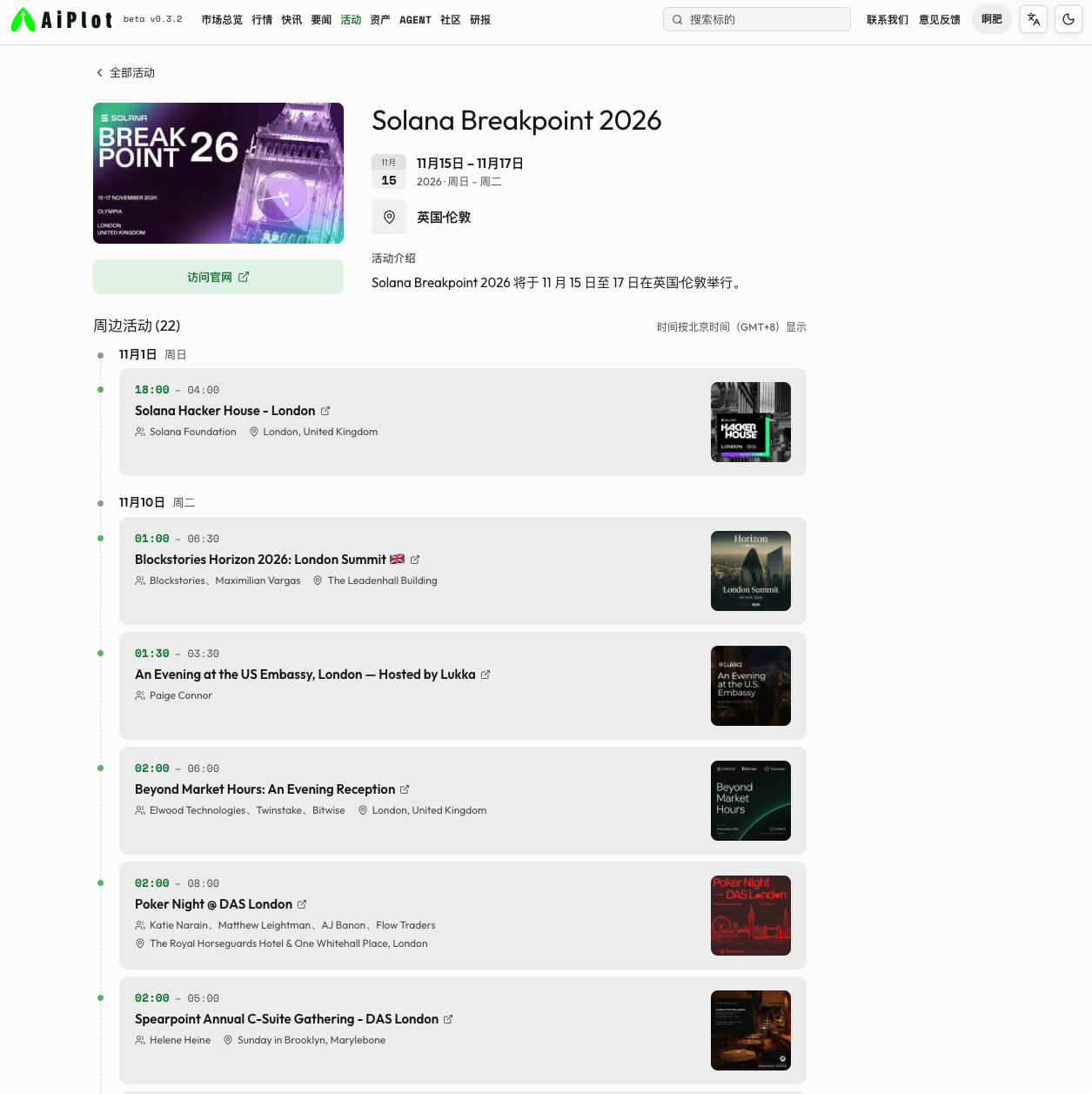
This conference has a clear distinction from traditional public chain developer meetings. Solana's officials no longer just emphasize transaction speed or the number of ecological projects, but directly place themselves into competition in the global capital market.
The official page mentions that last year, institutions including J.P. Morgan, Goldman Sachs, BlackRock, State Street, and Citigroup have already deployed production capital on Solana, positioning this Breakpoint as an event for financial institutions, tech companies, investors, and policymakers to discuss the next generation of capital markets together.
Regardless of the specific forms in which these institutions are deploying, this statement itself indicates that public chain competition is changing. The past focus of competition was on developer numbers, application counts, and on-chain transaction volumes; future competition will also include:
Whether it can support mass settlement of stablecoins, whether it can provide asset issuance tools acceptable to compliant institutions, whether it can connect tokenized assets with payments, loans, and trading protocols, and whether it can maintain predictable costs and performance during peak periods.
The Solana official page also lists ecological data such as over $4 billion in Solana RWA value and over $40 trillion in 2026 stablecoin processing volume. These numbers belong to the ecosystem metrics disclosed by project parties and should not be taken directly as independent audit data for the entire RWA market, but they reflect the market narrative Solana is trying to establish:
Solana is not just a public chain that carries crypto transactions but aims to become a financial operating system for stablecoins, tokenized assets, and real-time payments.
For RWA researchers, what is most worth tracking at Breakpoint is not "how many projects announce deployment," but whether institutional collaborations truly enter production environments, whether stablecoin trades form ongoing settlements, and whether tokenized stocks and funds create sufficient secondary liquidity.
5. CryptoCon Sydney: How RWA Transitions from Institutional Narratives to Regional Investor Markets
CryptoCon Sydney will take place from November 28 to 29 at ICC Sydney. The official positioning is as Australia's flagship event for crypto, blockchain, and Web3, attracting participants including founders, investors, developers, institutions, industry professionals, and the broader community.
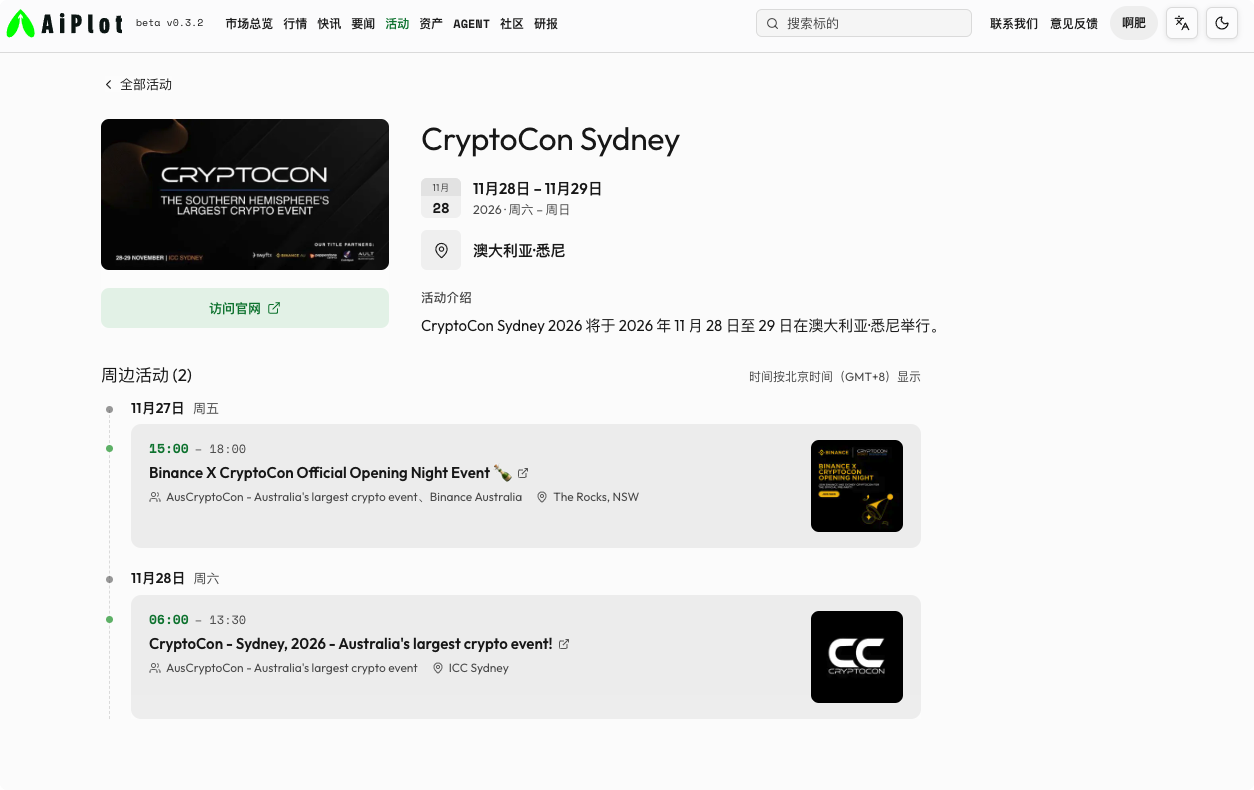
Compared to Hong Kong FinTech Week and Solana Breakpoint, the value of CryptoCon Sydney is more aligned with the market end. The official topics cover market trends, regulations, entrepreneurship, investments, blockchain infrastructure, and brand development.
This means it is capable of observing whether RWA is truly beginning to be understood by regional investors and ordinary market participants.
The institutionalization of RWA is not only happening within large banks and asset management companies. The Australian market also involves trading platforms, fintech companies, pensions and self-managed super funds, compliance brokers, and local investors. For tokenized assets to receive genuine demand, they must ultimately integrate into the investment, trading, and custody processes familiar to these institutions and users.
Therefore, what is worth focusing on at CryptoCon Sydney are three types of signals:
First, whether stablecoins and tokenized assets transition from technical topics to investment product discussions; second, how local regulatory agencies and trading platforms discuss asset issuance and investor protection; and third, whether trading platforms will incorporate RWA into existing investment, payment, and wealth management products.
From a marketing perspective, CryptoCon Sydney also represents an important phase for RWA: once assets are tokenized, the ability to articulate, sell, and ensure continuous use of these assets may be more crucial than who deploys contracts first.
6. Binance Blockchain Week: Trading Platforms Aim to Become the Scalable Entry for RWA
Binance Blockchain Week will take place from November 28 to 29 at Queen Sirikit National Convention Center in Bangkok, and is one of the most noteworthy events in the Asian market at the end of November. The official theme is EVOLVE, emphasizing the integration of TradFi and blockchain, as the previously time-limited financial markets become more globalized, open, and operate around the clock.
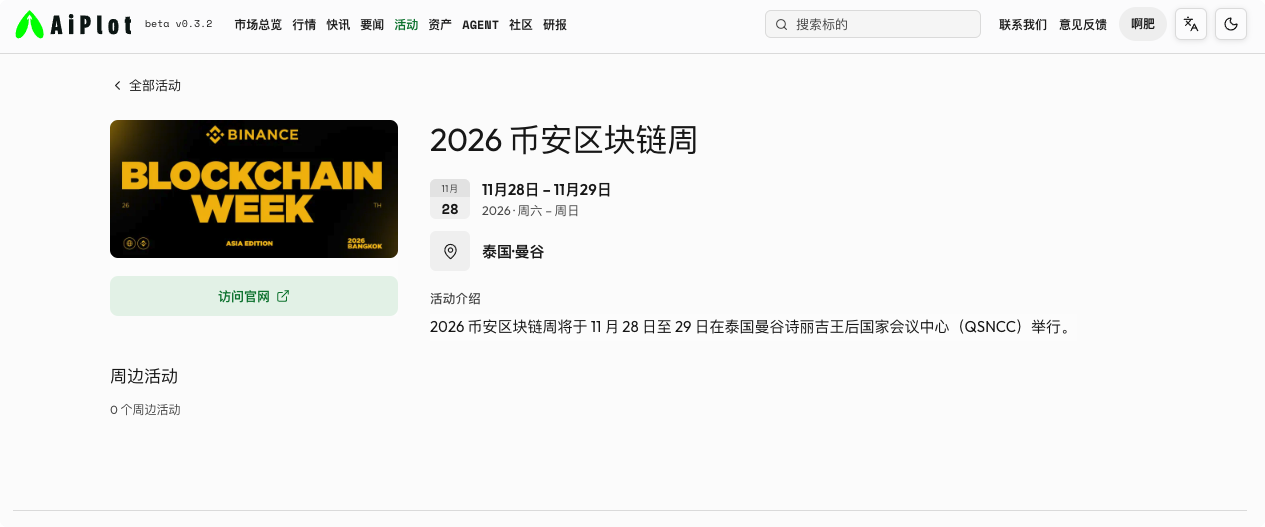
This theme is highly relevant to the growth of RWA perpetual contracts.
Trading platforms do not necessarily need to issue all real assets themselves. They can connect different assets through stablecoins, tokenized stocks, commodity contracts, RWA perpetual contracts, and income-generating products through the same user entry point.
For users, what is truly important may not be who issues the underlying assets, but whether they can complete deposit, trading, lending, leverage, and settlement with the same account. Thus, trading platforms have the opportunity to become the distribution layer and liquidity layer for RWA.
However, this also brings higher regulatory requirements. Stocks, commodities, bonds, and stablecoins are not the same financial products, and the applicable issuance rules, sales restrictions, custody structures, and investor protections differ. The more a trading platform wants to put these assets at the same entry point, the more it needs to establish a clear product classification and permissions system.
Binance Blockchain Week also incorporates AI into the narrative of financial evolution. AI might help users with asset screening, risk analysis, and trade execution, but once AI enters the financial system, the platform must answer one question: is AI a recommendation tool, or an automated execution agent capable of invoking stablecoins and tokenized assets?
If the latter becomes a reality, RWA competition will shift from "who has more tokens" to "who has more efficient asset distribution, trading, and settlement systems."
7. Behind the November Events, There is Actually a Direct Convergence of Four Routes
When looking at these five conferences together, it becomes evident that they represent different links in the RWA industry.
Hong Kong FinTech Week represents institutional connectivity and regulatory entry. It determines whether traditional financial institutions can participate in issuance, custody, distribution, and settlement.
Devcon 8 represents open infrastructure and protocol layers. It addresses issues of privacy, security, identity, composability, and system trustworthiness.
Solana Breakpoint represents high-performance public chains competing for institutional settlement and capital markets. It tries to place stablecoins, tokenized assets, payments, and AI economic activities on the same high-throughput network.
CryptoCon Sydney represents regional market familiarity and investor entry. It focuses on how assets are accepted by local trading platforms, investors, and industry participants.
Binance Blockchain Week represents trading platforms as distribution and liquidity entry points. It aims to unify TradFi products, digital assets, and around-the-clock trading into a larger user ecosystem.
These four routes may not necessarily form collaborations and could directly compete. Public chains want to meet issuance and settlement demands, trading platforms desire liquidity, financial institutions seek compliant digital channels, and developers hope for open and composable protocols.
Ultimately, the market landscape will depend on whether these capabilities can combine.
Conclusion: November is a Observational Window for RWA Transitioning from "Who Issues" to "Who Connects the Market"
In November 2026, industry conferences, distributed across Hong Kong, Mumbai, London, Sydney, and Bangkok on the surface, are collectively discussing the same industry change: how real assets will enter a financial system enabled by stablecoin settlement, supported by blockchain, distributed by trading platforms, and engaged by AI.
Hong Kong is responsible for connecting financial institutions and regulation, Devcon for building open systems, Solana is competing for institutional on-chain settlements, CryptoCon Sydney is monitoring regional investor acceptance, and Binance Blockchain Week represents the trading platforms' pursuit of global liquidity.
This indicates that the next stage for RWA will not simply be "more assets being tokenized." The more important question is: can these assets achieve compliant issuance, stable settlement, continuous liquidity, and real users?
For market observers, what is most worth tracking in November is not the individual projects at the conference, but whether four following data points synchronously improve post-conference: whether the scale of stablecoins grows, whether RWA assets increase, whether on-chain transactions are active, and whether networks and platforms genuinely gain sustained settlement demands.
The value of AiPlot lies in placing these dispersed activities, assets, and market data within the same research entry. Conferences provide direction, and data validates whether that direction is transforming into a market.
For more data and analysis, please follow Aiplot:
https://aiplot.com/?utm_source=aicoin
📖 Community Communication:
- Telegram:
https://t.me/+IIYMcJigBAo4Mjg1
The content of this article only represents the author's personal views and does not reflect the stance of this platform. The opinions, conclusions, and suggestions in the article are for investors' reference only and do not constitute any investment advice related to this platform. The market has risks, and investments should be made cautiously.
免责声明:本文章仅代表作者个人观点,不代表本平台的立场和观点。本文章仅供信息分享,不构成对任何人的任何投资建议。用户与作者之间的任何争议,与本平台无关。如网页中刊载的文章或图片涉及侵权,请提供相关的权利证明和身份证明发送邮件到support@aicoin.com,本平台相关工作人员将会进行核查。