Many people understand the competition among exchanges as a simple issue: whoever can attract more users wins.
However, the recent Hyperliquid partnership plan announced by Payward is taking the competition to another level.
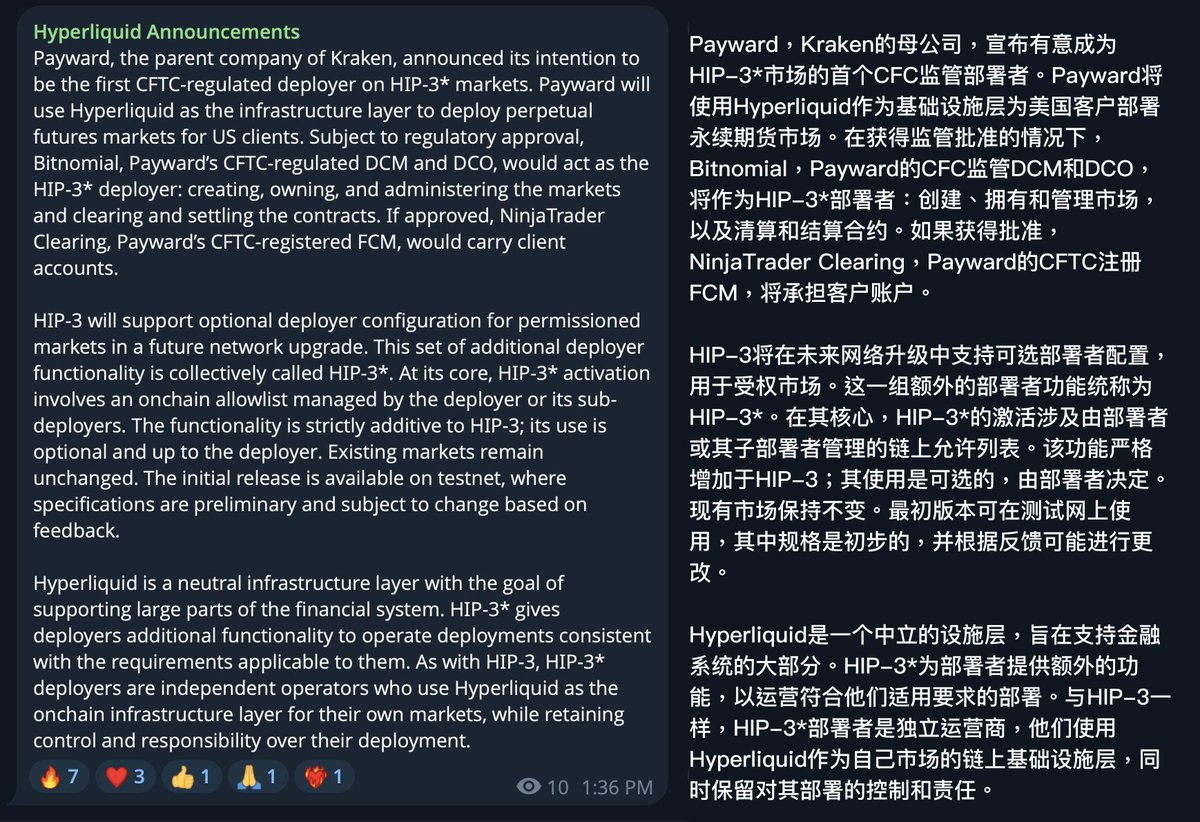
Kraken's parent company, Payward, already has exchanges, brokerage services, a clearing system, and millions of funded accounts, yet it still plans to deploy an on-chain perpetual contract market for U.S. customers through Hyperliquid's HIP-3.
This is not about "Kraken giving up its own exchange," nor is it simply about redirecting users to another platform.
A more accurate understanding is: frontend customers, compliant accounts, clearing systems, and on-chain order books are being disassembled into different modules and recombined.
If the plan is ultimately approved, what Hyperliquid offers will not just be a trading interface for retail customers, but could become an on-chain trading backend that traditional financial institutions can access.
1. What exactly does Payward want to connect to Hyperliquid?
According to the plan announced by Payward, Bitnomial is responsible for creating, owning, and operating the relevant market, while also handling contract clearing and settlement; NinjaTrader Clearing is responsible for handling customer accounts; Hyperliquid provides the on-chain order book and trading infrastructure.
U.S. customers do not directly connect to an unlicensed wallet and enter Hyperliquid for trading by themselves.
They need to open an account through NinjaTrader, with their accounts simultaneously entering the whitelists of both NinjaTrader and Bitnomial before they can trade the related perpetual contracts.
This structure is very important because it separates four things that were often mixed together in the past:
- Who owns the customer relationship;
- Who is responsible for account and compliance access;
- Who is responsible for market creation and clearing;
- Who is responsible for matching and on-chain record-keeping.
The official announcement from Payward clearly states that Bitnomial Exchange is a designated contract market regulated by the CFTC, Bitnomial Clearinghouse is a registered derivatives clearing organization, and NinjaTrader Clearing is a registered futures commission merchant and NFA member.
Therefore, this does not mean "Hyperliquid has already obtained U.S. regulatory approval," nor can American users currently trade these markets through a regular wallet.
Payward uses the term "intends" and clearly states that the relevant on-chain perpetual products still require regulatory approval.
2. Why doesn’t Kraken do this directly on its own exchange?
On the surface, this seems like a strange question.
Payward already has its own trading platform; why would it need to use Hyperliquid's order book?
The answer may lie in: the advantages of different platforms are not the same.
Payward has customers, licenses, brokerage, and clearing capabilities, but Hyperliquid has a set of already operational on-chain trading infrastructure. The two parties are not duplicating efforts at every level but are trying to piece together their respective strengths.
For Payward, connecting to Hyperliquid can reduce the costs of building on-chain order books, on-chain settlements, and protocol-level trading infrastructure from scratch, while allowing its customers to access new markets through a familiar account system.
For Hyperliquid, the importance is not just in gaining more trading volume, but in connecting with an institution that already possesses a distribution network and compliance capabilities.
This is why this matter cannot be understood simply as "Kraken launching Hyperliquid products." It resembles an attempt to validate a new exchange structure: institutions are responsible for customer entry and regulatory responsibility, while the protocol provides a transparent market infrastructure.
This is different from traditional exchanges concentrating all functionalities within a single company, and also differs from completely unlicensed on-chain trading.
It sits in between the two.
3. What HIP-3 genuinely addresses is "who can deploy a market"
Hyperliquid’s official document defines HIP-3 as allowing deployers to create their own perpetual DEX.
The deployer is responsible for market definition, including oracles, contract specifications, and market rules; also responsible for market operations, such as setting oracle prices, leverage limits, and settling the market when necessary.
Each HIP-3 DEX has an independent margin system, order book, and deployer settings.
This means that HIP-3 is not simply adding a few trading pairs to the existing Hyperliquid order book, but allows different institutions or teams to have relatively independent market deployment space.
Bitnomial in Payward’s plan combines this deployment capability with regulated market operations, clearing, and settlement systems.
From an architectural perspective, the value of HIP-3 is not "opening up more currencies" but expanding the market deployment rights from the protocol itself to compliant external operators.
In the future, if an institution possesses a specific customer base, data sources, compliance requirements, or product designs, it could theoretically establish a relatively independent trading market on top of Hyperliquid, rather than requiring all products to be directly produced by the protocol core team.
Of course, this freedom comes with responsibility. HIP-3 deployers must be responsible for oracles, market operations, and contract settlements, and must also meet staking requirements; official documents indicate that deployers need to stake 500,000 HYPE, and abnormal market operations may face staking reductions.
Therefore, HIP-3 is not "anyone can casually launch a perpetual market," but binds market innovation rights with operational responsibilities, staking risks, and on-chain auditability together.
4. Data already demonstrates: HIP-3 has demand, but has not yet proven that liquidity is adequately decentralized
A noteworthy snapshot: at the time of HIP-3, there were 165 active markets, with approximately $3.043 billion in trading volume over the past 24 hours, accounting for about 38.8% of the combined trading volume of native perpetuals and HIP-3.
This figure indicates that HIP-3 is no longer a marginal module that can be overlooked.
However, the same data also reveals its current structural issues: trade.xyz contributed about 97.9% of HIP-3's trading volume, as well as about 97.4% of the open interest.
These two numbers need to be viewed together.
On one hand, HIP-3 can generate substantial trading volumes, proving that externally deployed markets can indeed attract trading demand. On the other hand, the concentration of volume and open interest in a single leading market indicates that HIP-3 as a whole cannot simply be understood as "multiple independent markets have developed in balance."
It resembles a deployment layer that has just validated market demand, but liquidity still relies on a few leading markets.
After Payward's integration, what needs to be observed is not just the attention level on the announcement day, but three data changes:
First, can new markets establish independent and sustainable order book depth?
Second, is the increase in trading volume coming from genuine customers and market makers, or is it primarily from short-term arbitrage and incentives?
Third, is the open interest structure of HIP-3 starting to diversify from a single market to multiple deployers?
This is also the value of data platforms like AiCoin. News can only tell you "who announced cooperation," while volume, open interest, funding rates, order book depth, and market concentration can tell you whether the cooperation has translated into tangible trading activity.
5. What Payward brings is not an ordinary traffic access point
In the second quarter of 2026, Payward officially disclosed that the group had 6.6 million funded accounts as of June 30, with platform trading volume of approximately $310 billion for the second quarter.
The term "funded accounts" here includes accounts with balances greater than zero at the end of the quarter, with sub-accounts counted separately.
This does not mean that all 6.6 million accounts will trade in Hyperliquid's HIP-3 market, nor can Payward’s total quarterly trading volume be directly viewed as the potential trading volume for future new markets.
But it clearly illustrates what Payward can provide: an existing set of customer distribution, account systems, brokerage services, and trading access.
In the past, users wanting to use on-chain markets typically had to complete a sequence of actions themselves: understand the protocol, prepare a wallet, transfer assets, understand margin, and then familiarize themselves with a new trading interface.
Institutional integration aims to change this pathway.
If U.S. customers can access on-chain perpetuals through existing brokerage accounts, compliance processes, and customer support systems, Hyperliquid no longer just waits for users to actively discover it.
It can be invoked by platforms that already have traders and customers as underlying infrastructure.
This will lead to a more significant change: Hyperliquid's target is no longer just individual trading accounts, but potentially market operators that have customers and licenses.
6. For Hyperliquid, the greatest opportunity and risk arise simultaneously
If Payward’s plan is approved, the greatest opportunity is allowing Hyperliquid to enter the distribution system of traditional institutions.
But the greatest risk also lies here.
HIP-3 markets need to manage oracles, leverage, and settlements independently. If deployers face issues with product design, data sources, or risk control, users may encounter different trading and clearing risks than those associated with native markets.
In addition, different HIP-3 DEXs have independent order books. Even if Payward's market utilizes Hyperliquid's underlying technology, it will not automatically inherit all the liquidity of trade.xyz or native perpetuals.
This means new markets must attract market makers on their own, establish depth, and maintain order books.
There’s also an often-overlooked issue: openness may be replaced by compliance access.
The native Hyperliquid markets emphasize open access, whereas the markets designed by Payward require accounts to be whitelisted by both NinjaTrader and Bitnomial.
This is not necessarily a disadvantage. For regulated U.S. clients, it may be a necessary condition for the product to enter the traditional financial system.
But it also means that "using Hyperliquid" will no longer equal "all users can access all markets in the same way." In the future, the same underlying protocol may have open markets, restricted markets, institution-exclusive markets, and different regulatory jurisdiction markets existing simultaneously.
Average users comparing platforms cannot just look at the protocol names; they also need to examine who deploys specific markets, who is responsible for oracles, who is responsible for clearing, which accounts can participate, and whether the liquidity of the order books is independently established.
Conclusion: Hyperliquid is striving to become the “backend market layer” for financial institutions
Kraken has its own exchange but still plans to use Hyperliquid, which does not mean that traditional platforms have lost the ability to build exchanges.
It indicates that trading infrastructure is becoming layered.
Payward possesses customers, brokerage, and regulatory systems. Bitnomial has regulated market and clearing capabilities. NinjaTrader handles customer accounts. Hyperliquid provides the on-chain order book and underlying execution environment.
If this structure ultimately passes regulatory approval and goes live, Hyperliquid's role may expand from "an on-chain trading platform accessed actively by users" to "public infrastructure that other financial institutions can deploy markets on."
But markets will not mature automatically because of a cooperation announcement.
What needs to be observed next is whether the new markets have depth, whether customers are continuously trading, whether open interest is forming, whether funding rates are healthy, and whether HIP-3 can transition from concentration in a single leading market to liquidity being jointly provided by multiple deployers.
True competition is not about who moves users from one app to another, but about who can make customer access, compliance responsibilities, clearing capabilities, and on-chain liquidity work together within the same market structure.
Exclusive Benefits for AiCoin Users
👉 Enter the invitation code AICOIN88 when binding your Hyperliquid account to enjoy a 4% transaction fee rebate
🔗 Exclusive registration link:
https://app.hyperliquid.xyz/join/AICOIN88
📖 Beginner Tutorials:
- "AiCoin PC Hyperliquid Authorized Trading Tutorial":
https://www.aicoin.com/zh-Hans/article/514197
- "AiCoin Mobile Hyperliquid Authorized Trading Tutorial":
https://www.aicoin.com/zh-Hans/article/541383
- "Zero Basic Entry! Detailed Graphical Tutorial for First-Time Trading on Hyperliquid":
https://www.aicoin.com/zh-Hans/article/510225
📖 Community Communication:
- Telegram:
https://t.me/AiCoinWhaleData
- Discord:
https://discord.gg/5XSXjXSpz
- AiCoin Group Chat:
https://www.aicoin.com/link/chat?cid=N6OVMor5g
The content of this article reflects the author's personal opinion and does not represent the platform's stance. The views, conclusions, and suggestions in this article are for investor reference only and do not constitute any investment advice related to the platform. Investing in U.S. stocks still requires self-assessment of market risks, regulatory risks, and compliance with local laws and regulations (especially foreign exchange control, outbound investment declaration, etc.)
免责声明:本文章仅代表作者个人观点,不代表本平台的立场和观点。本文章仅供信息分享,不构成对任何人的任何投资建议。用户与作者之间的任何争议,与本平台无关。如网页中刊载的文章或图片涉及侵权,请提供相关的权利证明和身份证明发送邮件到support@aicoin.com,本平台相关工作人员将会进行核查。