Hyperliquid is an "on-chain perpetual contract trading platform": self-developed Layer 1, on-chain order book, trading experience close to centralized exchanges, asset self-custody, and an ever-expanding ecosystem.
This information is helpful for users who are encountering Hyperliquid for the first time, but it’s not enough for those with trading experience.
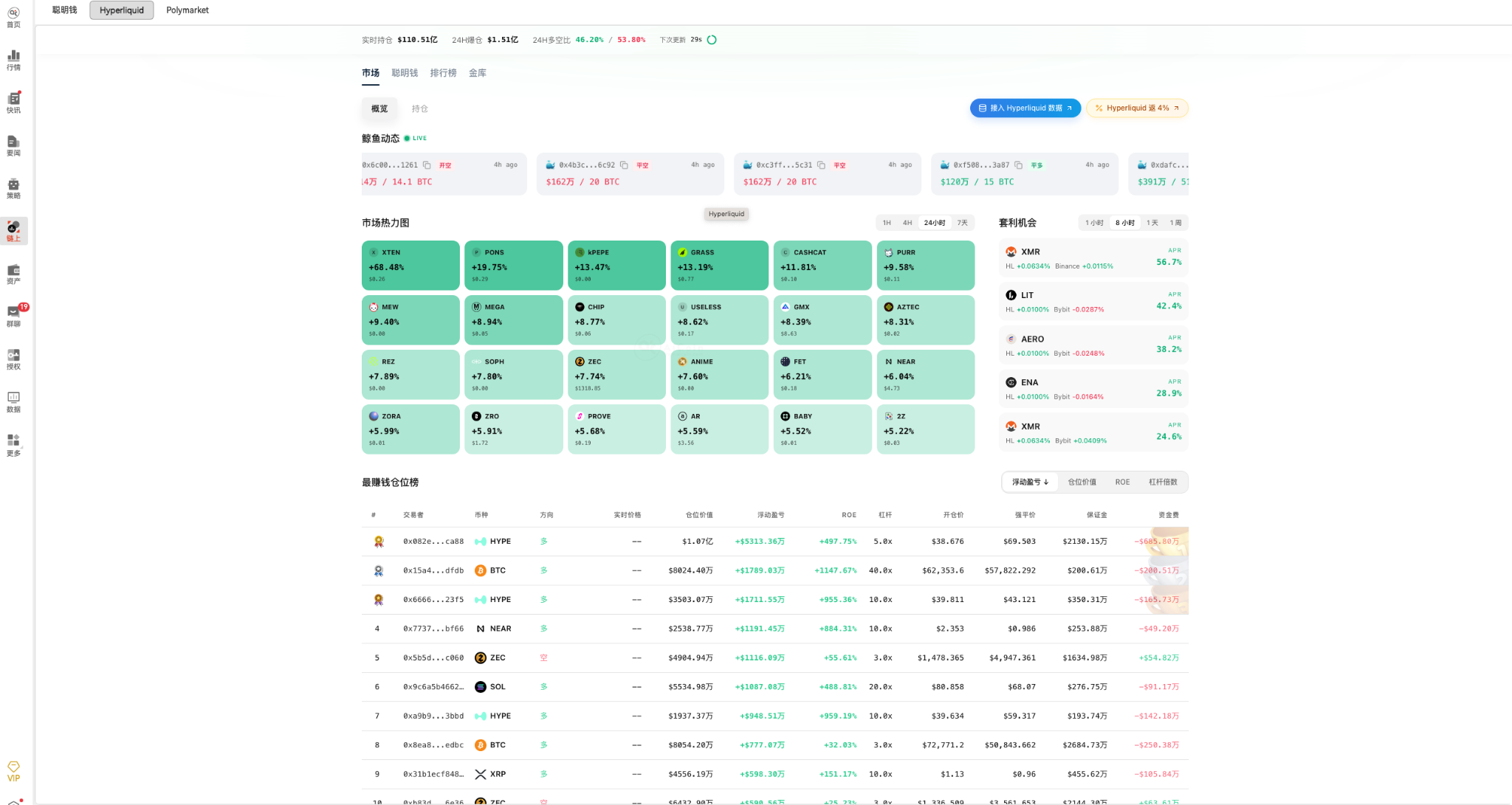
Because the real questions to answer when choosing Hyperliquid are not "can I go long or short here," but rather three more specific questions:
First, how are price and liquidity formed?
Second, can publicly available on-chain data help you identify market risks?
Third, how can ordinary users connect information, data, and execution?
If you only treat Hyperliquid as another platform to trade BTC and ETH, you will miss its most valuable part: trading behavior, orders, positions, and liquidations are becoming publicly available market data that can be continuously studied.
1. The core of Hyperliquid is not "having leverage," but making the trading process observable
Hyperliquid adopts an on-chain central limit order book, also known as CLOB. Buyers and sellers enter the same order book through limit orders, market orders, and other means, with prices formed by market supply and demand.
This is different from trading models that rely solely on automated market maker curves.
For ordinary traders, the most intuitive difference is the order book. You can not only see an oracle price or pool quote, but also observe the depth of the buy and sell orders, transaction direction, changes in pending orders, and the impact of large orders on prices.
For data analysis platforms, the difference is even greater.
Hyperliquid's official documentation positions it as a transparent, open, and high-performance on-chain financial infrastructure, clearly stating that trading records are on a public ledger, and anyone can view and verify them.
This shifts market research from "guessing what is happening inside the platform" to "analyzing what is happening in the public data."
Of course, on-chain transparency does not equate to complete information. You can see the position of a certain address, but you may not know its spot, options, or over-the-counter positions at other exchanges; you can see short positions in profit, but cannot determine from this record whether the entire institutional portfolio is profitable.
Therefore, the value of Hyperliquid's data is not to provide a constantly accurate buy and sell signal, but to give market participants more verifiable observable variables.
2. Why perpetual contracts are easy to use, but should not be understood as "low-risk trading"
The product logic of perpetual contracts is relatively simple: there is no fixed expiration date as with traditional futures, liquidity is concentrated in a single contract, and there is no need for physical delivery. Hyperliquid officially describes it as a tool suitable for expressing leverage direction.
This is also why it is easier for ordinary users to understand than options.
However, "no expiration date" does not mean that positions can be held indefinitely without cost. Traders still have to face funding rates, margin usage, price volatility, slippage, and liquidations.
A long position may judge the direction correctly, but if the leverage is too high, a short-term pullback may still trigger liquidation; a short position may be correct in the long run, but may still have its actual returns reduced due to funding rates and position adjustment costs.
Thus, studying the perpetual market cannot be limited to looking at candlestick charts.
At the very least, four types of data should be observed simultaneously:
- Open Interest (OI): to determine whether funds are consistently entering leveraged positions;
- Funding Rate: to observe crowded long and short positions and holding costs;
- Liquidation Data: to identify which direction leverage is concentrated in;
- Order Book and Large Orders: to judge whether price changes are supported by real liquidity.
For example, if the price rises but OI quickly increases, it could be due to new longs entering the market or shorts being forced to close; if the funding rate turns positive quickly, it may indicate crowding of long positions rather than a safer upward trend; if large liquidations happen frequently without significant price changes, it may be due to a concentrated leverage causing range battles.
Single indicators can rarely provide conclusions; only combinations of indicators have analytical value.
3. The difference between Hyperliquid and CEX should not just be summarized as "self-custody vs. custody"
In centralized exchanges, users see account balances, order statuses, and liquidation results provided by the platform. Matchmaking, risk control, account management, and asset custody are mostly completed by the platform's internal systems.
In Hyperliquid, users control accounts through wallets, and trading and related statuses are recorded on-chain. Users can verify a portion of transactions and account behavior themselves, but they also have to bear the responsibility for private keys, signatures, network operations, and address management.
Therefore, self-custody is not "risk-free," but rather the risk has shifted from part of the platform's credit to the users' operation and security management.
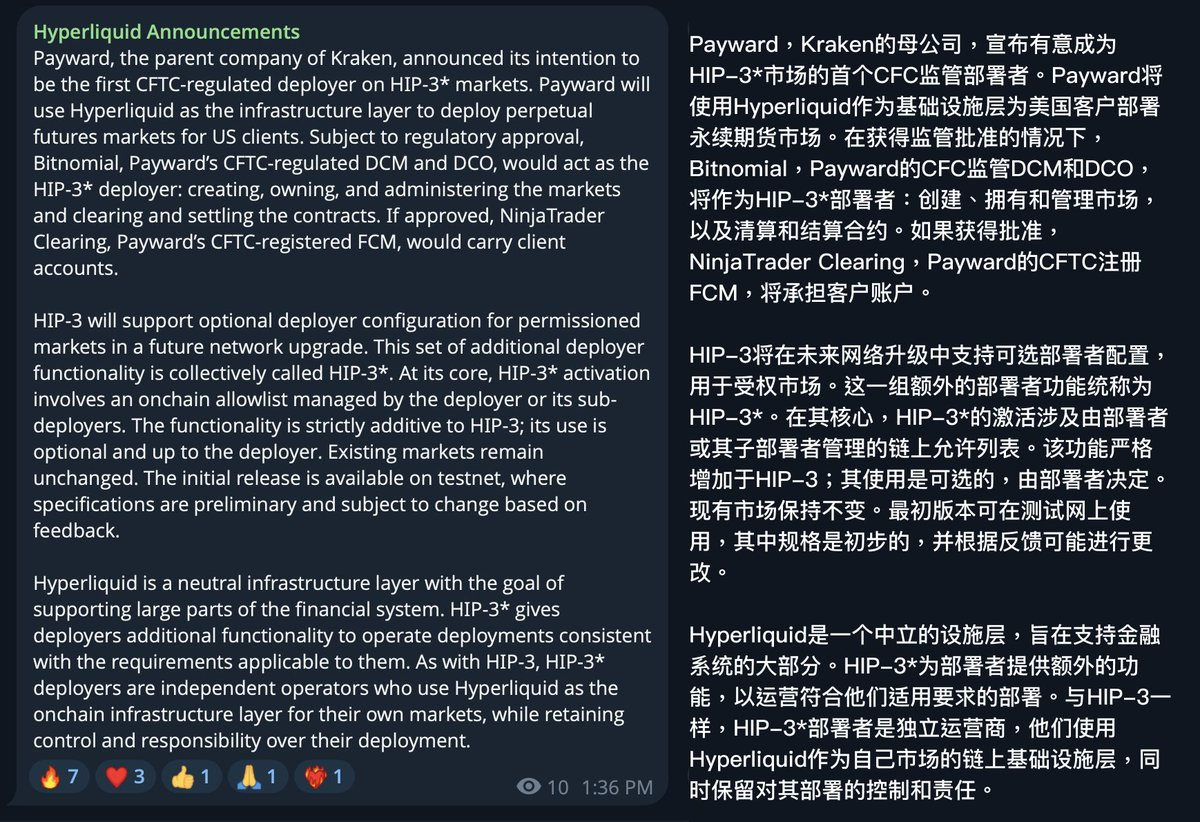
Similarly, not needing a traditional account opening process does not mean that all regions and markets are unconditionally open. Actual use is still subject to the laws of the locality, platform terms, product types, and market access rules. Recently, Payward plans to deploy a regulated on-chain perpetual market for U.S. customers through HIP-3, which indicates that in the future, the same underlying protocol may have both open markets and restricted markets.
Users cannot just look at the name "Hyperliquid," but should further confirm who deploys the specific market, who is responsible for the oracle, who handles the settlement, and which accounts can participate.
4. Hyperliquid's product expansion is moving from a trading interface to a layer of financial infrastructure
Hyperliquid's core product is perpetual contracts, but the ecosystem is expanding to spot trading, lending, developer tools, APIs, and third-party applications.
Hyperliquid officially describes itself further as liquidity infrastructure for developers. Official materials state that independent teams can use its liquidity to build mobile applications, trading terminals, and self-custody wallets, and the ecosystem is also extending to lending, stablecoins, and perpetual markets for different assets.
This means that Hyperliquid's competition may not only be other Perp DEXs.
If it is just a trading page, users typically compare fees, currency pairs, and interface speed; if it evolves into a layer of financial infrastructure, the market comparisons will shift to order book quality, margin systems, market deployment capabilities, liquidation mechanisms, data transparency, and developer ecosystems.
HIP-3 is an example of this change.
Official documentation shows that HIP-3 allows deployers to create independent perpetual DEXs. Deployers are responsible for market definition, oracle, leverage limits, and market settlement when necessary, and each HIP-3 DEX has its own margin and order book.
This provides external teams with greater market innovation space but also shifts part of the risk responsibility to deployers. When users utilize HIP-3 markets, they cannot assume that it has the same liquidity and risk control conditions as the native market.
5. A truly useful "Hyperliquid tutorial" should teach users how to verify the market
Basic tutorials usually tell you how to connect a wallet, deposit margin, select trading pairs, and submit orders.
These steps can help users complete their first trade, but cannot help users determine whether that trade is worth executing.
A more practical use framework should start with "check before placing an order."
First, look at the market's trading volume and order book depth. High trading volume does not necessarily mean there is sufficient liquidity at every price range; if trading is mainly concentrated in a few time slots, users may still face significant slippage during volatility.
Next, look at OI and funding rates. Sustained increases in OI indicate that leveraged positions are growing, but do not mean prices will continue to rise or fall; the funding rate tells you the direction of crowded positions and holding costs, which should be interpreted in conjunction with price and liquidation data.
Then observe large addresses and trading behaviors. Large short positions do not necessarily mean institutions are bearish, and may be due to spot hedging; large long positions do not necessarily represent long-term bullishness; they may just be a leg of arbitrage or inventory management.
Only at the end should you place an order and manage your position. The leverage multiple is just the outcome; what truly determines risk is the combination of nominal value of the position, account equity, margin rate, distance to liquidation, and funding rate.
6. Trading fees should not be viewed as a single percentage
Low costs and trading experience are listed as one of the main attractions of Hyperliquid. But the actual trading cost is not merely the rate displayed on the page.
Hyperliquid's official documentation shows that fee levels are calculated based on rolling 14-day trading volume, where spot and perpetual trading volumes jointly influence fee levels, with spot trading volume counted twice; Makers and Takers also have different rates, and some high-tier users may receive Maker rebates.
HIP-3 markets can also configure additional fee sharing, and in growth mode, adjustments to protocol fees, rebates, and trading volume contributions may occur.
This means that when users compare trading costs, they should at least differentiate:
- whether you are actively taking orders or passively placing orders;
- which fee level your 14-day trading volume falls under;
- whether you are trading native perpetuals, spot or HIP-3 markets;
- whether there are funding rates and slippage;
- whether the rebate or discount genuinely applies to your account and the specific market.
AiCoin promotional entry provides 4% fee rebates, and the invitation code is AICOIN88. Users can use the exclusive link
https://app.hyperliquid.xyz/join/AICOIN88
Connecting to Hyperliquid, specific qualifications, calculation methods, and arrival times are subject to the event rules.
But it must be emphasized that rebates can only reduce trading costs and cannot turn high leverage into low-risk trading, nor can they offset funding rates, slippage, and liquidation losses.
Conclusion: Choosing Hyperliquid means choosing a verifiable market observation method
For users who have already entered the market, the important questions are: Is trading here transparent? Is the liquidity real? Is a whale position a directional trade or a hedge? Does a high-volume market contribute mainly from a few accounts? Where does the revenue from a protocol ultimately flow?
There are no fixed answers to these questions, but they can be continuously verified through on-chain data, order books, OI, funding rates, liquidations, and address behavior.
This is precisely what distinguishes Hyperliquid from ordinary trading pages, and it is also the value that AiCoin as a news media and data analysis platform can provide: first understand the market with data, then execute trades with Hyperliquid; first confirm the risk structure, then decide whether to use leverage.
If you only need a buy-sell interface, any trading platform can perform basic operations. If you want to observe how liquidity is formed, how funds move, how institutions manage positions, and how different markets interact, Hyperliquid deserves to be studied as a public on-chain market.
Exclusive benefits for AiCoin users
👉 Enter invite code AICOIN88 when linking your Hyperliquid account to enjoy 4% fee rebates.
🔗 Exclusive registration link:
https://app.hyperliquid.xyz/join/AICOIN88
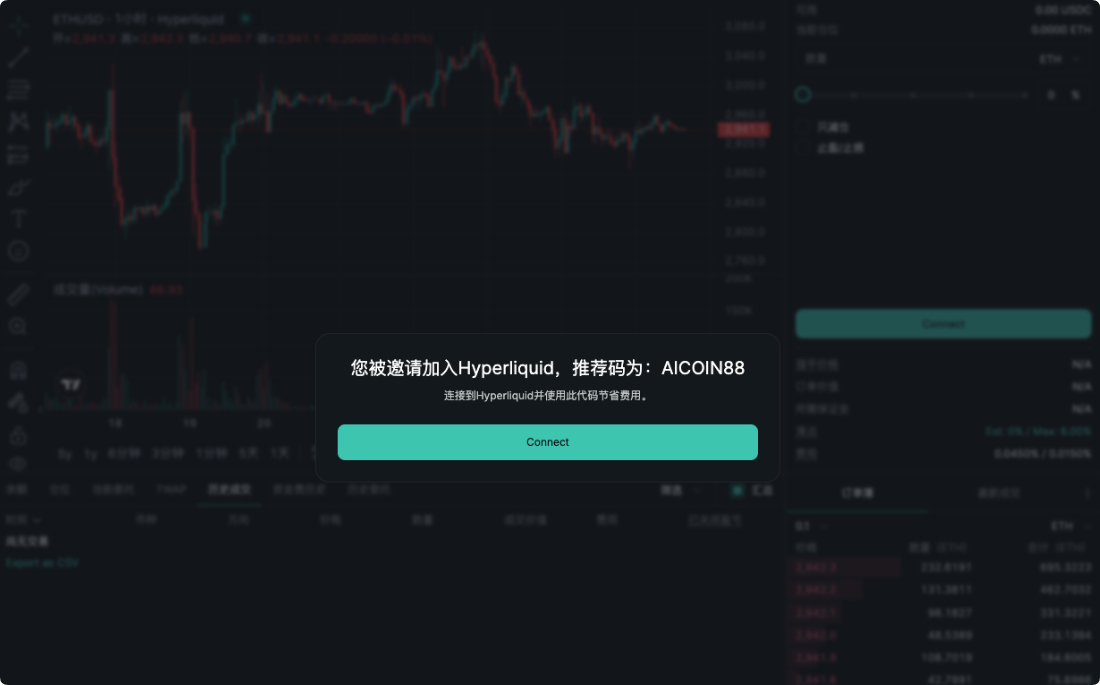
📖 New user tutorials:
"AiCoin PC Hyperliquid Authorized Trading Tutorial":
https://www.aicoin.com/zh-Hans/article/514197
"AiCoin Mobile Hyperliquid Authorized Trading Tutorial":
https://www.aicoin.com/zh-Hans/article/541383
"Zero Basics Entry! Hyperliquid First Trade Super Detailed Graphic Tutorial":
https://www.aicoin.com/zh-Hans/article/510225
📖 Community Communication:
Telegram:
Discord:
AiCoin Group Chat:
https://www.aicoin.com/link/chat?cid=N6OVMor5g
The content of this article only represents the author's personal views and does not represent the platform's position. The opinions, conclusions, and suggestions contained in the text are for the reference of investors only and do not constitute any investment advice related to the platform. Investing in US stocks still requires independently assuming market risks, regulatory risks, and compliance risks with local laws and regulations (especially foreign exchange controls and overseas investment declarations).
免责声明:本文章仅代表作者个人观点,不代表本平台的立场和观点。本文章仅供信息分享,不构成对任何人的任何投资建议。用户与作者之间的任何争议,与本平台无关。如网页中刊载的文章或图片涉及侵权,请提供相关的权利证明和身份证明发送邮件到support@aicoin.com,本平台相关工作人员将会进行核查。