Recent changes in U.S. cryptocurrency regulation: regulatory bodies are building a "track" for crypto finance from three directions.
The first track is the payment track. The OCC is implementing the GENIUS Act to establish federal rules for the issuance of payment stablecoins, with the final rules and legislation set to take effect on January 18, 2027.
The second track is the custody track. The OCC conditionally approved five national trust bank license applications in December 2025, involving First National Digital Currency Bank, Ripple National Trust Bank, BitGo, Fidelity Digital Assets, and Paxos.
The third track is the trading track. CFTC Chairman Michael Selig stated that the CFTC is providing a registration pathway for crypto trading platforms willing to enter the federal regulatory framework through Regulation CTX and Regulation CAM, tailored for the crypto market.
These three directions combine to indicate not that a particular token suddenly benefits from policy favors, but that the U.S. is attempting to break the crypto market into several layers of infrastructure that can be separately regulated and accessed: stablecoins for payments and settlements, trust banks for custody, and regulated trading venues for markets and leveraged trading.
Currently, the most noteworthy position for Hyperliquid is near the third track: Can it become the trading infrastructure used when regulators access on-chain markets?
I. Three regulatory tracks address three different issues
Payment stablecoins address how money enters the digital market, how settlements are conducted, and who can issue digital dollars. The OCC’s GENIUS Act final rules cover approved payment stablecoin issuers and foreign payment stablecoin issuers, and also involve some custody activities conducted by OCC-regulated entities; the effective date of the rules and legislation is January 18, 2027.
The trust bank licenses address asset custody and fiduciary management. The OCC clearly states that the approvals granted in December 2025 pertain to national trust bank licenses and are conditional approvals. They can undertake trust and custody-related business, but this does not equate to obtaining the full powers of ordinary commercial banks for deposit-accepting activities.
The CFTC trading rules address how the leveraged market enters the federal regulatory system. In an official statement, Selig noted that Regulations CTX and CAM will provide market rules for exchanges registered with the CFTC concerning crypto assets; eligible platforms can offer margin, leverage, or financing trading to retail clients within the federal framework.
These three tracks are not the same thing.
Stablecoin issuers are not exchanges. Trust banks do not automatically possess derivative clearing qualifications. Obtaining a registration pathway for trading platforms does not mean that any crypto asset or product can be directly listed.
Separating these concepts is essential to understanding why Hyperliquid is included in the discussion.
II. Hyperliquid is not the regulatory track itself, but may become the underlying layer for institutional market access
Payward's plan announced in September provides a specific case.
Kraken’s parent company, Payward, plans to deploy an on-chain perpetual contract market for U.S. customers through Hyperliquid HIP-3*. According to Payward’s scheme, Bitnomial will create, own, and operate the market, responsible for contract clearing and settlement; NinjaTrader Clearing will handle client accounts; Hyperliquid will provide an order book and underlying trading infrastructure running on a public blockchain.
This structure does not transfer regulatory responsibility to Hyperliquid.
Clients open accounts through NinjaTrader, and the relevant accounts must also be whitelisted by both NinjaTrader and Bitnomial. The Bitnomial Exchange is a designated contract market regulated by the CFTC, the Bitnomial Clearinghouse is a registered derivatives clearing organization, and NinjaTrader Clearing is a registered futures commission merchant and NFA member.
This means Hyperliquid provides the layer for trade execution and on-chain records, while client access, clearing, account relationships, and regulatory obligations are borne by the relevant registered entities.
This is precisely where the three regulatory tracks may intersect with on-chain infrastructure:
Regulatory bodies define who can serve clients, licensed entities take on legal responsibilities, and on-chain protocols provide a verifiable market execution layer.
Of course, this is still a proposal pending approval. Payward explicitly states that the relevant on-chain perpetual products must obtain regulatory approval.
Thus, it cannot be stated that “the CFTC has approved Hyperliquid’s entry into the U.S.,” nor that “U.S. users can trade all markets on Hyperliquid via Kraken.” A more accurate statement currently is: Payward is attempting to incorporate Hyperliquid into a regulated product deployment framework.
III. Why don’t regulated companies rebuild their own order books?
This is key to understanding the matter.
Payward already possesses a trading platform, brokerage system, clearing capability, and client channels. It does not lack the ability to create a trading interface.
But a trading interface does not equate to a mature on-chain market.
If it were to rebuild the order book, matching engine, on-chain settlement, margin system, API, and developer ecosystem, institutions would not only bear development costs but also have to wait for liquidity to develop from zero.
Hyperliquid positions itself as an on-chain liquidity infrastructure for financial applications, emphasizing that trade records are publicly verifiable, allowing developers and third-party teams to build trading terminals, mobile applications, self-custody wallets, and other financial products atop it.
What Payward may be interested in is this "underlying capability for reuse."
It can connect its clients, accounts, and regulatory systems to an existing on-chain order book rather than requiring all institutions to build their own on-chain trading systems from scratch.
For Hyperliquid, the value is not merely in increased trade volume. It might transform from a "user-accessed trading platform" into "a public infrastructure where institutions can deploy markets."
This indicates a shift in business models:
In the past, protocols needed to attract individual traders; in the future, protocols can also target market operators that have users, licenses, and distribution capabilities.
IV. HIP-3 addresses market deployment rights, not automatic liquidity
Hyperliquid’s official documentation indicates that HIP-3 allows external deployers to create their own perpetual DEX. Deployers are responsible for defining the market, including oracles and contract specifications; they are also responsible for market operations, including setting oracle prices, leverage limits, and settling the market when necessary.
Each HIP-3 DEX has independent margins, order books, and deployer settings.
Therefore, the core of HIP-3 is not simply adding a few trading pairs to existing markets, but rather opening the market creation rights and part of the market operation responsibilities to external deployers.
This is important for regulatory bodies because they may need to control:
- Which customers can enter the market;
- What collateral and margin rules are to be used;
- Who maintains the price sources;
- How to pause or settle contracts in the event of anomalies;
- How to connect market rules with existing clearing and compliance systems.
However, HIP-3 also has an easily overlooked limitation: newly deployed markets do not automatically gain all liquidity from the native Hyperliquid markets.
They possess their own order books and risk settings and need to attract market makers, build depth, and maintain a trading experience. A licensed institution can solve customer entry, but cannot guarantee a deep market simply based on a license.
This is also the variable that should be most closely monitored to determine whether Payward's plan succeeds.
V. Looking ahead, don’t just consider “approval status,” but also four sets of market data
Regulatory approval is just the first hurdle.
What truly determines whether this structure can be established is whether customers can continue trading and whether new markets can establish stable liquidity.
The first set of data is trading volume and order book depth. An increase in trading volume indicates trades are happening, but does not mean that large orders can be executed with low slippage. It’s necessary to observe the thickness of buy and sell orders, spreads, and impact costs over different time periods.
The second set of data is Open Interest (OI) and funding rates. If trading volume rises but OI does not continue to grow, it may indicate mainly short-term trading; if OI and funding rates rapidly skew to one side simultaneously, it may mean market congestion rather than improved liquidity quality.
The third set of data is market concentration. If a single deployer contributes the vast majority of trades and open interests, it indicates a head start advantage, but also means HIP-3 may overall rely on a single market. A decrease in concentration while total liquidity continues to grow is closer to ecological expansion.
The fourth set of data is account and funding pathways. The real changes brought by regulatory access are not social media popularity, but whether new customer accounts consistently deposit funds, place orders, hold positions, and reuse the market.
Policies tell you "which door might open," while on-chain data tells you "once the door is opened, did anyone actually come in?"
VI. What do the three tracks mean for HYPE and Hyperliquid?
If the U.S. regulatory framework gradually becomes clearer, the most direct beneficiaries may not be the price of a particular token, but the demand for compliant market infrastructure.
Payment stablecoins can reduce settlement friction. Custody and trust licenses can make it easier for institutions to manage client assets. The CFTC trading framework may allow certain leveraged products to have clearer compliance access.
If Hyperliquid can become the execution layer within this, it may gain greater ecological usage demand from trading activities.
However, a common leap must be avoided: the formation of regulatory tracks does not mean that HYPE will inevitably rise.
Hyperliquid's official resources show that HYPE bears functions such as network security, network fees, and trading fee discounts; the official fee document also describes the distribution mechanism for fees among HLP, the Assistance Fund, and deployers.
These mechanisms can assist in analyzing the protocol's economic structure but cannot eliminate risks related to market cycles, regulatory changes, competition, liquidity, and token supply.
A more prudent way to observe is to view HYPE as part of protocol usage and network security, while continually tracking real trading, fee sources, staking changes, and market deployment situations, rather than solely basing price projections on "regulatory favors."
VII. How can ordinary users utilize this information?
Ordinary users cannot replicate Payward's licenses, clearing systems, and client channels, nor should they interpret institutional cooperation announcements as opportunities to trade.
A more practical approach is to establish a market observation habit in advance:
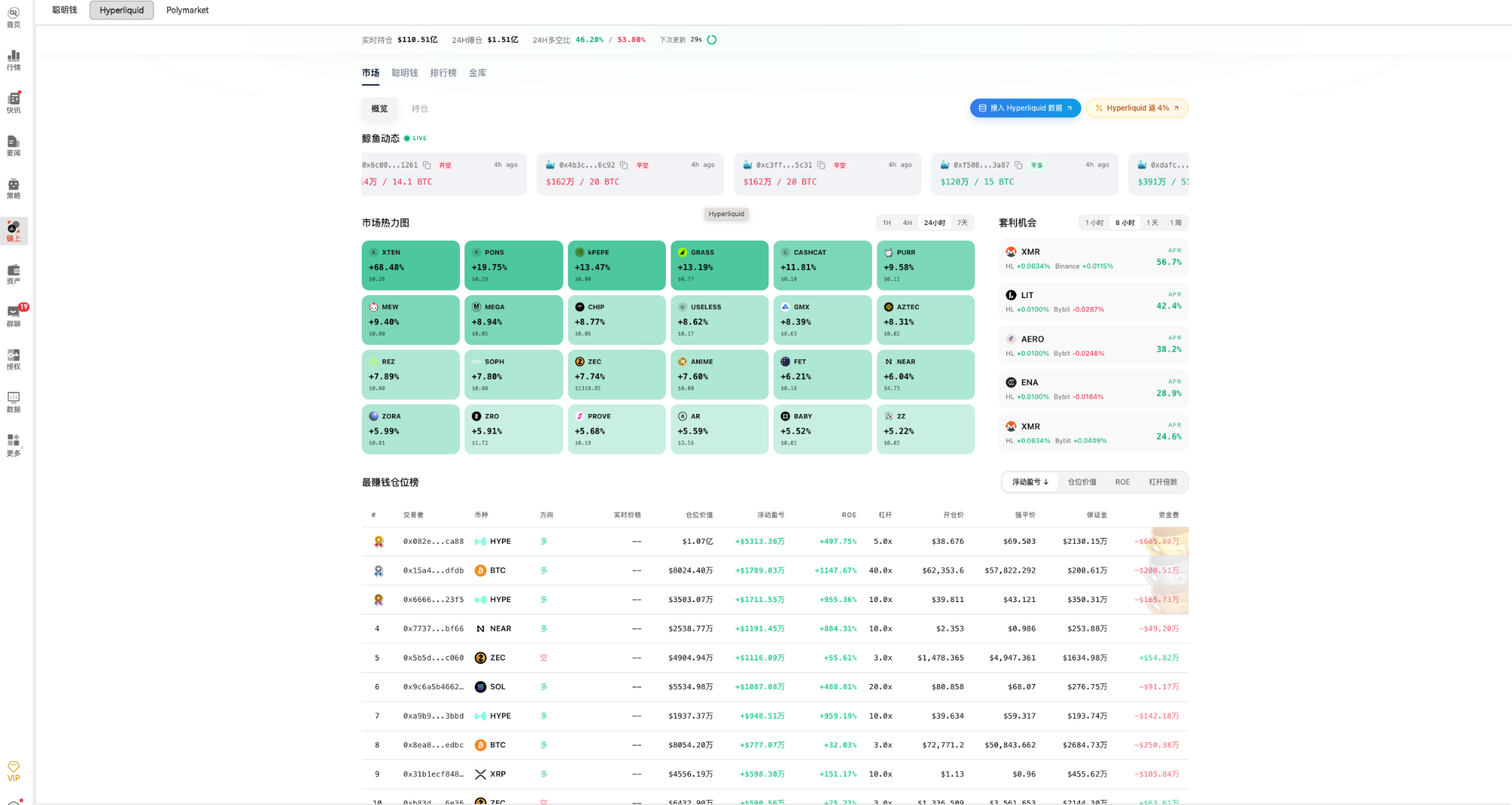
First, look at the order book and成交 depth of a market, then see whether OI and funding rates support price changes; when observing large accounts' positions, distinguish between directional trades and hedging trades; when noticing a HIP-3 market, confirm deployers, oracles, margin, and clearing rules rather than assuming they are identical to the native market.
The AiCoin mobile app can integrate these observations into a continuous data framework: from policy bulletins and market news to real-time candlesticks, OI, funding rates, large order movements, institutional funds, smart money, and clearing data.
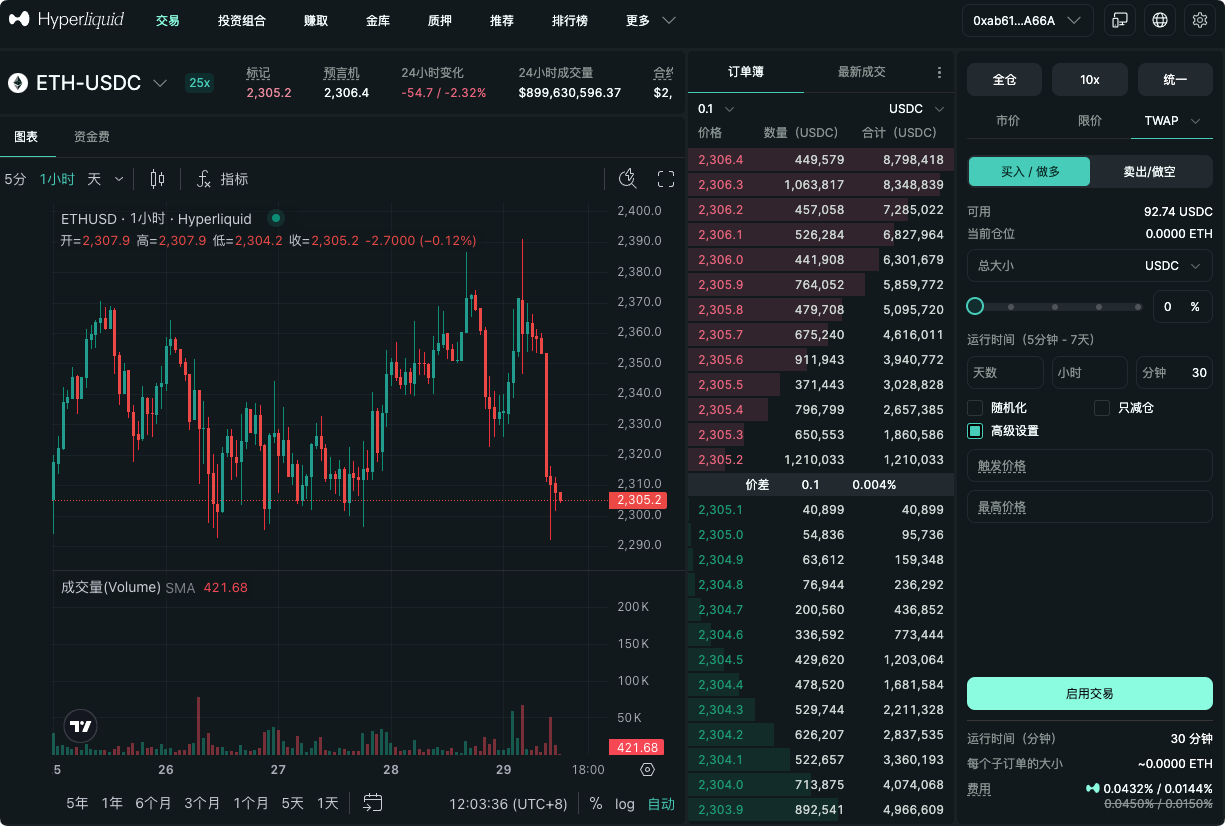
If, after making a judgment, executing a trade on Hyperliquid is required, a dedicated entry can be used: Connect to Hyperliquid.
Invitation code: AICOIN88. Qualifying trades can receive a 4% fee rebate, with specific qualifications, calculation methods, and disbursement times subject to the activity rules. The rebate can only reduce part of the trading costs and cannot offset leverage, funding rates, slippage, and clearing risks.
Conclusion: Regulation is stratifying, and trading infrastructure will also stratify
The three regulatory tracks mentioned by Coin Bureau are most noteworthy not for "the U.S. finally fully embracing crypto," but for the fact that the regulation is breaking payments, custody, and trading into different issues.
This leaves more room for combination for market participants.
Stablecoin issuers can focus on payments. Trust banks can concentrate on custody. Registered trading entities can focus on markets and client protection. On-chain protocols could provide order books, settlement, and transparent execution infrastructure.
Payward’s plan to connect to Hyperliquid via HIP-3 is a real-world test of this layered structure.
It has not been completed, nor has it received final regulatory approval. New markets must also prove they can attract market makers, build depth, and continuously serve customers.
But the direction is clear: future competition may no longer simply be about "which exchange has the most users," but rather "which financial institution can access the most efficient market infrastructure at the lowest cost."
When regulators define access points, institutions assume responsibilities, and protocols provide transparent trading layers, Hyperliquid is aiming not just for a trading user, but for a complete backend position in the financial market.
Exclusive Benefits for AiCoin Users
👉 Enter invitation code AICOIN88 when binding your Hyperliquid account to enjoy a 4% fee rebate
🔗 Exclusive registration link:
https://app.hyperliquid.xyz/join/AICOIN88
📖 Beginner Tutorials:
“AiCoin PC Hyperliquid Authorization Trading Tutorial”:
https://www.aicoin.com/zh-Hans/article/514197
“AiCoin Mobile Hyperliquid Authorization Trading Tutorial”:
https://www.aicoin.com/zh-Hans/article/541383
“Zero-Basis Introduction! Hyperliquid First Trading Super Detailed Text and Image Tutorial”:
https://www.aicoin.com/zh-Hans/article/510225
📖 Community Discussion:
Telegram:
Discord:
AiCoin-Group Chat:
https://www.aicoin.com/link/chat?cid=N6OVMor5g
The content of this article represents the author's personal opinion and does not represent the position of this platform. The views, conclusions, and suggestions in the text are for investor reference only and do not constitute any investment advice related to this platform. Investing in U.S. stocks still requires one to bear the risks of the market, regulatory risks, and compliance risks with local laws and regulations (especially foreign exchange controls, overseas investment declaration, etc.)
免责声明:本文章仅代表作者个人观点,不代表本平台的立场和观点。本文章仅供信息分享,不构成对任何人的任何投资建议。用户与作者之间的任何争议,与本平台无关。如网页中刊载的文章或图片涉及侵权,请提供相关的权利证明和身份证明发送邮件到support@aicoin.com,本平台相关工作人员将会进行核查。